

Most transformations do not fail because the strategy was wrong. They fail because the people who could approve, fund, slow or quietly resist the programme were engaged in the wrong order, with the wrong message, by the wrong person. Stakeholder engagement in transformation is therefore not a communications exercise or a search for consensus. It is the deliberate control of influence, information and expectation so that execution continues while the organisation is being changed. Within Change Management & Transformation Leadership, it sits alongside governance and programme management as an execution discipline, with its own owner, sequence and controls. The question for a board is not whether stakeholders are informed. It is whether their influence has been mapped, sequenced and contained before it can redirect the programme. Engagement is a control system. Treat it as one.
Why Does Stakeholder Engagement Decide Transformation Outcomes?
Transformation redistributes power. Budgets move, reporting lines change, roles disappear and new decision rights are created. Every group affected by that redistribution reassesses its position. Boards question risk exposure. Lenders examine covenant headroom. Regulators watch for compliance gaps. Senior managers recalculate their authority. Employees test which rules still apply.
Each of these reactions is rational. Left unmanaged, they convert uncertainty into delay, escalation or intervention. A lender that learns of a restructuring from the market will ask for information, then for conditions. A division head who hears about a new operating model in a town hall rather than in a briefing will treat the programme as something to be negotiated. A regulator that discovers a change in control functions after the fact will ask why it was not told.
Effective stakeholder engagement in transformation anticipates these reactions and places each stakeholder in a defined channel before the reaction occurs. The aim is not to remove disagreement. It is to ensure that disagreement arrives through governance, where it can be assessed, rather than through side channels, where it can derail the timetable.
Engagement Versus Communication: What Is the Difference?
Many programmes confuse stakeholder engagement with a communication plan. The two are related but serve different purposes. Communication distributes information. Engagement allocates influence. A communication plan answers what will be said and when. An engagement system answers who has authority to shape the programme, through which forum, and with what consequence.
| Dimension | Communication Plan | Engagement Control System |
|---|---|---|
| Primary purpose | Inform audiences of change | Direct influence over the programme |
| Unit of planning | Message and channel | Stakeholder, forum and decision right |
| Ownership | Communications or HR function | Programme sponsor with board mandate |
| Treatment of objections | Answered through FAQs and briefings | Routed to a forum, assessed and recorded |
| Measure of success | Reach and awareness | No unplanned escalation, no timetable slippage |
Both are required. A programme with good communication and no engagement system will be well understood and still stall. A programme with a sound engagement system and poor communication will hold its mandate but lose its workforce. The engagement system comes first because it determines what can be communicated.
Who Are the Stakeholders That Matter?
Stakeholders are not equal and should not be managed as if they were. The useful distinction is between the source of a stakeholder’s influence and the degree to which the transformation affects them. Four classes cover most institutional programmes.
Authority stakeholders. Boards, shareholders, sovereign or strategic partners and regulators hold formal power to approve, block or condition the transformation. Engagement with them is structured, documented and tied to the mandate. They receive decisions, risk controls and milestones, not speculation.
Capital stakeholders. Lenders, investors and funding partners care about capital certainty, covenant integrity and downside protection. They expect visibility, sequencing and explicit assumptions. A transformation that touches financing terms, collateral or reported earnings must be presented to them before it reaches the market.
Operational stakeholders. Executive teams, senior managers and functional leaders hold practical rather than formal influence. They control how the change is implemented. Engagement defines their roles, authority boundaries and accountability so that shadow decision making does not form.
Workforce stakeholders. Employees and middle managers influence execution through behaviour. They need clarity on what is changing, when, and what is expected of them. Engagement with this group is directional, but it should still collect operational intelligence, because the people doing the work often see implementation risks first.
Where Does the UAE Context Change the Approach?
For organisations operating in the UAE, several features of the environment shape stakeholder engagement in transformation. Many groups combine onshore companies, free zone entities and holding structures in the DIFC or ADGM. Each legal entity has its own board, and directors owe duties to their own company. A group-level transformation must therefore be approved through the right entity boards, not only announced by group management.
Regulated businesses must consider their supervisor early. Firms authorised by the DFSA in the DIFC or the FSRA in ADGM, and those regulated onshore by authorities such as the Central Bank of the UAE, may need to notify or seek approval for changes to controllers, senior roles or outsourced functions. Listed companies must also observe their disclosure obligations on material information, which constrains the order in which internal and external audiences are told. Workforce changes must comply with the applicable labour framework, including notice, end-of-service entitlements and visa processes. The precise requirement depends on the entity and sector, so legal review belongs in the engagement plan rather than after it.
How Should Engagement Be Sequenced?
Timing determines leverage. The same message delivered in the wrong order produces a different outcome. A disciplined sequence secures authority and capital confidence before the change is exposed more widely.
Secure the mandate before broad disclosure. Board and shareholder approval precede internal announcement. This prevents internal debate from escalating upward into a forum that has not yet committed, and it gives management a settled position to explain.
Engage capital early and confidentially. Lenders and investors are briefed before milestones become public, under appropriate confidentiality. Their questions are answered while there is time to adjust the plan, not after a covenant test has been missed.
Engage operational leaders once structure is set. Executives and functional heads are brought in after decision rights and governance are defined. Their input then improves implementation rather than reopening the design.
Address the workforce with clarity and a timetable. Employees are told what is changing, why, when and how it affects them. Messages are consistent across channels. Questions are collected and answered through a defined route.
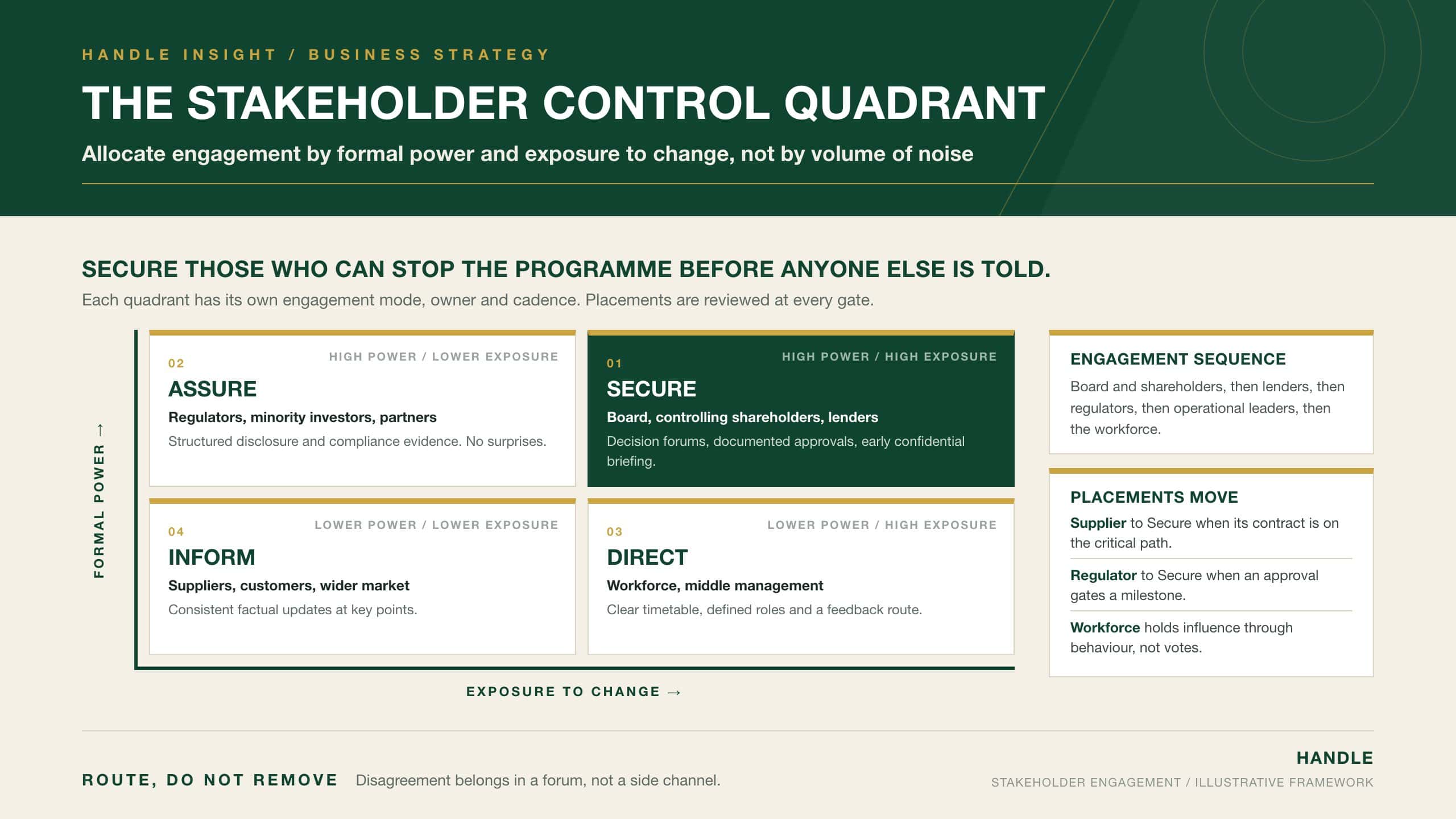
Original Analysis: The Stakeholder Control Quadrant
A practical way to allocate engagement effort is to plot each stakeholder group on two axes. The first is formal power: the ability to approve, block, fund or condition the programme. The second is exposure: how directly the transformation changes the group’s position, economics or work. The resulting quadrants define four engagement modes, each with its own owner, forum and cadence.
| Quadrant | Power and Exposure | Typical Stakeholders | Engagement Mode | Owner and Cadence |
|---|---|---|---|---|
| Secure | High power, high exposure | Board, controlling shareholders, lenders | Decision forums, documented approvals, early confidential briefing | Sponsor or chair; monthly and at each gate |
| Assure | High power, lower exposure | Regulators, minority investors, strategic partners | Structured disclosure, compliance evidence, no surprises | Compliance lead or CFO; as required and at milestones |
| Direct | Lower power, high exposure | Workforce, middle management, affected functions | Clear timetable, defined roles, feedback route | Line leadership and HR; weekly during change |
| Inform | Lower power, lower exposure | Suppliers, customers, wider market | Consistent factual updates where relevant | Commercial and communications; at key points |
The quadrant is not static. A supplier becomes a Secure stakeholder if the transformation depends on renegotiating its contract. A regulator moves into Secure if an approval sits on the critical path. Reviewing placements at every programme gate keeps effort aligned with real influence. The Secure quadrant receives the most senior time because it can stop the programme outright.
A Worked Example: Mapping a Group Restructuring
Consider an illustrative UAE group consolidating three divisions into two, with 1,400 employees, an AED 600 million syndicated facility and one entity regulated in a financial free zone. The programme team scores eleven stakeholder groups from 1 to 5 on power and exposure. The lending syndicate scores 5 and 5, because the restructuring alters the borrower group and may need lender consent. The board scores 5 and 4. The financial free zone regulator scores 5 and 2, because only the regulated entity’s senior roles change. The 380 employees in the two merging back-office functions score 1 and 5.
The sequence follows the scores. The board approves in week one. The facility agent and lenders are briefed confidentially in week two, with a consent request prepared in parallel. The regulator receives a notification on the senior role changes before any appointment is made. The 380 affected employees are briefed by their line leaders in week five, once roles in the new structure are defined. Without the map, the natural instinct would have been a group-wide announcement in week one. That would have put the lenders and the regulator behind the workforce. The numbers are illustrative. The discipline is not.
Which Controls Keep the Narrative Stable?
Narrative control is not secrecy. It is consistency. Over-communication creates noise and invites interpretation. Under-communication creates fear and rumour. The following control points keep engagement institutional.
| Control Point | What It Requires | Failure It Prevents |
|---|---|---|
| Single narrative | One approved fact base used across all audiences | Contradictory messages that signal instability |
| Stated non-negotiables | Legal compliance, capital protection, governance cadence and timeline ownership set out at the start | Scope creep through negotiation |
| Decisions, not options | Options debated only in authorised forums | Lobbying and reopening of settled decisions |
| Formal escalation route | A known forum and response time for concerns | Side-channel pressure on executives and directors |
| Commitment register | A record of every undertaking given to stakeholders | Implied promises that later become disputes |
How Should Resistance From Powerful Stakeholders Be Handled?
Resistance from influential stakeholders requires firmness without confrontation. The first task is to distinguish between a legitimate risk concern and the preservation of position. A lender worried about collateral cover has a risk concern that deserves evidence and, where appropriate, a control. A senior executive opposing the loss of a reporting line may have a valid point about capability, or may simply be protecting influence.
Risk-based objections are answered with data and mitigations, and the response is recorded. Preference-based objections are acknowledged, considered in the proper forum and, if the mandate stands, overridden. Leaders should rely on structure rather than personal persuasion. Mandate, governance and documentation give cover for difficult decisions and reduce emotional escalation. When resistance threatens outcomes, escalation to the sponsor or board should happen promptly and be framed as governance, not conflict.
Common Stakeholder Engagement Failures
- Announcing the transformation internally before the board, shareholders and lenders have committed, which hands the agenda to the least informed audience.
- Treating regulators as an afterthought and discovering late that a notification or approval sits on the critical path.
- Allowing different executives to describe the programme in different terms, which invites stakeholders to choose the version they prefer.
- Making informal commitments on roles, timing or protections that were never approved and later have to be withdrawn.
- Consulting widely on design questions that have already been decided, which creates expectations that cannot be met.
- Ignoring workforce intelligence, so implementation problems visible on the ground reach leadership only after they affect customers.
- Failing to update the stakeholder map as the programme moves, leaving senior time focused on groups whose influence has already passed.
Each failure is a control failure. Each is preventable when engagement has an owner, a map and a sequence.
Conclusion
Stakeholder engagement in transformation is the disciplined management of influence so that execution remains intact. It begins with a map of who holds power and who is most exposed, continues with a sequence that secures the board, shareholders and lenders before the wider organisation is told, and is sustained by controls that keep the narrative consistent and commitments deliberate. In the UAE, that sequence must also respect entity-level board authority, regulatory notification requirements and disclosure rules for listed companies. The Stakeholder Control Quadrant gives leadership a simple way to allocate senior time: secure those who can stop the programme, assure those who supervise it, direct those who must deliver it and inform the rest. Engagement does not remove disagreement. It routes it. When influence is mapped and sequenced, transformation proceeds on its timetable. When it is not, the timetable belongs to someone else.


