

Organisations do not learn their culture from the values statement. They learn it from what leaders approve, fund, promote, tolerate and punish, especially when results and standards point in different directions. Leadership’s role in vision and culture is therefore not to articulate them once but to keep them consistent through hundreds of decisions that the organisation is watching. Within Corporate Vision & Culture Strategy, vision defines where the institution intends to go and culture governs how it behaves on the way. Leadership is the mechanism that connects the two. When leaders’ decisions match the stated direction and standards, the organisation aligns without being told. When they contradict it, the organisation follows the decisions and quietly discounts the words. Culture is what leaders do when it costs them something.
Why Leadership Conduct Outweighs Stated Values
Every organisation has two cultures: the one it describes and the one it rewards. Employees resolve any difference between them quickly and rationally. If the values statement prizes integrity but the highest-earning team is never challenged on how it earns, people conclude that results excuse conduct. If the strategy emphasises long-term capability but every budget cut falls on training and development, people conclude that the short term decides.
This is not cynicism. It is learning. Employees observe leadership because leadership controls the outcomes that matter to them: pay, promotion, resources and job security. The signals leaders send through those outcomes are more credible than any communication because they carry consequences.
The practical implication is that culture cannot be delegated to human resources or to a communications function. Those functions can design programmes and measure sentiment, but the decisive signals come from the decisions of the board and the executive team.
Leadership as Custodian of the Vision
A vision sets the long-term position the institution intends to occupy: which markets it will lead, which capabilities it will build, how much capital it will deploy and what standards it will hold itself to. Boards and executive teams define it, and its usefulness depends on its precision. A vision that cannot be used to reject an opportunity is a slogan rather than a direction.
Custodianship means applying the vision when it is inconvenient. Opportunities that fall outside the strategic perimeter are declined even when they are profitable in the short term. Acquisitions are tested against the capabilities the vision requires, not just against financial returns. Each such decision, explained clearly, teaches the organisation what the vision actually means.
Consistency across strategic cycles matters as much as clarity. Markets change and execution must adapt, but a vision that shifts with each annual plan teaches the organisation that it is provisional. Leaders preserve the direction and adjust the route.
Leadership as Architect of Culture
Culture is the set of behaviours an organisation repeats without instruction. Leaders shape it through four instruments: the decision frameworks that determine how choices are made, the governance protocols that determine who may make them, the accountability structures that determine what happens afterwards, and the conduct standards that apply to everyone, including the most senior and most successful.
Culture must also fit the strategy. An institution competing on precision and expertise needs a culture of rigour and professional standards. One competing on speed needs a culture of decisive execution with clear limits. Leadership aligns the two by ensuring that incentives, performance management and promotion criteria reward the behaviours the strategy requires.
| Leadership Signal | What Leaders May Say | What the Organisation Learns If Decisions Contradict It |
|---|---|---|
| Capital allocation | “We are investing in long-term capability.” | Capability spending is the first thing cut under pressure. |
| Promotion | “We promote people who live our values.” | Results alone secure advancement. |
| Consequences | “Standards apply to everyone.” | High performers are exempt. |
| Response to bad news | “We want problems raised early.” | Raising problems is career-limiting. |
| Decision transparency | “We explain our choices.” | Decisions are made elsewhere and announced. |
Conduct Under Pressure
Leadership signals are most visible when the organisation is under strain: a missed quarter, a regulatory inquiry, a major client loss, a crisis. In those moments, employees look for evidence of which principles are real. Leaders who maintain governance discipline, protect standards and communicate honestly when it would be easier not to, confirm that the culture is genuine. Leaders who suspend standards to protect results confirm that it is not.
A single visible decision under pressure can outweigh years of messaging. That is why boards should treat significant conduct decisions during difficult periods as cultural events, not only operational ones.
Preparation helps. Leadership teams that agree in advance which standards are non-negotiable, and who decides when they are tested, are far less likely to improvise an exception in the moment. The time to decide what will not be compromised is before anyone is tempted to compromise it.
A Worked Example: The High Performer Who Bypassed the Process
Consider an illustrative case. A regional sales director achieves 140 per cent of target, earning a bonus entitlement of AED 400,000 under the plan. A review then finds that two large contracts were signed without the required credit and compliance approvals. No loss has yet occurred.
The leadership team has three options. It can pay the full bonus and say nothing, which tells the organisation that results excuse process breaches. It can terminate the director, which may be disproportionate and tells the organisation that leadership reacts unpredictably. Or it can pay the portion of the bonus attributable to compliant business, apply a defined malus to the rest under the plan’s terms, require remediation of the two contracts and explain the principle, without personal detail, to the wider leadership group.
The figures are illustrative. The third option is the one that converts a conduct standard from a statement into a rule. It also depends on the incentive plan having been drafted to allow it, which is itself a leadership decision taken long before the case arose.
Embedding Vision and Culture Across Management Layers
Executive signals reach most employees through their immediate managers. If managers interpret direction differently, or apply standards inconsistently, the culture fragments by department. Leadership must therefore equip managers with three things: a clear understanding of the strategic priorities, the authority to enforce standards in their teams, and the confidence that they will be supported when they do.
Communication should connect daily work to the strategic direction, explaining not only what was decided but why. Over time, teams that understand the reasoning behind decisions begin to make consistent decisions themselves, which is the practical meaning of a strong culture.
Governance: Who Oversees Leadership’s Conduct?
Boards hold executives accountable for strategy and results, and increasingly for culture and conduct as well. Under the UAE Commercial Companies Law (Federal Decree-Law No. 32 of 2021), directors must act in the interests of the company, and a culture that tolerates breaches of law or policy exposes the company and its directors to risk. For financial services firms in the DIFC and ADGM, the DFSA and the FSRA also expect governance arrangements that support sound conduct.
| Responsibility | Board | Chief Executive and Executive Team | Managers |
|---|---|---|---|
| Define the vision and standards | Approves | Proposes and articulates | Translates for teams |
| Align incentives with standards | Approves remuneration policy | Designs and applies | Applies in reviews |
| Enforce conduct | Oversees senior cases | Decides material cases | Addresses team-level conduct |
| Monitor culture | Reviews indicators annually | Tracks indicators quarterly | Raises concerns early |
What Happens When Leadership Signals Diverge?
Misalignment rarely announces itself. It appears first as inconsistency between departments, as each manager interprets mixed signals differently. Strategic initiatives then slow, because teams are unsure whether leadership is genuinely committed to them. Governance weakens as people learn which rules are enforced and which are not. Eventually, credibility declines with employees, investors, regulators and clients, who notice the gap between what the institution says and what it does.
By the time the problem appears in engagement surveys or attrition data, the underlying signals have usually been sending the wrong message for some time. That is why the signals themselves, not only their effects, should be reviewed.
Leadership Development and Cultural Continuity
Culture is most vulnerable at leadership transitions. A new chief executive, a generational change in a family business or a rapid expansion of the management layer can each reset the signals the organisation receives. Institutions preserve continuity by developing leaders who understand the vision and the standards before they inherit authority.
That preparation includes exposure to strategic decisions and the reasoning behind them, experience of governance and accountability frameworks, and mentoring by senior leaders who model the expected conduct. Promotion criteria should test judgement under pressure, not only technical results. In family enterprises, the same principle applies to the next generation: authority should follow demonstrated alignment with the institution’s standards.
Original Analysis: The Leadership Signal Wheel
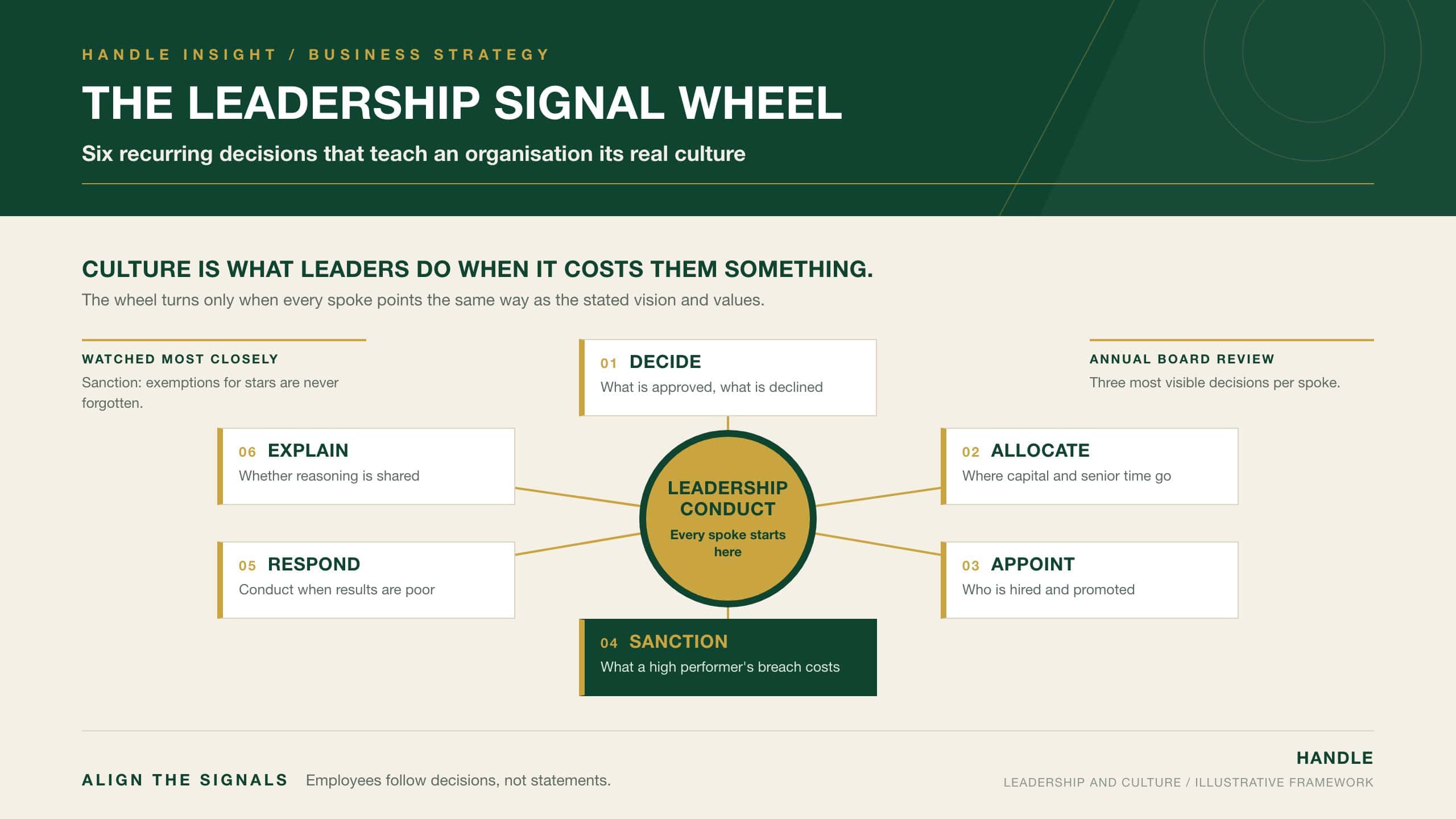
Leadership communicates culture through six recurring decisions. Together they form a wheel around a single hub, leadership conduct, and the wheel turns smoothly only when every spoke points in the same direction as the stated vision and values.
- Decide: which proposals are approved and which are declined, and on what grounds.
- Allocate: where capital, time and senior attention are directed, particularly when budgets are tight.
- Appoint: who is hired, promoted and given visible responsibility.
- Sanction: what happens when someone breaches standards, especially a high performer.
- Respond: how leaders behave when results are poor or a crisis arrives.
- Explain: whether the reasoning behind decisions is shared or withheld.
| Spoke | Annual Review Question | Warning Sign |
|---|---|---|
| Decide | Which attractive opportunities did we decline because they fell outside the vision? | None can be named |
| Allocate | Did capital and senior time follow the stated priorities when budgets tightened? | Strategic programmes cut first |
| Appoint | Did promotions reward how results were achieved as well as the results? | Known conduct concerns ignored at promotion |
| Sanction | Were standards applied to senior and high-performing staff in the same way as others? | Exceptions granted quietly |
| Respond | How did leaders behave in the hardest month of the year? | Standards suspended to protect numbers |
| Explain | Do managers understand why the major decisions were taken? | Decisions announced without reasons |
Sanction is the spoke that carries the most weight, because it is the one most likely to be compromised and the one employees watch most closely. An organisation can forgive slow decisions or imperfect communication. It does not forget an exemption granted to a star. Boards can use the wheel as an annual review: for each spoke, identify the three most visible decisions of the year and ask whether each one reinforced or contradicted the stated culture.
Common Failures in Leading Vision and Culture
- Treating culture as a communications exercise, so that values campaigns run while contradictory decisions continue.
- Exempting high performers from conduct standards, which teaches the whole organisation that results excuse behaviour.
- Changing strategic direction with every planning cycle, which signals that the vision is provisional.
- Cutting capability investment first under pressure while claiming long-term priorities.
- Leaving managers without the authority or support to enforce standards, so that culture varies by department.
- Designing incentive plans without malus or conduct conditions, which removes leadership’s ability to act consistently.
- Developing successors on technical ability alone, so that the culture weakens at each leadership transition.
Each failure is a decision, not an accident. That is why culture remains a leadership responsibility.
Conclusion
Leadership’s role in vision and culture is to make them credible. Vision sets the destination and culture governs the behaviour required to reach it, but employees judge both by what leaders decide, fund, appoint, sanction, explain and do under pressure. When those decisions align with the stated direction and standards, the organisation follows without instruction. When they contradict it, the organisation follows the decisions. Boards should therefore oversee culture as a matter of governance, approving incentive structures that allow consistent consequences and reviewing the most visible leadership decisions each year. Managers need the authority and support to apply standards locally, and successors should be developed for judgement as well as technical skill. The Leadership Signal Wheel offers a practical review: six decisions, one hub, one direction. Align the signals. Apply standards to everyone. Culture follows conduct.


