

Crisis does not create misalignment inside an organisation. It exposes the misalignment that was already there. Within Crisis Strategy & Scenario Planning, crisis war room setup and execution is the discipline of replacing routine governance with a temporary, tightly defined command structure when a disruption moves faster than ordinary decision cycles can absorb. Done well, a war room concentrates authority in one place, compresses the time between information and decision, and keeps liquidity, legal position and public narrative moving in the same direction. Done badly, it becomes a crowded meeting where senior people repeat what they already know. The difference lies almost entirely in preparation: the triggers, mandates, data feeds and stand-down criteria agreed before anything goes wrong. A war room is not convened. It is activated.
What Is a Crisis War Room and When Is It Needed?
A crisis war room is a temporary command structure, physical, virtual or both, that holds decision authority for a defined set of issues for a defined period. It does not replace the board or the executive committee. It operates under a mandate they grant, and it reports back to them on a fixed cadence.
Most disruptions do not need one. A supplier failure, a difficult customer dispute or a weak quarter can be handled through normal management channels. A war room is justified when three conditions coincide: the situation threatens the solvency, licence or reputation of the business; it requires coordinated decisions across finance, legal, operations and communications; and the speed of events exceeds the rhythm of regular governance.
The common error is to wait until all three conditions are obvious. By then, decisions have already been made in fragments, statements have been issued without legal review and lenders have heard the news from someone else.
Activation Triggers: Rules, Not Reactions
Activation should be rule-based. The board or a designated crisis committee approves a short list of measurable triggers in advance, and the mandate states who may activate the war room when a trigger is met. That removes the most dangerous delay in any crisis: the debate about whether the situation is serious enough.
| Trigger Category | Illustrative Threshold | Authority to Activate |
|---|---|---|
| Liquidity | Forecast cash runway falls below 12 weeks | Chief executive on the advice of the chief financial officer |
| Financing | Projected covenant breach within the next two test dates | Chief executive, with notice to the board chair |
| Regulatory | Formal notice, inspection or investigation by a regulator | General counsel and chief executive jointly |
| Legal | Litigation or arbitration seeking injunctive relief or material damages | General counsel and chief executive jointly |
| Cyber and data | Confirmed compromise of systems or personal data | Chief executive on the advice of the technology lead |
| Operational | Outage exceeding the maximum tolerable downtime of a critical service | Chief operating officer and chief executive |
Thresholds are illustrative and should reflect each organisation’s own risk appetite, facility terms and continuity plans. The principle is fixed. If a trigger is met, the war room stands up the same day and the board is informed.
Who Sits in the War Room?
Small is effective. A war room of five to seven decision-makers can act. A war room of twenty becomes an audience. Each seat should correspond to a function that must make decisions, not a function that would like to be informed.
The crisis lead, usually the chief executive or a designated deputy, holds final decision rights within the mandate. The chief financial officer controls liquidity, covenant monitoring and lender engagement. The general counsel controls litigation posture, regulatory engagement and privilege. The operational lead controls continuity, suppliers, systems recovery and workforce allocation. A single communications authority controls every internal and external statement. A secretariat, often overlooked, maintains the decision log, action tracker and data integrity.
Specialists such as external counsel, restructuring advisers, forensic investigators or public relations firms attend when their issue is on the agenda. They advise. They do not hold seats.
Setting Up the Physical and Digital Environment
Setup should be prepared well before activation. The minimum infrastructure is a restricted-access space or virtual room, encrypted communication channels that do not depend on systems that may be compromised, a document repository with version control and a dashboard showing the agreed data feeds.
The data feeds are the core of the room. A rolling thirteen-week cash forecast, a covenant tracker, an operational status board, an incident log, a register of regulatory correspondence, a litigation tracker and a media monitoring feed should all be defined in advance, with an owner and an update frequency for each. Data that has not been verified does not enter the room. Decisions taken on bad numbers are harder to reverse than decisions delayed by an hour.
Information security deserves particular attention. A leak from a war room can move markets, alert counterparties or prejudice legal proceedings. Access should be limited to named participants and every document should be marked and tracked.
Original Analysis: The War Room Command Wheel
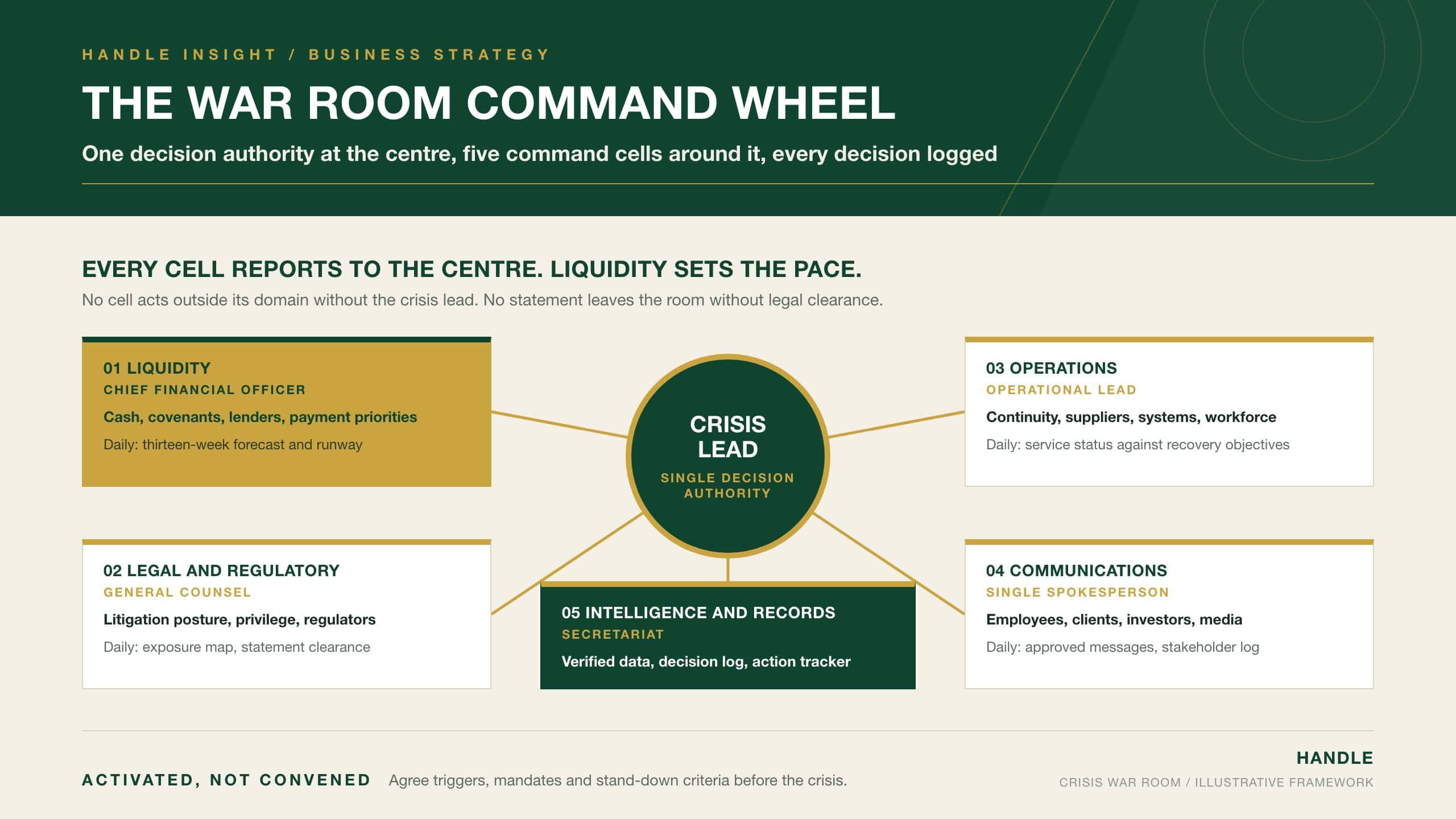
The War Room Command Wheel describes how a well-run war room actually works. At the centre sits a single decision authority. Around it sit five command cells, each owning a distinct domain, a distinct data feed and a distinct daily output. Every material decision passes through the centre, and every cell reports to the centre rather than to each other.
| Command Cell | Lead | Owns | Daily Output |
|---|---|---|---|
| Liquidity | Chief financial officer | Cash, covenants, lenders, payment priorities | Updated thirteen-week forecast and runway |
| Legal and regulatory | General counsel | Litigation posture, privilege, regulator engagement | Exposure map and clearance of all statements |
| Operations | Operational lead | Continuity, suppliers, systems, workforce | Service status against recovery objectives |
| Communications | Single spokesperson | Employees, clients, investors, media | Approved messages and stakeholder log |
| Intelligence and records | Secretariat | Data integrity, decision log, action tracker | Verified situation brief and open actions |
The wheel has two rules. First, no cell acts outside its domain without the centre. A communications lead who briefs a journalist on a legal position, or a finance lead who agrees a standstill without legal review, breaks the wheel. Second, the liquidity cell sets the pace. In almost every serious crisis, the scarcest resource is time measured in cash, and every other cell’s options narrow as runway shortens.
Operating Rhythm: How the War Room Runs Day to Day
Cadence stabilises decision-making under pressure. Each day begins with a short situation brief prepared by the secretariat: financial position, legal and regulatory exposure, operational status, stakeholder sentiment and progress against the previous day’s commitments. Only verified information is presented.
Material decisions are recorded in a decision log showing the time, the decision-maker, the options considered, the rationale and the implementation deadline. The log protects the organisation and its directors. If the conduct of the crisis is later examined by a regulator, a court, an arbitral tribunal or investors, a contemporaneous record of what was known and why each decision was taken is the strongest evidence available.
Actions are assigned to named owners with deadlines in an action tracker. Slippage is escalated at the next brief rather than discovered at the end of the week.
A Worked Example: Liquidity Under War Room Conditions
Consider an illustrative regional distribution group that loses its largest customer contract without notice. It holds AED 48 million of cash. The board has set a minimum operating cash balance of AED 12 million. After the loss, the thirteen-week forecast shows net outflow of AED 4 million per week.
Usable runway is therefore AED 36 million divided by AED 4 million, or nine weeks. That is below the illustrative twelve-week trigger, so the war room is activated the same day.
Within the first week, the liquidity cell halts discretionary spending and defers non-critical capital expenditure, reducing net outflow to AED 3 million per week. A targeted collection campaign on overdue receivables brings in AED 6 million. Usable cash rises to AED 42 million, and runway extends to fourteen weeks. In parallel, the legal cell reviews the terminated contract for compensation rights, and the communications cell briefs the two lending banks before they read about the loss elsewhere.
The war room has not solved the crisis. It has bought five weeks of time and preserved the lenders’ confidence, which is what gives management room to replace the lost revenue.
Legal and Regulatory Control in the UAE Context
Legal strategy must be integrated into every operational move, and jurisdiction shapes how that is done. Organisations operating onshore, in free zones and in the Dubai International Financial Centre or Abu Dhabi Global Market may face different regulators, courts and disclosure obligations in the same crisis.
Legal privilege should not be assumed. Its scope is not uniform across the UAE onshore courts and the common-law based courts of DIFC and ADGM, so the general counsel should decide early how sensitive analysis will be prepared and by whom. Firms regulated by the Dubai Financial Services Authority or the Financial Services Regulatory Authority typically have obligations to notify their regulator of significant events, and the federal, DIFC and ADGM data protection regimes each contain breach notification requirements that may apply to a cyber incident. Where solvency is in question, directors should take early advice on their duties and on the options available under the applicable restructuring regime before any lender or creditor arrangement is agreed. Regulators should receive accurate, verified information. Overstatement creates liability. Understatement destroys credibility.
Standing Down: When Does the War Room Close?
A war room is temporary by design. Leaving it in place too long concentrates authority beyond its mandate and exhausts the people in it. Stand-down criteria should be agreed at activation, not invented when fatigue sets in.
| Domain | Stand-Down Criterion | Confirmed By |
|---|---|---|
| Liquidity | Runway restored above the trigger with a buffer, financing stable | Chief financial officer |
| Legal and regulatory | Exposure contained, engagement on a normal timetable | General counsel |
| Operations | Critical services within recovery objectives | Operational lead |
| Governance | Decisions can return to standard approval pathways | Board |
After stand-down, a structured review should test whether the triggers fired at the right time, how quickly decisions were taken, where data failed and which lessons belong in the permanent risk framework.
Common War Room Failures
- Activating late because no trigger was agreed in advance, so the first days are spent debating whether a crisis exists.
- Filling the room with senior people who want information rather than people who must take decisions, which slows every discussion.
- Allowing several spokespeople to speak, so that employees, lenders and media hear different versions of the same event.
- Negotiating with lenders before legal review, which can create waivers, admissions or commitments that are difficult to unwind.
- Assuming communications are privileged when the applicable jurisdiction may not protect them.
- Deciding on unverified data, then spending days correcting decisions built on the wrong numbers.
- Failing to keep a decision log, leaving directors without evidence of how and why choices were made.
- Keeping the war room open indefinitely, so that emergency authority quietly becomes the normal way of running the business.
Most of these failures are failures of preparation rather than judgement. They are avoided in the planning, not in the crisis.
Conclusion
Crisis war room setup and execution is about restoring command when ordinary governance cannot keep pace with events. The essentials are consistent: measurable triggers agreed in advance, a small room of decision-makers with documented mandates, verified data feeds, a disciplined daily rhythm, and stand-down criteria defined at the outset. The War Room Command Wheel keeps those elements in order. One decision authority sits at the centre. Five command cells own liquidity, legal and regulatory exposure, operations, communications and records. Liquidity sets the pace, and every statement passes legal review. In the UAE, the room must also manage differences between onshore, free zone and financial centre regimes. Preparation determines the outcome. Triggers remove hesitation. Mandates remove confusion. Records protect the decisions taken.


