

Strategy fails quietly before it fails publicly. Every plan rests on assumptions about demand, costs, funding, regulation and competitors, and most of those assumptions go unexamined for as long as results look stable. By the time volatility exposes them, the options are fewer and more expensive. Within Crisis Strategy & Scenario Planning, stress testing strategic assumptions is the discipline of identifying what must remain true for the strategy to succeed, quantifying what happens when it does not, and agreeing the response before the pressure arrives. The output that matters is not a set of scenarios. It is a short list of breakpoints, each linked to an indicator that gives warning and a response the board has already approved. Assumptions identified. Breakpoints mapped. Response pre-authorised.
Why Strategic Assumptions Are a Hidden Risk
Every strategy depends on explicit and implicit assumptions: stable demand growth, predictable input costs, access to funding at known spreads, regulatory continuity, reliable supply chains, retained talent and competitors that behave as expected. Because these assumptions underpin the forecast, they are rarely challenged once the forecast is approved.
The risk is not that assumptions are wrong. Some always will be. The risk is that no one knows which assumptions carry the most weight, how far they can move before the strategy fails, or what the organisation will do when they move. Stress testing answers those three questions in advance, while there is time to act.
Three categories of assumption usually carry the most weight. Revenue assumptions cover growth rates, pricing power, customer concentration and churn. Cost structure assumptions cover how much of the cost base is fixed, how quickly costs can be reduced without damaging the core and which contracts lock costs in place. Capital access assumptions cover refinancing availability, interest rates and credit spreads. A strategy that is robust on all three is rare. A strategy that knows where it is fragile is manageable.
How a Strategic Stress Test Works
Stress testing is a structured sequence, not a debate about pessimism. It has five steps.
1. Identify critical assumptions. List the assumptions that, if invalidated, would materially impair enterprise value or strategic direction. Limit the list to those with high impact and a realistic chance of moving under volatility. A long list dilutes attention.
2. Define adverse parameters. For each assumption, set a severe but plausible deviation, expressed as a number over a period: a revenue decline of a given percentage over a given number of quarters, an input cost increase beyond the historical range, a regulatory change that alters operating conditions. Parameters must be numeric and time-bound.
3. Model financial and operational impact. Translate each deviation into cash flow, EBITDA, working capital, debt service coverage and covenant headroom, and into operational effects such as capacity utilisation, supply delays and workforce implications. The model shows not only how much damage occurs but when constraints begin to bind.
4. Identify breakpoints. Determine the point at which the strategy becomes unviable without intervention: a covenant breach, a negative cash position, regulatory non-compliance or a loss of market share beyond recovery. Breakpoints are the most valuable output of the exercise.
5. Define contingency responses. For each breakpoint, agree the response in advance: a cost containment sequence, asset sales, capital raising routes, regulatory engagement or market repositioning. Decision rights and escalation routes are approved at board level so that no one has to seek permission when the moment comes.
Which Technique Answers Which Question?
Three quantitative techniques support the process. Each answers a different question, and a credible stress test uses all three.
| Technique | Question It Answers | Best Use | Limitation |
|---|---|---|---|
| Sensitivity analysis | Which single variable moves the outcome most? | Ranking assumptions by impact | Ignores variables moving together |
| Scenario modelling | What happens when several variables move at once? | Testing compound stress, such as a rate rise with falling demand | Scenarios reflect the imagination of those who write them |
| Reverse stress testing | What would have to happen for the strategy to fail? | Exposing vulnerabilities forward models miss | Requires judgement on how plausible the failure conditions are |
Reverse stress testing is the most underused of the three. Starting from failure and working backward often reveals that the strategy breaks under a combination of modest changes that no single scenario would have flagged.
How Severe Should the Adverse Parameters Be?
Parameters that are too mild produce comfort. Parameters that are too extreme are dismissed as unrealistic and change nothing. The useful range is severe but plausible: outcomes that have happened before in the business, its sector or its markets, or that informed observers would recognise as possible within the planning horizon.
Three reference points help. Historical volatility shows how far each variable has moved in past downturns. Peer experience shows what has happened to comparable businesses in recent stress periods. Reverse stress testing shows how far a variable must move to cause failure, which tells the board whether the margin of safety is wide or narrow. Where these reference points disagree, the more severe parameter should normally be tested, with the reasoning recorded so that the choice can be challenged.
Worked Example: Finding the Covenant Breakpoint
Consider an illustrative business with revenue of AED 300 million, EBITDA of AED 60 million and net debt of AED 180 million, giving leverage of 3.0 times EBITDA. Its facility carries a maximum leverage covenant of 3.5 times. Each AED 1 of lost revenue reduces EBITDA by about AED 0.40, because variable costs absorb about 60 per cent of each dirham of revenue.
The covenant is breached when EBITDA falls below about AED 51.4 million, a reduction of AED 8.6 million. At a 40 per cent contribution margin, that requires a revenue decline of only about AED 21.4 million, or roughly 7 per cent. Management had been planning on 8 per cent growth. A revenue shortfall that the leadership team would describe as disappointing is, in fact, a covenant event.
The test also checks interest costs. If the debt is floating rate, a 200 basis point increase adds about AED 3.6 million of annual interest, reducing debt service coverage even before revenue moves. For a UAE business this is not a remote risk. Because the dirham is pegged to the US dollar, local interest rates tend to follow US rate decisions rather than domestic conditions.
The output is precise. The breakpoint is a revenue decline of around 7 per cent. The indicator is order backlog and pipeline conversion, which lead revenue by a quarter or more. The pre-authorised response is a defined cost reduction sequence, a pause on discretionary capital expenditure and early engagement with lenders before the test date.
Stress-Testing the Strategic Layer
Financial models capture only part of the exposure. Strategic positioning also needs testing.
Market structure. New entrants, technological displacement, regulatory reform or a sustained fall in demand can erode a competitive advantage that the financial model assumes is permanent. The question is whether the advantage remains defensible under stress.
Jurisdiction and regulation. Cross-border businesses should test their exposure to sanctions, capital controls, enforcement risk and political disruption. UAE businesses should also test tax and regulatory assumptions specific to their structure. A free zone company that relies on Qualifying Free Zone Person status under the Corporate Tax regime (Federal Decree-Law No. 47 of 2022) should model what happens if it fails the conditions and its qualifying income becomes taxable at 9 per cent above the AED 375,000 threshold. Groups expanding onshore should test licensing timelines and workforce obligations.
Reputation. A reputational event can reduce revenue faster than any market shift. Estimating customer attrition under a loss of trust, and aligning communication plans with that estimate, belongs in the same exercise.
Talent and supply. Strategies that depend on a small number of senior people, a single critical supplier or one logistics route carry concentration risk that rarely appears in a financial model. Testing the loss of each one, and the time needed to replace it, shows whether the strategy can absorb an operational shock or only a financial one.
Building the Assumption Register
The working document of a stress-testing programme is an assumption register. Each critical assumption is recorded with its adverse parameter, the indicator that will give early warning, the breakpoint and the pre-approved response.
| Assumption | Adverse Parameter | Early Warning Indicator | Breakpoint | Pre-Authorised Response |
|---|---|---|---|---|
| Revenue growth of 8% | Revenue down 10% over four quarters | Backlog and pipeline conversion | Leverage above 3.5 times | Cost sequence and lender engagement |
| Stable funding cost | Rates up 200 basis points | Policy rate and credit spread movement | Coverage below covenant minimum | Hedge or refinance fixed portion |
| Input costs within range | Key input up 25% | Supplier price notices | Gross margin below plan floor | Price pass-through and alternative sourcing |
| Tax status maintained | Loss of preferential status | Share of non-qualifying revenue | Effective tax rate above plan | Restructure activities or entities |
The figures in the register are illustrative. The structure is the point. Every row connects a belief to a signal, a limit and an action.
Governance: Making Stress Testing a Board Discipline
Stress testing is a board discipline, not a finance exercise. Strategic assumptions should be reviewed at least annually in stable conditions and more frequently in volatile ones, with an interim review whenever a material assumption shifts. The board approves the breakpoints and the contingency responses, so that escalation is procedural rather than discretionary. Internal audit should verify the integrity of the data and the modelling, and independent review may be justified for the highest-impact exposures.
Monitoring completes the system. Key risk indicators are tied to each assumption and reported on a fixed cadence: customer churn, backlog, input cost variance, credit spreads, regulatory enquiries. When an indicator crosses its threshold, the agreed response is triggered without waiting for the next strategy review.
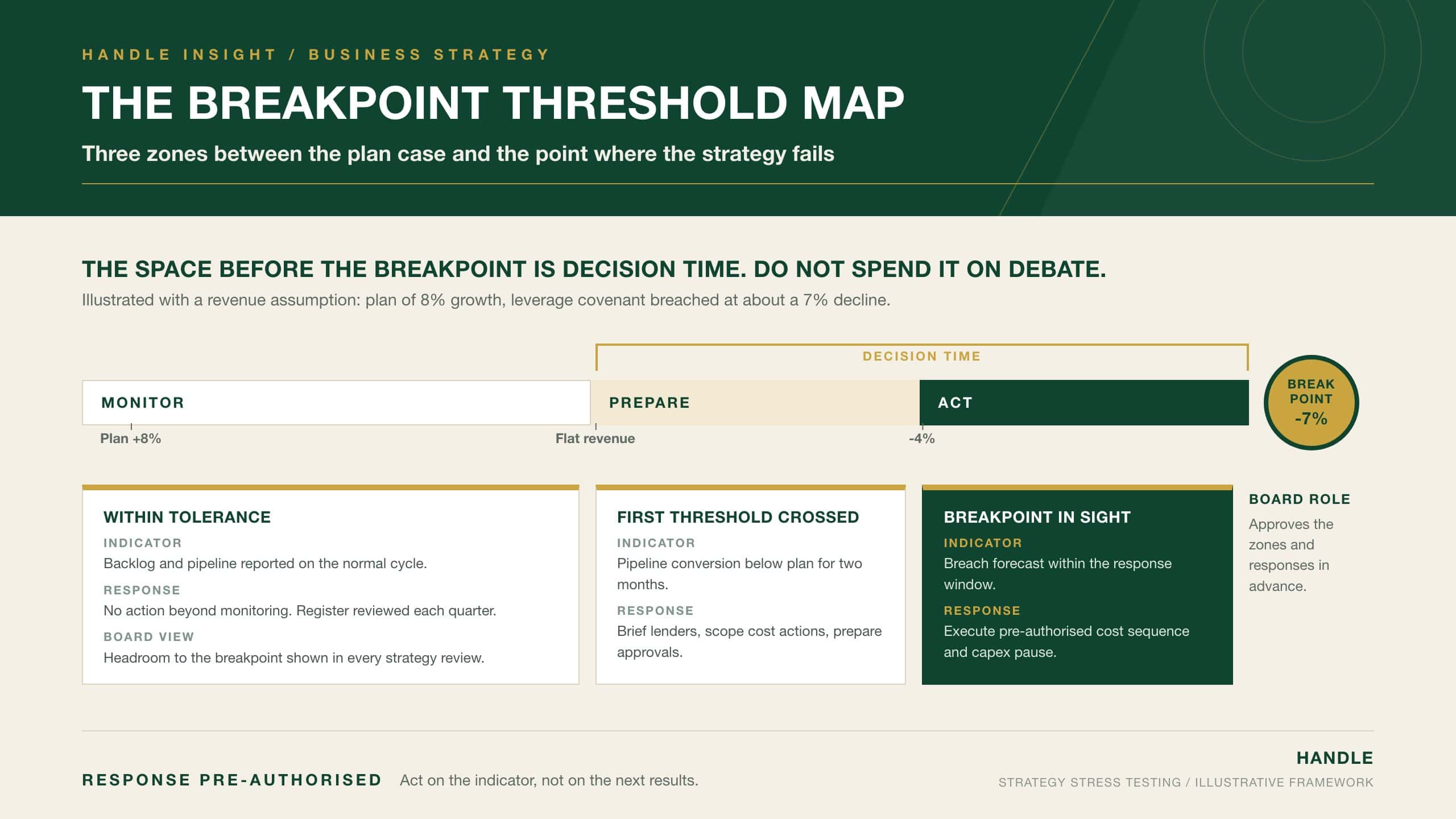
Original Analysis: The Breakpoint Threshold Map
The Breakpoint Threshold Map shows each critical assumption as a scale running from the plan case to the breakpoint, divided into three zones, each with a defined response.
- Monitor zone. The assumption is moving but remains within tolerance. Indicators are reported on the normal cycle.
- Prepare zone. The indicator has crossed its first threshold. Contingency plans are activated in readiness: lenders are briefed, cost actions are scoped and decisions are prepared for approval.
- Act zone. The indicator signals that the breakpoint will be reached within the response time available. Pre-authorised actions are executed without further approval.
The map’s value lies in the space between the first threshold and the breakpoint. That space is the organisation’s decision time. Stress testing exists to make it as wide as possible and to ensure that nothing in it is wasted on debate.
Common Stress-Testing Failures
- Allowing optimism bias to protect assumptions that have held historically, so the most important beliefs are never tested.
- Testing financial variables in isolation and ignoring the operational, regulatory and tax consequences that follow.
- Producing scenarios without breakpoints, which describes stress without showing where the strategy fails.
- Identifying breakpoints without pre-authorised responses, which leads to paralysis when the breakpoint approaches.
- Linking no indicators to assumptions, so the organisation learns an assumption has failed from its results.
- Treating the exercise as annual, so the register is out of date when it is needed most.
Each failure leaves fragility hidden. Stress testing exists to bring it into view while it can still be managed.
Conclusion
Stress testing strategic assumptions converts hidden fragility into managed foresight. It identifies the few assumptions on which enterprise value depends, sets severe but plausible deviations, models their financial, operational, regulatory and tax effects, and locates the breakpoints at which the strategy fails without intervention. The worked example shows how close those breakpoints can be: a revenue shortfall of around 7 per cent can be a covenant event. For UAE businesses, interest rates linked through the dollar peg and tax status under the Corporate Tax regime deserve a place in the register. The board approves the breakpoints and the responses, indicators provide warning, and action follows rules rather than debate. When markets shift, funding tightens or regulation changes, the strategy remains disciplined. Its foundations have already been tested. Its responses are already approved.


