

Most product portfolios do not lose pricing power to a stronger competitor. They lose it to their own ambiguity. When several products in the same portfolio claim similar customers, similar benefits and similar price points, buyers compare them on features and discount, and rivals exploit every overlap. Competitive positioning for product portfolios is the discipline of deciding which territory each product holds, against which alternatives, for which customer priority, and at what price. Within Customer and Product Strategy, it is the point where product decisions, pricing and commercial messaging are forced into one coherent position. The objective is not to be different on every dimension. It is to be decisively preferred on the dimensions customers actually pay for, and to stop spending on the rest. Position is chosen, not inherited.
What Is Competitive Positioning for a Product Portfolio?
For a single product, positioning answers one question: why should a defined customer choose this offer over the alternatives available to them? For a portfolio, the question multiplies. Each product needs its own answer, and the answers must not contradict one another. A premium offer that is undercut by a cheaper sibling with nearly the same capability teaches customers to buy down. A specialist product that drifts into general features loses the expertise that justified its price.
Portfolio positioning therefore operates at two levels. At the product level, it defines the target segment, the decisive benefit and the competitive frame of reference. At the portfolio level, it assigns roles: which product defines the brand, which product wins volume, which product defends against low-cost entrants and which product exists to deepen the relationship with existing customers.
When both levels are clear, three commercial outcomes follow. Sales teams know which product to lead with in each situation. Pricing holds because each tier has a visible reason for its price. Product development stops adding features that blur the boundaries between offers.
Who Are You Actually Competing Against?
Positioning begins with an honest map of the alternatives a customer considers. That set is usually wider than the list of named competitors in a strategy deck.
Direct competitors solve the same problem with similar capabilities and appear on the same shortlist. They set the reference point for price and feature expectations.
Indirect competitors solve the same problem through a different route: a service instead of software, an outsourced model instead of an in-house tool, a platform bundle instead of a point solution. They compete for the same budget even when they look nothing alike.
Substitutes and inertia are often the strongest competitor of all. A spreadsheet, a manual process or a decision to delay purchase wins whenever the perceived benefit of change is not large enough to justify the cost and risk of switching.
Internal competitors are the products in your own portfolio. Cannibalisation is not always a problem, but unplanned cannibalisation transfers revenue from higher-margin offers to lower-margin ones without any gain in market share.
| Competitor Type | How It Wins | Positioning Response |
|---|---|---|
| Direct competitor | Feature parity, price, sales coverage | Compete on a decisive benefit it cannot easily match; avoid feature-for-feature contests |
| Indirect competitor | A different delivery model or cost structure | Reframe the decision around outcomes, total cost and risk rather than format |
| Substitute or inertia | No switching cost, no implementation risk | Quantify the cost of the status quo and lower the barrier to adoption |
| Own portfolio | Similar capability at a lower price | Separate products by segment, use case and capability fences |
Which Capabilities Count as Differentiation?
Organisations routinely overestimate their differentiation. A capability is only a differentiator if it meets three conditions at once: customers value it, customers can perceive it before purchase, and competitors cannot replicate it quickly. Anything that fails one of these conditions is either a parity capability or a supporting capability.
Parity capabilities are the features a product must have to be considered at all. Reliability, security standards, basic integrations and acceptable service levels usually sit here. Failing on parity removes a product from the shortlist, but excelling on parity rarely wins the decision.
Differentiating capabilities are the reasons a customer chooses one product over another and accepts its price. They may rest on proprietary technology, specialised expertise, data advantages, delivery speed, regulatory approvals or an operating model that rivals cannot copy without restructuring.
Supporting capabilities improve the experience without defining the value proposition. Reporting tools, training, onboarding and account management belong here. They matter for retention, but positioning built on them is easily matched.
The discipline is to name the one or two differentiators that carry each product’s position and to resist claiming everything. A product that claims five advantages is remembered for none.
Choosing the Axes of Competition
Every market has a small number of axes along which customers sort alternatives. The original strategic choices are well known, but they are only useful when they are applied to a specific segment rather than to the market as a whole.
Value versus cost. Some products win by delivering superior outcomes at a premium price; others win by delivering acceptable outcomes at the lowest total cost. Both positions can be profitable. The position in between, moderate value at moderate price with no clear reason to prefer it, is where margins erode.
Specialisation versus breadth. A specialist wins depth of expertise and credibility in a narrow use case. A broad portfolio wins convenience, integration and a single supplier relationship. The choice depends on whether the target customer buys best-of-breed or buys consolidation.
Innovation versus reliability. Early adopters reward new capability and tolerate risk. Regulated, risk-averse buyers reward predictability, proven performance and long support horizons. The same feature can be an advantage in one segment and a concern in another.
| Segment Priority | Typical Decision Criteria | Strongest Position | Position to Avoid |
|---|---|---|---|
| Enterprise and regulated buyers | Reliability, compliance, integration, support | Proven, specialised, premium | Experimental features sold on novelty |
| Mid-market growth companies | Time to value, scalability, total cost | Broad platform with fast deployment | Complex enterprise packaging |
| Small businesses | Price, simplicity, self-service | Efficient, low-friction entry tier | High-touch offers priced for scale |
| Innovation-led buyers | New capability, speed of release | Specialist with rapid development | Generic parity offer |
How Should Roles Be Assigned Across the Portfolio?
A portfolio is positioned as a system. Each product has a role, and the roles are deliberately different.
Flagship products define what the organisation stands for. They carry the strongest differentiation, the highest visibility and usually the highest price. Their position must be protected, including from discounts that teach the market to expect less.
Volume products win share in the largest segments. They compete closer to the market reference price and rely on efficiency, distribution and reliability.
Entry products lower the barrier to adoption. They are designed with capability fences, limits on users, volumes, features or support, so that growing customers have a clear reason to move up rather than stay down.
Defensive products exist to block a low-cost entrant from establishing a foothold, without forcing the flagship to cut its price. They are deliberately narrower and should not be marketed as equivalents of the flagship.
Complementary products deepen the relationship with existing customers through add-ons, services or integrations. Their positioning is tied to the core product, not to the open market.
Tiering only works when the boundaries between tiers are visible and meaningful to the customer. If a customer cannot explain why the higher tier costs more, the tiers will collapse into the cheapest one.
A Worked Example: Repositioning a Three-Product Portfolio
Consider an illustrative software company in the UAE selling three compliance products to financial services firms. Product A is a full compliance platform at AED 240,000 a year. Product B is a mid-tier module at AED 150,000. Product C is an entry tool at AED 60,000. All three are sold by the same team, and all three are described as “comprehensive, easy to use and regulator-ready”.
A review of twelve months of deals shows the pattern. Thirty percent of Product B sales went to customers who had previously been quoted Product A. Discounts on Product A averaged 22 percent because buyers used Product B as an anchor. Product C attracted small firms, but very few upgraded because it already covered most of their needs. The portfolio was competing with itself.
The repositioning made three decisions. Product A was positioned for regulated institutions with multi-jurisdiction obligations, with its differentiator defined as audit-ready evidence across DFSA, FSRA and onshore requirements. Product B was repositioned for single-jurisdiction firms and fenced: no multi-entity reporting, no regulatory audit pack. Product C was limited to a defined number of users and screening volumes, with an explicit upgrade path to Product B.
The illustrative result after two quarters: Product A discounts narrowed to around 10 percent because Product B no longer offered a credible substitute, cannibalisation fell, and upgrades from Product C rose because the fence was reached by growing firms. None of the products changed materially. The positions did.
Original Analysis: The Portfolio Territory Map
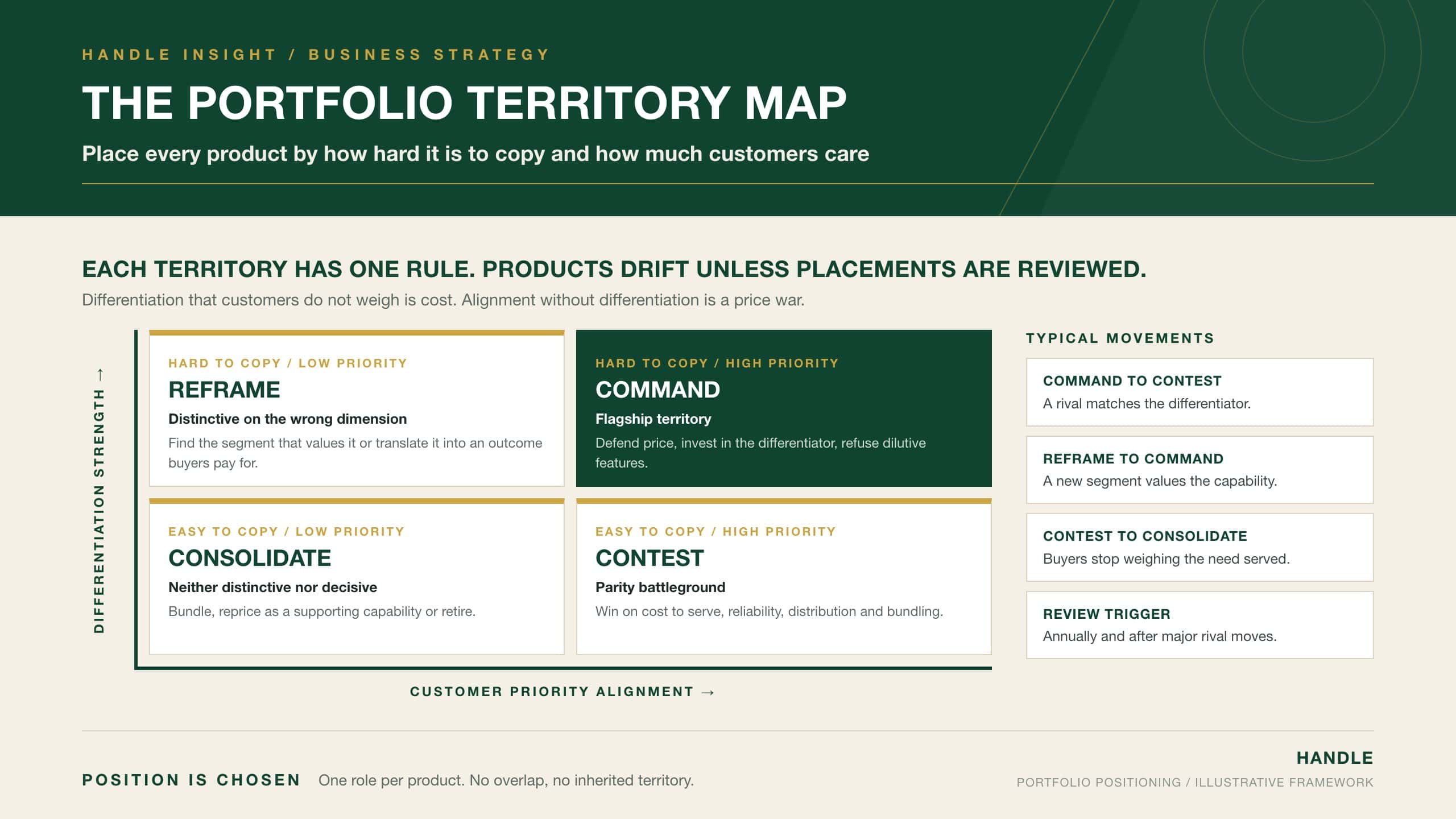
A practical way to test a portfolio is to place every product on two axes. The first is differentiation strength: how hard it is for a competitor to replicate the product’s decisive capability. The second is customer priority alignment: how closely that capability matches what the target segment actually weighs in its purchase decision. The result is four territories, each with a different management rule.
Command (high differentiation, high alignment). The product is hard to copy and solves what customers care about most. This is the flagship territory. The rule is to defend price, invest in the differentiator and refuse feature additions that dilute it.
Reframe (high differentiation, low alignment). The product is genuinely distinctive, but on a dimension customers do not prioritise. The rule is to either find the segment that does value the capability or translate it into an outcome customers already pay for. Investing further in the capability without reframing it wastes development spend.
Contest (low differentiation, high alignment). The product meets an important need, but so do the alternatives. This is a parity battleground. The rule is to compete on cost to serve, reliability, distribution and bundling, and to avoid premium claims the market will not accept.
Consolidate (low differentiation, low alignment). The product is neither distinctive nor important to buyers. The rule is to bundle it into a stronger offer, reprice it as a supporting capability or retire it. Keeping it as a standalone product spreads sales attention and confuses the portfolio.
The map is most useful when it is repeated. Products move between territories as competitors catch up and customer priorities shift. A product that held Command territory three years ago may now be in Contest without anyone having decided to compete on price. Reviewing placements annually, and after every significant competitor move, keeps the portfolio’s positions deliberate rather than historical.
Keeping the Position Current: Intelligence and Governance
Positions decay. Competitors release similar capabilities, change pricing models or enter adjacent segments. Customer priorities shift with regulation, technology and economic conditions. Competitive intelligence is the mechanism that tells leadership when a territory has moved.
Useful intelligence is specific: win and loss reasons recorded by deal, price points observed in competitive bids, feature releases tracked against the differentiators that carry each position, and changes in the language customers use to describe their needs. General market reports are a poor substitute for structured feedback from the sales process.
Governance converts intelligence into decisions. A positioning owner for each product, a portfolio review at least annually, and a rule that roadmap items must reinforce the product’s assigned role prevent the gradual drift that turns distinct products into overlapping ones. Messaging must follow the same discipline: every channel describes each product in the same terms, for the same customer and against the same alternative.
Common Positioning Failures in Product Portfolios
- Claiming differentiation on parity capabilities, which leaves sales teams defending a premium the customer cannot see.
- Allowing mid-tier products to absorb flagship features, so that customers buy down and the flagship becomes a discount anchor.
- Designing entry tiers without capability fences, which turns an adoption pathway into a permanent low-margin destination.
- Positioning against named competitors only, while losing most decisions to inertia and internal workarounds.
- Using the same messaging for every segment, which blurs the decisive benefit for each and invites price comparison.
- Letting the product roadmap follow the loudest customer requests rather than the assigned role of each product.
- Keeping low-alignment, low-differentiation products alive as standalone offers because they once had a reason to exist.
Each of these failures has the same root. The portfolio was assembled product by product, and no one was given authority to position it as a whole.
Conclusion
Competitive positioning for product portfolios decides whether a company sets its prices or accepts them. The work starts with an honest view of every alternative a customer considers, including inertia and the company’s own products. It continues by separating real differentiators from parity and supporting capabilities, choosing the axes on which each segment decides, and assigning every product a distinct role: flagship, volume, entry, defensive or complementary. The Portfolio Territory Map then shows where each product actually stands, and what rule applies to it: defend, reframe, contest or consolidate. Positions are not permanent. Competitors move, customer priorities change and roadmaps drift, so placements must be reviewed with evidence from the sales process. A portfolio positioned as a system protects its margins and directs its investment. A portfolio assembled product by product competes with itself. Clarity holds price. Overlap gives it away.


