

After a crisis, institutions are tempted to treat investor confidence as a communications problem: a new narrative, a roadshow, an optimistic plan. Investors read it differently. They are not asking whether management is persuasive. They are asking whether the risk that caused the loss has been contained, whether someone with authority is now accountable, whether the numbers can be trusted and whether commitments are being kept. Within Strategic Turnarounds for Institutions, restoring investor confidence post-crisis is treated as the visible result of four things done in order: exposure contained, authority reset, information rebuilt and execution proven. Only then does re-engagement with capital work. Confidence is not requested. It is earned through evidence, in sequence.
Why Restoring Investor Confidence Post-Crisis Is an Execution Problem
A crisis changes how investors process information. Before it, they extend the benefit of the doubt: forecasts are taken broadly at face value, explanations are accepted and management is assumed to be in control. After it, every statement is discounted until it is verified by action. A promise that would once have moved a share price or unlocked a facility now has almost no effect.
This is why narrative-led recoveries tend to stall. Optimistic guidance issued before control has been re-established invites comparison with delivery. When delivery falls short, credibility falls further than if no guidance had been given. Institutions often get one credible recovery window. Spending it on reassurance rather than evidence is the most common reason confidence takes years rather than months to return.
The working assumption should be simple. Investors return because risk has been reduced and outcomes have become predictable, not because they have been convinced.
| Narrative-Led Recovery | Evidence-Led Recovery |
|---|---|
| Broad roadshow soon after the crisis | Direct engagement with core investors and lenders first |
| Upside targets and growth language | Narrow, conservative guidance that can be met |
| Root cause attributed to external conditions | Root cause stated precisely, with ownership accepted |
| Leadership continuity presented as stability | Authority and accountability visibly reset |
| Extensive dashboards with caveats | Fewer metrics, reported reliably and on time |
| Plans announced | Irreversible actions completed, then reported |
What Investors Ask First
Investors reassess a damaged institution through a short set of questions. Each must be answered with facts rather than intent.
What broke? Investors want the root cause isolated: a governance failure, mispriced risk, excessive concentration, weak controls or an external shock that was poorly managed. Institutions that blur causality lose credibility. A precise, accepted diagnosis is the starting point for everything else.
Who is now in control? Investors look for a reset of authority. Changes in board composition, executive accountability and decision rights matter more than statements of commitment. If the same people make the same kinds of decisions under the same structure, investors assume the same outcome is possible.
What has been ring-fenced? Containment matters more than recovery plans. Investors want to know which exposures can no longer cause loss, which assets are protected from the problem and how much downside remains.
Can the numbers be trusted? Where reporting failed or was late, investors discount every subsequent figure until the information process itself has been repaired.
Containing Exposure and Rebuilding Capital Credibility
Capital credibility comes first because it determines whether the institution has time to recover. Three actions dominate this phase.
Make the balance sheet readable. Complexity increases suspicion. Separating core from non-core assets, simplifying structures and applying conservative valuations restore credibility faster than technically optimised presentation. If investors cannot see the downside, they assume it is larger than it is.
Hold liquidity as a signal. After a crisis, surplus liquidity is not inefficiency. It shows that the institution can absorb a further shock without returning to investors. Agreeing headroom with lenders and extending maturities early removes the most immediate source of fear.
Pause discretionary capital deployment. New investments, acquisitions and distributions are suspended or tightly limited until stability is demonstrated. Investors read this restraint as discipline.
Resetting Authority and Accountability
Confidence returns when accountability is visible. Boards must be seen to direct outcomes, not to endorse management explanations. That usually means clear decisions on leadership, the appointment of directors with relevant experience and independence, and documented consequences for the failures that occurred.
Executive mandates should be narrowed and made explicit. Each priority in the recovery has a named owner and a measurable outcome. Ambiguity about who is responsible for what is one of the first signs investors look for, and one of the easiest to remove.
The risk function deserves particular attention. Where risk was overridden or ignored, investors need evidence that it now has independent authority, direct access to the board and the ability to stop decisions. Cosmetic changes, such as renaming a role without changing its reporting line, are discounted immediately.
Rebuilding Information Integrity and Disclosure
Information failure accelerates capital flight. Rebuilding it involves three disciplines.
Reliability over volume. A small number of metrics, reported accurately and on schedule, is worth more than an extensive dashboard with qualifications. Each metric should connect directly to the risks investors are watching.
Forecast discipline. Guidance, where given at all, should be conservative and narrow. Eliminating negative surprises is more valuable in this phase than signalling upside.
A clear disclosure hierarchy. Material facts are identified early and escalated to the board for disclosure decisions. For issuers listed on the Abu Dhabi Securities Exchange or Dubai Financial Market, disclosure of material information is governed by the Securities and Commodities Authority’s rules; for issuers on Nasdaq Dubai, by the DFSA’s rules. Restraint after a crisis applies to commentary and promotion, never to information the market is entitled to receive. Selective silence on material developments does not stabilise confidence. It creates the next crisis.
A Worked Example: From Covenant Breach to Refinancing
Consider an illustrative UAE industrial group whose earnings fall sharply after the loss of a major contract and the discovery of weak project cost controls. Net debt stands at AED 1.2 billion and EBITDA falls to AED 200 million, taking leverage to 6.0 times against a covenant of 4.0 times. Lenders grant a waiver for twelve months on condition that a credible plan is delivered.
The group does not launch a roadshow. In the first quarter it appoints a new chief financial officer and an independent chair of the audit committee, freezes discretionary capital expenditure and agrees a monthly reporting pack with lenders. In the second and third quarters it sells a non-core logistics business for AED 300 million, applying the proceeds to debt, and removes AED 40 million of annual costs. Guidance is limited to a narrow EBITDA range, which is then met.
By month twelve, on these illustrative figures, net debt has fallen to AED 900 million and EBITDA has recovered to AED 240 million. Leverage is 3.75 times, inside the covenant. The refinancing that follows is priced higher than before the crisis, but it is available, and it includes fewer restrictive conditions than the waiver. The recovery was achieved through completed actions reported on time, not through a new strategy presentation.
Original Analysis: The Confidence Rebuild Sequence
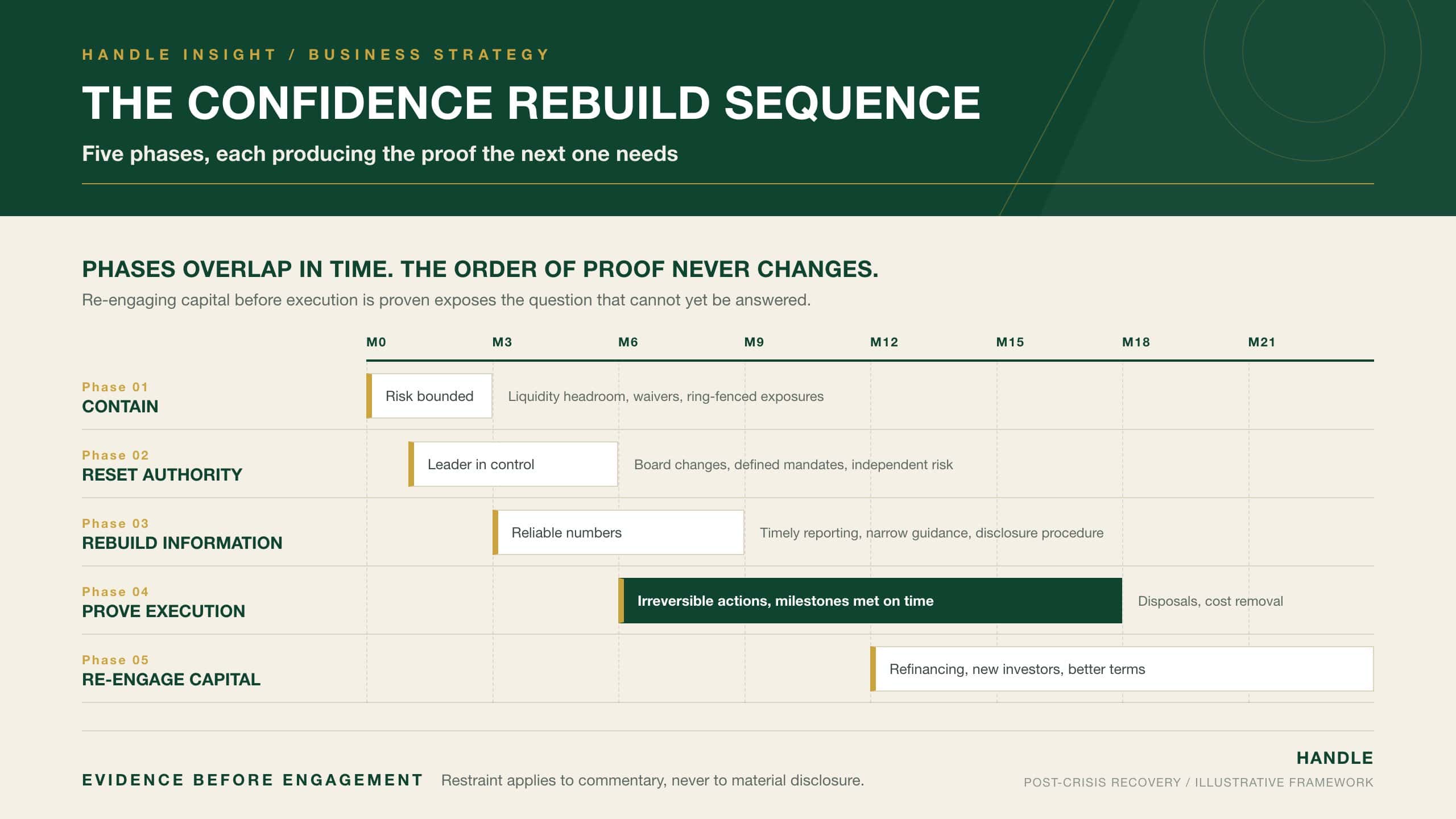
The phases of recovery are most effective when they are run in a fixed order, with each phase building the evidence the next one needs. The Confidence Rebuild Sequence sets out five phases and the proof each must produce.
| Phase | Illustrative Timing | Proof Investors Need | Typical Evidence |
|---|---|---|---|
| 1. Contain | Months 0 to 3 | Downside is bounded | Liquidity headroom, waivers, ring-fenced exposures, capital freeze |
| 2. Reset authority | Months 1 to 6 | Someone accountable is in control | Board and leadership changes, defined mandates, independent risk function |
| 3. Rebuild information | Months 3 to 9 | The numbers can be relied on | Timely reporting, narrow guidance, disclosure procedure |
| 4. Prove execution | Months 6 to 18 | Commitments are kept | Irreversible disposals, cost removal, milestones met on time |
| 5. Re-engage capital | Months 12 to 24 | Risk is priced, not feared | Refinancing, new investors, improved terms |
The phases overlap in time, but the order of proof does not change. Re-engaging capital before execution is proven exposes the institution to the question it cannot yet answer. Proving execution before information is reliable means results will not be believed. Rebuilding information before authority is reset means investors will ask who is standing behind the numbers.
The sequence also tells leadership what to stop doing. In phase one, growth language is withheld. In phase two, defensive explanations of the crisis are abandoned. In phase three, ambitious targets are replaced with deliverable ones. Each restraint is part of the evidence.
Who Should Be Re-Engaged First?
Re-engagement is sequenced, not broadcast. The first audience is the group whose continued support the institution cannot do without: relationship lenders, bondholders or their representatives, and long-term shareholders with board representation or significant holdings. Their commitment buys the time every other phase depends on, and their willingness to stay is itself evidence that other investors will watch.
These conversations should be fact-led. Meetings focus on actions taken, controls installed and exposures bounded, with forward-looking ambition kept secondary. Where price-sensitive information is shared with a limited group, for example during a refinancing, listed issuers must manage it within the applicable insider and disclosure rules, including confidentiality undertakings and cleansing disclosure where required.
Broader audiences follow evidence. Opportunistic investors, new lenders and the wider market are approached once execution has been demonstrated and the information process has proved reliable over at least one reporting cycle. Approaching them earlier invites short-term positioning and volatility that can undo the stability already achieved.
The terms of re-engagement deserve as much attention as its timing. Covenant structure, duration and governance rights shape the institution’s freedom of action for years. Accepting onerous terms to secure early capital can turn a recovery into a dependency.
How to Measure Whether Confidence Is Returning
Confidence shows up in behaviour before it shows up in sentiment. Useful indicators include funding terms that improve at successive renewals, a widening range of capital sources, lower sensitivity of valuation or credit spreads to routine news, and a change in the questions investors ask. When discussion moves from survival and liquidity to strategy and capital allocation, the recovery has taken hold.
Terms matter more than headline price. A refinancing with longer duration, looser covenants or fewer governance conditions is stronger evidence of restored confidence than a valuation that recovers temporarily.
Common Failures in Post-Crisis Investor Recovery
- Launching a broad investor campaign before exposure is contained, which invites scrutiny the institution cannot yet withstand.
- Blaming external conditions for a failure that investors can see had internal causes, which signals that nothing will change.
- Issuing growth targets before stability is proven, so that each missed milestone resets credibility to a lower level.
- Making cosmetic governance changes that leave the same decision-makers and reporting lines in place.
- Confusing restraint in commentary with withholding material information, which breaches disclosure obligations and destroys trust.
- Setting milestones that depend on outside parties, so that delays outside management’s control are read as failures of execution.
- Engaging opportunistic capital first, which brings volatility before core investors and lenders have re-committed.
Each of these failures replaces evidence with expectation. Investors who have just lost money do not accept that exchange.
Conclusion
Restoring investor confidence post-crisis is an execution discipline, not a communications campaign. Investors who have suffered a loss discount every promise until it is confirmed by action. The work therefore follows an order: contain exposure so that the downside is bounded, reset authority so that someone accountable is visibly in control, rebuild information so that the numbers can be relied on, prove execution through irreversible actions completed on time, and only then re-engage capital. The Confidence Rebuild Sequence makes that order explicit and shows what each phase must prove. For listed issuers, restraint applies to commentary, never to material disclosure. Recovery is measured in terms rather than sentiment: better funding conditions, wider sources of capital and investor questions that move from survival to strategy. Evidence comes first. Engagement follows. Confidence is the result.


