

Boards rarely fail because they lack information. They fail because every major decision is approached in the same way: a management paper, a discussion, a vote. An acquisition that commits a third of the balance sheet for a decade receives roughly the same process as a product launch that could be reversed in six months. Strategic decision-making models exist to correct that. Within Leadership & Board Advisory, they give boards and leadership teams structured methods for testing evidence, valuing alternatives, sizing risk against capital and assigning the right level of authority to each choice. The question is not which model is best, but which combination of models a particular decision deserves. The weight of the process should match the weight of the decision.
Why Do Boards Need Strategic Decision-Making Models?
Strategic decisions shape an institution for years: capital deployment, acquisitions, market entry, restructuring and senior appointments. When such decisions rely on instinct, the loudest voice or the most persuasive presentation, the institution takes risks it has not measured.
Structured models change three things. They make the criteria explicit, so that options are compared on the same basis. They expose assumptions, so that directors can challenge the inputs rather than only the conclusion. And they create a record, so that the board can later show how it reached its decision and what it knew at the time. That record matters for governance. Directors owe duties to the company, and for UAE companies under the Commercial Companies Law (Federal Decree-Law No. 32 of 2021), and in the DIFC and ADGM under their own companies regimes, evidence of a careful, informed process is the best protection a board has when a decision turns out badly.
What Are the Main Strategic Decision-Making Models?
No single model answers every question. The main families each address a different part of the decision.
Evidence and Capability Assessment
Every structured decision starts with the facts: market dynamics, competitor behaviour, regulatory developments and technology shifts outside the organisation, and financial capacity, operational capability, talent and infrastructure inside it. A strategy that the institution cannot execute is not an option, however attractive the market.
Scenario Analysis
Scenario analysis tests how a decision performs under different external conditions: a base case, an upside and at least one credible adverse case such as a downturn, a regulatory change, supply chain disruption or a strong competitor response. Its value lies less in predicting which scenario will occur than in showing whether the decision survives the bad ones.
Financial Evaluation
Return on investment, net present value, internal rate of return and payback models measure whether the expected return justifies the capital committed. Cash flow analysis adds the liquidity dimension: how the decision affects reserves, borrowing capacity and covenant headroom during the period before returns arrive.
Risk Evaluation
Risk models assess the probability and severity of operational, financial, legal and reputational risks. The output that matters to the board is whether the downside sits within the organisation’s defined risk appetite, not only whether the expected outcome is positive.
Decision Trees
Decision trees map choices, uncertain events and outcomes in sequence, attaching probabilities and values to each branch. They are particularly useful for comparing alternatives with different risk profiles and for valuing the option to stop, expand or change course partway through.
Structured Deliberation
Executive committee review and structured debate techniques, such as assigning a member to argue against the proposal or requiring a written pre-mortem, bring financial, operational, legal and market perspectives to bear and reduce the risk of groupthink.
| Model | Question It Answers | Main Output | Main Limitation |
|---|---|---|---|
| Evidence and capability assessment | Is the opportunity real and can we execute it? | Market and capability findings | Can confirm existing beliefs if scoped narrowly |
| Scenario analysis | Does the decision survive adverse conditions? | Outcome range across scenarios | Scenarios may be too mild |
| Financial evaluation | Does the return justify the capital? | NPV, IRR, payback, cash flow profile | Sensitive to optimistic assumptions |
| Risk evaluation | Is the downside within appetite? | Probability and severity ratings | Rare, severe events are underweighted |
| Decision tree | Which path has the best risk-weighted value? | Expected value by option, value of flexibility | Probabilities are judgements, not facts |
| Structured deliberation | Have assumptions been properly challenged? | Documented challenge and dissent | Depends on a culture that tolerates dissent |
How Should the Process Match the Decision?
Applying every model to every decision wastes time and slows the organisation. Applying too few to a major decision exposes it to avoidable error. The practical approach is to calibrate the process to two characteristics of the decision: how much capital or strategic value is at stake, and how easily the decision can be reversed.
A large but reversible decision, such as entering a new market through a pilot, can be managed through staged commitment and milestones. A small but irreversible decision, such as signing a long lease for a non-core site, is best handled by clear policy rules. A large and irreversible decision, such as a major acquisition, deserves the full set of models and board approval. A small, reversible decision should be delegated.
A Worked Example: Acquisition or Organic Growth
Consider an illustrative UAE healthcare group whose board must choose between two ways of expanding into a new emirate. The figures are illustrative.
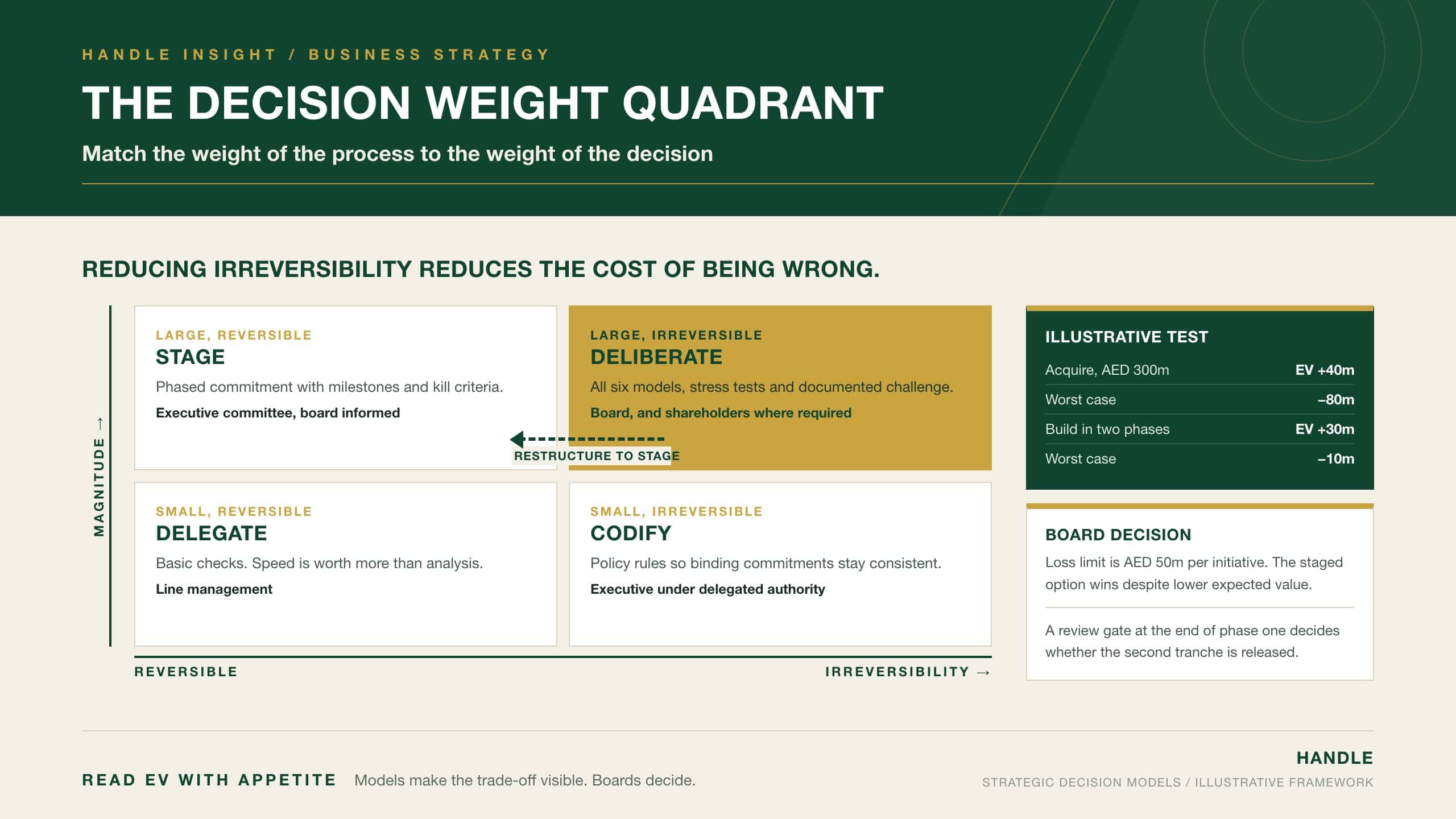
Option A is to acquire an existing clinic network for AED 300 million. Management estimates a 60% probability that integration succeeds, producing a net present value of AED 120 million, and a 40% probability that it underperforms, producing a negative value of AED 80 million. The expected value is AED 40 million.
Option B is to build a network organically in two phases, committing AED 80 million in phase one and a further AED 100 million in phase two only if phase one meets its milestones. Management estimates a 50% probability of success with a value of AED 70 million, and a 50% probability that phase one disappoints, in which case the group stops and loses AED 10 million. The expected value is AED 30 million.
On expected value alone, Option A wins. But the board’s risk appetite limits the maximum acceptable loss on a single strategic initiative to AED 50 million. Option A’s adverse outcome breaches that limit, while Option B’s does not. The acquisition would also require a merger control assessment under the UAE Competition Law, Federal Decree-Law No. 36 of 2023, adding time and uncertainty. The decision tree shows that the staged option is worth less on average but preserves the ability to stop. The board approves Option B, with a review gate at the end of phase one and a standing instruction to revisit acquisition targets if valuations fall.
The models did not make the decision. They made the trade-off visible.
What Should the Board Approve, and What Should It Delegate?
Major strategic initiatives require board approval, and some may require shareholder approval under the Commercial Companies Law or the company’s articles of association, depending on the company’s form and the nature of the transaction. The board should therefore maintain a clear delegation of authority that sets financial thresholds and categories of decision reserved to it, with everything below those thresholds delegated to management.
When a proposal reaches the board, directors should test strategic alignment with the agreed direction, the evidence behind key assumptions, the downside against risk appetite, legal and regulatory implications, and the feasibility of execution. A board paper should state which models were used, what they showed and where the main uncertainties lie.
| Decision Profile | Typical Example | Models Required | Approval Level |
|---|---|---|---|
| Small and reversible | Pricing test, minor hire | Basic financial check | Line management |
| Small and irreversible | Long lease, long-term supply contract | Policy criteria and legal review | Executive under delegated authority |
| Large and reversible | Market pilot, staged product launch | Scenarios, staged financials, milestones | Executive committee, board informed |
| Large and irreversible | Acquisition, major capital project | All six models with documented challenge | Board, and shareholders where required |
What Should a Board Paper Give Directors?
Information quality also matters. Board papers for major decisions should reach directors early enough to be read and questioned, should separate fact from management judgement, and should present the strongest case against the proposal as well as the case for it. Where directors lack the expertise to test a key assumption, the board should be able to commission independent advice, from valuation specialists, technical experts or legal counsel, without needing management’s agreement. A board that relies only on the proposing executive’s analysis is reviewing advocacy, not evidence.
Conflicts of interest require particular care. Where a director or senior executive has a personal interest in the outcome, for example because a related party is a counterparty, the conflict should be declared, recorded and managed in line with the applicable companies regime and the company’s own policies before the decision is taken.
How Are Decisions Monitored After Approval?
Approval is not the end of the process. Each major decision should carry execution milestones, the key assumptions that justified it and the indicators that would show those assumptions failing. Post-decision reviews, conducted against the original board paper, show whether the models were reliable and improve the next decision. A board that never reviews its past decisions cannot calibrate its future ones.
Original Analysis: The Decision Weight Quadrant
The Decision Weight Quadrant places each strategic decision on two axes: magnitude, meaning the capital or strategic value at stake, and reversibility, meaning how quickly and cheaply the decision could be undone. Each quadrant implies a different process.
- Delegate (small, reversible). Management decides quickly with basic checks. Speed is more valuable than analysis.
- Codify (small, irreversible). Policy rules and standard criteria apply, so that individually minor but binding commitments are made consistently.
- Stage (large, reversible). Commitment is released in phases with milestones and kill criteria, so that learning reduces risk before the full investment is made.
- Deliberate (large, irreversible). The full set of models applies, with scenario stress tests, decision trees, documented challenge and board approval.
The quadrant’s most important use is moving decisions between quadrants. A large irreversible decision can often be restructured as a staged one, as in the worked example, by phasing investment, using options or partnering before acquiring. Reducing irreversibility reduces the cost of being wrong. The deliberate quadrant is where boards should spend most of their time, and where process shortcuts are least defensible.
Common Decision-Making Failures
- Applying the same process to every decision, so that the board is overloaded with minor items and under-prepared for major ones.
- Presenting a single recommended option without credible alternatives, which leaves the board able only to approve or reject.
- Using scenarios that are too mild to test the decision, so that the adverse case is merely a slightly worse base case.
- Relying on expected value without checking whether the downside outcome is within the organisation’s risk appetite.
- Treating board approval as the end of the process, with no milestones or post-decision review.
- Overlooking regulatory approvals, such as merger control or shareholder consent, until late in the process.
Each of these failures is a process failure. Each is preventable.
Conclusion
Strategic decision-making models bring structure to the choices that shape an institution for years. Evidence and capability assessment, scenario analysis, financial evaluation, risk evaluation, decision trees and structured deliberation each answer a different question, and together they turn judgement into a process the board can examine and defend. The process should be calibrated to the decision: delegate small reversible choices, codify small irreversible ones, stage large reversible ones and deliberate fully on large irreversible ones, with board and, where required, shareholder approval. Wherever possible, a large irreversible decision should be restructured to make it staged. Expected value must be read alongside risk appetite, regulatory approvals must be identified early, and every major decision should be reviewed against the paper that justified it. Models do not decide. Boards do. Models make the trade-offs visible before the commitment is made.


