

Founder-led businesses rarely fail for lack of vision. They stall when the organisation outgrows the capacity of one person to decide everything, and the structures needed to share that load have not been built. Within Leadership & Board Advisory, governance for founder-led businesses is the work of converting personal authority into institutional authority without losing the clarity and pace that made the business succeed. That means defining what the founder decides, what the board decides and what management decides; building a board that can genuinely challenge; and designing protections that let the founder retain influence while satisfying investors, lenders and regulators. The aim is not to reduce the founder’s role. It is to make the business work whether or not the founder is in the room. Governance does not replace the founder. It extends the founder’s reach.
Why Founder-Led Businesses Need Governance Earlier Than They Think
In the early years, concentrated authority is an advantage. The founder knows every client, approves every hire and makes every material decision. Speed is high and coordination costs are low.
The same concentration becomes a constraint as the business grows. Decisions queue behind one person. Senior hires discover they have titles without authority. Investors and lenders ask who approves what, and the honest answer is that it depends on the founder’s view on the day. Key person risk, which every serious investor assesses, becomes the dominant risk in the business.
The trigger for formal governance is usually external: a funding round, a bank facility, a regulatory licence, a joint venture or a planned listing. Founders who wait for that trigger build governance under negotiation pressure, on the counterparty’s terms. Founders who build it earlier negotiate from a position of strength, because they can show a working structure rather than promise one.
The table below sets out how governance typically develops as external capital and scrutiny increase.
| Growth Stage | Typical Trigger | Governance Minimum |
|---|---|---|
| Early growth | First senior hires, first significant clients | Written founder role, basic delegation of authority, advisory board |
| Institutional capital | Private equity investment or bank facility | Governing board with independent members, decision rights matrix, audit oversight |
| Regulated or multi-entity scale | Regulatory licence, joint ventures, group restructuring | Board committees, risk framework, documented succession plan |
| Public markets | Planned listing | Listed company governance rules on board composition, independence and committees |
What Does Governance for Founder-Led Businesses Actually Involve?
Governance for founder-led businesses has four components. The first is a defined role for the founder, set out in writing. The second is a board with the composition and authority to provide real oversight. The third is a decision rights framework that allocates authority between shareholders, board, founder and management. The fourth is a set of control systems covering financial reporting, risk and succession.
None of these is unusual in itself. What makes founder-led governance distinct is the need to design each component around a person who holds disproportionate influence, often as the largest shareholder, the chief executive and the source of the company’s culture at the same time.
Which Role Should the Founder Hold?
The founder’s role is the first governance decision, and it shapes every other. Three models are common.
| Founder Role | Founder Retains | Board Provides | Main Risk |
|---|---|---|---|
| Founder chief executive | Operational leadership and strategy formation | Oversight, challenge, approval of major decisions | Board deference, with oversight in name only |
| Founder executive chair | Strategy, key relationships, board leadership | Oversight of a professional chief executive | Two centres of power and unclear authority for the chief executive |
| Founder non-executive chair | Board leadership, mission, long-term direction | Full oversight of management | Founder re-entering operations informally |
No model is inherently correct. The founder chief executive model suits businesses still in rapid growth. The executive chair model is often a transitional step. The non-executive chair model suits founders preparing for succession or a major liquidity event. What matters is that the chosen model is documented and that the founder’s behaviour follows it.
Building a Board That Can Govern
Many founder-led businesses begin with an advisory board: experienced individuals who offer guidance without formal authority. Advisory boards are useful, but they are not governance. They cannot approve, reject or hold management to account.
A governing board has legal authority under the company’s constitutional documents and the applicable company law. Its composition should reflect the risks the business now carries. That usually means at least one or two independent directors with experience in finance, law, the relevant industry or capital markets, alongside the founder and any investor representatives. Independence must be real. A director who is a long-standing personal friend of the founder, or who depends on the business for consulting fees, will struggle to challenge when it matters.
As the business matures, committees follow. An audit committee supervises financial reporting, internal controls and the relationship with external auditors. A nomination and remuneration committee addresses executive appointments, pay and succession. A risk committee becomes relevant where regulatory or operational exposure is significant.
How Should Decision Rights Be Divided?
Ambiguity about who decides is the most common source of conflict between founders, boards and investors. A written decision rights matrix removes most of it. The matrix allocates each category of decision to the level that must approve it, usually with monetary thresholds.
| Decision | Management | Founder Chief Executive | Board | Shareholders |
|---|---|---|---|---|
| Operating expenditure within budget | Up to AED 2 million | Up to AED 10 million | Above AED 10 million | No |
| Capital expenditure outside budget | No | Up to AED 3 million | Above AED 3 million | No |
| Senior executive appointments | No | Proposes | Approves | No |
| Annual budget and strategy | Prepares | Recommends | Approves | No |
| Acquisitions and new borrowing above set limits | No | Recommends | Approves | Where reserved |
| New share issues and constitutional changes | No | No | Recommends | Approves |
The thresholds are illustrative and should be calibrated to the size of the business. The structure matters more than the numbers. Management can act quickly within limits, the founder retains broad executive authority, and decisions with lasting consequences receive board or shareholder scrutiny.
Original Analysis: The Founder Governance Quadrant
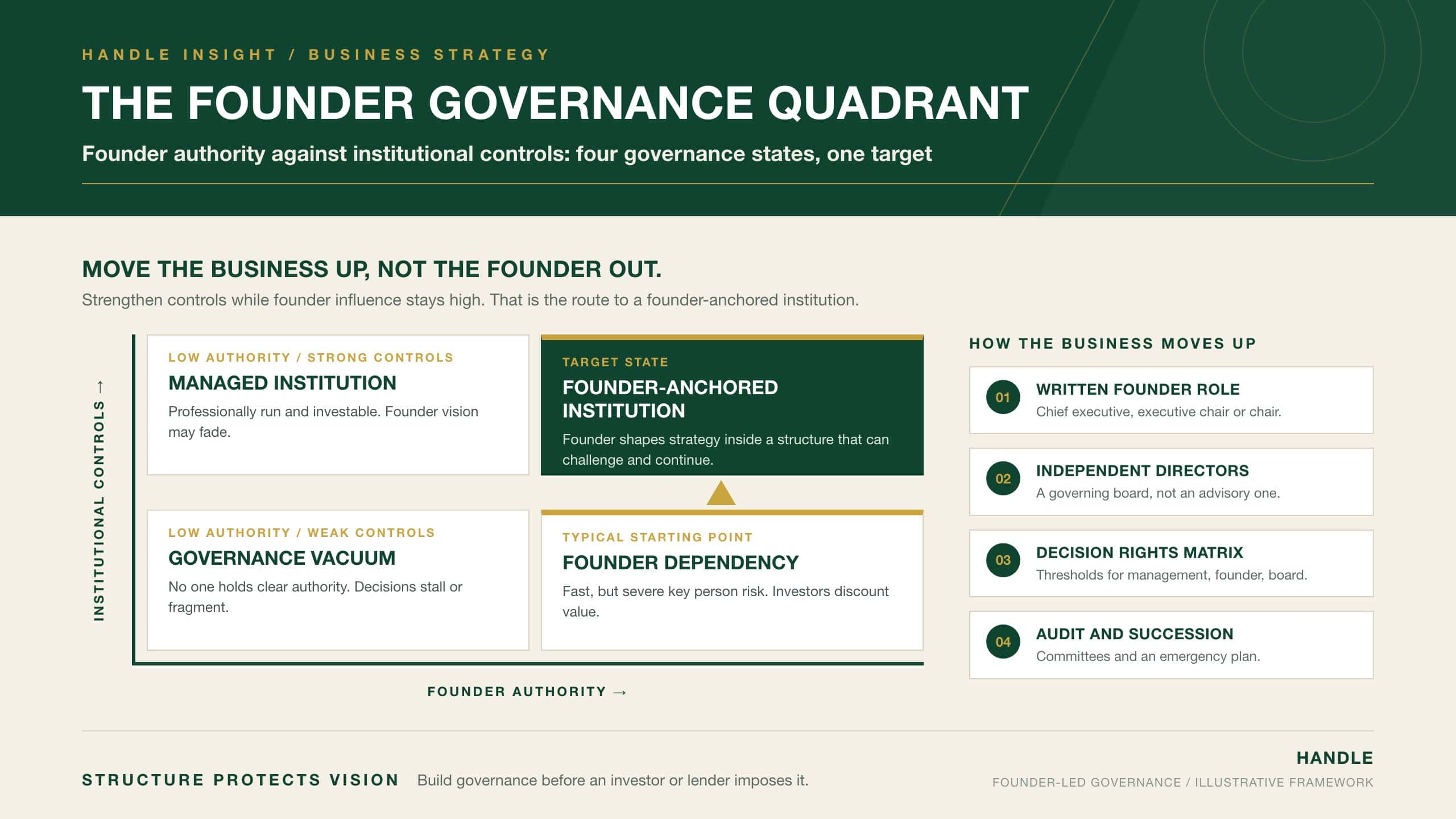
Founder-led businesses can be positioned on two dimensions. The first is the concentration of authority in the founder, from high to low. The second is the strength of institutional controls: board independence, documented decision rights, financial oversight and succession planning. The combination produces four distinct governance states.
Founder Dependency combines high founder authority with weak controls. The business moves quickly but carries severe key person risk, and investors will discount its value accordingly. Most founder-led companies start here.
Governance Vacuum combines low founder authority with weak controls. It often follows a founder’s sudden withdrawal, illness or dispute with co-owners. No one holds clear authority, and decisions stall or fragment.
Managed Institution combines low founder authority with strong controls. The business is professionally run and investable, but the founder’s vision and pace may fade if the transition is mishandled.
Founder-Anchored Institution combines high founder influence with strong controls. The founder continues to shape strategy and culture, but within a structure that can challenge, approve and continue without them. This is the target state for most founder-led businesses in a growth phase.
The quadrant clarifies the direction of travel. The objective is not to move the founder out. It is to move the business upward by strengthening controls while the founder’s influence remains high. Moving straight from Founder Dependency to Managed Institution is possible, but it is usually a succession decision rather than a governance one.
A Worked Example: Moving Up the Quadrant
Consider an illustrative UAE technology services company with annual revenue of AED 120 million, a founder holding 70 percent of the shares and two early investors holding the rest. The founder is chief executive and personally approves every contract above AED 250,000, every hire above middle management and every price change. The board consists of the founder and the two investors and meets twice a year. The company sits firmly in Founder Dependency.
A bank offers a growth facility, conditional on improved governance. Over twelve months the company adopts a decision rights matrix, raises the founder’s contract approval threshold to AED 5 million and delegates smaller contracts to management, appoints two independent directors with finance and industry experience, establishes an audit committee chaired by one of them, and moves to quarterly board meetings. The founder remains chief executive and retains reserved matters covering strategy changes, new share issues and the sale of the business.
Founder influence is still high. Controls are now strong. The company has moved to the Founder-Anchored Institution quadrant. The founder spends less time approving routine contracts and more time on strategy and key accounts, and the bank, the investors and prospective senior hires can all see how authority works.
Founder Governance in the UAE
The legal vehicle shapes the governance toolkit. Onshore companies are governed by the Commercial Companies Law, Federal Decree-Law No. 32 of 2021, and their memorandum or articles of association. Companies in the Dubai International Financial Centre operate under DIFC Companies Law No. 5 of 2018, and those in Abu Dhabi Global Market under the ADGM Companies Regulations 2020. Both financial centres offer common-law based company regimes that many founders and investors find familiar for holding structures.
Whatever the vehicle, founder protections are usually built through the articles of association and a shareholders’ agreement. Common tools include reserved matters requiring the founder’s consent, the right to appoint a set number of directors, and pre-emption and transfer provisions that protect the founder’s position on future share issues. Investors will expect reciprocal protections, typically veto rights over fundamental decisions and information rights.
Where a founder-led company plans to list on a UAE exchange, the governance standard rises significantly. Public joint stock companies are subject to corporate governance rules issued by the Securities and Commodities Authority, including requirements on board composition, independence and committees. Founders considering a listing should build towards that standard several years in advance rather than in the months before admission.
Succession and Continuity
Every founder-led business eventually faces the question of continuity. Boards should maintain an emergency succession plan, identifying who would lead if the founder were suddenly unavailable, as well as a longer-term plan for planned succession. Institutional knowledge held by the founder, including key relationships, pricing logic and strategic intent, should be documented and shared with the leadership team over time rather than transferred in a rush when succession becomes urgent.
Common Founder Governance Failures
- Appointing a board of loyal advisers and calling it independent, which gives investors no comfort and the founder no genuine challenge.
- Hiring senior executives without delegating authority to them, so that capable people leave and decisions continue to queue behind the founder.
- Building governance only when an investor demands it, which means accepting the investor’s structure rather than designing one.
- Leaving the decision rights matrix unwritten, so that disputes over authority are resolved by personality rather than by agreement.
- Moving the founder to chair while allowing informal operational involvement to continue, which undermines the new chief executive.
- Ignoring emergency succession until a health event or dispute forces the issue, by which point options are limited.
- Treating governance as a constraint on the founder rather than as the structure that makes the founder’s vision durable.
Each of these failures stems from the same assumption: that governance and founder leadership are in competition. They are not.
Conclusion
Governance for founder-led businesses converts personal authority into institutional authority while keeping the founder’s vision at the centre of the enterprise. The building blocks are consistent: a documented role for the founder, a governing board with genuine independence, a decision rights matrix that lets management act quickly within limits, and control systems for reporting, risk and succession. The Founder Governance Quadrant shows the direction of travel. The aim is to move from Founder Dependency to a Founder-Anchored Institution, strengthening controls while the founder’s influence remains high. In the UAE, the choice between onshore, DIFC and ADGM vehicles determines the legal tools available, and a planned listing raises the standard further. Founders who build governance early negotiate from strength. Structure protects the vision. Authority becomes durable.


