

The Gulf is often presented as a single market of six economies. Commercially, it behaves like one: customers, capital and executives move across it constantly. Legally, it does not. Each state has its own company law, licensing authorities, foreign ownership rules, labour nationalisation programmes and courts. An entry strategy for GCC markets therefore has to reconcile regional ambition with national execution. Within our Market Entry & International Expansion mandate, that reconciliation rests on three decisions made in order: where to anchor ownership and governance, which market to enter for scale, and when the platform is ready to extend further. Companies that make those decisions in sequence build a controlled regional business. Companies that enter several markets at once usually build several separate problems. One holding logic. Jurisdiction-specific execution.
Why GCC Market Entry Requires a Modular Strategy
The six members of the Gulf Cooperation Council, Saudi Arabia, the United Arab Emirates, Qatar, Kuwait, Bahrain and Oman, share a customs union framework, broadly similar business cultures and strong economic links. They do not share a single licensing regime, a single company law or a single court system.
Three features shape every entry decision. Regulators retain significant discretion in licensing, especially in sectors linked to national priorities. Commercial access often runs through relationships with government entities, state-linked investors and established family groups. And national workforce policies impose hiring obligations that affect cost and timing from the first day of operation.
A modular strategy accepts these realities. It designs one regional structure for ownership, governance, capital and dispute resolution, and then plugs national operating entities into it, each built to its own country’s rules.
How Do the Main GCC Markets Compare as Entry Points?
Each market plays a different role in a regional plan. The comparison below reflects typical considerations rather than rules that apply to every sector.
| Market | Typical Role in a Regional Plan | Key Entry Considerations |
|---|---|---|
| United Arab Emirates | Regional holding, financing and management hub | Onshore, free zone and DIFC or ADGM options; 100% foreign ownership available onshore for most activities; Corporate Tax at 9% above AED 375,000 with free zone regimes |
| Saudi Arabia | Scale market with large public and private spending | Investment licensing through the Ministry of Investment and sector regulators; Saudisation requirements; local presence expectations for public contracts |
| Qatar | Targeted sector opportunities, including energy and infrastructure | Sector licensing and ownership rules; free zone and financial centre alternatives |
| Kuwait, Bahrain, Oman | Selective extension markets | Distinct ownership, licensing and agency regimes; sector-specific restrictions; smaller but sometimes less contested markets |
The table explains a common pattern. The UAE is frequently chosen as the anchor for ownership and governance, while Saudi Arabia is frequently chosen as the first scale market. That pattern is not automatic. A business whose customers are almost entirely Saudi may anchor differently, and regulated sectors may require local entities whose structure is dictated by the regulator.
Choosing the Anchor Jurisdiction
The anchor is the jurisdiction in which the regional holding company sits. It determines the governing law of shareholder arrangements, how dividends and capital flow, how executives are employed and where disputes between investors are resolved.
The UAE offers several anchor options. A holding company in the Dubai International Financial Centre, under the DIFC Companies Law No. 5 of 2018, or in Abu Dhabi Global Market, under the ADGM Companies Regulations 2020, provides a common-law based corporate framework and access to the DIFC Courts or ADGM Courts. Onshore and free zone companies under the Commercial Companies Law (Federal Decree-Law No. 32 of 2021) and the relevant free zone rules suit businesses that will also trade from the UAE. The UAE Corporate Tax regime under Federal Decree-Law No. 47 of 2022 applies a 9% rate above AED 375,000, with a 0% rate for a Qualifying Free Zone Person on qualifying income, and the UAE has a wide network of tax treaties. Whether treaty benefits are available depends on genuine substance in the UAE, not registration alone.
The anchor should be chosen on the basis of control and capital mobility, not convenience. A holding company that has no real management, board activity or staff in its jurisdiction will struggle to justify its tax position or its role in disputes.
Ownership Structures and Local Participation
Foreign ownership rules across the GCC have liberalised substantially, but they have not disappeared. In the UAE, most onshore activities may now be 100% foreign-owned, while activities of strategic impact remain subject to conditions. Elsewhere in the region, ownership caps, local partner requirements or licensing conditions still apply in certain sectors.
Where a local partner is required or commercially valuable, the shareholder agreement must protect the foreign investor’s control over what matters: reserved matters requiring its consent, deadlock resolution, transfer restrictions, put and call options with clear valuation formulas, and a dispute clause providing for arbitration in a reliable seat. Shared equity should not become shared control by default.
Distribution through agents or distributors is an alternative to equity participation, but it carries its own risks. Several GCC states protect registered commercial agents, and the UAE regulates commercial agencies under its own federal legislation. Termination of a registered agency can be difficult and costly. The registration status and termination terms of any agency should be settled before appointment, not when the relationship is failing.
Licensing, Workforce and Capital Sequencing
Licensing determines what an entity may do. Sector regulators in financial services, healthcare, education, energy and telecommunications exercise significant discretion, and their timelines rarely match a company’s commercial plan. Early, structured engagement with the regulator usually saves more time than it costs.
Workforce nationalisation programmes, including Saudisation in Saudi Arabia and Emiratisation in the UAE, impose quotas or hiring targets that vary by sector and company size. They must be built into the business plan from the outset, including recruitment and training budgets. Visa and residency processes for expatriate staff should be mapped in parallel, because a delayed visa can delay a licence or a contract mobilisation.
Capital planning must cover minimum capital requirements where they apply, local office obligations, banking relationships and the documentation of intercompany arrangements. With the UAE Corporate Tax regime in force and other GCC states developing their own tax frameworks, intercompany services, loans and royalties need written agreements and arm’s length pricing from the start.
Original Analysis: The Anchor-Scale-Extend Model
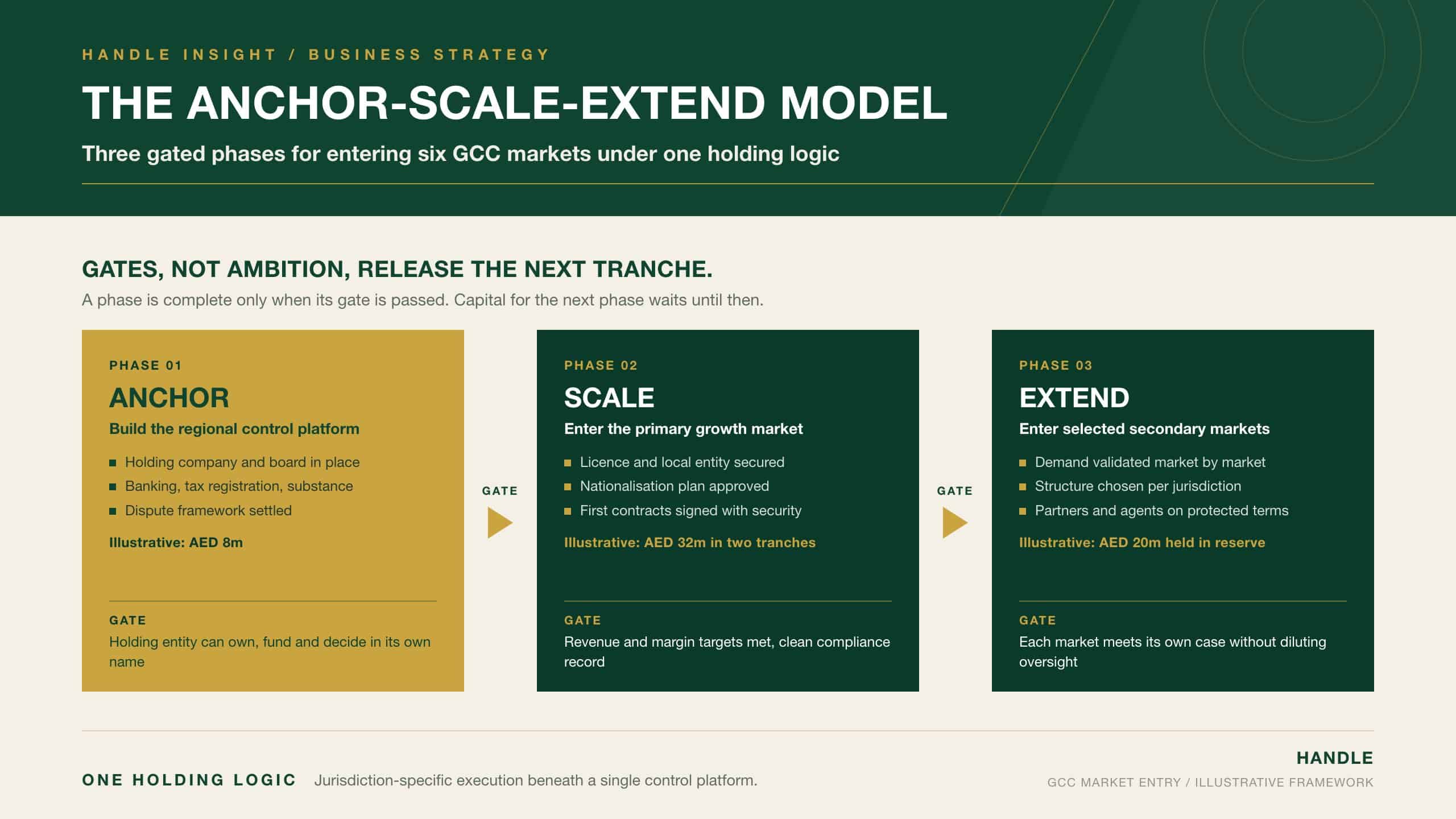
The Anchor-Scale-Extend Model divides regional entry into three phases, each closed by a gate. A phase is complete only when its gate criteria are met. Capital for the next phase is released only when the gate is passed. The model replaces simultaneous expansion with controlled sequencing.
| Phase | Objective | Core Actions | Gate to Pass Before Moving On |
|---|---|---|---|
| 1. Anchor | Establish the regional control platform | Holding company incorporated; board and governance in place; banking opened; tax registration and substance established; dispute resolution framework set | Holding entity can own subsidiaries, move capital and take decisions in its own name |
| 2. Scale | Enter the primary growth market | Licence obtained; local entity or partnership formed; nationalisation plan approved; first contracts signed with security | Revenue and margin targets met for an agreed period; compliance record clean |
| 3. Extend | Enter selected secondary markets | Demand validated; structure chosen per market; local partners or agents appointed on protected terms | Each new market meets its own entry case without diluting oversight of existing operations |
The gates do the work. They prevent a company from opening a third market while its second is still losing money, and they force the anchor to be operational before it is asked to hold anything of value.
A Worked Example: Phasing an AED 60 Million Regional Budget
Consider an illustrative European engineering services company with an approved regional budget of AED 60 million over four years.
In the Anchor phase, it allocates AED 8 million to a holding company in a UAE financial free zone with an operating subsidiary in Dubai, a regional finance team, bank accounts, Corporate Tax registration and a board that meets in the UAE. The gate is passed after nine months, when the holding company has executed its first intercompany agreements and the UAE operation has signed its first two contracts.
In the Scale phase, it commits AED 32 million to Saudi Arabia in two tranches of AED 16 million. The first tranche funds licensing, an office, a Saudisation-compliant hiring plan and mobilisation for initial contracts. The second tranche is released only when the Saudi entity reaches an agreed revenue run rate and maintains a clean compliance record for two consecutive quarters.
The remaining AED 20 million is reserved for the Extend phase. Eighteen months later, the company tests Qatar and Oman against the same entry case. Qatar meets it and Oman does not. AED 12 million is deployed in Qatar and AED 8 million stays unallocated. Under a simultaneous entry plan, the full AED 60 million would have been spread across four markets in the first year, with no evidence that any of them worked.
Contract Enforcement and Dispute Resolution Across the GCC
All six GCC states are parties to the New York Convention, and the member states have arrangements for the mutual enforcement of judgments among themselves. Enforcement nevertheless remains a national process, and its speed varies. Governing law and dispute resolution clauses should be chosen with the likely place of enforcement in mind.
The DIFC Courts and ADGM Courts offer English-language, common-law based litigation, and arbitration seated in the DIFC, ADGM or onshore UAE is supported by modern arbitration legislation, including the UAE Federal Arbitration Law No. 6 of 2018. Security should be negotiated before reliance on a counterparty begins: parent guarantees, performance bonds, advance payment guarantees, escrow arrangements and, where permissible, security over assets.
How Should Each New Market Be Stress-Tested?
Before any market passes from planning into execution, the entry case should be tested against the risks that most often derail GCC expansion. The test is the same for the scale market and for every extension market, which makes results comparable and decisions defensible to the board.
| Risk | Stress Question | Control if the Answer Is Weak |
|---|---|---|
| Licensing delay | Can the business survive if the licence takes twice as long as planned? | Phase hiring and leases to licensing milestones; early regulator engagement |
| Ownership restriction | Does the activity require a local partner or regulator approval of shareholders? | Reserved matters, deadlock and exit provisions; alternative structures such as agency or joint venture |
| Workforce quotas | Can nationalisation targets be met at the planned cost? | Recruitment and training budget; sector-specific advice on quota calculation |
| Payment and credit risk | What happens if a major customer pays six months late? | Advance payments, bonds, guarantees, credit limits per counterparty |
| Enforcement | Where would a judgment or award need to be enforced, and how quickly? | Arbitration seat and governing law chosen for enforceability; security taken up front |
| Policy change | How exposed is the plan to a change in tax, procurement or localisation rules? | Scenario modelling; capital released in tranches; stabilisation clauses where available |
A market that fails two or more of these questions without a credible control should not pass its gate, however attractive its headline size.
Common Mistakes in GCC Market Entry
- Entering several GCC markets at once, which spreads management attention and capital too thinly to make any market succeed.
- Establishing a holding company with no real substance, which weakens its tax position and its credibility with banks and counterparties.
- Appointing a local agent or distributor without checking registration and termination rules, and then finding the relationship difficult to end.
- Treating nationalisation requirements as an administrative detail rather than a structural cost that shapes the business plan.
- Accepting a local partner’s equity participation without reserved matters and deadlock mechanisms, so that shared ownership becomes shared control.
- Choosing governing law and dispute forums by habit, without considering where judgments or awards will actually need to be enforced.
Each mistake replaces sequence with enthusiasm. The Gulf rewards the opposite.
Conclusion
An entry strategy for GCC markets succeeds when it treats the Gulf as one commercial opportunity and six legal systems. The regional structure should be designed once: an anchor jurisdiction for ownership, governance, capital and dispute resolution, often in the UAE through a DIFC, ADGM, free zone or onshore holding company with genuine substance. National entities are then built to each country’s licensing, ownership, agency and workforce rules. The Anchor-Scale-Extend Model turns that design into a sequence. The anchor must be operational before it holds value. The scale market must prove its economics before capital moves on. Each extension market must meet its own entry case. Gates, not ambition, release the next tranche. Structure comes first. Scale follows evidence. Control is preserved at every step.


