

Choosing a market entry vehicle is a decision about who will control the business when circumstances change. A wholly owned subsidiary keeps every decision inside one group. A joint venture exchanges part of that control for something the entrant cannot easily buy: a licence, a customer base, distribution, local credibility or shared capital. Within our Market Entry & International Expansion mandate, the comparison of joint ventures vs wholly owned subsidiaries is framed by four questions: how much control the strategy requires, what the partner genuinely contributes, how much capital and risk the entrant can carry alone, and how either party will exit. In the UAE, legal reform has removed the old assumption that foreign investors need a local partner, which makes the choice more deliberate than it once was. Structure should follow strategy, not habit.
What Distinguishes a Joint Venture From a Wholly Owned Subsidiary?
A wholly owned subsidiary is a company in which the parent holds all the shares. Its board, budget, appointments, policies and strategy are set by one shareholder. Decisions move at the speed of the parent’s own governance.
A joint venture is a business owned and controlled by two or more independent parties. It is usually incorporated as a separate company with a shareholders’ agreement, although some arrangements remain contractual. Control is shared by design, through board composition, reserved matters and voting thresholds. Even a minority partner can hold vetoes that slow or prevent decisions.
| Dimension | Wholly Owned Subsidiary | Joint Venture |
|---|---|---|
| Control | Full and unilateral | Shared through board seats and reserved matters |
| Capital | Entrant funds the full requirement | Funding shared according to agreed proportions |
| Market access | Built by the entrant from scratch | Partner’s licences, customers or networks available from day one |
| Profit share | All profits retained | Profits shared according to economic interests |
| Intellectual property | Stays within the group | Licensed to the venture and exposed to the partner |
| Decision speed | Set by the parent | Subject to partner consent and deadlock risk |
| Exit | Parent decides when and how | Depends on negotiated transfer and exit provisions |
Neither structure is superior in the abstract. Each is a trade between control and contribution.
The Control Equation
A wholly owned subsidiary gives the parent full command of operations, consistent execution of group strategy and clear reporting lines. There is no partner veto, no deadlock and no divided loyalty. The parent can restructure, refinance, sell assets or change the business model without anyone’s consent.
A joint venture distributes authority. The parties must agree a detailed shareholders’ agreement, a list of reserved matters, deadlock procedures and exit triggers. Those documents are not formalities. They determine whether shared control produces shared commitment or shared paralysis. A joint venture without enforceable governance becomes a negotiation every time a decision is needed.
Capital Exposure and Risk Allocation
Full ownership concentrates exposure but keeps it transparent. The parent can fund in tranches, choose between equity and shareholder loans, control dividends and repatriation, and see the full financial picture through its own audit.
A joint venture reduces the entrant’s initial capital, but introduces counterparty risk. If the partner fails to fund a capital call, the venture may stall or the entrant may have to fund alone. The agreement should therefore set pro rata funding obligations, consequences for default such as dilution or loss of rights, and protection against value moving to the partner through related party contracts.
How Has UAE Law Changed the Calculation?
Before 2021, most onshore UAE companies required majority UAE national ownership, and many foreign entrants formed joint ventures because the law left little alternative. The reforms now consolidated in the Commercial Companies Law, Federal Decree-Law No. 32 of 2021, permit full foreign ownership of onshore companies for most commercial and industrial activities. Activities designated as having strategic impact remain subject to additional conditions, and individual emirates and sector regulators may still impose requirements. Free zone companies, including those in the DIFC and ADGM, have long permitted full foreign ownership within their own jurisdictions.
The practical effect is that a UAE joint venture should now exist because the partner adds value, not because the law demands a local shareholder. Arrangements in which a nominal partner holds shares while the foreign party carries on the business in substance remain exposed under the federal law on combating commercial concealment. Where a local relationship is needed mainly for distribution, a commercial agency or distribution agreement under the federal commercial agencies law of 2022 may achieve the commercial aim without shared equity.
| UAE Factor | Wholly Owned Subsidiary | Joint Venture |
|---|---|---|
| Foreign ownership | Available for most onshore activities and in free zones | Required only where an activity or regulator demands local participation |
| Corporate Tax grouping | Can join a tax group at 95% ownership | Outside either party’s tax group; dividends from a UAE resident venture generally exempt |
| Merger control | Internal formation not normally a concentration | Formation of a jointly controlled venture can require notification under Federal Decree-Law No. 36 of 2023 |
| Governing law for the vehicle | Onshore, free zone, DIFC or ADGM as strategy requires | DIFC or ADGM holding vehicles often preferred for shareholder agreements and share classes |
| Accounting | Consolidated in full | Typically equity accounted as a joint venture |
The Corporate Tax point deserves emphasis. Under Federal Decree-Law No. 47 of 2022, a parent and its 95% subsidiaries can form a tax group and offset profits and losses. A 60:40 joint venture cannot join either party’s tax group, so early-stage losses stay inside the venture rather than reducing the entrant’s taxable profits elsewhere in the UAE.
Speed, Access and Operational Reality
Where full ownership is permitted, a wholly owned subsidiary offers procedural clarity: licensing, hiring, contracting and banking are all within the entrant’s control. Execution is sequential and predictable, although building customer relationships may take longer.
A joint venture can accelerate entry where the partner already holds licences, distribution, government relationships or a recognised brand. The acceleration has a price in governance complexity, and in brand and compliance risk. Brand use, intellectual property licences, compliance standards, audit rights and termination triggers must all be enforced contractually, because the entrant does not control the venture structurally.
A Worked Example: Pricing the Partner
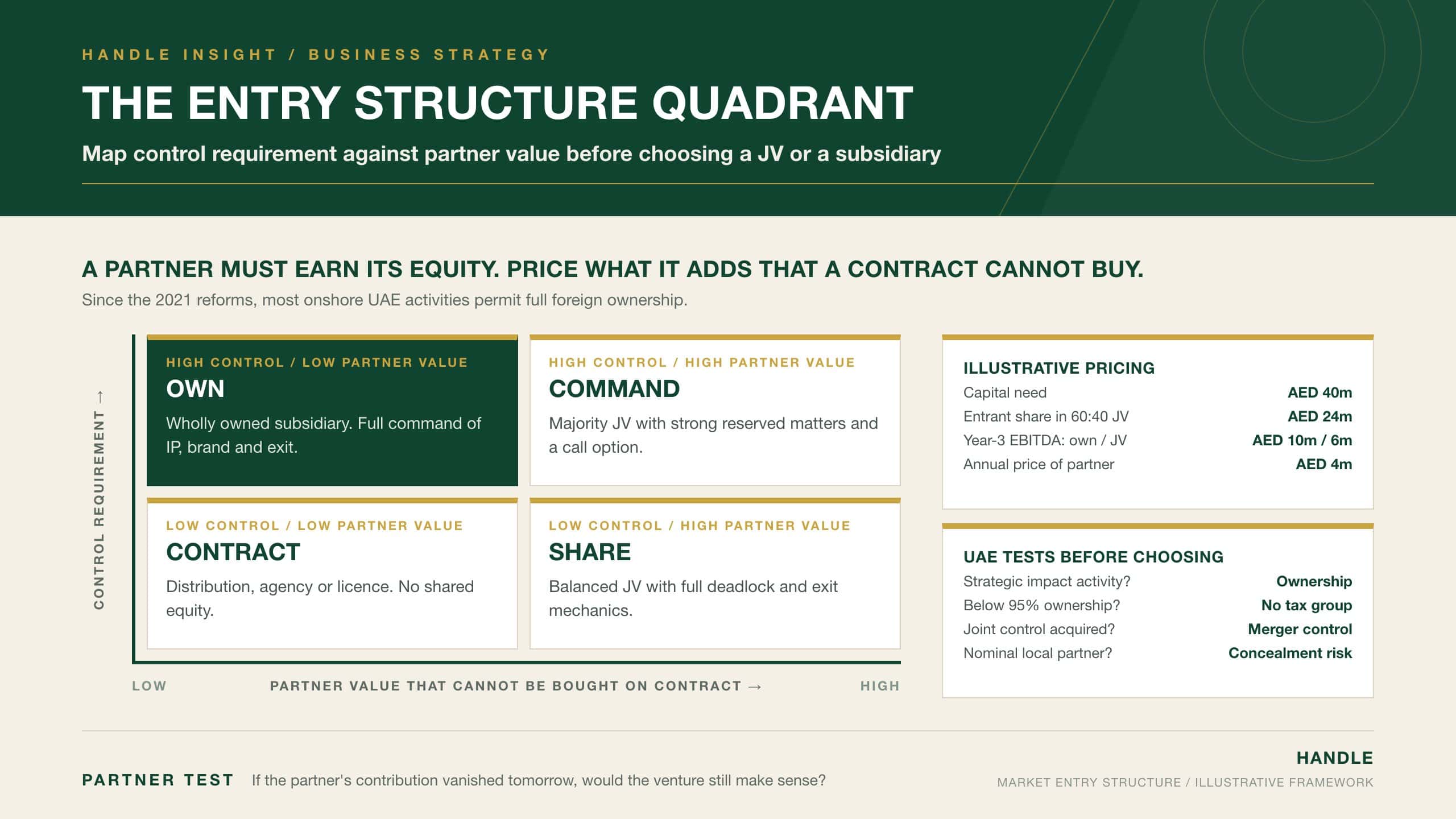
Consider an illustrative entrant planning a UAE operation that needs AED 40 million of capital and is expected to reach AED 10 million of annual EBITDA by year three. A wholly owned subsidiary requires the full AED 40 million and keeps the full AED 10 million. A 60:40 joint venture with a partner that contributes AED 16 million and an established distribution network requires AED 24 million from the entrant and gives it AED 6 million of year-three EBITDA.
The entrant is therefore paying AED 4 million a year, on these assumptions, for AED 16 million of shared capital and the partner’s access. If the network brings revenue forward by eighteen months, the trade may be sound. If the same access could be bought through a distribution agreement, the entrant is giving away 40% of the business for something available on contract. A call option at fair value, exercisable after an agreed period, can preserve the route to full ownership once the partner’s contribution has been absorbed. The numbers are illustrative. The discipline of pricing what the partner adds is not.
Governance Engineering for Joint Ventures
A joint venture that works is engineered before it is incorporated. Reserved matters should be enumerated with thresholds: capital expenditure, borrowing, senior appointments, dividend policy, related party contracts and changes to the business plan. Deadlock procedures should escalate from the board to senior executives of each party, then to mediation or expert determination, and finally to buy-sell or put and call mechanisms where commercially balanced. Disputes should be referred to arbitration with a seat whose courts will support enforcement, whether onshore under the Federal Arbitration Law No. 6 of 2018 or in the DIFC or ADGM.
Exit discipline completes the design. Transfer restrictions, pre-emption, tag-along and drag-along rights, valuation methods and defined exit triggers determine whether either party can leave without destroying the business. Exit is not a later discussion. It is a term of entry.
When Does Each Structure Prevail?
A wholly owned subsidiary is usually the stronger choice when the law permits full ownership, when long-term control of strategy and brand is essential, when the business depends on proprietary technology or know-how, and when the entrant has the capital and patience to build market access itself. It is also the cleaner platform for later acquisitions, because the parent can add businesses beneath it without a partner’s consent.
A joint venture is usually justified when an activity or regulator requires local participation, when access to customers, licences or government relationships depends on an established partner, when risk sharing materially improves the viability of a large project, or when the partner contributes assets that would be expensive or slow to replicate. Project-based collaborations, such as a single infrastructure bid, can sometimes be structured contractually rather than through a new company, although the parties then need to address liability, decision-making and ownership of results with particular care.
The test in every case is the same. If the partner’s contribution disappeared tomorrow, would the venture still make sense? If it would, the entrant may be sharing ownership it does not need to share.
Original Analysis: The Entry Structure Quadrant
The choice can be mapped on two axes. The first is the control the strategy requires: over intellectual property, brand, pricing, compliance and the timing of future decisions. The second is the value of the partner’s contribution that cannot be bought on contract. We call this the Entry Structure Quadrant.
| Quadrant | Control Requirement | Partner Value | Preferred Structure |
|---|---|---|---|
| Own | High | Low | Wholly owned subsidiary |
| Command | High | High | Majority joint venture with strong reserved matters and a call option |
| Share | Low | High | Balanced joint venture with full deadlock and exit mechanics |
| Contract | Low | Low | Distribution, agency or licensing agreement without shared equity |
The quadrant tests the reason for a partner before the partner is chosen. Since the UAE reforms, many entrants that once defaulted to a shared joint venture sit in the Own or Contract quadrants. Where the partner’s value is real and control matters, the Command quadrant offers access without surrendering the future.
Common Mistakes in Choosing Between a JV and a Subsidiary
- Forming a joint venture out of habit or outdated assumptions about UAE foreign ownership rules, without testing whether full ownership is now available.
- Paying for a partner’s contribution with permanent equity when the same access could be secured through a distribution or agency agreement.
- Agreeing equal ownership without a deadlock mechanism, so the first serious disagreement freezes the business.
- Licensing core intellectual property into a venture without field-of-use limits, audit rights and termination provisions.
- Overlooking merger control when forming a jointly controlled venture between parties with significant UAE market presence.
- Ignoring the Corporate Tax effect of falling below 95% ownership, which removes tax grouping and isolates early losses.
- Leaving exit terms for later, when the parties’ interests have already diverged.
Each mistake reflects a structure chosen before the strategy was defined.
Conclusion
Joint ventures vs wholly owned subsidiaries is a choice between control and contribution. A wholly owned subsidiary keeps strategy, intellectual property, capital decisions and exit timing within one group, at the cost of funding and building everything alone. A joint venture brings capital, licences or access from a partner, at the cost of shared authority, counterparty risk and a more complex exit. In the UAE, the reforms consolidated in Federal Decree-Law No. 32 of 2021 have made full foreign ownership available for most activities, so a partner must now justify its place by what it contributes. Corporate Tax grouping, merger control and the choice of onshore, free zone, DIFC or ADGM vehicle all shift the balance. The right structure prices the partner’s value, secures control where it matters and settles exit before entry. Decide the architecture first. Commit the capital second.


