

Most execution problems that look like failures of strategy are failures of authority. A decision that has no clear owner is delayed, revisited or taken twice, and an outcome that has no clear owner is explained rather than corrected. Decision rights and accountability models fix both problems by answering four questions for every material decision: who proposes, who decides, who must be consulted and who answers for the result. Within Operating Model and Governance, they are the mechanism that turns a governance structure on paper into a predictable flow of decisions across the board, the executive team, business units and control functions. The design task is not to centralise or decentralise. It is to place each decision where the information, the risk and the accountability can sit together. Authority without accountability is power. Accountability without authority is blame.
Why Decision Rights Matter More as Organisations Grow
In a small organisation, decision rights are implicit. The founder or chief executive decides, everyone knows it, and the speed of decision is limited only by that person’s capacity. As the organisation grows, that model breaks. The leader becomes a bottleneck, and authority begins to spread informally to whoever is closest to the issue or most willing to act.
Informal authority produces three recognisable symptoms. Several functions claim the right to decide the same question. Senior executives intervene in operational matters because no threshold tells them not to. Committees multiply, each reviewing the same proposal without any of them owning the outcome. Decisions slow down, and when results disappoint, responsibility cannot be traced.
A deliberate decision rights model replaces this drift with an explicit allocation. It does not remove judgement. It tells each leader where their judgement is final and where it must be escalated.
What Is a Decision Rights and Accountability Model?
A decision rights model is a documented allocation of authority across roles and governance bodies. It specifies which decisions each role may take alone, which require approval from a higher authority, which require consultation with specialist functions and which are reserved to the board or the shareholders.
An accountability model is its counterpart. It identifies, for each decision and each outcome, a single role that answers for the result and is measured on it. The two models must match. When a business unit head is accountable for profit but needs central approval for every pricing change, accountability has been assigned without the authority to deliver it.
In practice, the two are captured in three instruments: a schedule of reserved matters for the board, a delegation of authority setting financial and contractual thresholds, and a role-based matrix such as RACI for recurring cross-functional decisions.
Which Decisions Belong Where?
Decisions can be grouped into categories, each with a natural home. The allocation below is typical for a mid-sized group and should be adapted to the organisation’s size, regulatory status and ownership structure.
| Decision Category | Proposes | Decides | Consulted | Accountable for Outcome |
|---|---|---|---|---|
| Strategy, acquisitions and disposals | Chief executive | Board | Finance, legal, risk | Chief executive |
| Annual budget and capital plan | Chief financial officer | Board | Business unit heads | Chief executive |
| Capital projects within budget | Business unit head | Executive committee or delegate, by threshold | Finance | Business unit head |
| Pricing, hiring and operations within budget | Line manager | Business unit head | Human resources, finance as needed | Business unit head |
| Regulatory and legal risk positions | Business or function | General counsel or chief compliance officer | Chief executive | Control function head |
Two features of this allocation are deliberate. Every row has one decider and one accountable role. And control functions hold a defined veto in their own domain, so that operational autonomy never extends to taking unapproved legal or regulatory risk.
How Delegation of Authority Works in Practice
A delegation of authority converts the model into thresholds. It sets the monetary and contractual limits up to which each role may commit the organisation, and it requires escalation above those limits. Good delegations are short, cover the decisions that actually recur and are reviewed when the business changes.
Consider an illustrative group with annual revenue of AED 600 million. Its delegation might allow a business unit head to approve budgeted operating expenditure up to AED 2 million per commitment, the chief financial officer up to AED 10 million, the chief executive up to AED 25 million, and require board approval above that or for any unbudgeted item over AED 5 million. Contracts longer than three years, guarantees and related-party transactions might go to the executive committee or the board regardless of value.
| Commitment Type | Business Unit Head | Chief Financial Officer | Chief Executive | Board |
|---|---|---|---|---|
| Budgeted operating expenditure | Up to AED 2m | Up to AED 10m | Up to AED 25m | Above AED 25m |
| Unbudgeted expenditure | Not permitted | Up to AED 1m | Up to AED 5m | Above AED 5m |
| Contracts over three years, guarantees | Not permitted | Recommends | Recommends | Approves |
| Related-party transactions | Not permitted | Reviews | Recommends | Approves, conflicted directors excluded |
The thresholds in this example are illustrative. The principle is not: routine decisions should be taken quickly and close to the work, while decisions that commit the organisation for years or expose it to concentrated risk should rise to the level that can carry that risk.
The Legal Layer: What Cannot Be Delegated
Some decision rights are fixed by law rather than by internal design. Under the UAE Commercial Companies Law (Federal Decree-Law No. 32 of 2021), matters such as amendments to the constitutional documents, changes to share capital, and mergers or dissolution require shareholder approval, often by special resolution, and cannot be delegated to management. Directors and managers also owe duties to the company that cannot be contracted away by an internal policy.
In the financial free zones, DIFC Companies Law No. 5 of 2018 and the ADGM Companies Regulations 2020 set comparable rules on the division of powers between shareholders and directors. Firms regulated by the DFSA or the FSRA must also maintain clear, documented allocations of responsibility, and individuals approved for senior roles are personally accountable to the regulator. A decision rights model must therefore start from the legal allocation and build the internal allocation on top of it.
How Should Decisions Escalate?
Escalation is the safety valve of a decision rights model. It should be designed as carefully as the allocation itself, because an escalation path that is unclear or slow pushes managers either to sit on decisions or to take them informally.
Three rules keep escalation useful. First, escalation should be triggered by defined criteria, such as a threshold, a disagreement between functions or a risk flag raised by a control function, not by a manager’s discomfort. Second, each escalation should go to a named decider with a defined response time, so that an escalated question does not sit in a committee queue. Third, the decision taken on escalation should be recorded with its rationale, so that the organisation learns which decisions recur and can delegate them in future.
Escalation volume is also a diagnostic. If many decisions are escalated, thresholds are probably too low. If almost none are, either thresholds are too high or decisions are being taken informally.
Founder-Led and Family-Owned Groups
Many UAE businesses remain founder-led or family-owned, and their decision rights carry a particular tension. The founder or the family often holds authority that is not written down, exercised through relationships rather than through the board. This works while the founder is present and the business is small enough to oversee personally. It becomes a risk as the group grows, as the next generation joins and as outside investors or lenders require evidence of governance.
The solution is not to remove the founder’s authority but to locate it. Reserved matters can be drafted to reflect what the founder or family genuinely wishes to control, while routine authority is delegated to professional management under clear thresholds. A family charter or shareholders’ agreement can then align ownership decisions with the board’s decision rights, so that the two do not compete.
RACI and Its Limits
RACI assigns four roles to each decision: responsible for doing the work, accountable for the outcome, consulted before the decision and informed after it. It is useful for recurring cross-functional processes, such as product launches or system changes, because it makes participation explicit.
RACI fails when it is applied too widely. A matrix with dozens of consulted parties recreates the committee problem it was meant to solve. The discipline is to keep one accountable role per decision, limit consultation to those whose input changes the decision, and use the matrix only where cross-functional confusion is real.
Original Analysis: The Decision Placement Quadrant
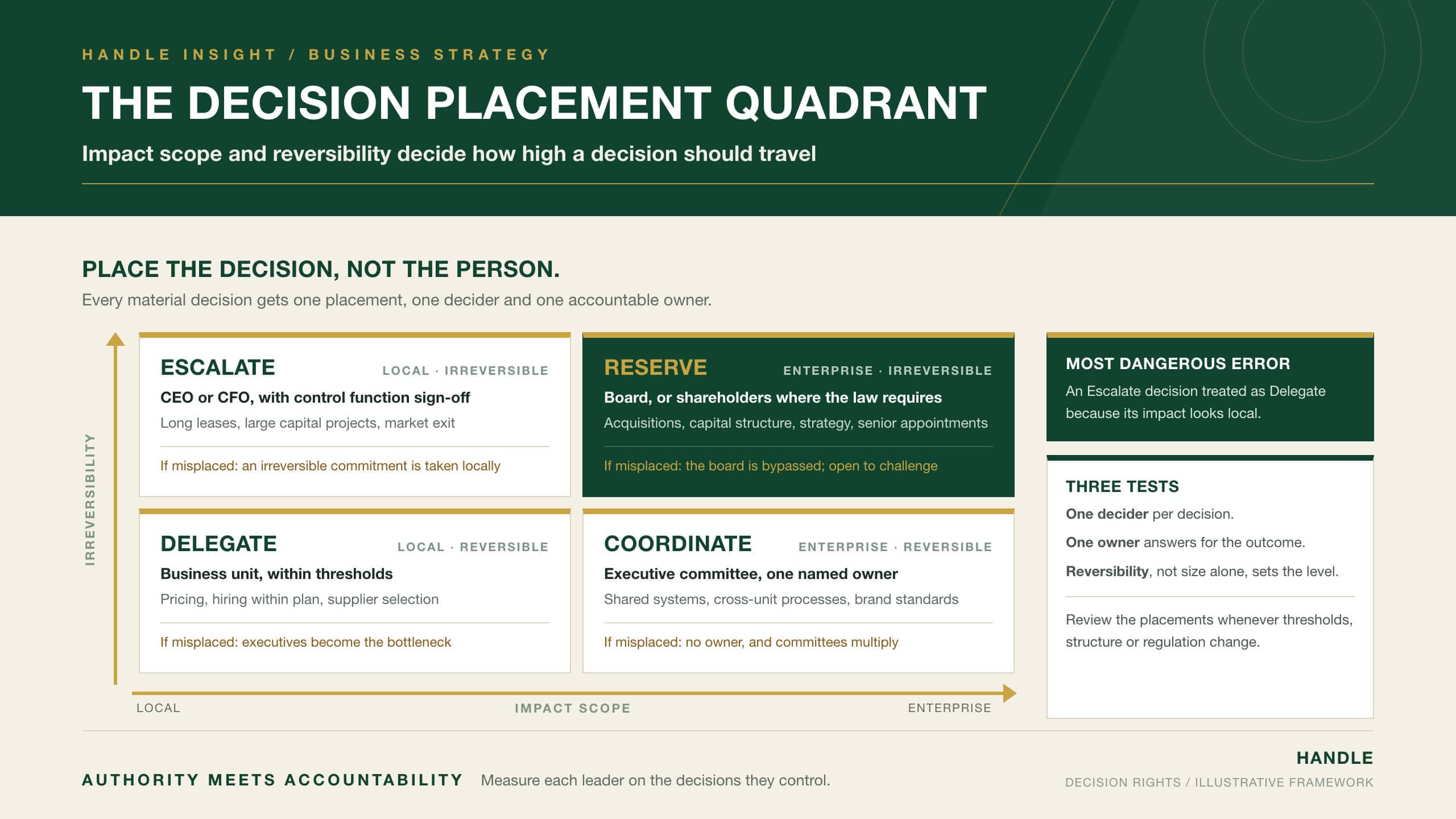
Most decision rights models start from the organisation chart. A more reliable starting point is the decision itself. Two characteristics determine where a decision should sit: its impact scope, meaning whether its consequences stay within one unit or reach across the enterprise, and its reversibility, meaning how costly it is to undo. Plotting decisions on these two axes produces four placements.
| Placement | Impact Scope | Reversibility | Where Authority Sits | Typical Decisions |
|---|---|---|---|---|
| Delegate | Local | Reversible | Business unit, within thresholds | Pricing adjustments, hiring within plan, supplier selection |
| Coordinate | Enterprise | Reversible | Executive committee with one named owner | Shared systems, cross-unit processes, brand standards |
| Escalate | Local | Irreversible | Chief executive or chief financial officer, with control function sign-off | Long-term leases, large capital projects, exit from a market |
| Reserve | Enterprise | Irreversible | Board, or shareholders where the law requires | Acquisitions, capital structure, strategy, senior appointments |
The quadrant explains the common failures in a single picture. Centralisation pulls Delegate decisions upwards and slows the business. Fragmentation leaves Coordinate decisions without an owner. The most dangerous error is placing an Escalate decision in the Delegate quadrant because its impact appears local: a business unit signs a ten-year lease or exits a key market under its own authority, and the organisation discovers the irreversibility only afterwards. Reversibility, not size alone, should decide how high a decision travels.
Linking Accountability to Performance
Accountability becomes real only when it is measured. Each accountable role should carry performance measures that reflect the decisions within its authority: business unit heads on unit profit and operational outcomes, the chief financial officer on capital discipline and financial control, control function heads on regulatory standing and incident rates.
The board, in turn, should review the decision rights model itself. A useful annual test is to sample significant decisions taken during the year and check three things: whether each was taken at the right level, whether the accountable person was clear at the time, and whether the outcome was reviewed against the original rationale.
Common Decision Rights Failures
- Concentrating routine decisions at the top, which turns senior executives into a bottleneck and teaches the organisation to wait.
- Allowing several functions to claim authority over the same decision, so that time is spent negotiating authority rather than solving the problem.
- Assigning collective accountability to a committee, which ensures that no individual answers for the outcome.
- Setting thresholds by value alone and ignoring reversibility, so that long-term commitments are approved at too low a level.
- Writing a delegation of authority and never updating it, which leaves thresholds misaligned with the scale of the business after growth or acquisitions.
- Ignoring legally reserved matters, which exposes decisions to challenge and directors to personal liability.
- Holding leaders accountable for outcomes they lack the authority to influence, which erodes trust in the model and encourages informal workarounds.
Each of these failures emerges gradually. That is why decision rights must be designed and reviewed deliberately rather than left to evolve.
Conclusion
Decision rights and accountability models decide whether an organisation executes with discipline or stalls in internal negotiation. They allocate authority deliberately, from matters reserved by law to the shareholders and the board, through executive thresholds, to operational decisions taken close to the work, and they attach one accountable role to every material decision and outcome. Delegation of authority turns the model into thresholds, RACI clarifies participation where cross-functional confusion is real, and control functions hold a defined veto in their own domain. The Decision Placement Quadrant adds a simple test: how far a decision’s impact reaches and how hard it is to reverse determine how high it should travel. Organisations that apply that test, measure leaders on the decisions they control and review the model as they grow keep speed and control together. Place the decision deliberately. Name the owner. Measure the result.


