

A group of companies is not one company. Each subsidiary, joint venture and special purpose vehicle is a separate legal person with its own board, its own creditors, its own regulators and its own directors’ duties. The parent owns the shares, but it does not automatically control the decisions. Governance for multi-entity organizations exists to close that gap: to let the group act as one institution while each entity continues to act lawfully in its own name. Within Operating Model and Governance, multi-entity governance defines how strategic intent travels from the group board to every entity, how decisions return when they exceed local authority, and how the parent sees what is happening across the structure before it becomes a problem. Most group failures are not failures of strategy. They are failures of transmission. Ownership confers rights. Governance converts those rights into control.
Why Governance for Multi-Entity Organizations Is Different
Groups expand through separate entities for sound reasons. Subsidiaries hold licences in particular jurisdictions, ring-fence regulated activities, hold intellectual property or real estate, isolate project risk, or bring in co-investors. Each reason creates a legal boundary, and each boundary interrupts the flow of authority.
Three features make group governance distinctive. First, subsidiary directors owe their duties to their own company, not to the parent. They may take group strategy into account, but they cannot act against the interests of the company they direct, particularly where it has minority shareholders or is approaching insolvency. Second, information does not flow across entity lines by default. Each entity keeps its own books, contracts and records, and the parent sees only what reporting lines deliver. Third, liabilities are generally contained within each entity, which is often the purpose of the structure, but that containment can be lost through guarantees, cross-default clauses, commingled cash or a parent that behaves as the real decision-maker.
Group governance must respect these boundaries while ensuring they do not become blind spots.
Choosing the Group Operating Model
The first design decision is how much authority sits at the centre. There is no single correct answer. The right model depends on how integrated the businesses are, how regulated the entities are and how much the group relies on shared capabilities.
| Feature | Centralised Model | Hybrid Model | Federated Model |
|---|---|---|---|
| Strategic authority | Held at group level for all entities | Group sets direction; entities shape local plans | Entities set strategy within group return targets |
| Capital allocation | Central treasury and investment committee | Central approval above defined thresholds | Entities self-fund within agreed limits |
| Subsidiary boards | Mostly group executives | Group executives plus local or independent directors | Largely local, with group representation |
| Best suited to | Integrated businesses sharing brand, systems and customers | Diversified groups with some shared services | Portfolio holdings with distinct industries or co-owners |
| Principal risk | Subsidiary directors become nominal; slow local decisions | Unclear thresholds and duplicated approvals | Loss of group visibility and inconsistent controls |
Many groups operate different models for different entities. A wholly owned trading company may be run centrally, while a regulated subsidiary or a joint venture with a strong partner operates on a federated basis. The model should be chosen for each entity deliberately and recorded.
How the Parent Board and Subsidiary Boards Should Divide Work
The parent board sets group strategy, risk appetite, capital structure and policy, and it oversees the portfolio. It does not run subsidiaries. Subsidiary boards remain responsible for their own companies: approving accounts, satisfying local law and regulation, managing their own risks and taking decisions within their authority.
The composition of subsidiary boards is the parent’s main lever. Appointing group executives provides alignment and information flow. Adding local directors provides market and regulatory knowledge. Independent directors are valuable, and sometimes required, in regulated entities and in subsidiaries with outside shareholders. Every group-appointed director should understand that the appointment carries personal duties to the subsidiary. A director who simply executes group instructions without independent judgement exposes both themselves and the group.
Who Decides What: Allocating Authority Across Entities
Authority across a group is allocated through three instruments working together: the constitutional documents of each entity, shareholder resolutions or reserved matters exercised by the parent as shareholder, and a group delegation of authority that sets financial and operational thresholds. The table below shows a typical allocation for a hybrid group.
| Decision Type | Subsidiary Management | Subsidiary Board | Group Executive Committee | Group Board or Shareholder Resolution |
|---|---|---|---|---|
| Operating expenditure within budget | Approves | Monitors | Informed | No role |
| Capital expenditure above local threshold | Proposes | Recommends | Approves within group limit | Approves above group limit |
| Borrowing, guarantees and security | Proposes | Recommends | Reviews | Approves |
| Acquisitions, disposals and new entities | No role | Recommends | Reviews | Approves |
| Appointment of subsidiary directors and auditors | No role | Recommends | Nominates | Approves as shareholder |
| Dividends and intra-group funding | No role | Declares or approves within law | Plans | Sets group policy |
The allocation only works if every entity’s constitution supports it. A delegation policy adopted by the group board does not bind a subsidiary until the subsidiary board adopts it or the parent exercises its shareholder rights. Groups that skip this step have a policy, not a control.
Capital, Treasury and Intra-Group Transactions
Money moves around groups constantly: equity injections, intra-group loans, management fees, shared service charges, dividends and guarantees. Each movement is a transaction between separate legal persons, and each must be authorised, documented and priced.
In the UAE, related-party transactions between group entities fall within the arm’s length and transfer pricing rules of the Corporate Tax regime (Federal Decree-Law No. 47 of 2022), and documentation may be required depending on the size of the group. Wholly or near-wholly owned resident companies may be able to form a tax group, which requires at least 95 per cent common ownership and other conditions; entities that do not meet those conditions are taxed separately at 9 per cent on taxable income above AED 375,000, and a Qualifying Free Zone Person may benefit from 0 per cent on qualifying income only if it meets the substance and income conditions. Treasury design and tax structure must therefore be considered together.
Solvency matters at entity level. A subsidiary that upstreams cash or guarantees group debt without considering its own creditors may expose its directors to claims, whatever the group’s consolidated position.
Risk, Compliance and Jurisdictional Layers
A group operating across the UAE often combines several legal regimes: onshore companies under the Commercial Companies Law (Federal Decree-Law No. 32 of 2021), free zone companies under their own regulations, and holding or regulated entities in the DIFC (DIFC Companies Law No. 5 of 2018) or ADGM (ADGM Companies Regulations 2020), with the DFSA or FSRA supervising regulated financial activities. Each regime has its own filing, audit, beneficial ownership and director requirements. Acquisitions that create or strengthen control may also require clearance under the UAE Competition Law (Federal Decree-Law No. 36 of 2023) where the merger control thresholds are met.
The effective approach is layered. Group policy sets a common minimum standard for ethics, anti-bribery, sanctions, anti-money laundering, data protection and financial control. Local compliance adds what each jurisdiction and regulator requires. The group compliance function then maintains a single register showing every entity, its regulators, its filing calendar and its open issues.
A Worked Example: Tracing Control Through a Five-Entity Group
Consider an illustrative group with an ADGM holding company, a wholly owned onshore Dubai trading LLC, a free zone logistics company, a 60 per cent owned joint venture in Saudi Arabia and a property SPV holding the group’s warehouse.
The trading LLC wants to borrow AED 18 million from a bank, secured by a guarantee from the property SPV. Under the group delegation of authority, local management can commit up to AED 2 million, the group executive committee up to AED 10 million, and anything above that, or any guarantee, requires group board approval. The request therefore escalates.
The group board approves the borrowing in principle. That is not the end of the process. The trading LLC’s manager must approve the facility under its memorandum of association. The property SPV’s board must separately decide that giving the guarantee is in that company’s interest, and it should receive a guarantee fee priced at arm’s length. Group treasury records the contingent liability, and group legal checks whether the joint venture’s financing covenants contain cross-default clauses affected by the new facility. Four separate legal decisions sit behind one group approval. Missing any of them leaves the transaction exposed.
Original Analysis: The Group Control Hub
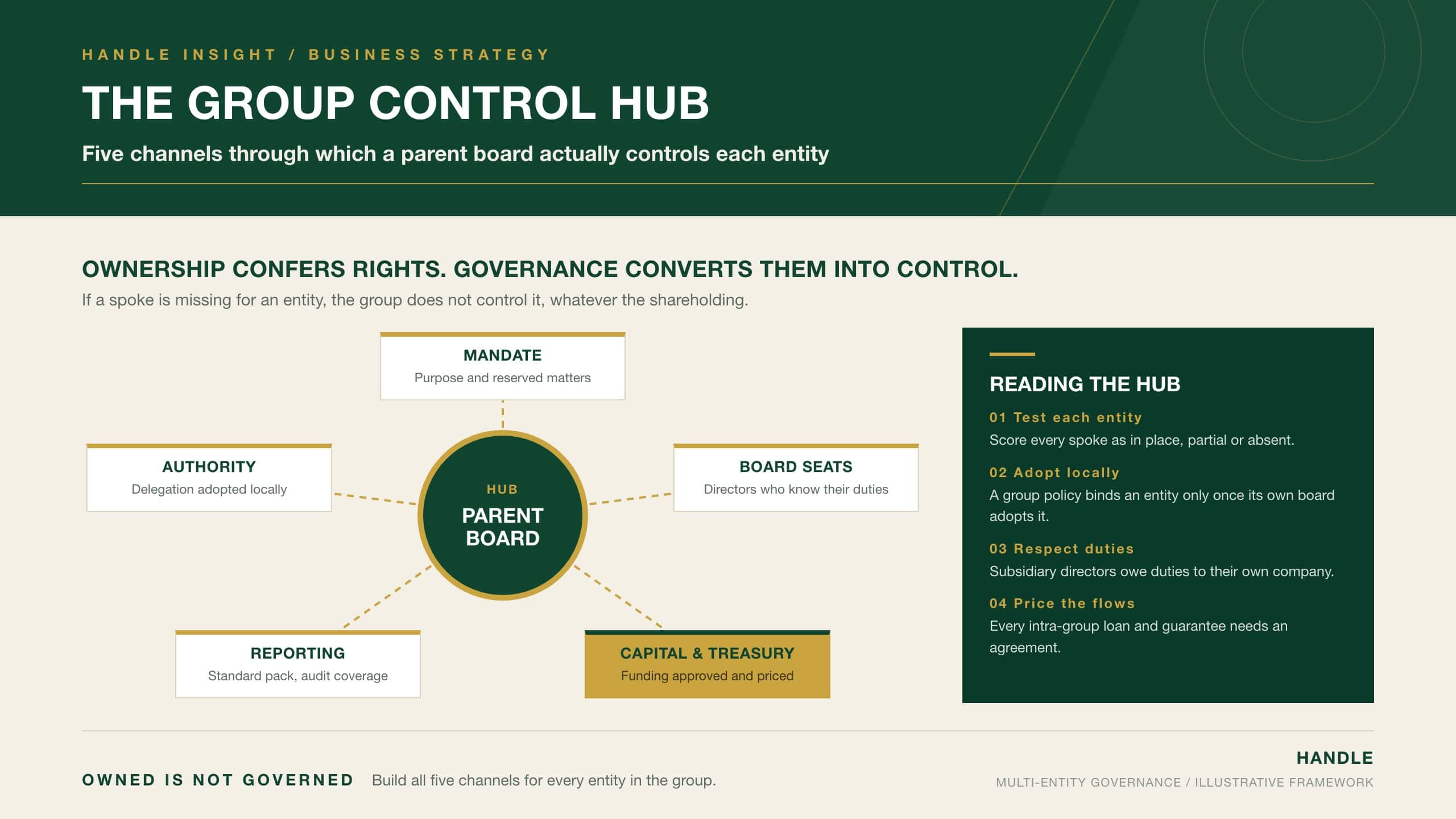
Group control can be modelled as a hub with five spokes. The hub is the parent board, which sets direction and risk appetite. Each spoke is a channel through which that direction reaches an entity and through which evidence returns. If a spoke is missing for an entity, the group does not control it, whatever the shareholding.
- Mandate: each entity has a written purpose, operating model and set of reserved matters.
- Board seats: the parent appoints directors who understand their duties to the entity and report on it to the group.
- Authority thresholds: a delegation of authority, adopted by the entity itself, defines what escalates and to whom.
- Capital and treasury: funding, guarantees, cash pooling and dividends are approved and priced through one documented process.
- Reporting and assurance: standard financial, risk and compliance reporting reaches the group on a fixed cycle and is tested by internal audit.
The hub turns a legal chart into a control map. For each entity the board can ask a simple question: are all five spokes in place, partially in place or absent? A wholly owned subsidiary with no adopted delegation and no standard reporting is owned but not governed.
| Control Spoke | Stress Test Question | Evidence Required |
|---|---|---|
| Mandate | Could the entity’s board state its purpose and reserved matters today? | Approved entity charter and constitution consistent with group policy |
| Board seats | Would group directors be able to explain a decision in the entity’s own interest? | Appointment letters, duties briefing and board minutes |
| Authority thresholds | Has the entity adopted the group delegation as its own? | Board resolution adopting the delegation, bank mandates aligned to it |
| Capital and treasury | Is every intra-group loan and guarantee documented and priced? | Signed agreements, arm’s length support, treasury register |
| Reporting and assurance | Would a problem in this entity reach the group board within one cycle? | Standard reporting pack, risk register and internal audit coverage |
Common Failures in Multi-Entity Governance
- Treating subsidiaries as departments, so group executives instruct entities directly and subsidiary boards become a formality that offers no legal protection.
- Adopting a group delegation of authority at parent level without having each entity adopt it, leaving thresholds unenforceable inside the subsidiaries.
- Appointing directors who do not understand that their duties are owed to the subsidiary, which exposes them personally when group and entity interests diverge.
- Moving cash and guarantees between entities without agreements or pricing, creating tax, solvency and creditor risks that surface only under stress.
- Allowing dormant or legacy entities to remain without directors, filings or oversight, where compliance failures accumulate unseen.
- Running joint ventures on the same governance model as wholly owned subsidiaries, ignoring the partner’s rights and the shareholder agreement.
- Relying on consolidated reporting alone, which can hide an individual entity’s breach of covenant, regulatory capital or licence condition.
Each failure arises when the group is governed as the chart suggests rather than as the law requires.
Conclusion
Governance for a multi-entity organisation is the discipline of turning ownership into control without erasing the legal identity of each entity. The parent board sets direction, risk appetite and policy. Subsidiary boards remain responsible for their own companies and must exercise genuine judgement in their own interest. Authority is allocated through constitutions, reserved matters and a delegation of authority that each entity adopts. Capital moves through documented and priced transactions, and reporting brings evidence back to the centre on a fixed cycle. In the UAE, that architecture must also respect the different regimes that apply onshore, in the free zones and in the DIFC and ADGM. Groups that build all five control channels for every entity can act quickly and lawfully at the same time. Groups that rely on the shareholding alone discover their gaps under stress. Ownership is a right. Control is a system.


