

Most organisations know their total costs. Far fewer know how much of that cost escapes the decisions that were supposed to govern it. Discounts granted outside policy, penalties never claimed from suppliers, software licences nobody uses and receivables left to age are rarely visible in a budget report, yet together they can erode margin more than any single line item. Identifying cost leakages in operations is the discipline of finding where spend, revenue or capital leaves the business without authorisation or return, proving it with evidence, and changing the control that allowed it. Within Operational Efficiency Strategy, leakage identification is treated as a governance exercise rather than a cost-cutting one. The distinction matters. Cost cutting reduces spend once. Sealing a leak changes the control so the loss does not return. Leakage is a control failure before it is a cost.
What Counts as a Cost Leakage?
A cost leakage exists wherever value leaves the organisation outside its mandate. That includes spend that was never properly approved, spend that was approved but not delivered against, revenue that was contractually due but not collected, and capital tied up longer than the operating model requires. The common feature is not overspending as such. It is the absence of an effective control at the point where the value escaped.
This definition excludes deliberate investment that simply underperformed, and it excludes legitimate cost increases driven by market prices or volume. Those are performance questions. Leakage is a control question. Keeping the two apart prevents the exercise from turning into a general debate about budgets.
Why Do Leakages Stay Hidden?
Leakages accumulate quietly because each one is small relative to the totals that management reviews. A 2% price variance across fragmented purchasing, a few unused licences per department, a handful of unclaimed service credits: none of these moves a monthly cost line enough to attract attention. Aggregate reporting averages them away.
They also sit between functions. Commercial leakages often fall between sales, legal and finance, so no single owner sees the whole picture. Process leakages appear as overtime, rework or exception handling, which operations teams absorb as normal. Capital leakages are explained as the nature of the business. Identifying cost leakages in operations therefore requires decomposing costs to the activity that creates them and testing contracts against what actually happened.
The Four Channels of Leakage
Classification by origin prevents misdiagnosis. A leakage that is designed into the operating model needs a structural fix, whereas one caused by poor contract enforcement needs a commercial fix. Four channels cover most cases.
| Channel | Where It Hides | Typical Evidence | Sealing Mechanism |
|---|---|---|---|
| Structural | Duplicated functions, overlapping approvals, fragmented procurement authority, misaligned incentives | Organisation charts, delegation of authority, approval logs | Redesign of authority and operating model |
| Process | Rework, idle time, manual intervention, exception handling | Workflow timestamps, error and rework logs, overtime records | Process redesign and automation of controls |
| Commercial | Unauthorised discounts, unclaimed penalties and rebates, off-contract buying, billing errors | Contracts compared with invoices, credit notes and service level reports | Contract enforcement and pricing controls |
| Capital | Slow collections, excess inventory, early payments, idle assets | Ageing reports, inventory turns, payment terms analysis | Working capital policy and monitoring |
Structural leakages persist regardless of volume because they are built into how the organisation works. Process leakages tend to grow faster than revenue because exceptions multiply with scale. Commercial and capital leakages are often the largest and the quickest to recover, which is why they usually provide the early evidence that justifies the wider exercise.
Where Do Leakages Concentrate in Operations?
Procurement and vendor management. Fragmented buying produces unit price dispersion for the same item, off-contract purchasing and contracts that renew automatically on unfavourable terms. Comparing prices paid for identical items across sites is one of the fastest diagnostic tests available. A renewal calendar showing every contract that will extend automatically in the next twelve months is another, because renewal inertia is a decision taken by default rather than by anyone with authority.
Revenue operations. Discounts granted beyond policy, credit extended without approval and billing errors reduce revenue that the business has already earned. Where the loss results from operational failure rather than a commercial decision, it should be treated as leakage.
Shared services. Support functions leak through overcapacity, duplicated reporting and manual reconciliations. Cost to serve should be measured against actual consumption by the business units that use the service.
Technology. Unused licences, overlapping systems, custom workarounds and systems kept running after replacement are common. Spend should be tested against utilisation and against the control function each system performs. A system that no one logs into still costs money, and one that is bypassed through spreadsheets no longer controls anything.
Tax administration. In the UAE, VAT is charged at 5%, and input VAT is recoverable only where documentation and timing requirements are met. Supplier invoices that do not meet tax invoice requirements, or input tax that is not reclaimed in time, can turn a recoverable amount into a permanent cost. The rules are technical, so findings in this area should be confirmed with tax advisers before they are quantified.
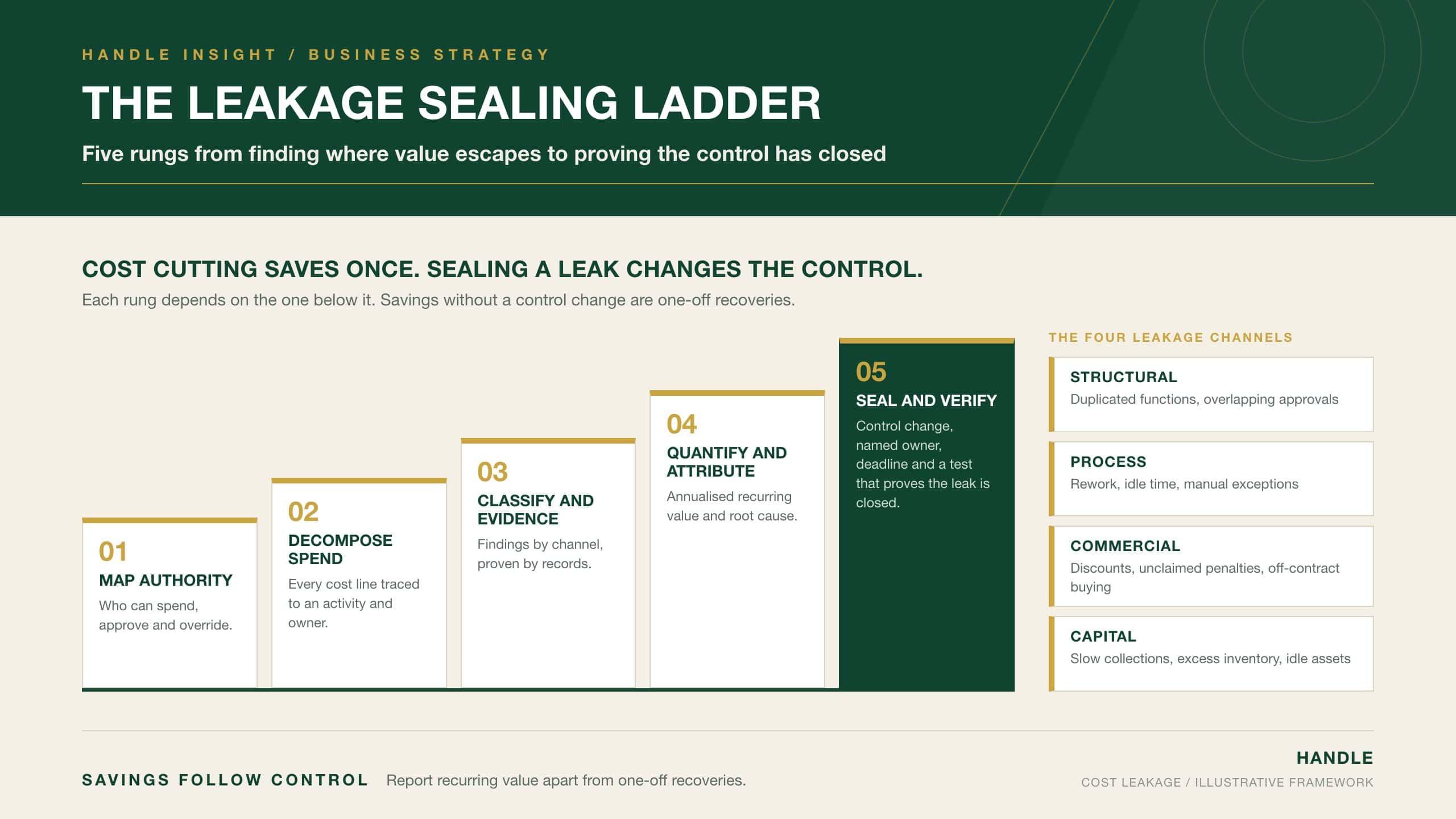
Original Analysis: The Leakage Sealing Ladder
Identification and remediation work best as a sequence of five rungs. Each rung depends on the one below it. Skipping a rung produces findings that cannot be defended or savings that do not last.
| Rung | Question | Output |
|---|---|---|
| 1. Map authority | Who is authorised to spend, approve, override and commit? | Authority map showing where mandate is unclear or informal |
| 2. Decompose spend | Which activity and owner generate each cost line? | Activity-level cost base; costs without an owner flagged |
| 3. Classify and evidence | Which channel does each leakage belong to, and what proves it? | Evidence-backed findings by channel |
| 4. Quantify and attribute | What is the recurring annual value, and what is the root cause? | Annualised value, materiality ranking and root cause category |
| 5. Seal and verify | What control change stops the leak, who owns it and by when? | Control change, owner, deadline and verification test |
The top rung is the one most often omitted. A recovered rebate is welcome, but if the contract monitoring that missed it is unchanged, the same rebate will be missed next year. Savings without a control change should be recorded as one-off recoveries, not as sealed leakages. That distinction keeps reported results honest.
Why Does the Same Leak Return?
Leaks return when remediation addresses the symptom rather than the cause. Each finding should therefore be attributed to one of six root cause categories before a fix is designed: governance design, where authority was never clearly allocated; control enforcement, where a control existed but was not applied; process design, where the workflow itself generates waste; capability, where people lacked the skills or information to act correctly; technology, where systems could not enforce the rule; and cultural override, where informal practice consistently beat formal policy.
The category determines the remedy. A discount leak caused by unclear approval limits is fixed by redesigning authority. The same leak caused by sales managers routinely overriding clear limits is fixed by enforcement in the order system and by consequences. Applying the wrong remedy wastes effort and leaves the leak open. Attribution is the step that turns a list of findings into a programme of control changes.
What Evidence Standard Should Apply?
Findings must withstand challenge from the managers whose areas are affected and, ultimately, from the board. Management explanations are useful context but are not evidence. Acceptable evidence includes reconciled financial data, system logs, approval records, executed contracts, service level reports and workflow timestamps. A finding that cannot be traced to such evidence should be excluded or held for further work, however plausible it seems.
Budget variance is not an explanation in itself. A variance should be attributed to a specific decision, behaviour or control gap. Market conditions may be accepted as a cause only when supported by external price data.
A Worked Example: Quantifying Leakage in a Distribution Business
Consider an illustrative UAE distribution business with AED 220 million of annual revenue and AED 140 million of third-party spend. A twelve-week review produces the following annualised findings.
| Finding | Channel | Annualised Value (AED) | Recurring? |
|---|---|---|---|
| Off-contract purchasing at prices above framework rates | Commercial | 1,900,000 | Yes |
| Unclaimed service credits under logistics contracts | Commercial | 650,000 | Yes |
| Discounts granted above approved limits | Commercial | 1,200,000 | Yes |
| Unused software licences across three systems | Structural | 420,000 | Yes |
| Duplicate supplier payments recovered | Process | 310,000 | No, one-off |
| Financing cost of receivables ten days beyond terms | Capital | 360,000 | Yes |
Total identified value is AED 4.84 million, of which AED 4.53 million is recurring, equivalent to about 2.1% of revenue. The recurring items are sealed through specific control changes: purchase orders blocked unless linked to a framework contract, a monthly service credit reconciliation owned by logistics, discount approval limits enforced in the order system, licence reviews tied to the renewal calendar and weekly collection reporting. The duplicate payments are recovered once and the payment control is fixed. The figures are illustrative. The method is not.
Who Should Own the Review?
A leakage review needs a sponsor with authority across the functions it will examine, typically the chief financial officer or chief operating officer, reporting to the audit committee or board. The review team should combine finance, procurement, commercial and operations expertise, with access to contracts and system data rather than summary reports. Internal audit can provide independence and evidence discipline, although it should not own the remediation it later tests.
Each sealed leak then needs a named business owner. Finance can measure the result, but only the function that controls the activity can change the behaviour. Ownership sits with the activity, not with the analyst who found the leak.
When Should a Leakage Review Be Triggered?
A structured review is most valuable at moments when confidence in reported performance matters: during margin compression, before a capital raise, in preparation for a sale or acquisition, after a merger when two control environments are being combined, and under regulatory or lender scrutiny. In each case the review supports more than savings. It gives buyers, lenders and boards evidence that the numbers reflect a business operating as authorised.
Common Cost Leakage Identification Mistakes
- Treating leakage identification as a cost-cutting target, which encourages teams to defer spend rather than fix the controls that allowed it to escape.
- Relying on aggregated cost categories, which hides the activity-level dispersion where most leakage sits.
- Accepting management explanations as evidence, so findings collapse when challenged at board level.
- Counting one-off recoveries as recurring savings, which overstates results and undermines credibility in later periods.
- Assigning findings to functions rather than named owners with deadlines, which leaves no one accountable for the control change.
- Ignoring commercial leakage because it sits between sales, legal and finance, when it is often the largest channel.
- Stopping at identification without verification, so sealed leaks reopen within a year.
Every one of these mistakes treats the symptom rather than the control. Every one is avoidable with a defined method and an evidence standard.
Conclusion
Identifying cost leakages in operations is an exercise in reclaiming control, not in cutting budgets. Leakage occurs where spend, revenue or capital escapes the decisions meant to govern it, and it hides in the gaps between functions and beneath aggregated reporting. A disciplined review maps authority, decomposes spend to the activity that creates it, classifies each finding into the structural, process, commercial or capital channel, quantifies it on an annualised basis and traces it to a root cause. The Leakage Sealing Ladder adds the step most often missed: a control change with an owner, a deadline and a test that proves the leak has closed. Findings must rest on evidence that a board would accept. One-off recoveries must be reported separately from recurring value. When leakages are sealed through governance, margin becomes reliable and reported performance can be trusted. Savings follow control. Control does not follow savings.


