

Organisations are built in functions, but their most important initiatives cut across them. A market entry needs legal, finance, commercial and operations to move together. A systems replacement needs technology, finance and every user department. A restructuring touches people, property, contracts and customers at once. Each function has its own budget, its own targets and its own leader, and none of them owns the initiative. Within PMO and Execution Governance, cross functional project governance supplies what the organisation chart lacks: a single line of authority over work that no single department controls. Its purpose is not to override functional expertise. It is to decide, quickly and visibly, when one function’s priority must give way to the initiative’s. Initiatives do not fail between functions by accident. They fail where nobody has the authority to decide.
Why Cross-Functional Initiatives Break Down
Functional organisations are designed to optimise within departments. Budgets, performance targets and reporting lines all run vertically. A cross-functional initiative runs horizontally, which means every contributing team is serving two masters: its own function and the initiative.
Three predictable problems follow. Priorities compete, because each department is measured on its own results and the initiative is extra work. Decisions stall, because no participant has authority over the others and disagreements escalate slowly through separate hierarchies. Information fragments, because each function tracks progress in its own systems and nobody holds a single view of dependencies and risks.
None of these problems reflects bad intent. They are the natural result of placing horizontal work inside a vertical structure. Governance exists to add the horizontal authority that the structure does not provide.
What Cross Functional Project Governance Must Provide
Effective cross functional project governance answers five questions before work begins: who sponsors the initiative and answers for its outcome, who leads delivery day to day, what each function must contribute and by when, which decisions can be taken at which level, and how conflicts between functions will be resolved. If any of these questions is left open, it will be answered during execution, usually under pressure and usually by whoever holds the most informal influence.
The answers are normally captured in a short initiative charter approved by the executive sponsor. The charter does not need to be long. It needs to be explicit about authority.
The charter should also record what the initiative is not. Scope boundaries matter more in cross-functional work than in departmental projects, because each function will tend to add its own requirements once it is involved. A clear statement of exclusions, approved at the outset, gives the programme director a basis for declining additions that would otherwise expand the initiative one reasonable request at a time.
The Three-Tier Governance Structure
Most organisations govern significant cross-functional initiatives through three tiers. Each has a distinct remit, and confusion between them is a common source of delay.
| Tier | Membership | Remit | Typical Cadence |
|---|---|---|---|
| Executive steering committee | Executive sponsor and heads of contributing functions | Direction, scope, funding, benefits and resolution of escalated conflicts | Monthly, or at stage gates |
| Programme leadership | Programme director, workstream leads and PMO | Integrated plan, dependencies, resource balancing, risk and reporting | Weekly |
| Functional delivery teams | Specialists from each function | Delivering their workstream to agreed scope, quality and dates | Daily or weekly within each team |
The steering committee should be small enough to decide. A committee that includes every interested manager becomes a briefing forum, and decisions migrate to informal conversations outside it. The executive sponsor should be a single named individual with enough seniority to direct the contributing functions, not a committee chair rotating between departments.
How Decision Rights Should Be Allocated
Authority should be allocated by type of decision and by tolerance. Tolerances define how far the programme can deviate from its approved baseline before a decision must move up a tier. They allow the programme director to act without constant escalation while protecting the sponsor’s control over what matters.
| Decision | Functional Lead | Programme Director | Steering Committee |
|---|---|---|---|
| Technical method within a workstream | Decides | Informed | No role |
| Reallocation of budget between workstreams | Consulted | Decides within tolerance | Decides above tolerance |
| Schedule change on the critical path | Proposes | Decides within tolerance | Decides above tolerance |
| Release of named specialists from functional work | Consulted | Requests | Decides if the function refuses |
| Change to scope, benefits or total budget | Consulted | Recommends | Decides |
| Regulatory, legal or reputational exposure | Flags | Escalates immediately | Decides |
The fourth row is the one most organisations leave undefined. If a functional head can withdraw people from the initiative without consequence, the initiative’s plan is only a request.
Resources, Dependencies and the Role of the PMO
The hardest constraints in cross-functional work are rarely money. They are named people and sequence. The same specialists are often needed by the initiative and by their home function, and one team’s output is frequently another team’s starting point.
The PMO’s contribution is to make those constraints visible. It maintains an integrated plan showing every inter-team dependency, a resource view showing where key individuals are committed, and a single risk and issue register for the initiative. It also runs the reporting cycle, consolidating workstream updates into one status view for the steering committee. The PMO does not replace functional judgement. It ensures that each function can see how its delays and decisions affect the others.
Reporting That Surfaces Problems Early
Cross-functional reporting fails in a recognisable way. Each workstream reports green on its own tasks while the initiative as a whole slips, because the problem sits in a hand-off that nobody reports on. Status reports that aggregate functional updates without testing dependencies give the steering committee comfort rather than information.
Useful reporting is built around the critical path and the tolerances. It shows the milestones that determine the end date, the dependencies between teams that are at risk, any forecast breach of budget or schedule tolerance, and the decisions the steering committee is being asked to take. Everything else can be handled at programme level. A steering committee pack that runs to dozens of pages is usually a sign that the programme director is reporting activity because the decision rights are unclear.
Reporting should also be honest about confidence. A milestone forecast as on time but dependent on an unconfirmed input from another function is not on time. It is at risk, and it should be reported as such.
Keeping the Initiative Aligned With Strategy and Benefits
Cross-functional initiatives often run for a year or more. During that time the strategy that justified them may change, a competitor may move, or regulation may shift. Governance should therefore include stage gates at which the steering committee confirms that the initiative still serves its strategic purpose and that the expected benefits remain achievable.
Benefits need an owner. The programme delivers capabilities, but the benefits are usually realised in business-as-usual functions after the programme closes: higher revenue in a commercial unit, lower cost in operations, faster close in finance. Naming the function that will own each benefit, and building it into that function’s targets, prevents the common outcome in which the programme is declared complete and nobody is accountable for whether it paid off.
Closure is also a governance act. When an initiative ends, responsibility for its systems, processes and residual risks must transfer formally to the functions that will run them, and the temporary authority granted to the programme must be withdrawn.
A Worked Example: A Market Entry Across Five Functions
Consider an illustrative UAE retailer launching an online channel in Saudi Arabia, with an approved budget of AED 12 million and a launch date nine months out. Five functions contribute: legal sets up the entity and licences, finance establishes banking and tax registrations, technology builds the platform and payment integration, operations arranges warehousing and delivery, and marketing prepares the launch.
The charter names the chief commercial officer as executive sponsor and appoints a programme director. The programme director may move up to AED 500,000 between workstreams and accept slippage of up to two weeks on any milestone. Anything beyond that goes to the steering committee.
In month four, technology reports that the payment provider cannot go live until the local entity’s bank account is open, and legal reports a six-week delay in the commercial registration. The dependency map shows that the delay now pushes the launch date back by five weeks. The programme director cannot absorb a five-week slip, so the issue is escalated with three options: delay the launch, launch with a third-party marketplace first, or add AED 400,000 for an external payment aggregator. The steering committee chooses the aggregator, and the programme director funds it by reallocating within tolerance from the marketing workstream, whose launch campaign is rescheduled accordingly. One decision, taken in one meeting, protects the date. Without the tolerance rules and the dependency map, the same problem would have been debated in three departments for a month.
Original Analysis: The Coordination Balance Matrix
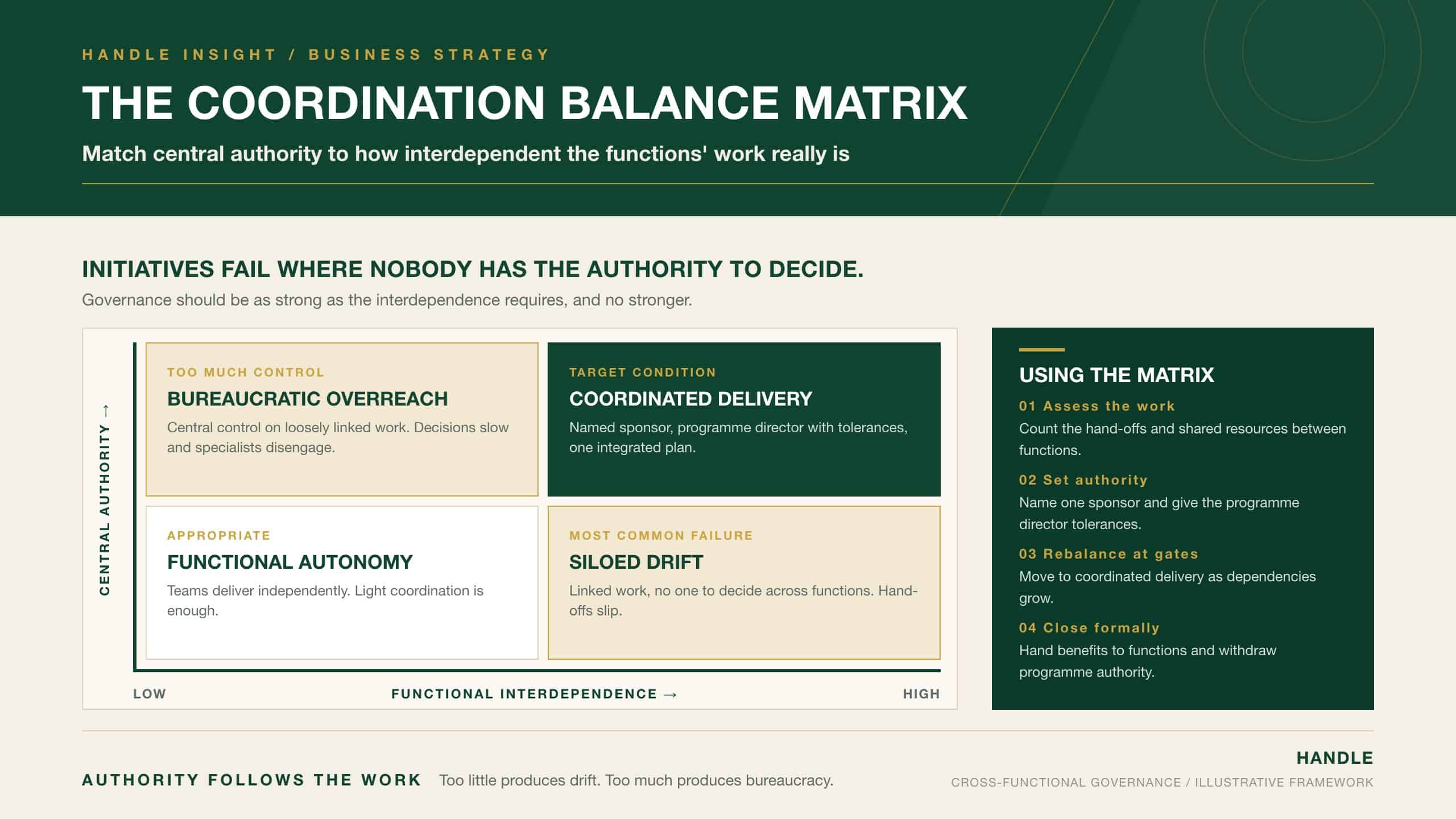
Cross-functional governance is a balance between two forces: how interdependent the functions’ work is, and how much central authority the initiative holds. The Coordination Balance Matrix plots those two dimensions and identifies four conditions.
- Functional autonomy (low interdependence, light central authority). Functions can deliver largely independently. Light coordination is appropriate and heavy governance would only add cost.
- Bureaucratic overreach (low interdependence, strong central authority). Central control is imposed on work that does not need it. Decisions slow, specialists disengage and governance becomes a reporting burden.
- Siloed drift (high interdependence, light central authority). Work is tightly linked but nobody can decide across functions. Each department optimises locally, dependencies slip and the initiative stalls. This is the most common failure condition.
- Coordinated delivery (high interdependence, strong central authority). A named sponsor, a programme director with defined tolerances and an integrated plan match the authority to the interdependence. This is the target condition for most strategic initiatives.
The matrix gives leaders a simple diagnostic. Assess how interdependent the work is, then set central authority to match. Governance should be as strong as the interdependence requires and no stronger.
| Condition | Warning Signs | Corrective Action |
|---|---|---|
| Siloed drift | Repeated slippage at hand-offs; disputes escalated through separate hierarchies | Appoint a single sponsor, set tolerances and build an integrated dependency plan |
| Bureaucratic overreach | Long reporting packs; technical choices sent to committee; specialists waiting for approval | Push technical decisions back to functions and reduce reporting to exceptions |
| Functional autonomy | Low dependency count; teams delivering on time independently | Maintain light coordination and review if scope grows |
| Coordinated delivery | Escalations resolved within one cycle; one shared view of risk and progress | Protect the model and test it at each stage gate |
Common Failures in Cross-Functional Governance
- Appointing a steering committee without a single executive sponsor, so every function has a voice and no one has the deciding vote.
- Giving the programme director responsibility for delivery but no authority over budget, schedule or people, which turns the role into coordination by persuasion.
- Leaving the release of functional specialists to the goodwill of their home departments, so the initiative loses its people whenever business-as-usual pressure rises.
- Tracking progress separately in each function, which hides the dependencies where most delays begin.
- Imposing heavy governance on loosely connected work, which slows experts without reducing risk.
- Leaving functional targets and incentives unchanged, so managers are rewarded for protecting their departments rather than delivering the initiative.
- Failing to revisit the initiative’s alignment with strategy at stage gates, allowing a programme to continue long after its original rationale has changed.
Each failure is a mismatch between where the work flows and where authority sits.
Conclusion
Cross-functional initiatives are where strategy meets the limits of the organisation chart. Functions are built to optimise their own results, and horizontal work inside a vertical structure will drift unless someone has the authority to decide across it. Effective governance provides that authority in proportion to the need: a single executive sponsor, a steering committee small enough to decide, a programme director with defined tolerances over budget, schedule and people, and an integrated view of dependencies and risk maintained by the PMO. Functional teams keep control of their technical work, and decisions move up a tier only when they exceed agreed limits. The Coordination Balance Matrix offers a simple test: match central authority to the interdependence of the work. Too little produces drift. Too much produces bureaucracy. The right balance lets an organisation move as one without ceasing to think as many.


