

Strategic initiatives rarely fail because a risk was unknown. They fail because a known risk sat in a project register where nobody with authority could see it, or because twenty modest risks across separate projects added up to one serious exposure that no single register recorded. Execution introduces exposure: initiatives touch operational change, regulatory frameworks, capital deployment and contractual commitments, and as they multiply across programmes and departments, risk compounds faster than any project team can track. Within PMO and Execution Governance, risk management within PMO structures is the control system that identifies, consolidates, escalates and contains these exposures before they threaten delivery or the institution itself. Its purpose is not to eliminate risk, which would stop transformation altogether. It is to ensure that every material exposure is visible to the right level of authority and accepted deliberately. Unseen risk is unmanaged risk.
What Is the PMO’s Role in Risk Management?
Risk management within a PMO extends well beyond tracking operational problems. Its purpose is to maintain institutional awareness of execution exposure across the whole portfolio. Strategic programmes interact with regulators, financing structures, technology platforms and external partners, and each interaction introduces uncertainty that individual project teams can see only in part.
The PMO’s distinctive contribution is consolidation. It brings risk information from separate projects and programmes into a single view, applies common definitions and scoring, and identifies patterns that no individual team can detect: the same vendor appearing as a dependency in four programmes, or several initiatives relying on the same scarce specialists in the same quarter. Isolated project risks become structured governance intelligence.
Which Categories of Risk Should the PMO Track?
Large-scale initiatives expose organisations to several categories of risk. Each needs its own leading indicators and a clear owner.
| Category | Typical Sources | Leading Indicator | Usual Owner |
|---|---|---|---|
| Operational | Resource shortages, integration failures, supplier disruption, resistance to change | Vacancy rates in critical roles, defect trends, supplier performance | Programme director |
| Financial | Budget overruns, weak projections, cost escalation | Forecast at completion against approved budget | Finance business partner |
| Regulatory and legal | Approvals, licensing, compliance obligations, contractual commitments | Approval timelines, open compliance findings | Legal and compliance |
| Strategic | Shifting market conditions, changed priorities, competitive moves | Variance between business case assumptions and current reality | Executive sponsor |
Operational risks tend to emerge gradually as projects move into implementation. Financial risks are revealed by forecast variance before they appear in actual spend. Regulatory risks are often binary: an approval is granted or it is not. Strategic risk is the easiest to overlook, because a programme can be delivered perfectly and still no longer serve the purpose that justified it.
How Is Risk Governed Across Project, Programme and Portfolio?
Risk management operates through a layered structure that connects day-to-day monitoring with executive oversight.
Project level. Project teams identify operational risks during delivery. Each project maintains a risk register recording threats, assessed impact and likelihood, owners and mitigation actions. Project managers monitor these continuously, but they rarely have visibility beyond their own initiative.
Programme level. Programme governance consolidates risks from projects within the same initiative and evaluates cross-project dependencies and systemic exposures that individual teams cannot see. Mitigation is coordinated so that one project’s response does not create another project’s problem.
Portfolio level. The PMO consolidates risk information from every programme, giving leadership a view of cumulative exposure. At this level executives can judge whether risk concentration exceeds the organisation’s appetite, whether particular vendors, regulators or capabilities are single points of failure, and whether the portfolio as a whole remains within tolerance.
How Should Risks Be Identified and Assessed?
Effective risk management begins with disciplined identification. Structured workshops at the start of major initiatives bring together operational specialists, legal advisers and programme leadership to identify risk scenarios, and the resulting register becomes the foundation for ongoing monitoring. Identification should be repeated at each phase gate, because the risks of design differ from the risks of deployment.
Each risk is assessed on impact and likelihood using a common scale, so that a score means the same thing in every programme. High-impact risks deserve attention even at moderate likelihood. Prioritisation then concentrates governance attention and mitigation resources on the exposures with meaningful institutional consequences, rather than spreading effort evenly across a register of dozens of items.
What Mitigation Strategies Are Available?
Identifying risk does not protect execution. Each material exposure needs a response that is owned, resourced and tracked.
| Response | When It Fits | Examples |
|---|---|---|
| Prevent | The cause can be removed or its likelihood reduced | Quality assurance gates, vendor contract safeguards, early regulatory engagement |
| Prepare | The risk cannot be prevented but its impact can be limited | Alternative suppliers, revised timelines, financial contingency reserves |
| Transfer | Another party is better placed to bear the risk | Contractual allocation to vendors, performance security, insurance |
| Escalate | The exposure exceeds the authority of the current level | Referral to programme board or executive committee under defined thresholds |
| Accept | The cost of response exceeds the expected impact, within appetite | Documented acceptance by the accountable owner, with a review date |
Acceptance is a legitimate response only when it is explicit. A risk that is simply left on the register without action has been accepted by default, by nobody.
How Should Risk Be Reported to Leadership?
Risk management is effective only when leadership has clear visibility of exposure across the portfolio. The PMO should integrate risk reporting into regular governance reviews rather than producing it as a separate document that is read occasionally. Reports should summarise the highest-priority risks, the progress of mitigation, emerging exposures and any risks accepted since the last review.
Three features distinguish useful risk reporting. First, it shows movement: which risks have increased, decreased or been closed, and why. Second, it shows concentration: where several risks share a cause, a vendor or a regulator. Third, it shows the decision required: for each escalated risk, what leadership is being asked to approve, fund or accept. Executive dashboards should highlight the small number of risks requiring immediate attention, with the detail held in the supporting registers.
Why Does Risk Culture Matter as Much as Process?
A well-designed escalation process fails if teams are reluctant to use it. Project teams often hesitate to escalate emerging risks because escalation feels like an admission of failure or invites unwelcome scrutiny. The result is that risks are held at project level until they become issues, at which point the options for mitigation have narrowed.
Leadership sets the culture through its response. When early escalation is met with support and resources, teams escalate early. When it is met with blame, risks stay hidden. The PMO can reinforce the right behaviour by recognising timely escalation in programme reviews and by treating a risk that materialises without ever having been reported as the more serious governance failure. Early warning is a contribution. Silence is the failure.
Regulatory and Legal Risk in UAE Programmes
For organisations operating in the UAE, regulatory and legal risk deserves particular attention because many strategic programmes change the legal or regulatory footprint of the business. A programme that creates new entities may trigger registration and filing obligations under the Corporate Tax regime (Federal Decree-Law No. 47 of 2022) and VAT rules. Digital and data programmes must comply with the Personal Data Protection Law (Federal Decree-Law No. 45 of 2021) or, for entities in the DIFC and ADGM, their own data protection regimes. Joint ventures and acquisitions delivered as programmes may require merger control notification under the Competition Law (Federal Decree-Law No. 36 of 2023) where the thresholds are met. Workforce programmes must preserve Emiratisation commitments and comply with the applicable employment framework. Regulated businesses must factor in approval timelines from their supervisors, such as the Central Bank of the UAE, the DFSA or the FSRA.
These risks share a feature: they are often binary and slow to resolve once triggered. They belong in the register from the first workshop, with legal and compliance ownership, rather than being discovered at go-live.
A Worked Example: The Risk Only the Portfolio Could See
Consider an illustrative organisation running 18 strategic programmes, with around 600 risks recorded across project registers. All figures are illustrative. Each risk is scored on a five-point scale for impact and for likelihood, giving scores from 1 to 25.
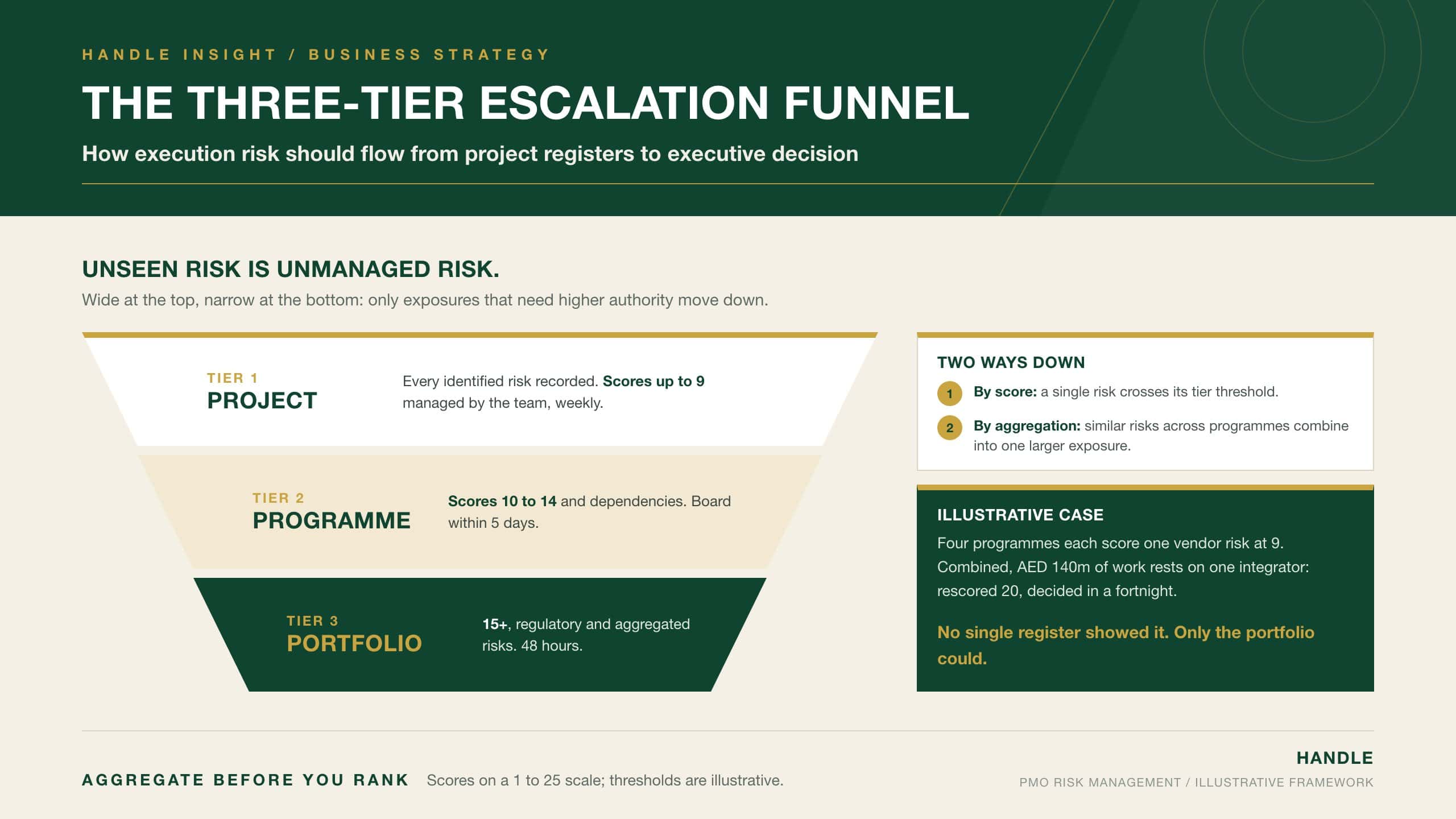
Four separate programmes each record a moderate risk that a single systems integrator may be unable to staff their work in the second half of the year. In each project register the risk scores 9, below the programme escalation threshold, and each team plans to manage it locally. When the PMO consolidates the registers, the four entries are recognised as one exposure: the same vendor, the same quarter and a combined value of work of AED 140 million. Rescored at portfolio level for combined impact, it reaches 20.
The executive committee approves two actions within a fortnight: a second integrator is pre-qualified for two of the programmes, and the start date of a third is moved by one quarter. No individual project was wrong to score the risk as moderate. The exposure existed only in aggregate, and only the portfolio view could see it.
Original Analysis: The Three-Tier Escalation Funnel
The Three-Tier Escalation Funnel describes how risk should flow through a PMO structure. The top of the funnel is wide: every project records its risks. Each tier filters by score and by aggregation, so that only exposures requiring higher authority move down, and the portfolio tier receives a short list of risks that genuinely need executive decision.
| Tier | What Enters | Illustrative Threshold | Decision Forum and Timing |
|---|---|---|---|
| Project | Every identified risk | Scores up to 9 managed locally | Project team, weekly |
| Programme | Scores 10 to 14, and cross-project dependencies | Escalated within 5 working days | Programme board, fortnightly |
| Portfolio | Scores 15 and above, regulatory risks and aggregated exposures | Escalated within 48 hours | Executive committee, monthly or by exception |
The funnel has two inputs, not one. Risks move down when their own score crosses a threshold. They also move down when the PMO aggregates similar risks across programmes and the combined exposure crosses a threshold, as in the worked example. A PMO that only applies score-based escalation will miss the second category, which is often the most dangerous. Regulatory risks enter the portfolio tier automatically because of their binary nature.
Common Failures in PMO Risk Governance
- Keeping isolated project registers that are never consolidated, so leadership cannot see cumulative or correlated exposure.
- Escalating only by individual score, which misses exposures that exist only when similar risks are aggregated across programmes.
- Discouraging early escalation by treating it as a reporting failure, so teams hold risks until they become issues.
- Recording risks without owned, resourced mitigation, which creates documentation rather than protection.
- Leaving regulatory and legal risks to be discovered late, when approval timelines can no longer be absorbed.
- Accepting risks by default because nobody formally decided to act or to accept.
Each failure allows exposure to grow out of sight. Each is corrected by consolidation, clear thresholds and named ownership.
Conclusion
Risk management within PMO structures provides the oversight that complex initiatives need to move through uncertain environments without uncontrolled disruption. Project teams identify and manage risks within their authority. Programme boards resolve dependencies and systemic exposures. The portfolio tier gives leadership a view of cumulative and correlated risk, judged against appetite. Disciplined identification, common scoring, owned mitigation and explicit acceptance turn a register into a control system. In the UAE, regulatory and legal risks, from tax registration to data protection, merger control and sector approvals, deserve early ownership because they are binary and slow to resolve. The Three-Tier Escalation Funnel adds the essential insight: risks move up by score and by aggregation, and the second route is the one most organisations miss. Exposure is accepted deliberately. Execution proceeds with awareness. Control holds.


