

Every diversified group eventually discovers that it owns businesses it would not buy today. The question is not whether those units are profitable. It is whether they strengthen the position the group has chosen, at a cost in capital, governance attention and risk that the group can justify. Within Portfolio Strategy & Business Unit Optimization, strategic fit assessment for business units is the discipline that answers that question with evidence and turns the answer into a capital decision. Units that fit are funded to compound. Units that do not fit are repaired on a deadline, managed for cash or separated. An assessment that ends in a report rather than an allocation has not been completed. Fit is a decision, not a description.
What Does Strategic Fit Actually Measure?
Strategic fit is the degree to which a business unit advances the group’s declared direction under real constraints: the cost of capital, regulatory exposure, leadership capacity and time. It is not sector membership. A logistics unit inside an industrial group may fit perfectly or not at all, depending on whether it strengthens the group’s position or simply shares a label with it.
A rigorous strategic fit assessment for business units separates two questions that are often merged. The first is whether the unit belongs, which is a question of fit. The second is whether the unit performs, which is a question of return. A high-performing unit can be a poor fit, and a strategically essential unit can be underperforming. Treating the two questions together is how portfolios end up protecting the wrong businesses.
The Four Lenses of Fit
Fit is tested through four lenses. Each produces a distinct type of evidence, and weakness in one cannot be fully offset by strength in another.
| Lens | Core Question | Evidence of Strong Fit | Warning Signal |
|---|---|---|---|
| Capital fit | Does the unit convert capital into returns above the group’s hurdle within its horizon? | Return on invested capital above hurdle, stable cash conversion, contained capex intensity | Continuous reinvestment with no compounding cash flow |
| Governance fit | Is the oversight it consumes proportionate to its value? | Routine board agenda, clean audit and compliance record | Recurring disputes, regulator friction, special committees |
| Risk fit | Does it diversify or concentrate group exposure? | Uncorrelated counterparties, jurisdictions and regulatory risks | Exposures that cluster with existing businesses |
| Capability fit | Does it benefit from, or strengthen, the group’s capabilities? | Shared customers, procurement, data, IP or leadership bench | Needs an operating model the group does not have |
The lenses keep the assessment honest. A unit with attractive margins but poor governance fit may still destroy value by absorbing board time that higher-fit units need.
How Should Each Dimension Be Scored?
The lenses are applied through seven scored dimensions. Each is rated from one to five and supported by named evidence. Scores without evidence are not accepted.
1. Mission Alignment
The unit must reinforce the group’s declared direction, whether that is sector leadership, cash compounding or regional expansion. If the link cannot be stated in one sentence, alignment is weak.
2. Economic Engine Compatibility
Units earn money in different ways: recurring contracts, transactions, projects, regulated tariffs, asset yield or platform economics. A group built for predictable cash should be cautious about anchoring itself to a volatile engine unless the volatility is compensated and bounded.
3. Defensible Advantage
The test is whether the advantage survives pressure. Proprietary access, regulatory position, distribution control, cost leadership, switching costs and enforceable contracts qualify. A brand without contractual capture rarely does.
4. Synergy That Converts to Cash
Revenue synergy counts only where there is a shared customer base, a compatible buying cycle and aligned sales incentives. Cost synergy counts only where the group has the authority to enforce integration. Risk synergy counts only where exposures are genuinely uncorrelated.
5. Integration Burden
High integration burden, such as system replacement or leadership change, does not prevent action, but it lowers fit and determines how action is phased.
6. Jurisdiction and Enforcement
For groups operating across the UAE and the wider region, jurisdiction affects licensing, contract enforcement and the speed of dispute resolution. A unit dependent on counterparties in weak enforcement environments needs stronger contracts, security and counterparty selection, or a lower capital weighting.
7. Capital Pathway
Every unit needs a defined route: reinvest, leverage, partner or exit. A unit without one consumes capital without creating options.
What Evidence Should Support the Scores?
Evidence prevents the assessment from becoming a contest of internal advocacy. Four evidence packs are standard.
The financial pack includes unit-level cash flow, return on invested capital, working capital behaviour, margin bridges and capex intensity. Earnings without cash conversion are treated as incomplete. The commercial pack covers customer concentration, renewal and churn data, pipeline quality and pricing power. Market share claims require external verification. The operational pack covers process stability, supply chain dependencies, key person risk and systems maturity. The legal and regulatory pack covers licence status, compliance history, litigation exposure, contract templates and dispute clauses.
Units in the UAE also need confirmation that their licensed activities match what they actually do, and that their Corporate Tax position under Federal Decree-Law No. 47 of 2022 is understood. A unit operating in a free zone, for example, may rely on Qualifying Free Zone Person status, which affects its after-tax return and constrains the kinds of revenue it can earn without losing that status. That constraint is a fit question, not only a tax question.
Original Analysis: The Fit and Return Quadrant
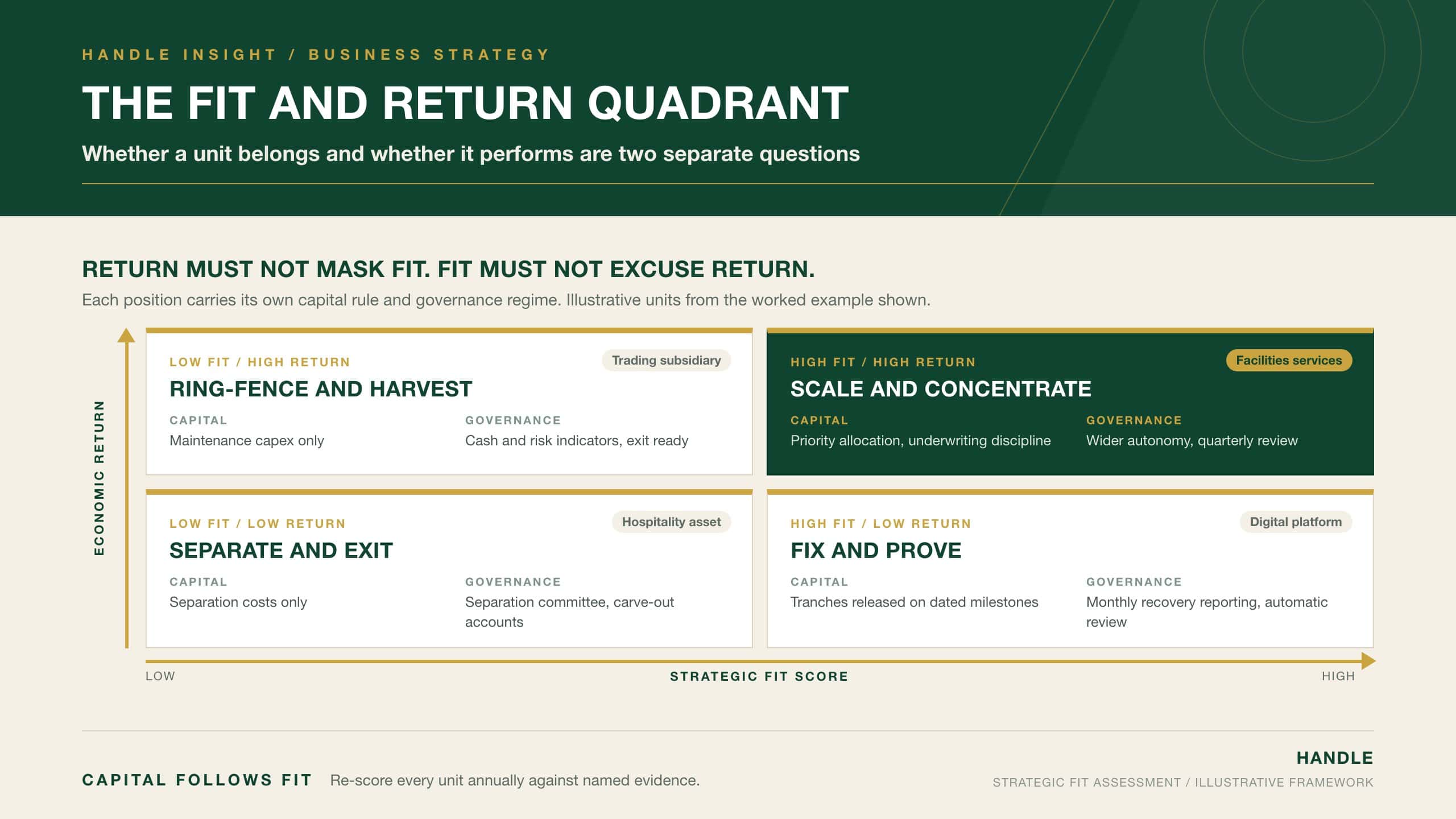
The Fit and Return Quadrant places each unit on two independent axes. The horizontal axis is the composite fit score from the seven dimensions. The vertical axis is economic return, measured as return on invested capital relative to the group hurdle and adjusted for cash conversion. The position determines the action, the capital rule and the governance regime.
| Quadrant | Fit / Return | Portfolio Action | Capital Rule | Governance Regime |
|---|---|---|---|---|
| Scale and Concentrate | High fit, high return | Grow deliberately; strengthen management | Priority allocation within underwriting discipline | Wider autonomy, quarterly review of return drivers |
| Fix and Prove | High fit, low return | Recovery plan with dated milestones | Tranches released only on milestones | Monthly recovery reporting; automatic review if milestones are missed |
| Ring-Fence and Harvest | Low fit, high return | Extract cash; preserve optionality | Maintenance capex only | Cash and risk indicators; exit readiness maintained |
| Separate and Exit | Low fit, low return | Structured separation and sale | No new capital beyond separation costs | Separation committee; carve-out accounts prepared |
The quadrant’s main contribution is to stop return from masking fit, and fit from excusing poor return. A unit in the Fix and Prove quadrant is not protected indefinitely because it is strategic. It is given a defined period to move upwards. A unit in the Ring-Fence and Harvest quadrant is not expanded because it is profitable. It is managed for cash until a buyer values it more than the group does.
A Worked Example: Four Units, One Capital Budget
Consider an illustrative UAE-based group with a hurdle rate of 12% and AED 200 million of discretionary capital for the year. It assesses four units on a composite fit score out of 5.
| Unit | Fit Score | ROIC | Quadrant | Illustrative Allocation |
|---|---|---|---|---|
| Facilities services | 4.3 | 17% | Scale and Concentrate | AED 120 million |
| Digital platform | 4.0 | 6% | Fix and Prove | AED 60 million in three milestone tranches |
| Trading subsidiary | 2.1 | 15% | Ring-Fence and Harvest | AED 20 million maintenance only |
| Hospitality asset | 1.8 | 4% | Separate and Exit | Nil; separation budget held centrally |
Before the assessment, the trading subsidiary had requested AED 50 million to expand because it was the second most profitable unit. The quadrant shows that its profitability does not translate into fit: it shares no customers, capabilities or strategic direction with the rest of the group. The digital platform, by contrast, scores well on fit but earns half the hurdle. It receives capital, but only AED 20 million at a time, each tranche tied to a dated milestone such as a contracted revenue target. If the second milestone is missed, the unit moves automatically to a separation review. The allocation is now explainable to the board, lenders and family shareholders in a single page.
How Fit Outcomes Change Governance
Fit assessment matters only if it changes how units are governed. Three mechanisms carry the outcome into practice.
Decision rights should vary by quadrant. High-fit, high-return units earn wider approval thresholds. Fix and Prove units operate under tighter delegation until they recover. Reporting cadence should follow what must be controlled: return drivers for growth units, milestones for recovery units and cash extraction for harvest units. Incentives should reward group outcomes rather than local optimisation, so that a unit cannot lift short-term earnings by degrading cash conversion, compliance or customer durability.
Exit decisions also carry legal and regulatory steps. In the UAE, the sale of a unit may require counterparty consents, licence transfers, employee transfers and, where thresholds are met, merger control clearance under the Competition Law, Federal Decree-Law No. 36 of 2023. These steps should be mapped when a unit enters the Separate and Exit quadrant, not when a buyer appears.
Who Should Run the Assessment, and How Often?
The assessment should be owned by the group, not by the units being assessed. In practice, a small portfolio committee of the board, supported by group strategy and finance, sets the method, approves the weighting of the seven dimensions and challenges the scores. Unit management supplies evidence and may contest a score, but it does not assign its own.
Independence matters most where the group is family-controlled. Founding units often carry the identity of the family, and the people who built them may still sit on the board. An external reviewer, or at least a scoring panel that includes independent directors, makes it easier to reach conclusions that are uncomfortable but correct.
The full assessment should run annually, aligned with the budget cycle so that the quadrant feeds directly into the capital plan. Interim reviews are triggered by defined events: a missed recovery milestone, a material regulatory change, a significant acquisition or a change in the group’s declared direction. Between reviews, each unit’s position is monitored through the indicators attached to its quadrant. A unit should never discover its classification at the moment its budget is cut. The criteria, the scores and the consequences should be known in advance, which is what allows the process to be accepted as fair.
Common Failures in Strategic Fit Assessment
- Founding units are protected for sentimental reasons, so they continue to absorb capital long after they stopped advancing the group’s direction.
- Synergy is claimed on the basis of a shared brand or theoretical cross-selling, without the incentives or authority needed to capture it.
- Revenue growth is treated as value creation even when it increases working capital drag and concentration risk.
- Scores are assigned by the unit’s own management without independent challenge, so the assessment confirms existing budgets.
- Fix and Prove units are given recovery plans without dated milestones, so the plan never ends and capital continues to flow.
- The assessment is run once and filed, rather than repeated annually as markets, regulation and the group’s direction change.
Each failure allows narrative to override evidence. The cure is a fixed method, documented scores and a capital rule attached to every outcome.
Conclusion
Strategic fit assessment for business units is the gatekeeper of a diversified portfolio. It tests each unit through capital, governance, risk and capability lenses, scores seven dimensions against named evidence and separates the question of whether a unit belongs from the question of whether it performs. The Fit and Return Quadrant converts those answers into four actions: scale and concentrate, fix and prove, ring-fence and harvest, or separate and exit. Each action carries its own capital rule and governance regime, so the assessment changes how money and oversight are actually allocated. Groups that apply the method annually stop funding units because they are familiar, profitable in isolation or loudly championed. They fund units because the evidence supports it. Capital follows fit. Return is tested. Exits are planned before they are needed.


