

Most margin erosion does not come from a single bad pricing decision. It comes from thousands of small ones: a discount granted to close a quarter, a legacy contract rate never reviewed, a regional price list that drifted from the corporate one, a rebate that no one tracks. Pricing governance frameworks for corporations exist to make those decisions visible, assign them to the right level of authority and hold someone accountable for the outcome. Within Pricing and Revenue Management, governance is what turns a pricing strategy from a document into behaviour across every deal, region and channel. Without it, the price a company announces and the price it actually realises separate a little more each quarter. Pricing authority must be designed, not assumed.
What Is a Pricing Governance Framework?
A pricing governance framework is the set of rules, roles, approval thresholds and controls that determine who may set or change a price, within what limits, and how those decisions are recorded and reviewed. It sits between pricing strategy, which decides how the company wants to compete, and pricing execution, which happens in quotes, contracts and invoices.
A complete framework answers four questions. Who owns list prices and price corridors? Who may approve a deviation, and how large may it be? What information must accompany a request? How is realised price monitored against the approved price after the deal is signed? A framework that answers only the first two will control discounts but miss the leakage that occurs after contract signature.
Why Pricing Authority Fragments
Pricing authority fragments for understandable reasons. Sales teams are rewarded on volume and revenue rather than margin, so a discount that secures a deal looks rational to the individual. Regional managers adapt prices to local competition and gradually create their own price books. Product teams launch new offers without aligning them to existing price architecture. Finance sees the consequences in the margin report weeks later, without visibility into the deals that caused them.
The result is not a lack of pricing decisions but too many uncoordinated ones. Governance does not remove flexibility. It places each kind of flexibility with the person who has the information and the accountability to use it well.
The Building Blocks of Pricing Governance
Price architecture. Official list prices, price corridors by segment and channel, and clear rules for volume discounts, rebates and payment terms. The architecture defines the “normal” price against which every deviation is measured.
Decision rights. A written allocation of who may approve what. Executive leadership sets pricing strategy and price levels. Commercial leadership sets corridors and policies. Sales executes within the corridor and escalates beyond it.
Approval thresholds. Discount bands linked to approval levels, often combined with deal size and contract length so that a small percentage on a very large multi-year contract still reaches senior review.
A pricing committee. A cross-functional body, typically with finance, sales, marketing and product representation, that approves strategic price changes, reviews large exceptions and monitors pricing performance.
Data and systems. A single source of approved prices, quote workflows that enforce thresholds automatically, and integration between contract terms and billing so that what was approved is what is invoiced.
Designing the Approval Matrix
An approval matrix converts decision rights into thresholds that sales teams can apply without debate. The figures below are illustrative and should be calibrated to each company’s margin structure.
| Deviation From Corridor Price | Deal Value Below AED 1 Million | Deal Value AED 1 to 10 Million | Deal Value Above AED 10 Million |
|---|---|---|---|
| Within corridor | Sales representative | Sales manager | Commercial director |
| Up to 5% below corridor | Sales manager | Commercial director | Pricing committee |
| 5% to 10% below corridor | Commercial director | Pricing committee | Pricing committee with CFO |
| More than 10% below corridor | Pricing committee | Pricing committee with CFO | Chief executive |
Two design rules make the matrix work. First, every request above the lowest level must carry a short business case showing margin impact, competitive context and the alternative if the discount is refused. Second, non-price concessions such as extended payment terms, free services or volume commitments without penalties should be converted into a price equivalent and approved in the same way. Otherwise discounts migrate into terms that the matrix does not see.
The Role of the Pricing Committee
The pricing committee is the institutional centre of the framework. Its mandate typically covers three areas. It approves strategic pricing moves, such as general price increases, new product pricing and repositioning in a market. It decides exceptions above the thresholds delegated to individuals. And it reviews pricing performance, including realised price, discount distribution and leakage, to decide whether policies need to change.
The committee should meet on a fixed cycle, with an expedited route for time-critical deals. Its decisions should be minuted, with reasons, so that the next similar request is decided consistently. A committee that approves almost every request it receives is not exercising governance. It is adding delay.
Monitoring Realised Price
Governance must continue after the deal is signed. The most useful measures are those that reveal the gap between the price approved and the price collected.
| Metric | What It Reveals | Typical Owner |
|---|---|---|
| Price realisation (realised price as a share of list) | Overall discount depth by product, segment and region | Pricing function |
| Discount dispersion | Whether similar customers receive very different prices | Commercial leadership |
| Exception rate | How often deals fall outside the corridor | Pricing committee |
| Off-invoice leakage | Rebates, free goods, payment terms and other concessions after invoicing | Finance |
| Contract compliance | Whether invoices match approved contract terms | Finance and billing |
A simple price waterfall, starting from list price and deducting each on-invoice and off-invoice element down to the net price received, is often the most persuasive tool for showing leadership where margin is lost.
How Should Exceptions Be Handled Without Killing Flexibility?
No framework removes exceptions. Markets move, competitors cut prices and some customers are worth winning at a lower margin. The aim is not to refuse exceptions but to make each one deliberate, documented and reviewable.
A good exception process has four features. Requests are submitted through a single channel, usually the quoting system, so that none are agreed by email or telephone. Each request carries a standard business case covering margin impact, competitive evidence and the commitment received in return, such as volume, term or exclusivity. Approvals carry an expiry date, so that a concession granted for one tender does not become the customer’s permanent price. And approved exceptions are reviewed in aggregate each quarter. When the same exception appears repeatedly, it is a signal that the corridor itself is wrong and should be reset by policy rather than defended deal by deal.
Central Corridors, Regional Execution
Groups operating across several countries face a further tension. Regional teams need room to respond to local competition, currency movements and customer expectations. Headquarters needs consistent positioning, protection against cross-border arbitrage by multinational customers and a margin floor that holds everywhere.
The usual answer is a central framework with regional execution. Headquarters sets the price architecture, the margin floor and the corridors by region. Regional leaders price within those corridors and escalate beyond them through the same matrix. Global key accounts are priced centrally, so that a customer cannot use one region’s price to negotiate in another. Regional autonomy is preserved. Regional drift is not.
Pricing Governance in the UAE Context
For companies operating in the UAE, pricing governance has a compliance dimension as well as a commercial one. The UAE Competition Law, Federal Decree-Law No. 36 of 2023, prohibits anti-competitive agreements and abuse of a dominant position. Pricing frameworks should therefore make clear that prices are set independently, that commercial teams must not exchange pricing information with competitors, and that any restrictions on distributors’ resale prices are reviewed by legal counsel before use. A company with a strong market position should also assess whether selective or below-cost pricing could be treated as abusive.
Consumer-facing businesses must also ensure that displayed prices meet UAE requirements, including showing prices inclusive of VAT at 5% where the rules require it. These obligations belong inside the pricing policy, not in a separate legal manual that sales teams never read.
Worked Example: The Value of One Per Cent
Consider an illustrative industrial distributor with annual revenue of AED 500 million and operating profit of AED 50 million, a 10% operating margin. A price waterfall review shows that average realised price is 18% below list, but that discounts vary from 8% to 30% for customers of similar size and volume.
The company introduces corridors, an approval matrix and monthly committee review of exceptions. Within a year, discount dispersion narrows and average realised price improves by 1% on the same volume. With costs unchanged, this adds roughly AED 5 million to operating profit, an increase of about 10%. Achieving the same profit improvement through volume growth at a 10% margin would require around AED 50 million of additional sales.
The figures are illustrative. The arithmetic is not. Price is the most direct lever on profit, which is why its governance deserves the same rigour as capital expenditure.
Original Analysis: The Pricing Authority Quadrant
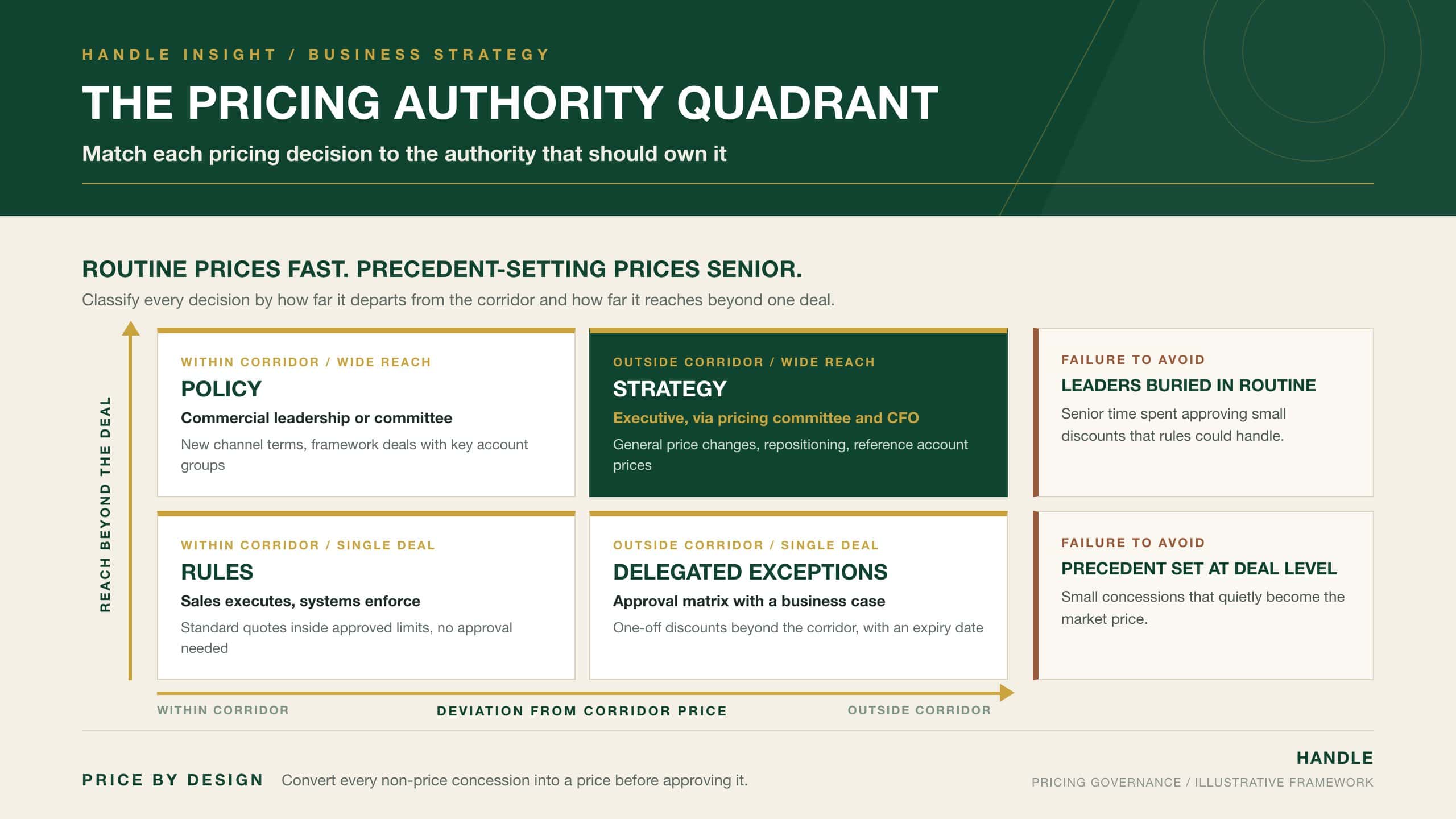
Not every pricing decision needs the same level of scrutiny. The Pricing Authority Quadrant classifies decisions on two dimensions: how far the price departs from the approved corridor, and how far the decision reaches beyond a single deal.
Within corridor, single deal: Rules. Routine pricing within approved limits. Sales executes without approval, and systems enforce the limits. Governance here is about speed and consistency.
Outside corridor, single deal: Delegated exceptions. A discount beyond the corridor on one deal. Approval follows the matrix, supported by a business case. Governance here is about evidence and accountability.
Within corridor, wide reach: Policy. Decisions that stay within current limits but set a precedent, such as standard terms for a new channel or a framework agreement with a key account group. These belong with commercial leadership or the committee because they shape many future deals.
Outside corridor, wide reach: Strategy. General price changes, market repositioning or a strategic account price that will become a reference for others. These are executive decisions taken through the pricing committee, with finance sign-off.
The quadrant prevents two opposite failures: senior leaders spending time on routine discounts, and precedent-setting decisions being taken at deal level because each one looked small.
Common Pricing Governance Failures
- Setting approval thresholds on discount percentage alone, so that small percentages on very large contracts escape senior review.
- Allowing non-price concessions such as payment terms or free services to bypass the approval matrix.
- Rewarding sales teams purely on revenue, which makes every discount look rational to the person granting it.
- Running a pricing committee that approves nearly every request and therefore adds delay without adding control.
- Monitoring approved prices but not invoiced and collected prices, missing leakage after contract signature.
- Letting regional price lists drift from the central architecture without periodic reconciliation.
- Treating competition law as a legal issue outside the pricing process, rather than a rule built into it.
Each failure allows price to be decided by default. Governance exists so that it is decided by design.
Conclusion
Pricing governance frameworks give corporations control over the lever with the most direct effect on profit. They define a price architecture, allocate decision rights, link approval to the size and reach of each deviation, and monitor realised price after contracts are signed. A pricing committee provides consistent judgement on exceptions and strategic moves, while systems enforce the rules at the point of quotation and billing. In the UAE, the same framework should also embed competition law and price display obligations, so that commercial discipline and legal compliance operate together. The Pricing Authority Quadrant keeps routine decisions fast and precedent-setting decisions senior. Discounts should be earned with evidence. Concessions should be priced. Leakage should be measured. Price is decided either by design or by default.


