

Most five-year plans fail quietly. They are approved with conviction, presented once to the board and then overtaken by annual budgets that never refer back to them. The problem is rarely the ambition. It is that the plan was written as a forecast of what might happen rather than as a set of commitments about what the organisation will and will not do with its capital, its leadership attention and its governance authority. Within Strategic Planning & Visioning, building a 5-year strategic plan means fixing direction firmly enough to compound advantage while leaving room to respond to change without abandoning the thesis. Five years is long enough to build a position and short enough to hold leaders to account for it. A plan that does not constrain decisions is not a plan. It is a brochure.
What Is a Five-Year Strategic Plan Actually For?
The function of a five-year plan is to impose a single governing logic on an institution through a period in which markets, regulation, capital conditions and leadership will all change. It answers three questions that every material decision must respect: where the organisation will compete, how it intends to win there and what it will deliberately not do.
That last question is the one most often left out. Exclusions protect focus. Without them, every attractive opportunity becomes an argument for diverting capital and management time, and the plan erodes one exception at a time.
A five-year plan is also a governance instrument. It tells the board what it is approving, tells management what it is accountable for and tells investors or family shareholders how capital will be used. When it is done properly, the plan frames every major decision for the next sixty months and removes the need to re-argue strategy at each board meeting.
How Should the Five Years Be Structured?
A five-year plan should be built in phases, not written as a straight-line projection. Each phase has a different job, and the degree of commitment changes from one phase to the next.
Year One: Lock the Baseline
The first year fixes the platform from which everything else compounds. Core markets and profit engines are confirmed. Capital structure and regulatory posture are settled. Legacy inefficiencies are addressed and non-core activities are exited or ring-fenced. Decision rights are clarified so that the next four years are not spent arguing about who decides.
Years Two and Three: Deploy and Scale
The middle years are for controlled expansion. Capital is deployed against theses agreed in advance, market entries follow a sequence rather than opportunity, and talent is upgraded in roles that are critical to the strategy. Systems, reporting and compliance scale with volume so that growth does not outrun control.
Years Four and Five: Consolidate and Create Options
The final phase secures the position that has been built. Leadership in core markets is defended, the balance sheet is strengthened and strategic alternatives are opened: acquisition, partial sale, capital raising, listing or succession. The aim is to end the cycle with choices rather than obligations, and to begin the next plan from strength.
| Phase | Primary Objective | Degree of Commitment | Board Focus |
|---|---|---|---|
| Year 1: Lock | Stabilise the core and settle decision rights | Fixed: budgets, exits and structure approved | Baseline metrics and governance clarity |
| Years 2-3: Deploy | Grow against pre-agreed theses | Committed theses, staged capital releases | Return thresholds and sequencing discipline |
| Years 4-5: Position | Consolidate and open strategic alternatives | Directional: options identified, not yet chosen | Balance sheet strength and exit or succession readiness |
What Belongs in the Strategic Core?
Every credible five-year plan is anchored by a strategic core: the small set of businesses, capabilities or markets in which the institution commits to win decisively. The core receives first claim on capital, the most senior management attention and the strongest protection in budget negotiations.
Activities outside the core are treated differently. Peripheral businesses are run for cash or prepared for exit. Experimental initiatives are ring-fenced with defined budgets and kill criteria. This separation prevents a common pattern in which a promising new venture gradually absorbs resources that the core business needed to defend its position.
Why Do Exclusions and Kill Criteria Matter?
What a plan excludes is as important as what it includes. The plan should state which markets, products, customer segments and types of transaction are off-limits for the period, and why. Written exclusions give the board a basis for declining proposals that are attractive in isolation but inconsistent with the strategy.
Kill criteria do the same for initiatives already under way. Each initiative should carry conditions under which it will be stopped: a missed milestone, a return below threshold after a defined period or a change in the market that removes the original rationale. Agreeing those conditions at the outset protects leaders from sunk-cost reasoning later. Termination becomes execution discipline rather than an admission of failure.
How Should Capital Be Allocated Over Five Years?
A five-year plan without a capital framework is a narrative. Capital must be allocated by rule, not by enthusiasm. Each growth initiative should be underwritten against a return threshold, a defined risk tolerance and an assessment of its liquidity impact.
The framework should set deployment ceilings for each phase, a reinvestment ratio for operating cash flow, minimum liquidity and reserve requirements, and the authority to reallocate capital when circumstances change. Reallocation authority matters as much as the original allocation. If moving capital between initiatives requires a full board debate every time, the organisation will react slowly to both risks and opportunities.
For UAE businesses, the capital framework should also reflect the tax and regulatory landscape. Corporate Tax under Federal Decree-Law No. 47 of 2022, at 9% on taxable income above AED 375,000, affects after-tax returns and the comparison between operating structures, and Qualifying Free Zone Person status, where it applies, depends on conditions that must be maintained throughout the plan period rather than assumed.
A Worked Example: Phasing AED 200 Million
Consider an illustrative UAE industrial services group with annual revenue of AED 400 million that approves a five-year plan with total growth capital of AED 200 million.
In year one, the board releases AED 30 million to modernise the core business and exit two loss-making contracts, and sets a minimum liquidity reserve of AED 25 million that cannot be used for growth. In years two and three, AED 110 million is allocated against two pre-approved theses: entry into Saudi Arabia and expansion of a maintenance services line. Each thesis carries a minimum internal rate of return of 15% and is funded in tranches, with the second tranche released only when the first meets agreed milestones. In years four and five, the remaining AED 60 million is held for consolidation: either a bolt-on acquisition or debt reduction ahead of a potential minority sale.
When the Saudi entry falls behind its year-two milestones, the second tranche of AED 25 million is not released automatically. The executive committee, acting under delegated authority, redirects AED 15 million to the maintenance line, which is ahead of plan, and the board is informed at its next meeting. The plan has adapted without being rewritten.
Governance, Risk and Decision Rights
Governance must be built into the plan, not layered on afterwards. The plan should state who approves what, which decisions are delegated to management and which are reserved to the board or shareholders. For UAE companies, those reserved matters must also be consistent with the company’s constitutional documents and, where relevant, the Commercial Companies Law (Federal Decree-Law No. 32 of 2021) or the DIFC or ADGM companies regime.
Risk should be mapped across legal, financial, operational and geopolitical dimensions, with each material risk paired with a trigger and a response agreed in advance. Contingencies approved before a crisis can be executed in days. Contingencies designed during a crisis take months.
| Plan Element | Fixed for Five Years | Reviewed Annually | Adjusted as Needed |
|---|---|---|---|
| Strategic core and exclusions | Yes | Only if a structural change invalidates the thesis | No |
| Capital ceilings by phase | Total envelope | Phase allocations | Tranches within delegated authority |
| Control metrics | Definitions | Targets | No |
| Initiatives and projects | No | Portfolio review | Kill or accelerate against criteria |
| Leadership and incentives | Alignment to strategic metrics | Succession plans | Individual roles |
How Should Progress Be Measured and Enforced?
Measurement is how strategy is enforced. The plan should define a short list of control metrics, typically no more than eight to ten at group level, tied directly to strategic outcomes. Lead indicators show deviation early. Lag indicators confirm results. Definitions are fixed for the life of the plan so that progress can be compared across years.
The plan should be reviewed annually but not rewritten. Adjustments should be targeted and evidence-based, and the governing thesis should change only when a structural shift invalidates it. Exceptions require formal justification, and every material decision should be tested against the plan before approval.
Incentives complete the loop. If executive rewards are tied to annual profit while the plan depends on multi-year investment, management will optimise for the year, not for the plan.
Original Analysis: The Five-Year Horizon Architecture
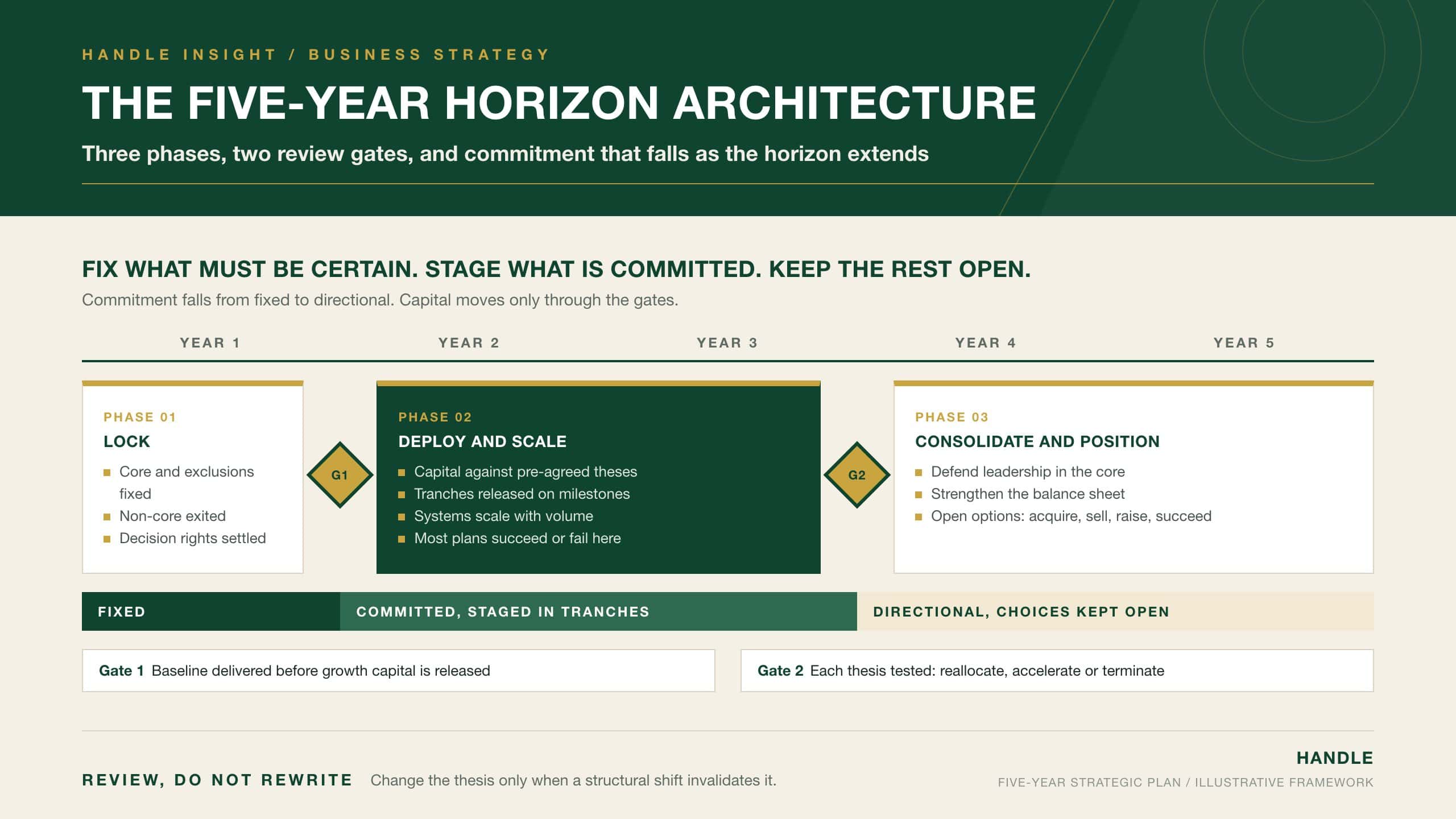
A practical way to design a plan that holds its course and still adapts is to treat the five years as three phases separated by formal review gates, with the degree of commitment falling as the horizon extends.
- Lock (year one). Commitment is highest. Structure, exits, baseline budgets and decision rights are fixed.
- Gate one. The board confirms the baseline has been delivered before growth capital is released.
- Deploy (years two and three). Theses are committed, but capital is staged in tranches linked to milestones.
- Gate two. The board tests each thesis against evidence, reallocating, accelerating or terminating.
- Position (years four and five). Direction is set but specific choices remain open: acquisition, partial exit, capital raising or succession.
The architecture works because it separates what must be certain from what can be decided later. Fixing the baseline removes ambiguity at the start. Staging deployment keeps capital disciplined in the middle. Keeping the final phase directional preserves options that cannot sensibly be chosen five years in advance. The deploy phase is where most plans succeed or fail, because it is where capital is committed and where the temptation to fund opportunities outside the theses is strongest.
Common Five-Year Planning Failures
- Writing the plan as a revenue forecast, so it describes an outcome without committing to the decisions needed to reach it.
- Leaving out strategic exclusions, which allows every new opportunity to compete for the capital reserved for the core.
- Releasing all growth capital at once instead of in milestone-linked tranches, so underperforming initiatives continue to be funded.
- Reviewing the plan annually by rewriting it, which turns a five-year commitment into a series of one-year plans.
- Changing metric definitions between years, making it impossible to tell whether the strategy is working.
- Paying executives on annual results while expecting them to deliver multi-year investments.
- Failing to align reserved matters with the company’s constitutional documents, creating doubt about who can approve key decisions.
Each of these failures weakens the plan’s authority. Once authority is lost, the plan stops shaping decisions.
Conclusion
Building a 5-year strategic plan is an exercise in deciding what will be fixed, what will be committed in stages and what will be left open. Year one locks the baseline: the strategic core, the exits, the capital structure and the decision rights. Years two and three deploy capital against agreed theses, released in tranches and tested at a formal gate. Years four and five consolidate the position and keep strategic alternatives available. Around that architecture sit a capital framework with clear reallocation authority, a short list of stable control metrics, pre-agreed risk responses and incentives that reward progress against the plan rather than the year. Reviewed annually and rewritten only when the thesis is invalidated, such a plan survives leadership changes and market cycles. It does not predict the future. It governs the decisions that shape it. Direction holds. Capital follows.


