

Most organisations do not lack strategy. They lack a fixed moment at which strategy is decided, tested and enforced. Without that moment, direction is reopened whenever a quarter disappoints, capital is committed whenever a sponsor is persuasive, and the board spends its time reacting to papers rather than making decisions. Creating a strategic planning calendar addresses this problem directly. Within Strategic Planning & Visioning, the calendar is the governance instrument that fixes when each class of decision is taken, who holds the authority to take it, what evidence must be ready and when the matter is closed. It is not a list of meeting dates. It is a sequence of commitments that removes drift, shortens decision latency and keeps board authority, executive delivery and capital discipline in step through the year. When the calendar governs, settled decisions stay settled. Rhythm is a control.
Why Does Strategy Need a Calendar at All?
Institutions operate continuously, but strategy does not need to be decided continuously. It needs defined moments of review, recalibration and enforcement, with clear rules about what may and may not be reopened between them. A strategic planning calendar creates those moments in advance, before any particular pressure arises.
The benefit is protection against three forms of reactive planning. The first is market noise, where a single data point prompts a change of direction that the evidence does not support. The second is leadership pressure, where a persuasive executive secures a decision outside the cycle because the board has no basis for deferring it. The third is short-term performance, where a weak quarter quietly reopens a multi-year thesis. A calendar answers each of these with the same response: the matter will be decided at the scheduled point, on complete evidence, by the body that holds the authority.
The calendar also makes governance visible. Directors, investors and lenders can see when strategy will be confirmed, when capital will be allocated and when execution will be tested. Predictability of process builds confidence in the decisions it produces.
How Does a Planning Calendar Differ From the Budget Cycle?
The most common design error is to treat the strategic planning calendar as an extension of budgeting. The two are related, but they answer different questions. Budgeting allocates resources for a defined period. Strategic planning governs direction, scope and risk posture over several years. When the two are merged, strategy collapses into incremental forecasting: next year looks like this year plus a percentage.
| Dimension | Strategic Planning Calendar | Annual Budget Cycle |
|---|---|---|
| Core question | Where are we going and what will we not do? | What will we spend and earn next year? |
| Time horizon | Three to ten years, confirmed annually | Twelve months |
| Primary owner | Board, with executive recommendation | Executive and finance, with board approval |
| Key outputs | Strategic priorities, explicit exclusions, risk appetite, capital posture | Revenue, cost and capital expenditure targets |
| Change rule | Reopened only at the direction cycle or through a defined exception | Reforecast within approved strategic limits |
The calendar must therefore separate strategic decisions from financial mechanics while keeping the two aligned. Strategy sets the frame. Budgets conform to it.
What Are the Core Cycles of a Strategic Planning Calendar?
An effective calendar is built on a small number of non-negotiable cycles. Each has a defined purpose, a defined output and a defined decision authority. Adding further cycles rarely improves control. It usually dilutes attention.
The Strategic Direction Cycle
This cycle governs long-term direction. It is normally held once a year and owned by the board. Its purpose is to confirm or adjust the strategic thesis, risk appetite and capital posture. Its outputs are validated strategic priorities and, equally important, explicit exclusions: the markets, activities and transactions the organisation has decided not to pursue.
The Scenario and Risk Review Cycle
This cycle tests strategy against uncertainty. It reviews scenario assumptions, trigger points and response readiness. Its purpose is to confirm that the strategy remains resilient without reopening direction unnecessarily. A scenario review that ends in a new strategy has usually been run in place of the direction cycle, not alongside it.
The Capital Allocation Cycle
This cycle governs the deployment of capital in line with confirmed strategy. It sets investment ceilings, reserve requirements and reallocation rules. Capital decisions taken outside this cycle require explicit exception approval and are recorded as exceptions.
The Execution Review Cycle
This cycle monitors delivery against strategic objectives. It concentrates on milestones, variance and corrective action. It does not revisit strategy unless a structural deviation is evident, and when it is, the matter is referred to the direction cycle rather than decided in the execution forum.
How Should the Year Be Sequenced?
The order of the cycles matters more than their dates. A planning calendar must follow strategic logic rather than administrative convenience. Capital cannot be allocated coherently before direction is confirmed, and execution cannot be judged fairly before capital has been committed.
First quarter: direction and risk. The year opens with confirmation of strategic direction and a scenario review. The organisation enters the year with clarity on ambition, constraints and downside exposure. No major capital or execution decisions should precede this phase.
Second quarter: capital and portfolio decisions. Once direction is set, capital allocation follows. Investments, divestments and funding actions are evaluated against the confirmed strategy, and portfolio adjustments are authorised here.
Third quarter: execution reinforcement. This phase concentrates on delivery. Performance is reviewed against strategic milestones, and underperforming initiatives are corrected or terminated before year-end pressure builds.
Fourth quarter: forward preparation. The final phase prepares the next cycle. Early insights are framed for the coming direction review, and budgets are finalised within strategic constraints. The calendar resets without reopening settled decisions.
Who Decides What, and When?
A planning calendar is ineffective without explicit decision rights. Each cycle must specify who decides, who recommends, who is consulted and who executes. The board governs direction, risk boundaries and capital posture, and its time is reserved for decisions that cannot be delegated without eroding governance. The executive team owns execution within approved parameters: it presents evidence, proposes action and delivers outcomes. Committees and management forums prepare material and enforce follow-through. They do not substitute for board or executive authority.
| Cycle | Decides | Recommends | Prepares | Closed When |
|---|---|---|---|---|
| Strategic direction | Board | Chief executive | Strategy function | Priorities and exclusions minuted |
| Scenario and risk | Board or risk committee | Chief risk officer | Risk and finance | Triggers and responses approved |
| Capital allocation | Board within delegated limits | Investment committee | Finance and business units | Ceilings and reserves recorded |
| Execution review | Executive committee | Programme owners | PMO | Corrective actions assigned with dates |
Anchoring the Calendar in the UAE Governance and Compliance Year
In the UAE, a strategic planning calendar does not operate in isolation from statutory and regulatory deadlines. It should be built around them so that strategic decisions are not crowded out by compliance work at the same moment.
For companies governed by the Commercial Companies Law (Federal Decree-Law No. 32 of 2021), the annual general assembly that approves the financial statements is a fixed point; for joint stock companies it is generally required within four months of the financial year end, and the constitutional documents of other company forms set their own requirements. Under the UAE Corporate Tax regime (Federal Decree-Law No. 47 of 2022), the tax return for a tax period is due within nine months of the period end, and VAT returns follow the filing periods assigned by the Federal Tax Authority. Entities in the Dubai International Financial Centre or Abu Dhabi Global Market add the reporting and filing timetables of their own registrars and, where regulated, of the DFSA or FSRA.
None of these deadlines is a strategic decision. Each consumes finance and board attention. The calendar should place strategic cycles where they do not compete with audit, assembly and filing peaks.
A Worked Example: Calendar for a December Year-End Group
Consider an illustrative family-owned holding group with a 31 December year end, an onshore operating company and a DIFC holding company. Its calendar might read as follows.
- Late January: two-day board strategy session confirms the five-year thesis, three priorities and four explicit exclusions.
- February: risk committee approves three scenarios with defined trigger points, such as a sustained fall in a key market’s volumes beyond an agreed percentage.
- April: annual general assembly approves the prior-year audited financial statements, outside any strategy discussion.
- May: investment committee allocates an illustrative AED 120 million growth budget across four initiatives and holds AED 20 million in reserve, releasable only by board resolution.
- July and October: execution reviews against milestones; one initiative is paused in July and its unused allocation returned to reserve.
- September: Corporate Tax return filed before the nine-month deadline, with no strategic agenda that month.
- November: budget finalised within the May capital ceilings; insights for January are framed but not decided.
Every paper is subject to a data cut-off ten working days before its meeting. Information arriving after the cut-off waits for the next cycle unless it meets an exception threshold. The result is twelve months in which every major decision has a home.
How Is the Calendar Embedded in Governance?
A planning calendar must be formalised. Informal calendars are overridden as soon as pressure arrives. Board and committee charters should refer to the calendar explicitly, which anchors the timing and scope of decisions to governance mandates. Capital approval policies, risk escalation rules and reporting standards should align with it, so that a request arriving out of cycle is visibly an exception requiring justification.
Evidence discipline completes the design. Materials for each cycle must be written as decision briefs, not updates: the issue, the evidence, the options, the consequences and the recommendation. Data cut-off dates must be fixed. Late information is deferred, which prevents endless postponement and protects the integrity of each decision.
Managing Exceptions Without Undermining the Calendar
Exceptional events will occur. The calendar must absorb them without collapsing. Thresholds for out-of-cycle decisions should be defined in advance, typically material regulatory change, a liquidity event, a transaction opportunity with a fixed deadline or an existential risk. When a threshold is met, escalation follows a defined path: the decision is taken by the body that would have taken it in cycle, it is confined to the matter that triggered it and it is recorded. The calendar then resumes intact.
An exception that is not recorded becomes precedent. A recorded exception remains an exception.
Original Analysis: The Quarterly Decision Rhythm
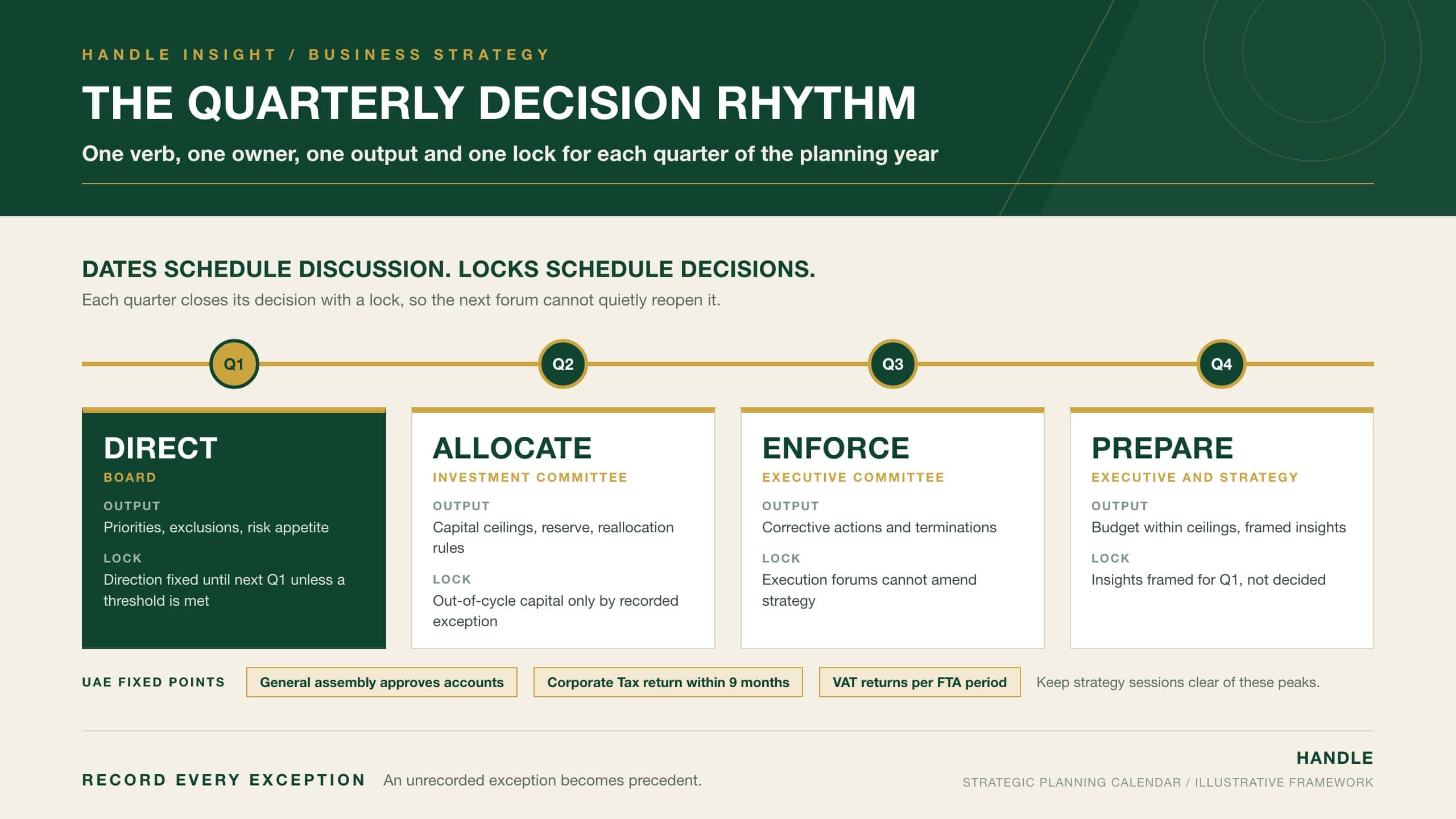
The Quarterly Decision Rhythm is a simple model for judging whether a calendar is doing its job. It assigns each quarter one dominant verb, one owner, one output and one lock: the rule that prevents the decision taken in that quarter from being reopened in the next.
| Quarter | Verb | Owner | Output | Lock |
|---|---|---|---|---|
| Q1 | Direct | Board | Priorities, exclusions, risk appetite | Direction fixed until next Q1 unless an exception threshold is met |
| Q2 | Allocate | Board and investment committee | Capital ceilings, reserve, reallocation rules | Out-of-cycle capital only by recorded exception |
| Q3 | Enforce | Executive committee | Corrective actions, terminations | Execution forums cannot amend strategy |
| Q4 | Prepare | Executive with strategy function | Budget within ceilings, framed insights | Insights framed, not decided |
The lock is the element most calendars omit. A calendar with dates but no locks schedules discussion. A calendar with locks schedules decisions. Where the lock for a quarter is routinely broken, the board learns precisely which part of its governance is under pressure.
Common Failures in Strategic Planning Calendars
- Cycles are scheduled too frequently, so strategy is effectively reopened every quarter and nothing is ever settled.
- Decision rights are blurred, so committees take decisions that belong to the board or the board is drawn into execution detail.
- Leadership bypasses the calendar under pressure, and each unrecorded bypass makes the next one easier to justify.
- Execution reviews quietly reopen strategic direction instead of referring structural deviations to the direction cycle.
- Strategic sessions are placed in the same weeks as audit, general assembly or tax filing work, so neither receives proper attention.
- Papers arrive as narrative updates rather than decision briefs, and meetings revert to opinion.
Each failure reintroduces drift. Each is avoidable when the calendar is written into governance rather than kept as a diary.
Conclusion
Creating a strategic planning calendar is an act of institutional discipline. It fixes when strategy is set, when it is tested against uncertainty, when capital is committed and when execution is enforced. It separates strategic decisions from budgeting while keeping the two aligned, assigns each cycle a clear owner and output, and anchors the year around the statutory and tax deadlines that already shape a UAE organisation’s governance. The Quarterly Decision Rhythm adds the missing element: a lock that stops each decision from being reopened in the next forum. Exceptions remain possible, but they are defined in advance, confined to their trigger and recorded. The outcome is a year in which decisions occur by design rather than by reaction. Authority holds. Capital is controlled. Execution stays aligned.


