

Most strategies do not fail because the direction was wrong. They fail in translation, when priorities are announced but sequencing is unclear, ownership is implied rather than assigned and dependencies are discovered halfway through delivery. A strategy execution roadmap is the instrument that prevents this, and a template is what makes the instrument consistent across every unit that uses it. Within Strategic Planning & Visioning, strategy execution roadmap templates define the fields every plan must complete, the gates every initiative must pass and the cadence at which leadership reviews progress. The objective is not a more attractive slide. It is a common operating discipline that makes deviation visible early and correction routine. A roadmap that explains delay has failed. A roadmap that forces decisions is working.
What an Execution Roadmap Must Answer
An effective roadmap answers five questions without debate: what moves first, what depends on it, who owns each move, what resources are committed, and when leadership intervenes if performance deviates. If any of these questions requires a meeting to answer, the roadmap is incomplete.
These questions also explain why a roadmap differs from a strategy document. A strategy states intent and choices. A roadmap converts those choices into sequence, ownership and commitment, and creates the record against which delivery will be judged. It is the bridge between what the board approved and what the organisation does on Monday.
Why Templates Matter More Than the Plans Themselves
Without a template, each business unit builds its roadmap in its own format, with its own definitions of a milestone, a risk or a completed initiative. The result cannot be aggregated, compared or reviewed consistently. Leadership ends up interpreting narratives rather than reading evidence.
A standard template removes that problem. It fixes the fields, the terminology and the decision points, so every roadmap can be read the same way and rolled up into a single enterprise view. Templates are not shortcuts. They are control devices. Without them, roadmaps become narratives. With them, roadmaps become an operating system.
The Core Components of a Roadmap Template
Every template should contain a fixed set of components. Omitting any one of them creates a blind spot that will surface during execution.
| Component | What It Captures | Control It Enforces |
|---|---|---|
| Strategic objective | The objective each initiative serves | Initiatives that cannot be mapped do not proceed |
| Initiative definition | Outcome, boundary and success condition | Blocks scope creep at the point of approval |
| Sequencing and phasing | Order based on dependency, risk and capital impact | Parallel work only where dependencies are resolved |
| Ownership | One accountable owner with authority to execute | No shared ownership; support roles listed separately |
| Milestones and gates | Progress markers and decision points | Advancement requires evidence, not optimism |
| Resources and capital | Headcount, budget and external support committed | Unfunded initiatives do not appear on the roadmap |
| Risks and dependencies | Key risks, mitigations and escalation thresholds | Prevents surprise-driven delay |
| Metrics and cadence | Outcome measures and fixed review dates | Progress is reviewed on schedule, not on request |
The distinction between milestones and gates deserves emphasis. A milestone records that something has happened. A gate is a decision: proceed, adjust, pause or stop. Templates that contain milestones but no gates track progress without ever forcing a choice.
Which Type of Roadmap Template Does Each Level Need?
One template does not fit every level of the organisation. Four types cover most needs, and they must connect so that detail at one level feeds the level above without reinterpretation.
| Template Type | Owner | Typical Horizon | Review Cadence | Level of Detail |
|---|---|---|---|---|
| Enterprise strategy roadmap | Executive team, reviewed by the board | Three to five years | Quarterly | Objectives, major initiatives, capital and risk |
| Programme roadmap | Senior executive accountable for outcomes | One to two years | Monthly | Coordinated initiatives and cross-functional dependencies |
| Initiative delivery roadmap | Initiative owner | Weeks to months | Fortnightly or weekly | Tasks, milestones, resources and issues |
| Turnaround or transformation roadmap | Chief executive or transformation lead | Months, in short phases | Weekly at the start | Tight gates, cash and risk oversight, stabilisation before growth |
The turnaround template is the exception that proves the rule. Under pressure, phases shorten, gates tighten and capital oversight intensifies. The same fields apply, but the tolerance for deviation is far lower.
Design Principles for Templates That Hold
Templates succeed or fail on design discipline. Four principles distinguish templates that enforce execution from those that are filled in and ignored.
Every field supports a decision. Descriptive fields are minimised. Evidence, commitments and thresholds are prioritised. If no one will decide anything differently because a field is completed, the field should be removed.
Language is standardised. Objectives, milestones, gates and metrics are defined once and used consistently, so initiatives can be compared across units.
Visibility without noise. Senior views show progress, risk and decisions required. Execution views hold operational detail. Neither overwhelms the other.
Governance is embedded. Approval points, escalation paths and authority thresholds are built into the template rather than added as a separate process. The template itself tells the user when to escalate and to whom.
How to Build a Roadmap From the Template
The order in which the template is completed matters. Teams that start with timelines tend to produce schedules that look precise and rest on unexamined assumptions. A more reliable sequence starts with the objective and works outwards.
First, confirm the strategic objective and the outcome that will show it has been achieved. Second, define the initiatives required to reach that outcome, each with a boundary and success condition. Third, map dependencies between initiatives and identify the critical path. Fourth, assign owners and confirm that each owner has the authority and resources the initiative needs. Fifth, place gates at the points where a decision to continue, adjust or stop would change capital or risk materially. Only then should dates be set, because dates set before dependencies are understood are rarely met.
The completed draft should be challenged by someone outside the team, usually the strategy office or a peer executive, before it is submitted for approval. Challenge at this stage is cheap. Challenge after launch is expensive.
Worked Example: An Eighteen-Month UAE Expansion Roadmap
Consider an illustrative group planning to enter the UAE market with a regional hub, with AED 25 million of approved capital over eighteen months. The programme roadmap divides the work into three phases, each closed by a gate, and releases capital in tranches tied to those gates.
Phase one, months one to four: establish. The group incorporates its holding and operating entities, for example a holding company in the DIFC or ADGM and an operating company licensed onshore or in a free zone that permits the intended activity. It opens bank accounts and completes Corporate Tax and, where required, VAT registration. Capital released: AED 5 million. Gate one requires the operating licence issued, bank accounts active and the first senior hires in place.
Phase two, months five to ten: build. The group recruits its core team, deploys systems and signs its first customer contracts. Capital released: AED 12 million. Gate two requires a contracted pipeline of an agreed value, the core team at an agreed headcount and operating costs within ten per cent of budget.
Phase three, months eleven to eighteen: scale. The group expands sales coverage and moves stabilised processes into business-as-usual controls. Capital released: AED 8 million, but only if gate two was passed without exception.
The structure means that if licensing takes longer than planned, AED 20 million remains uncommitted until the delay is resolved. The roadmap has protected capital without anyone having to argue for it.
Using the Roadmap Across the Execution Lifecycle
A roadmap evolves under control. At initiation, it forces clarity: objectives, scope, ownership and resources are locked before execution begins. During active execution, it is the reference point against which progress is reported and variance is made visible. When performance deviates, intervention follows predefined options: course correction, resource reallocation or termination. At closure, completed initiatives are formally closed, outcomes are confirmed and execution metrics transfer into operational controls.
The roadmap should connect to the organisation’s wider governance cycle. Boards review enterprise roadmaps for coherence and risk. Budgets follow roadmap commitments, and spending outside the roadmap requires exception approval. Executive performance is assessed against roadmap delivery, so incentives point in the same direction as the strategy.
Implementing Roadmap Discipline at Scale
A template is only as strong as the institution that maintains it. Three practices determine whether templates survive their first year.
Central ownership of the template. One function, usually a strategy or transformation office, owns the template and its definitions. Units may add fields relevant to their work, but they may not remove core fields or redefine terms. Changes to the template itself require approval, so that consistency is preserved across planning cycles and roadmaps from different years remain comparable.
Training and expectation setting. Leaders are trained to use the roadmap as an execution tool rather than a reporting obligation. Expectations are explicit: roadmaps are current before each review, gates are not passed without evidence and variance is reported when it occurs, not when it can no longer be hidden. Non-compliance is addressed as a performance issue.
Tool integration. Roadmaps should live in a system that supports version control, dependency tracking and roll-up reporting. Spreadsheets and slide decks circulated by email multiply versions and make it impossible to know which plan is current. The system does not need to be complex. It needs to hold one authoritative version of each roadmap and show who changed what, and when.
Organisations that skip these practices often find that their templates decay within a few cycles. Fields are left blank, definitions drift and each unit quietly returns to its own format. Discipline at scale is a governance choice, renewed every planning cycle.
Original Analysis: The Three-Tier Roadmap Cascade
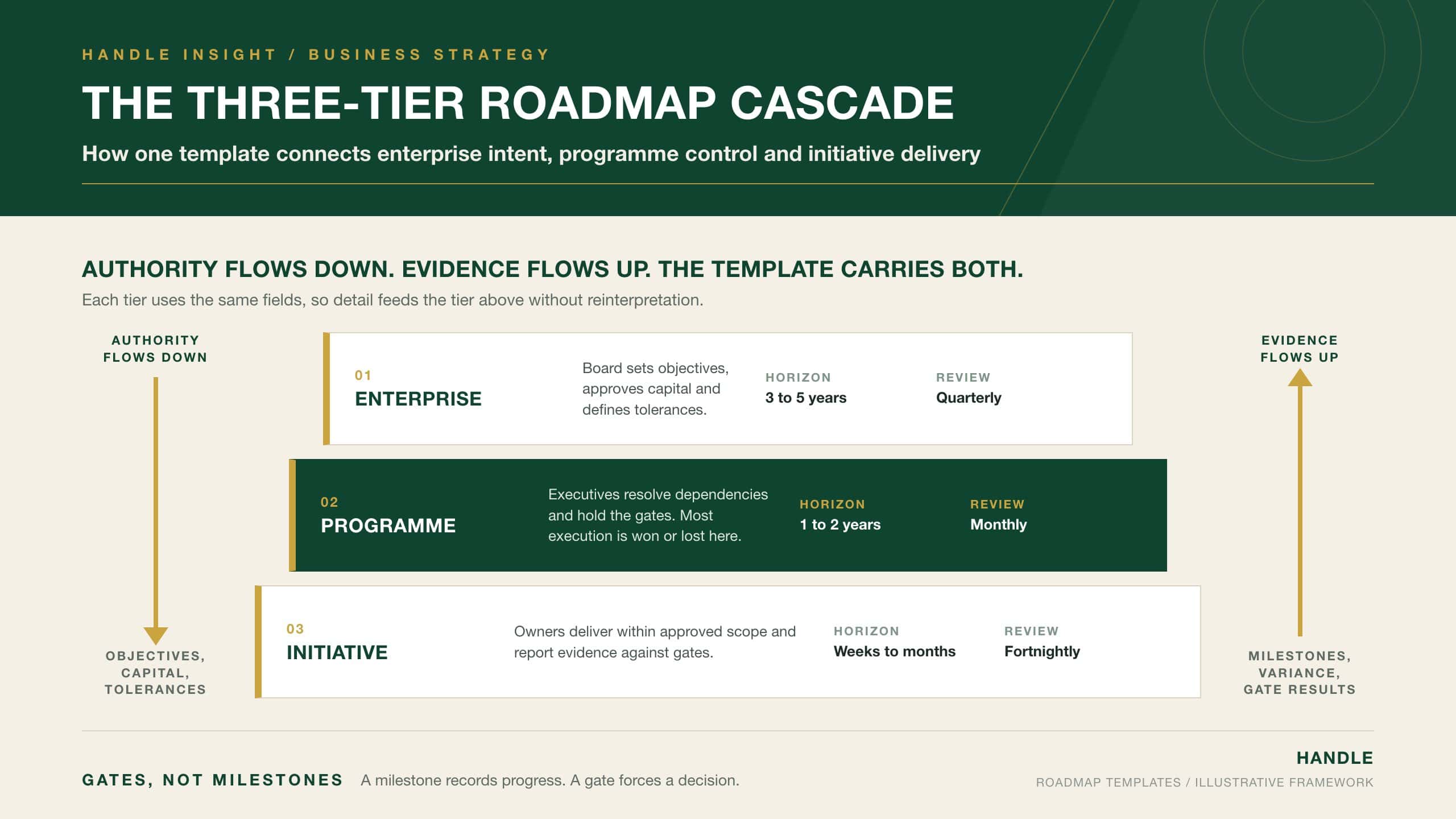
Roadmap templates work as a system rather than as individual documents. The Three-Tier Roadmap Cascade describes how authority flows down and evidence flows up between the enterprise, programme and initiative tiers.
- Enterprise tier. The board and executive team set objectives, approve capital and define the tolerances within which programmes may operate. Authority originates here.
- Programme tier. Senior executives translate objectives into coordinated initiatives, resolve dependencies between functions and hold the gates. This is where most execution is won or lost, because it is where competing initiatives meet shared resources.
- Initiative tier. Owners deliver tasks and milestones within the scope, budget and timetable approved above them, and report evidence against gates.
The cascade fails in predictable ways. If authority does not flow down, programme leaders cannot reallocate resources and escalate everything. If evidence does not flow up unaltered, the board sees an optimistic summary rather than the true position. The template is the mechanism that keeps both flows intact.
Common Roadmap Failures
- Allowing each unit to customise the template, so roadmaps can no longer be compared or aggregated.
- Assigning initiatives to teams rather than to named owners with authority to execute.
- Recording milestones without gates, so the roadmap tracks progress but never forces a decision.
- Including initiatives that have no committed funding, which inflates the plan and dilutes attention.
- Updating the roadmap to explain delay rather than to trigger correction.
- Treating the roadmap as a communication document rather than a control instrument.
Each failure turns the roadmap back into a narrative. Template discipline keeps it an instrument.
Conclusion
Strategy execution roadmap templates turn strategic intent into sequence, ownership and commitment that can be reviewed consistently across the organisation. A good template fixes the essential fields: objective, scope, sequence, owner, gates, resources, risks and metrics. It provides different versions for the enterprise, programme, initiative and turnaround levels, and connects them so that authority flows down and evidence flows up without distortion. Gates, not milestones, are what make the roadmap enforceable, and capital released in tranches against those gates protects the organisation when execution slips. Templates must be governed centrally, used by trained leaders and supported by systems that preserve version control. When they are, strategy stops being an annual declaration. It becomes a governed process. Delay is visible early. Decisions are made on evidence. Delivery holds.


