

A company in distress does not need a better strategy document. It needs a short, enforceable programme that stops cash leaving faster than it arrives, restores authority over decisions and gives creditors a reason to stay patient. A 90-day corporate recovery plan does that by compressing the work into a horizon that management cannot defer and stakeholders can verify. Ninety days is long enough to stabilise liquidity and reset the cost base, and short enough that slippage is visible within weeks rather than quarters. Within Turnaround & Recovery, the 90-day plan is the execution architecture that converts a diagnosis into controlled delivery: one mandate, a cash-led sequence, three gated phases and a weekly governance rhythm. The objective is not a vision for the business. It is control of the business. Recovery starts with authority, not analysis.
Why a 90-Day Horizon Rather Than a Longer Plan?
Long recovery plans fail under pressure for a simple reason: they cannot be tested in time. A twelve-month plan promises improvement in later quarters while the cash position deteriorates today. Lenders, suppliers and employees are asked to trust a forecast they have no way to check.
A 90-day corporate recovery plan reverses that logic. It commits to a small number of outcomes that can be measured within the period, publishes the evidence weekly and earns the right to a longer strategic plan by delivering the first one. It also aligns with the 13-week cash forecast that most lenders and advisers expect in a stressed situation, so the plan and the liquidity view run on the same clock.
The short horizon is not a promise that every problem will be solved in three months. It is a commitment that control will be restored in three months, so that longer-term decisions are taken from a stable base rather than in crisis.
What Must Be in Place Before the Plan Starts?
No recovery plan survives without authority. The plan begins with a formal mandate approved by the board, or by a restructuring committee to which the board has delegated authority. The mandate should be in writing and should define:
- A single accountable execution lead, whether the chief executive, a chief restructuring officer or an interim leader, with direct reporting to the board or committee.
- Authority across operations, cash and stakeholder engagement, including the right to suspend non-essential projects and spending.
- The reporting cadence to the board and to key creditors, and the information each will receive.
- Reserved matters that remain with the board, so that the execution lead’s authority is wide but not unlimited.
The mandate removes ambiguity and closes parallel decision channels. Without it, every intervention becomes a negotiation with the function it affects.
The UAE Legal Backdrop Boards Should Understand
A 90-day plan is a management tool, but it operates within a legal framework that directors in the UAE should keep in view. Onshore, financial restructuring and insolvency are governed by Federal Decree-Law No. 51 of 2023 on Financial Restructuring and Bankruptcy, which replaced the earlier 2016 bankruptcy law. It provides court-supervised procedures, including preventive composition and restructuring, that allow a debtor to agree a plan with creditors under court oversight. The DIFC and ADGM operate their own insolvency regimes for entities established in those financial free zones.
Two practical points follow. First, the law places obligations on a debtor that has ceased to pay its debts for a sustained period to consider and, where required, apply for formal proceedings within a statutory window, and directors may face exposure if they allow the position to deteriorate without acting. Second, informal agreements with creditors, such as standstills and covenant waivers, are contractual and depend on the terms of existing facilities and security. Boards should take legal advice early in the first phase so that the plan is designed with the formal options in mind, rather than discovering them when informal support runs out.
How Should Objectives Be Set?
Recovery plans fail when they try to fix everything. The 90-day horizon enforces selectivity. Objectives should be few, measurable within the period and directly linked to control. A typical set covers four outcomes: liquidity stabilised with predictable weekly cash movements; a cost base resized to the revenue the business can realistically sustain; key stakeholder support secured on documented terms; and core operations delivering to customers without disruption.
If an objective cannot be measured within 90 days, it belongs in the next plan. Revenue growth initiatives, new markets and major technology changes usually fall into that category. They are not abandoned. They are sequenced.
Why Cash Leads Every Workstream
Cash is the pacing mechanism of recovery. Every workstream is ranked by its effect on liquidity, and every payment is released against a rolling forecast. The cash workstream usually starts on day one with four actions: centralising payment authority so that no payment leaves without approval; building a 13-week rolling cash forecast that is updated and reconciled weekly; tiering payments by criticality to operations and legal obligation; and releasing working capital trapped in receivables, inventory and unbilled work.
Payment tiering requires judgement. Payroll, taxes, critical suppliers and secured lenders typically sit in the top tier. Discretionary spending, deferrable capital expenditure and non-critical services sit lower. The aim is not to stop paying creditors arbitrarily. It is to ensure that each payment is a decision, made with the forecast in view.
Original Analysis: The Three-Gate Recovery Timeline
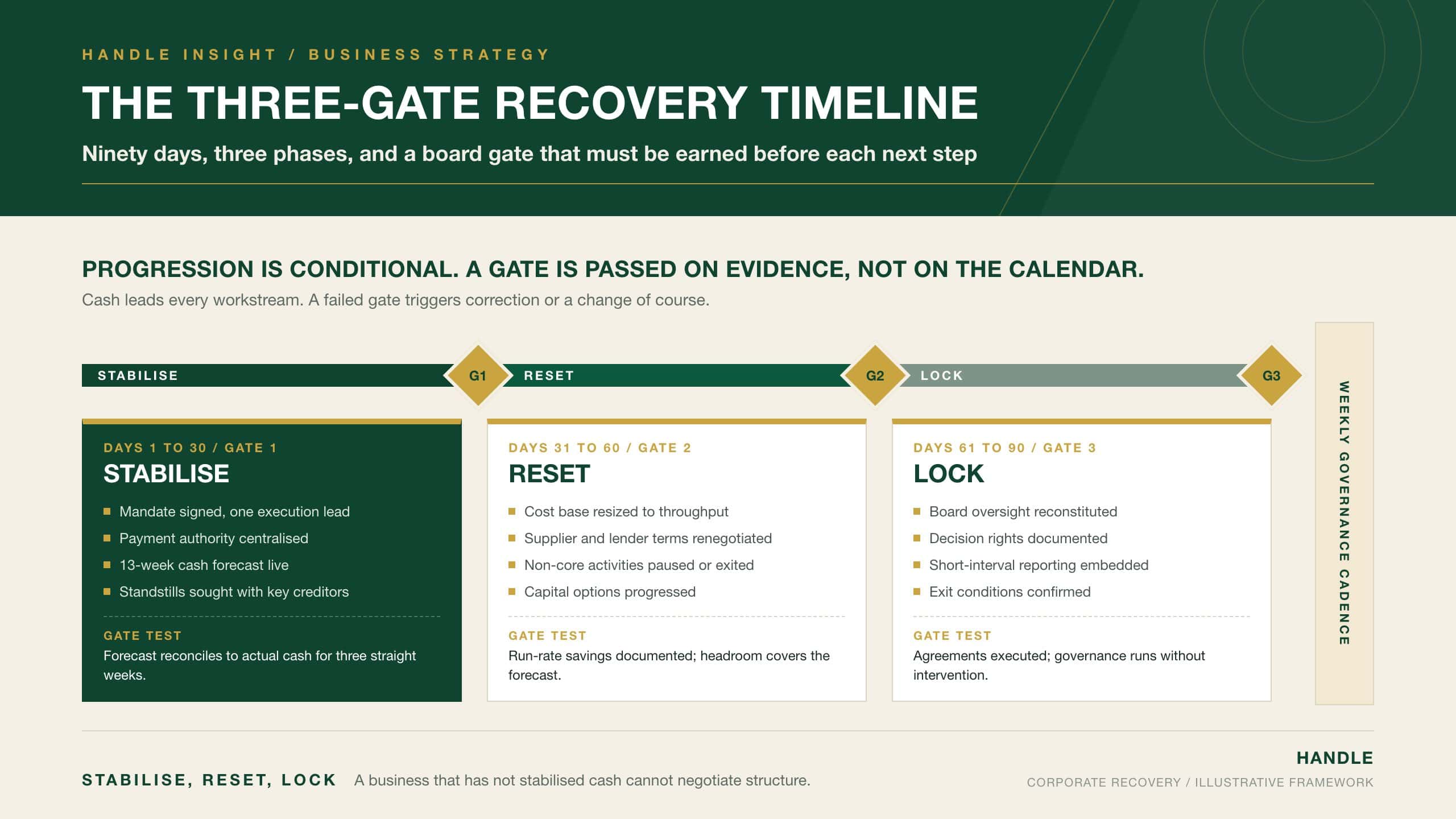
The 90 days are not a single block. They are divided into three phases, each closed by a gate that the board must pass before the next phase begins. Progression is conditional. A gate that is not passed is not ignored; it triggers either a corrective action within a defined period or a change in the plan, including consideration of formal restructuring options.
| Phase | Objective | Core Actions | Gate Test to Proceed |
|---|---|---|---|
| Days 1 to 30: Stabilise | Stop deterioration and reassert control | Mandate signed, payment control centralised, discretionary spend frozen, interim standstills sought, 13-week forecast live | Forecast reconciles to actual cash within an agreed tolerance for three consecutive weeks; no unplanned enforcement action |
| Days 31 to 60: Reset | Address the structural causes of distress | Cost base resized to throughput, supplier and lender terms renegotiated, non-core activities paused or exited, capital options progressed | Run-rate cost reductions documented; key creditor terms agreed in principle; liquidity headroom covers the forecast period |
| Days 61 to 90: Lock | Institutionalise the gains before discretion returns | Board or committee oversight reconstituted, decision rights and reserved matters documented, short-interval reporting embedded | Agreements executed; governance operating without intervention; board approves exit from recovery mode |
The gates are what distinguish a recovery plan from a recovery wish. Each one forces the board to compare evidence with the plan and to decide whether to proceed, correct or change course. The first gate is the most important, because a business that has not stabilised its cash cannot negotiate its structure.
A Worked Example: The First 30 Days in Numbers
Consider an illustrative UAE manufacturer with AED 18 million of cash, weekly operating outflows of AED 4.2 million and weekly receipts that have fallen to AED 3.1 million. Cash falls by AED 1.1 million a week. A AED 6 million loan instalment is due in week nine. By then cash would stand at about AED 9.2 million; paying the instalment would leave roughly AED 3.2 million, which the weekly outflow would exhaust within three weeks. On that profile the business runs out of cash around week twelve, inside the forecast window.
In the first phase the execution lead freezes AED 0.3 million of weekly discretionary spend and launches a collection drive on AED 9 million of overdue receivables that recovers an average of AED 0.4 million a week. Weekly net outflow falls from AED 1.1 million to AED 0.4 million. A further AED 2.5 million of non-critical capital expenditure is deferred, and the lender agrees under a standstill to defer the week-nine instalment while terms are renegotiated. The 13-week forecast now ends at about AED 12.8 million, with the deferred capital expenditure protecting further headroom above the minimum operating balance. Gate one is passed not because the business is healthy, but because its cash is now predictable. The figures are illustrative. The logic applies to any stressed balance sheet.
Who Owns What: The Recovery Decision Matrix
Recovery plans fail when accountability is diffused across committees and functions. Each workstream needs one named owner with decision rights, measurable outputs and direct access to the execution lead. The matrix below sets out a typical allocation.
| Decision | Execution Lead | Workstream Owner | Board or Committee |
|---|---|---|---|
| Release of payments within approved tiers | Approves | Proposes | Receives weekly report |
| Workforce and overhead reductions | Recommends | Designs and implements | Approves |
| Creditor standstills and covenant amendments | Negotiates | Supports with data | Approves final terms |
| Exit or pause of non-core activities | Recommends | Prepares case | Approves |
| Entry into formal restructuring procedures | Advises | Not involved | Decides, on legal advice |
Running the Plan on a Weekly Cadence
A 90-day corporate recovery plan runs on cadence. Weekly governance sessions replace monthly reviews, and decisions are made in the meeting rather than deferred to the next one. A disciplined agenda covers four items: the cash variance against the 13-week forecast and its explanation; delivery status of each milestone against its deadline; stakeholder risk, including any creditor, supplier or employee issue that could escalate; and a decision log recording what was decided, by whom and with what consequence.
Frequency is itself a control. When owners know they will report every week, slippage surfaces in days. When reporting is monthly, a missed milestone can absorb half of a phase before anyone acts on it.
When Is Recovery Complete?
The plan should end only when predefined exit conditions are met. Leaving recovery mode without criteria recreates fragility, because discretion returns before discipline is embedded. Typical exit conditions are that cash forecasts have been met consistently over several weeks, the cost base is aligned with achievable revenue, stakeholder agreements are executed and stable, and governance is operating without intervention from the execution lead. Recovery is complete when predictability replaces volatility.
Common 90-Day Recovery Plan Failures
- Starting analysis before the mandate is signed, so the execution lead spends the first weeks negotiating authority rather than exercising it.
- Setting too many objectives, which spreads management attention and makes it impossible to tell whether the plan is working.
- Building the cash forecast once and not reconciling it weekly, so the board relies on numbers that no longer reflect reality.
- Treating phase gates as calendar dates rather than evidence tests, which allows the plan to move forward while the underlying position is still deteriorating.
- Assigning workstreams to committees or functions instead of named individuals, which removes accountability for missed deadlines.
- Delaying legal advice on formal restructuring options until informal creditor support has already been exhausted.
- Declaring success at day 90 without exit criteria and returning discretion to a management team whose controls have not yet been tested.
Each failure weakens control at the moment it matters most. Each is avoidable when the plan is treated as an enforcement instrument rather than a document.
Conclusion
A 90-day corporate recovery plan is not a roadmap. It is an enforcement instrument that restores control through authority, sequencing and measurable delivery. It starts with a written mandate and a single accountable lead, puts cash at the centre of every decision, and divides the period into three phases that must each be earned through evidence at a board gate. Stabilise, reset, lock. In the UAE, the plan should be designed with the formal restructuring options under Federal Decree-Law No. 51 of 2023, or the DIFC and ADGM regimes where relevant, in view from the first weeks, so that informal support and formal protection are not considered in isolation. Weekly governance keeps slippage visible. Exit criteria prevent discretion returning too early. Businesses that operate this way recover in days and weeks, not quarters. Those that plan without mandate or gates drift. Control comes first. Recovery follows.


