Classical strategy offers two routes to competitive advantage: be the lowest-cost operator, or offer something distinctive enough to command a premium. A hybrid strategy in business attempts both at once, delivering differentiated value at a cost base close to that of the efficient competitors. Within Business Strategy, hybrid strategy deserves careful treatment because it is both the most attractive position and the most frequently mis-executed. When it works, customers receive more value for a similar price and the business earns healthy margins without depending on a premium. When it fails, the organisation carries the costs of differentiation without the pricing power, and the efficiencies of a cost leader without the scale. The difference lies in whether the business has capabilities that lower cost and raise value at the same time. Hybrid is not a compromise between two strategies. It is a separate strategy with its own conditions for success.
What Is Hybrid Strategy in Business?
Hybrid strategy is a competitive approach that combines cost efficiency with meaningful differentiation. The business aims to offer customers a product or service they value above the market average, at a price at or slightly below the market average, while keeping its own costs low enough to earn an attractive margin.
The strategy rests on a simple economic idea. Profit is the gap between the price customers will pay and the cost of serving them. A cost leader widens the gap by reducing cost. A differentiator widens it by raising willingness to pay. A hybrid business attempts to widen it from both sides, usually by a smaller amount on each side, but with a combined effect that competitors find difficult to match.
Why Organisations Pursue a Hybrid Position
Markets have made pure positions harder to hold. Price comparison is easier, customers expect a good experience even at moderate prices, and technology allows competitors to copy features and match costs faster than before. A business that relies on a single source of advantage is exposed if that source is eroded.
A hybrid position offers three benefits. It broadens customer appeal, because the offer attracts both value-seeking and quality-seeking buyers. It improves resilience, because the business is less exposed to a price war or to a competitor launching a superior product. And it supports enterprise value, because margins are protected by two mechanisms rather than one.
Hybrid Strategy Versus Cost Leadership and Differentiation
The three generic positions differ in how they create the gap between price and cost, and in what they demand of the organisation.
| Dimension | Cost Leadership | Differentiation | Hybrid Strategy |
|---|---|---|---|
| Source of margin | Lowest cost in the market | Price premium from distinctive value | Above-average value at a near-average cost |
| Pricing | At or below market | Above market | At or slightly below market |
| Core capabilities | Scale, process efficiency, procurement | Brand, innovation, service, design | Capabilities that do both, such as technology platforms and standardised quality |
| Main vulnerability | A competitor with lower costs or a shift in customer priorities | Imitation or customers refusing to pay the premium | Losing clarity and drifting into the middle |
| Management challenge | Relentless cost control | Sustained investment in what customers value | Investing in value without letting costs drift |
The comparison shows why hybrid strategy is demanding. It does not require less discipline than the pure strategies. It requires both disciplines at once, applied to different parts of the business.
What Makes a Hybrid Strategy Work?
Capabilities That Serve Both Objectives
The decisive condition is the presence of capabilities that reduce cost and increase customer value simultaneously. A digital ordering platform that cuts processing cost and also makes buying easier is one example. A standardised operating model that lowers unit cost and also delivers consistent quality is another. Where every value investment adds cost and every cost saving reduces value, a hybrid position cannot be sustained.
Selective Differentiation
Hybrid businesses do not differentiate on everything. They identify the few attributes customers value most and invest heavily in those, while running everything else at the efficiency standard of a cost leader. The discipline lies in deciding what not to offer.
Operational Excellence
Operations are not a support function in a hybrid model. They are the mechanism through which both advantages are delivered. Consistency, speed, quality and scalability are what allow the business to offer more value without carrying the cost structure of a premium competitor.
Technology Enablement
Automation, analytics and integrated workflows are frequently the bridge between efficiency and differentiation. They allow personalised service at scale and reduce the cost of the features customers value.
Where Hybrid Strategies Appear in Practice
Hybrid positions are found across sectors. Retailers combine a curated, well-presented range with disciplined sourcing and logistics, so that the shopping experience feels premium while prices remain competitive. Technology providers offer advanced functionality through standardised, scalable delivery models that keep the cost of serving each customer low. Hospitality operators deliver consistent, well-designed service through tightly engineered operations. Professional services firms use technology and standardised methods to provide specialist expertise at a lower cost per engagement than traditional models.
The UAE market illustrates why the position is attractive. Customer bases in the country span a wide range of income levels and expectations, and many buyers are internationally experienced and compare offers across markets. Businesses serving these customers frequently need to meet high service expectations without relying on premium pricing across every segment. A hybrid model allows one operating platform to serve several segments, provided the business is clear about which attributes it will invest in and which it will run at efficiency standard.
A Worked Example: Comparing Four Competitive Positions
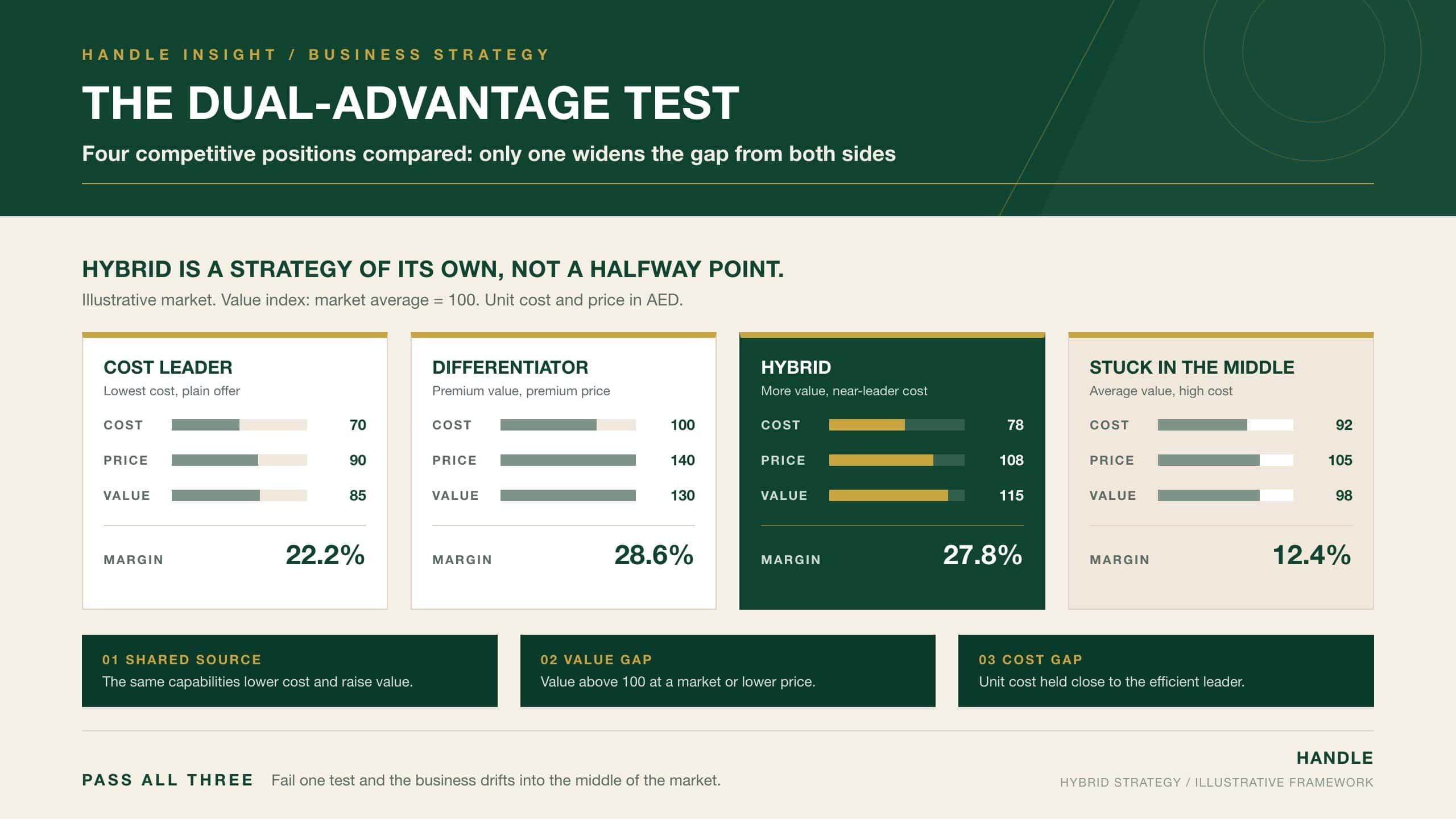
Consider an illustrative market in which four competitors sell a comparable service. Each is scored on unit cost, price and a customer value index, where 100 represents the market average.
| Competitor | Unit Cost (AED) | Price (AED) | Customer Value Index | Operating Margin |
|---|---|---|---|---|
| Cost leader | 70 | 90 | 85 | 22.2% |
| Differentiator | 100 | 140 | 130 | 28.6% |
| Hybrid competitor | 78 | 108 | 115 | 27.8% |
| Stuck in the middle | 92 | 105 | 98 | 12.4% |
The hybrid competitor earns a margin close to that of the differentiator while charging 23 per cent less, and offers noticeably more value than the cost leader at a price only AED 18 higher. Its cost base is AED 8 above the cost leader’s, which is the price of its selective differentiation. The fourth competitor shows the failure mode: costs close to the differentiator’s, value close to average and a price that cannot support a healthy margin. On paper, both the hybrid competitor and the stuck competitor sit between the two pure strategies. In practice, they occupy completely different positions. The numbers are illustrative. The pattern is common.
The Risk of Being Stuck in the Middle
The principal danger of hybrid strategy is drift. A business that adds features to compete with differentiators and cuts prices to compete with cost leaders, without the capabilities to support either, ends up with average value, above-average cost and squeezed margins. It is then exposed to both groups of competitors at once.
Drift usually happens gradually. Each product decision, discount or service addition seems reasonable in isolation. The cumulative effect is a cost base that has grown faster than customers’ willingness to pay. The protection is regular measurement of both sides of the gap, not a general commitment to value.
Original Analysis: The Dual-Advantage Test
A business claiming a hybrid strategy should be able to pass three tests. Together they distinguish a genuine hybrid position from a business stuck in the middle.
| Test | Question | Passing Evidence | Warning Sign |
|---|---|---|---|
| 1. Shared source | Do the same capabilities lower cost and raise customer value? | Named platforms or processes that deliver both outcomes | Separate initiatives for cost and value that compete for budget |
| 2. Value gap | Do customers rate the offer above average at an average or lower price? | Value index above 100 with price at or below market | Value near average while prices rise |
| 3. Cost gap | Is unit cost close to the efficient competitors and stable over time? | A defined, monitored distance from the lowest-cost competitor | Unit cost rising towards differentiator levels |
The tests are cumulative. A business that passes the value gap but fails the cost gap is an underpriced differentiator. A business that passes the cost gap but fails the value gap is a cost leader with a marketing claim. Only a business that passes all three holds a hybrid position, and the shared source test is the one that makes the other two sustainable. Without shared capabilities, the value gap and the cost gap pull against each other.
How Is a Hybrid Advantage Sustained Over Time?
A hybrid position decays if it is not renewed. Competitors copy visible features, suppliers raise prices, and the capabilities that once delivered both lower cost and higher value become industry standard. Sustaining the position requires three habits.
First, the business re-tests its position against competitors at a fixed interval, measuring unit cost, price and customer value on a consistent basis. Second, it renews the shared-source capabilities before they are matched, typically by investing in the next generation of technology, data or process design that can again lower cost and raise value together. Third, it removes features and services that customers no longer value, so that the cost of past differentiation does not accumulate. Each habit protects one side of the gap. Together they keep the hybrid position from sliding towards the middle. Advantage that is not renewed becomes parity.
The Role of Leadership
Leadership sustains the hybrid position by controlling resource allocation. Investment in value must be directed at the few attributes customers prize most. Cost discipline must apply everywhere else. Performance management should track customer value and unit cost together, so that neither side is optimised at the expense of the other. In practice, this means a leadership team prepared to refuse attractive proposals that would add cost without moving the value index, and to refuse savings that would reduce it.
Governance should reflect the same balance. The board pack for a hybrid business should show unit cost against the most efficient competitor, the customer value index against the market and the margin bridge between them on a single page. When the two measures are owned by different executives and reviewed in different meetings, trade-offs are made implicitly and drift follows. When they are reviewed together, every decision is tested against both sides of the strategy.
Common Mistakes in Pursuing a Hybrid Strategy
- Declaring a hybrid strategy without identifying the capabilities that deliver both lower cost and higher value.
- Differentiating on too many attributes, so that the cost base rises towards that of premium competitors.
- Cutting costs in the areas customers value most, which erodes the value gap that justifies the strategy.
- Measuring cost and customer value in separate reports owned by separate teams, so that drift goes unnoticed.
- Competing on price against cost leaders when the business lacks their scale or efficiency.
- Treating technology as a cost centre rather than as the main bridge between efficiency and differentiation.
Each mistake moves the business away from a defensible hybrid position and towards the middle of the market.
Conclusion
Hybrid strategy combines cost efficiency with meaningful differentiation to deliver above-average value at an average or lower price while preserving healthy margins. It is not a halfway point between cost leadership and differentiation, and it is not a slogan about value. It depends on capabilities that lower cost and raise customer value at the same time, on selective investment in the attributes customers prize most, and on operational and technological discipline everywhere else. The Dual-Advantage Test gives leadership a practical way to check the position: a shared source of advantage, a measurable value gap and a controlled cost gap. Businesses that pass all three earn resilience and pricing flexibility. Businesses that fail drift into the middle of the market. Hybrid strategy rewards clarity. It punishes drift.