Ask who is responsible for business strategy and most organisations will name the chief executive. The answer is incomplete. Strategy is set, approved, formulated, translated and delivered by different people, and each of those acts carries a different kind of accountability. Owners decide what the business is for. The board decides whether the proposed direction is acceptable and holds management to it. The chief executive decides how the organisation will compete and commits resources accordingly. Executives and business units convert that direction into results. Within Business Strategy, the practical question is not who writes the strategy document. It is who must answer when the strategy fails, and whether that person had the authority to change it. Responsibility without authority produces blame. Authority without responsibility produces drift. Strategy holds only when both sit in the same place.
Who Is Responsible for Business Strategy, in Law and in Practice?
Formal responsibility follows the legal form of the organisation. In a company, the board of directors, or the managers of a limited liability company, hold the power to manage the business and owe duties to the company in exercising it. Shareholders hold the rights reserved to them by law and the constitutional documents, usually including changes to capital, the constitution, major disposals and the appointment of directors. Executives hold only the authority delegated to them.
Practical responsibility is wider. The people who analyse markets, propose initiatives and run operations shape strategy every day, even though they cannot approve it. Confusion arises when practical influence is mistaken for formal accountability, or when the formal holders of authority leave strategy entirely to management and then disown the result.
The distinction can be stated simply. Owning strategy means making the decisions, allocating the resources and accepting the consequences. Participating in strategy means informing, analysing and implementing those decisions. Many people participate. Few own.
| Dimension | Strategic Ownership | Strategic Participation |
|---|---|---|
| Core act | Decides direction and commits resources | Provides information, analysis and delivery |
| Typical holders | Owners, board, chief executive | Executives, functional leaders, strategy teams, advisers, employees |
| Accountability | Answers for outcomes, including failure | Answers for the quality of its contribution |
| Authority source | Law, constitutional documents and formal delegation | Role description and instructions from owners of the decision |
| Risk if confused | Owners disown decisions they approved | Contributors are blamed for decisions they could not make |
Why Owners Define the Mandate
Every strategy answers to a purpose set by those who own the capital. Shareholders, founders and controlling families decide the return they expect, the risk they will tolerate, the time horizon they accept and whether they intend to hold, grow or sell the business. These choices are rarely written into a strategy document, yet they constrain every option management can propose.
In privately held and family businesses, the mandate is often implicit. Management is then forced to guess at it, and a strategy built on a guessed mandate is fragile. The remedy is to make the owner mandate explicit: target returns, leverage limits, dividend expectations, acceptable sectors and the intended exit or succession path. Owners who state their mandate gain the right to hold the board to it. Owners who do not state it lose that right in practice.
Why the Board Carries Final Accountability
The board sits between ownership and management. It approves strategic direction, tests whether the strategy is consistent with the owner mandate and the organisation’s risk appetite, approves major investments and disposals, and monitors execution. It also appoints, evaluates and, where necessary, replaces the chief executive. That last power is the board’s most important strategic tool, because it is the mechanism by which accountability for strategy is enforced.
The board should not write the strategy. A board that drafts detailed plans cannot objectively challenge them, and it blurs the line between oversight and management. Its contribution is challenge, approval and monitoring. Directors who approve a strategy they have not understood cannot later claim that its failure belonged to management alone.
Why the Chief Executive Owns Formulation and Resource Allocation
The chief executive translates the owner mandate and the board’s guidance into an actionable strategy. That means choosing where the organisation will compete, how it will win, what it will stop doing and how capital, people and management attention will be allocated. Formulation can be collaborative. Ownership of the final proposal cannot be shared.
The chief executive is also the person who adjusts direction between board meetings. When markets move, a competitor acts or an initiative underperforms, the chief executive decides whether to persist, redirect or escalate. That ongoing judgement is why the role is the hinge of strategic accountability. It sits close enough to operations to see the evidence and close enough to the board to change the plan.
How Executives, Business Units and Functions Share Delivery
Senior executives own the translation of strategy into their domains. The chief financial officer turns strategic priorities into capital allocation, financial targets and investment discipline. The chief operating officer aligns capacity, processes and service delivery. Commercial, technology and people leaders do the same in their areas. Each is accountable for the part of the strategy assigned to them, not for the strategy as a whole.
Business unit leaders adapt group direction to their markets and are accountable for measurable results: revenue, margin, market share and customer outcomes. Employees determine how well those results are achieved through the quality of their daily work. Strategy becomes real only when it changes what people prioritise. It changes behaviour only when targets, budgets and incentives reflect it.
Where Strategy Teams and Advisers Fit
Internal strategy teams and external advisers add analysis, structure and challenge. They model scenarios, assess competitors, test assumptions and run planning cycles. Their value is real, but their role is advisory. They do not approve strategy, allocate resources or answer for outcomes. An organisation that allows a strategy function or consultancy to become the de facto owner of direction has created a gap between those who design strategy and those who must live with it. Accountability cannot be outsourced.
A Strategic Accountability Matrix
Responsibility becomes clearer when it is assigned to each stage of the strategy process rather than to strategy in general. The matrix below sets out a typical allocation for a privately owned group with an independent board. A, R, C and I indicate accountable, responsible, consulted and informed.
| Strategy Stage | Owners | Board | Chief Executive | Executive Team | Business Units |
|---|---|---|---|---|---|
| Set mandate, returns and risk tolerance | A | C | C | I | I |
| Formulate strategic options | I | C | A | R | C |
| Approve strategy and major investments | C | A | R | I | I |
| Allocate capital and resources | I | C | A | R | C |
| Execute and deliver results | I | I | A | R | R |
| Monitor performance and adjust | I | A | R | R | C |
Each row has one accountable party. Where a row has two, accountability has not been decided. Where a row has none, it has been abandoned.
How Responsibility Shifts With Ownership Structure
The same roles carry different weight depending on how the organisation is owned and governed.
| Structure | Where Strategic Authority Concentrates | Typical Governance Risk |
|---|---|---|
| Founder-led business | The founder, often as owner, director and chief executive at once | No independent challenge; strategy depends on one person |
| Family enterprise | Family shareholders and a board with family and independent members | Family preferences overriding the board, or branches disagreeing on the mandate |
| Widely held or listed company | The board, with management formulating and executing | Short-term market pressure and distance between owners and decisions |
| Private equity-backed company | The investor through board seats, reserved matters and the value creation plan | Strategy constrained to the investor’s holding period and exit route |
In the UAE, the legal frame differs by jurisdiction. Onshore companies are governed by the Commercial Companies Law (Federal Decree-Law No. 32 of 2021): a limited liability company is run by the manager or managers appointed under its memorandum of association, while a joint stock company is managed by its board subject to matters reserved to the general assembly. Companies in the DIFC and ADGM operate under the DIFC Companies Law No. 5 of 2018 and the ADGM Companies Regulations 2020, both of which set out directors’ general duties to the company. Listed companies are also subject to the corporate governance rules of the capital markets regulator. The legal holder of authority should always be checked before strategic responsibility is allocated in practice.
A Worked Example: One Investment Decision, Five Levels of Responsibility
Consider an illustrative family-owned distribution group in Dubai with annual revenue of AED 400 million. The owners have set a mandate: no more than 2.5 times net debt to EBITDA, a minimum return on new capital of 15 per cent and a preference for growth within the GCC.
The chief executive proposes a new logistics hub in Saudi Arabia costing AED 60 million. The delegation of authority allows the chief executive to approve capital expenditure up to AED 5 million, requires board approval above that level and reserves to shareholders any single investment above AED 50 million or any entry into a new country. The proposal therefore needs all three layers.
The executive team builds the case: the chief financial officer models a 17 per cent return and confirms that leverage would peak at 2.2 times; the chief operating officer sets out the build timetable; the commercial director commits to volume targets. The board challenges the assumptions, requires a phased commitment of AED 35 million in year one and AED 25 million only after volume targets are met, and recommends the investment to shareholders. The shareholders approve it as consistent with their mandate. The regional business unit is then accountable for hitting the volume targets that release the second tranche.
If the hub underperforms, responsibility is traceable. The business unit answers for volumes, the executives for their assumptions, the chief executive for the proposal, the board for its challenge and the owners for the mandate. No one can claim the decision was someone else’s.
Original Analysis: The Strategic Accountability Ladder
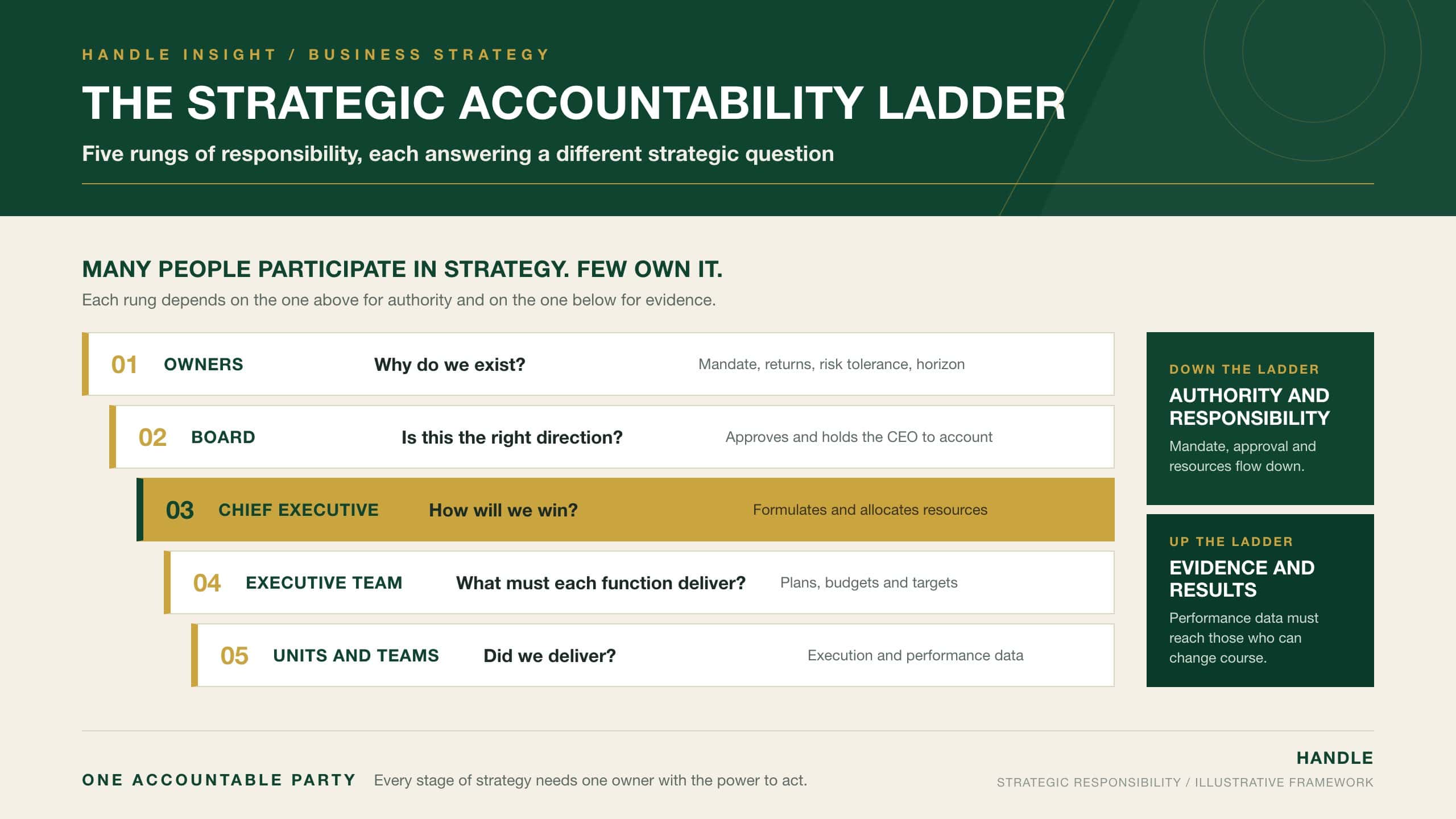
Strategic responsibility is best understood as a ladder of five rungs, each defined by the question it must answer. Every rung depends on the one above it for authority and on the one below it for evidence.
- Rung 1, Owners: Why do we exist? Owners set the mandate: purpose, return expectations, risk tolerance and time horizon.
- Rung 2, Board: Is this the right direction? The board approves strategy against the mandate, oversees risk and holds the chief executive to account.
- Rung 3, Chief Executive: How will we win? The chief executive formulates the strategy, allocates resources and adjusts direction as evidence emerges.
- Rung 4, Executive Team: What must each function deliver? Executives translate strategy into functional plans, budgets and targets.
- Rung 5, Business Units and Teams: Did we deliver? Units and employees execute and produce the performance data that tells every higher rung whether the strategy is working.
The ladder exposes two failure modes. When a rung is missing, the rung above or below fills the gap without the right authority: boards drift into management, or managers guess at the mandate. When information stops climbing the ladder, upper rungs approve and monitor a strategy that no longer reflects reality. Responsibility flows down the ladder. Evidence must flow up it.
Common Failures in Allocating Strategic Responsibility
- Treating the chief executive as the sole owner of strategy, which lets owners and directors avoid accountability for the mandate and the approval they gave.
- Leaving the owner mandate unwritten, so management formulates strategy against assumptions the owners never confirmed.
- Allowing the board to draft strategy rather than challenge it, which removes the independent test the board exists to provide.
- Delegating strategy to a planning team or external adviser that has no authority over resources and no accountability for outcomes.
- Approving a strategy without changing budgets, targets and incentives, so the organisation continues to reward the old priorities.
- Assigning two accountable parties to the same decision, which guarantees that neither will act decisively when results disappoint.
- Ignoring the legal holder of authority, for example where an LLC manager or a holding company board must approve a decision that management treats as its own.
Each failure has the same root. Responsibility was assumed rather than assigned, and nobody tested whether the person answerable for the outcome also had the power to change it.
Conclusion
Responsibility for business strategy is not held by one person. It is distributed across a ladder of roles, each answering a different question. Owners define the mandate. The board approves direction and holds management to account. The chief executive formulates the strategy, allocates resources and adjusts course. Executives translate it into functional plans, and business units deliver the results that show whether it is working. Strategy teams and advisers strengthen the analysis but never own the decision. The test of a well-governed organisation is whether every stage of the strategy process has one accountable party with the authority to act, and whether evidence of performance reaches the people who can change direction. Where that test is met, failure can be diagnosed and corrected. Where it is not, failure becomes an argument about blame. Strategy needs owners. It also needs proof that they own it.