

An award creditor who finds no assets to seize faces a tempting conclusion: wait until something appears, then enforce. It is usually the wrong one. Time continues to run, the debtor continues to reorganise its affairs, other creditors move ahead and, when an asset finally surfaces, the creditor must start the court process from the beginning while the asset moves again. Award Recognition and Enforcement does not depend on assets being visible on day one. Award enforcement in the absence of assets is a distinct phase whose purpose is to convert the award into enforceable court standing, preserve priority and build the information needed to recover later. Recovery may be deferred. Standing should not be. Secure the order first, and the assets become a question of when rather than whether.
Why Award Enforcement in the Absence of Assets Still Matters
An arbitral award is binding on the parties, but it does not by itself authorise seizure of property. Execution requires a court order in the jurisdiction where assets are located. Obtaining that order takes time, and the debtor may use that time to challenge the award, move assets or prioritise other creditors.
Proceeding to recognition while assets are absent achieves four things. It fixes the debtor’s liability as a court-sanctioned obligation in the enforcing jurisdiction. It removes the delay between the discovery of an asset and the ability to attach it. It unlocks court-supervised tools to obtain information about the debtor’s assets. And it positions the creditor to act in insolvency or restructuring proceedings. None of these benefits requires an asset to exist at the time of application.
How Recognition Works in the UAE
For awards made in arbitrations seated onshore in the UAE, the Federal Arbitration Law (Federal Law No. 6 of 2018, as amended by Federal Law No. 15 of 2023) governs. A party may apply to set aside the award within 30 days of notification of the award under Article 54, before the competent Court of Appeal. Recognition and enforcement are sought under Article 55, and execution then proceeds under the civil procedure framework, now Federal Decree-Law No. 42 of 2022 on Civil Procedure.
Foreign awards are recognised under the New York Convention, to which the UAE acceded in 2006, applied through the civil procedure rules on the enforcement of foreign awards. The grounds for refusal are limited and broadly track the Convention.
The financial free zones have their own regimes. Awards seated in the Dubai International Financial Centre are governed by the DIFC Arbitration Law No. 1 of 2008, under which a set-aside application must be made within three months, and are recognised by the DIFC Courts. Awards seated in Abu Dhabi Global Market are governed by the ADGM Arbitration Regulations 2015 and the ADGM Courts. Recognition orders from these courts can be executed in the relevant emirate through the established cooperation arrangements with the onshore courts.
The practical lesson is that the recognition route must be chosen with the expected location of future assets in mind, not only the location of the debtor’s registered office.
What Does “No Assets” Actually Mean?
Asset absence takes different forms, and each calls for a different response. Treating them as the same problem leads to the wrong strategy.
| Scenario | What Is Happening | Primary Risk | Enforcement Response |
|---|---|---|---|
| Temporary illiquidity | Assets exist but are encumbered, illiquid or tied up in projects | Other creditors attach first | Recognise early to establish standing and act as soon as value becomes available |
| Assets elsewhere | Value sits in another emirate, free zone or country | Debtor relies on jurisdictional distance | Parallel recognition where assets are located or likely to arrive |
| Asset-light entity | The contracting company is a shell; value sits in affiliates | Recovery limited to an empty vehicle | Disclosure, examination of transfers, insolvency remedies, and any available guarantees or security |
| Deliberate dissipation | Assets moved after the dispute arose | Value disappears before execution | Urgent interim or precautionary measures, investigation of transfers, insolvency avoidance tools where available |
| Genuine insolvency | The debtor cannot pay its debts as a group | Pro rata dilution | Prove the claim, participate in creditor processes, assess personal or group liability routes |
How Does the Objective Change When Assets Are Absent?
When assets are visible, enforcement aims at recovery: identify the asset, attach it and realise it. When they are not, the objective shifts to control. The creditor’s task is to put itself in the strongest possible position for the moment value appears.
| Dimension | Assets Visible | Assets Absent |
|---|---|---|
| Primary goal | Recovery now | Standing, priority and information |
| Key court step | Recognition and attachment together | Recognition first, attachment when value appears |
| Use of information tools | Confirm and value known assets | Discover unknown assets and transfers |
| Measure of success | Cash received | Readiness to execute without delay |
| Main threat | Challenge to the award | Time, dissipation and competing creditors |
Building the Asset Intelligence File
Recognition gives the creditor standing. Information tells it where to use that standing. From the moment an award is issued, and ideally from the moment a dispute begins, the creditor should maintain an asset intelligence file that is updated as new facts emerge. The file combines lawful private research with the information that court processes produce.
| Source | What It Can Reveal | When It Becomes Available |
|---|---|---|
| Commercial and free zone registers | Shareholdings, subsidiaries, managers, changes of ownership | Immediately, subject to each register’s access rules |
| Contract and project records | Counterparties who owe money to the debtor, milestone dates | From the arbitration record and market research |
| Arbitration evidence | Bank details, assets and affiliates referred to in the proceedings | During the arbitration, subject to confidentiality obligations |
| Court inquiries in execution | Bank balances, registered property, vehicles, licences | After recognition and opening of the execution file |
| Insolvency process | Statements of affairs, transaction history, creditor list | Once bankruptcy or restructuring proceedings begin |
The table shows why sequencing matters. The richest sources, court inquiries and insolvency disclosures, are available only to a creditor with standing. Private research can identify where to look. Court processes allow the creditor to look properly.
The creditor should also review whether anyone other than the debtor stands behind the obligation. Parent company guarantees, performance bonds, letters of credit and security granted under the underlying contract may provide recovery routes that do not depend on the debtor’s own assets. These instruments often have their own claim procedures and time limits, and they should be reviewed as soon as the award is issued.
Original Analysis: The Standing-First Leverage Hub
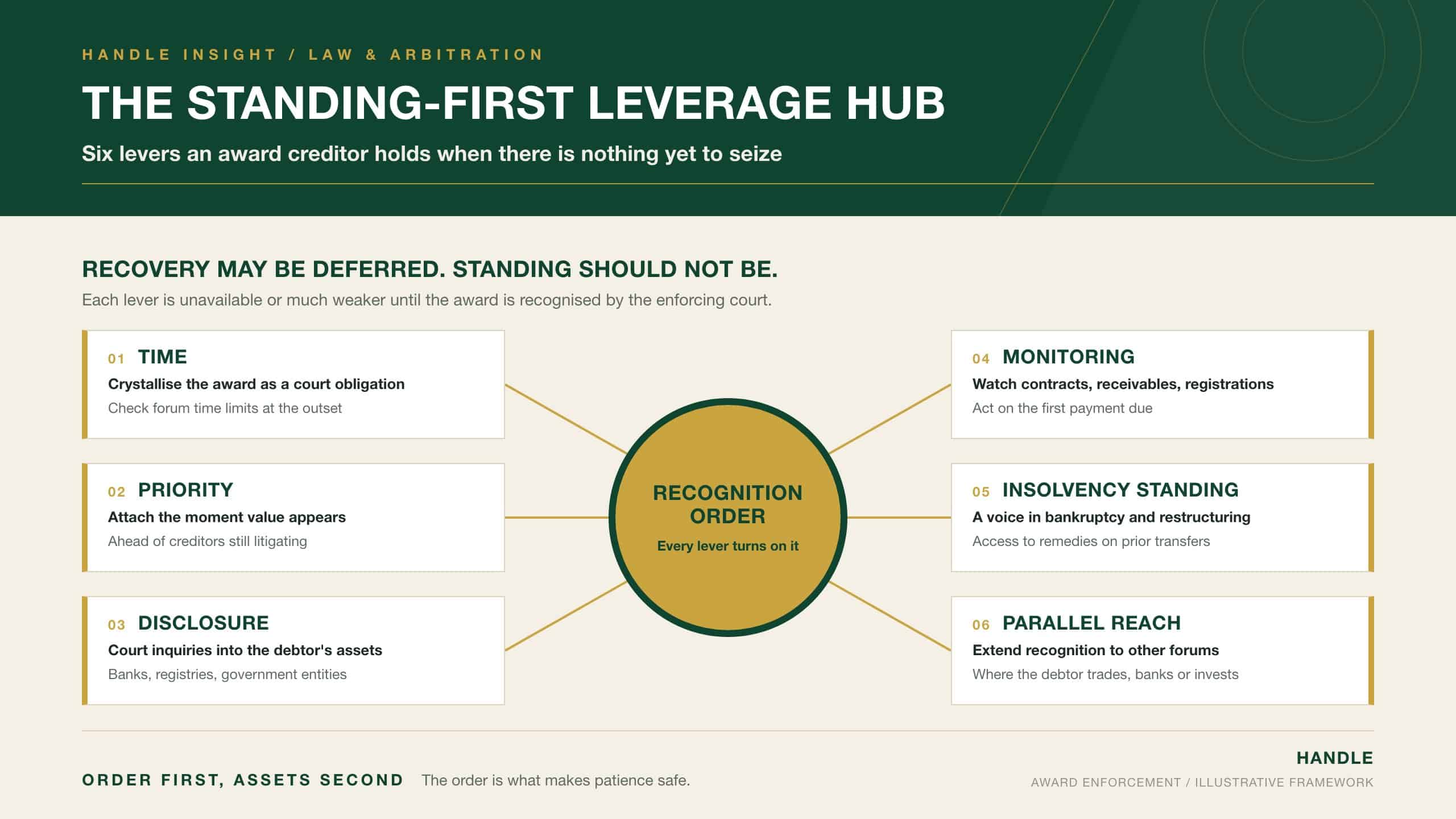
The Standing-First Leverage Hub places the court recognition order at the centre of the creditor’s strategy. Six forms of leverage radiate from it. Each is either unavailable or substantially weaker without recognition. The hub explains why recognition should be pursued even when there is nothing to seize: it is the instrument that turns every other lever.
1. Time
Recognition crystallises the award as an enforceable court-backed obligation, reducing the risk that delay erodes rights. Limitation and procedural time limits differ by forum and should be checked at the outset rather than assumed.
2. Priority
A creditor with an enforceable order can attach assets the moment they are identified, ahead of creditors who are still litigating.
3. Disclosure
In execution, UAE courts can make inquiries of government authorities, registries and banks about the debtor’s assets. The DIFC and ADGM Courts have their own powers to order disclosure in aid of enforcement. These tools surface assets that private investigation cannot.
4. Monitoring
Once standing exists, the creditor can monitor the debtor’s contracts, receivables, property registrations and corporate changes, and act immediately when a target appears.
5. Insolvency Standing
An unpaid, enforceable debt gives the creditor standing in bankruptcy or restructuring proceedings under the UAE’s federal bankruptcy framework or the DIFC and ADGM insolvency regimes. That standing brings information, a voice in the process and access to remedies against prior transactions where the law permits.
6. Parallel Reach
Recognition in one forum supports applications in others. A creditor can extend its net to jurisdictions where the debtor trades, banks or holds investments.
The hub also clarifies sequencing. Recognition is the first move. The spokes are then activated according to the scenario: monitoring and priority for temporary illiquidity, parallel reach for displaced assets, disclosure and insolvency standing for asset-light or dissipating debtors.
A Worked Example: From Empty Account to Recovery
Consider an illustrative award of AED 18 million against a contractor incorporated as an onshore limited liability company. Searches show no real estate, minimal bank balances and vehicles subject to finance. The debtor’s management signals that it will pay “when the market improves” and proposes informal discussions.
The creditor applies for recognition and enforcement immediately after the set-aside period expires without challenge. Once the enforcement file is open, it asks the execution judge to make inquiries of banks and government entities. The responses show that the contractor is party to a government-related project, with payments due to it, and that it holds a 40% stake in a free zone subsidiary.
Eight months later, a project milestone payment of AED 6 million becomes due. Because the creditor already holds an enforceable order and has identified the payer, it applies to attach the receivable before the payment is made. It separately seeks attachment of the shareholding. The creditor recovers a third of the award within the year, and holds a secured position over a further asset. A creditor who had waited for visible assets would still have been preparing its recognition application when the milestone payment was received and spent.
Common Errors That Destroy Leverage
- Waiting for assets before applying for recognition, so that every discovery is followed by months of procedure while the asset moves.
- Assuming that a time limit is generous without confirming it for the specific forum, award type and execution step.
- Accepting assurances or payment plans from the debtor without securing an enforceable order in parallel.
- Choosing the recognition forum by reference to the debtor’s registered office rather than the likely location of future assets.
- Treating the corporate debtor as the only target without examining guarantees, affiliated entities and transfers made after the dispute arose.
- Ignoring insolvency processes and failing to prove the claim, which forfeits both a share of any distribution and influence over the outcome.
Each error transfers control from the creditor to the debtor. Each is avoided by treating recognition as the starting point rather than the reward for finding assets.
When Is a Pause Strategic?
Pausing execution can be sensible. A debtor may be negotiating a refinancing that will produce cash, a sale may be imminent or aggressive attachment may push a viable business into collapse and reduce recovery. The distinction is between pausing execution and failing to enforce. A creditor holding a recognition order that chooses to wait is exercising a judgment. A creditor without one is simply exposed. Any standstill agreed with the debtor should therefore be documented, time-limited and conditional on payment milestones, with an express acknowledgement of the debt and the creditor’s right to resume execution without further notice if a milestone is missed. The order is what makes patience safe.
Conclusion
Award enforcement in the absence of assets is not a dead end but a different phase with a different objective. When nothing can be seized, the creditor’s aim shifts from recovery to control: an enforceable court order, priority over competing creditors, access to court-supervised disclosure, standing in insolvency and the ability to extend recognition to other forums. In the UAE, the routes run through the Federal Arbitration Law and the civil procedure rules onshore, the New York Convention for foreign awards, and the DIFC and ADGM regimes in the financial free zones. The Standing-First Leverage Hub sets the sequence. Recognition comes first because every other lever depends on it. Assets that are invisible today rarely stay invisible. The creditor who holds the order when they appear recovers. The creditor who does not starts again.


