

Many arbitrations are decided in stages. A tribunal may rule on jurisdiction, then on liability, then on quantum, and may order interim payment or security along the way. Each of those decisions has value only if a court will give it effect before the final award arrives. Award Recognition and Enforcement therefore extends beyond final awards to partial and interim decisions, but not automatically and not on the same terms. Recognition of partial or interim awards depends on what the decision is, how it was issued and what it actually orders. A partial award that finally decides a severable issue is generally capable of recognition as an award. An interim measure is usually enforced through a different route, and its treatment varies by forum. The label on the document settles nothing. Finality on the issue decided is what courts enforce.
Partial Awards, Interim Awards and Procedural Orders: What Is the Difference?
Three kinds of tribunal decision are often confused, and the confusion causes failed applications.
A partial award finally determines part of the dispute while reserving the rest. Common examples are awards on jurisdiction, on liability with quantum reserved, or on one of several claims. Once issued, the tribunal cannot revisit the issue decided. It is an award in the full sense for that issue.
An interim award is a term used inconsistently. Some practitioners use it as a synonym for a partial award. Others use it for a decision granting provisional relief, such as interim payment, security for costs or preservation of assets, pending the final outcome. Because the term carries both meanings, the substance of the decision must always be examined.
An interim measure or procedural order manages the proceedings or protects the position of a party until the final award. It may be varied or revoked by the tribunal. Courts in many jurisdictions do not treat such orders as awards for the purposes of the New York Convention, because they do not finally determine any right.
| Decision Type | What It Decides | Can the Tribunal Revisit It? | Usual Enforcement Route |
|---|---|---|---|
| Partial award | A severable issue or claim, finally | No, on the issue decided | Recognition and enforcement as an award; exposed to annulment |
| Interim award for provisional relief | Payment, security or preservation pending final outcome | Often yes, if circumstances change | Depends on forum and on whether the relief is final in effect |
| Interim measure or procedural order | Conduct of the proceedings or temporary protection | Yes | Court enforcement of tribunal interim measures where the seat’s law provides for it |
When Is a Partial or Interim Award Enforceable?
Courts look at substance. Across most arbitration-friendly jurisdictions, the questions are consistent.
Is the decision final on the issue it addresses? A determination that the tribunal intends to be conclusive, and cannot reopen, is the strongest candidate for recognition. A decision expressly subject to review at the final hearing is not.
Is the issue severable? Liability, jurisdiction and discrete claims can usually stand alone. A finding that only makes sense once other issues are decided is harder to enforce separately.
Was it issued in award form? A reasoned, signed decision described as an award, complying with the formal requirements of the seat, is easier to present to a court than a short order or an email from the tribunal secretary.
Does it order something a court can execute? A declaration of liability fixes a legal position but does not itself require payment. An order to pay a sum, provide security or deliver an asset gives a court something to enforce.
Counsel cannot draft the tribunal’s decision. What counsel can do is ask the tribunal, at the right time, to decide a defined issue by partial award, to give reasons, and to frame any relief in clear, mandatory terms. That request is often the difference between an enforceable decision and a persuasive one.
The UAE Position Onshore and in the Financial Free Zones
Onshore UAE arbitration is governed by Federal Arbitration Law No. 6 of 2018, as amended by Federal Law No. 15 of 2023. The law allows the tribunal, unless the parties agree otherwise, to issue interim or partial awards before the final award, and to order interim or provisional measures. It also provides a court route for a party to seek enforcement of a tribunal’s interim measures, and separately allows the courts to grant interim measures in support of arbitration.
A partial award that finally determines an issue is generally treated as an award for annulment and enforcement purposes. That has a consequence parties often overlook. An action to set aside an award must be brought before the competent Court of Appeal within 30 days of notification of the award under Article 54. A party that waits for the final award before challenging an adverse partial award should assume that it may be out of time. Recognition and enforcement are sought under Article 55, with the Civil Procedure regime now set out in Federal Decree-Law No. 42 of 2022 governing execution.
The DIFC and ADGM operate their own frameworks. The DIFC Arbitration Law No. 1 of 2008 and the ADGM Arbitration Regulations 2015 are based on the UNCITRAL Model Law, provide for tribunal interim measures and for their recognition and enforcement by the DIFC Courts and ADGM Courts respectively, and treat awards in the usual way. Under the DIFC regime, an application to set aside must generally be made within three months of receipt of the award.
For awards made outside the UAE, recognition proceeds under the New York Convention, to which the UAE acceded in 2006. A foreign partial award that finally decides an issue fits the Convention without difficulty. A foreign interim measure is less certain, because the Convention addresses awards, and courts differ on whether provisional relief qualifies.
| Forum | Partial Award | Tribunal Interim Measure | Key Timing Point |
|---|---|---|---|
| Onshore UAE | Recognised as an award under the Federal Arbitration Law | Enforcement through the court route the law provides | Set-aside within 30 days of notification (Art. 54) |
| DIFC | Recognised and enforced by the DIFC Courts | Recognised and enforced by the DIFC Courts | Set-aside generally within three months |
| ADGM | Recognised and enforced by the ADGM Courts | Recognised and enforced by the ADGM Courts | Time limits under the ADGM Arbitration Regulations |
| Foreign seat | New York Convention recognition | Uncertain; depends on whether treated as an award | Challenge governed by the law of the seat |
Why Pursue Recognition Before the Final Award?
Early recognition changes the economics of the dispute. A recognised liability award removes the respondent’s ability to deny responsibility in negotiations. A recognised payment award puts money in the claimant’s hands while quantum proceedings continue. A recognised security or preservation measure reduces the risk that assets will be moved before the final award.
It also shortens the eventual enforcement phase. Grounds of resistance that relate to the partial award are tested early. If they fail, they cannot be reargued when the final award is enforced, which narrows the respondent’s options at the stage when the largest sum is at stake.
The benefit must be weighed against cost and risk. A failed application signals weakness and may encourage the respondent. An application that seeks more than the decision grants invites the court to question the whole instrument.
A Worked Example: Staged Relief in a Construction Dispute
Consider an illustrative onshore arbitration in which a contractor claims AED 85 million from an employer. The tribunal bifurcates the proceedings and issues three decisions during the first year.
First, a reasoned partial award finding the employer liable for wrongful termination, with quantum reserved. Second, within the same instrument, an order that the employer pay AED 20 million representing certified but unpaid interim payment certificates, expressed as final and not subject to adjustment. Third, a separate procedural order requiring the employer to maintain a bank guarantee of AED 15 million pending the final award.
The liability finding is final and severable but orders no payment, so it fixes the position without producing cash. The AED 20 million order is final, severable, issued in award form and executable, which makes it the strongest candidate for recognition and enforcement. The guarantee order is a provisional measure that the tribunal may vary, so the contractor seeks its enforcement through the court route for interim measures rather than as an award. The employer has 30 days from notification of the partial award to bring any set-aside action, and the contractor’s timetable is planned around that window.
Original Analysis: The Finality Filter
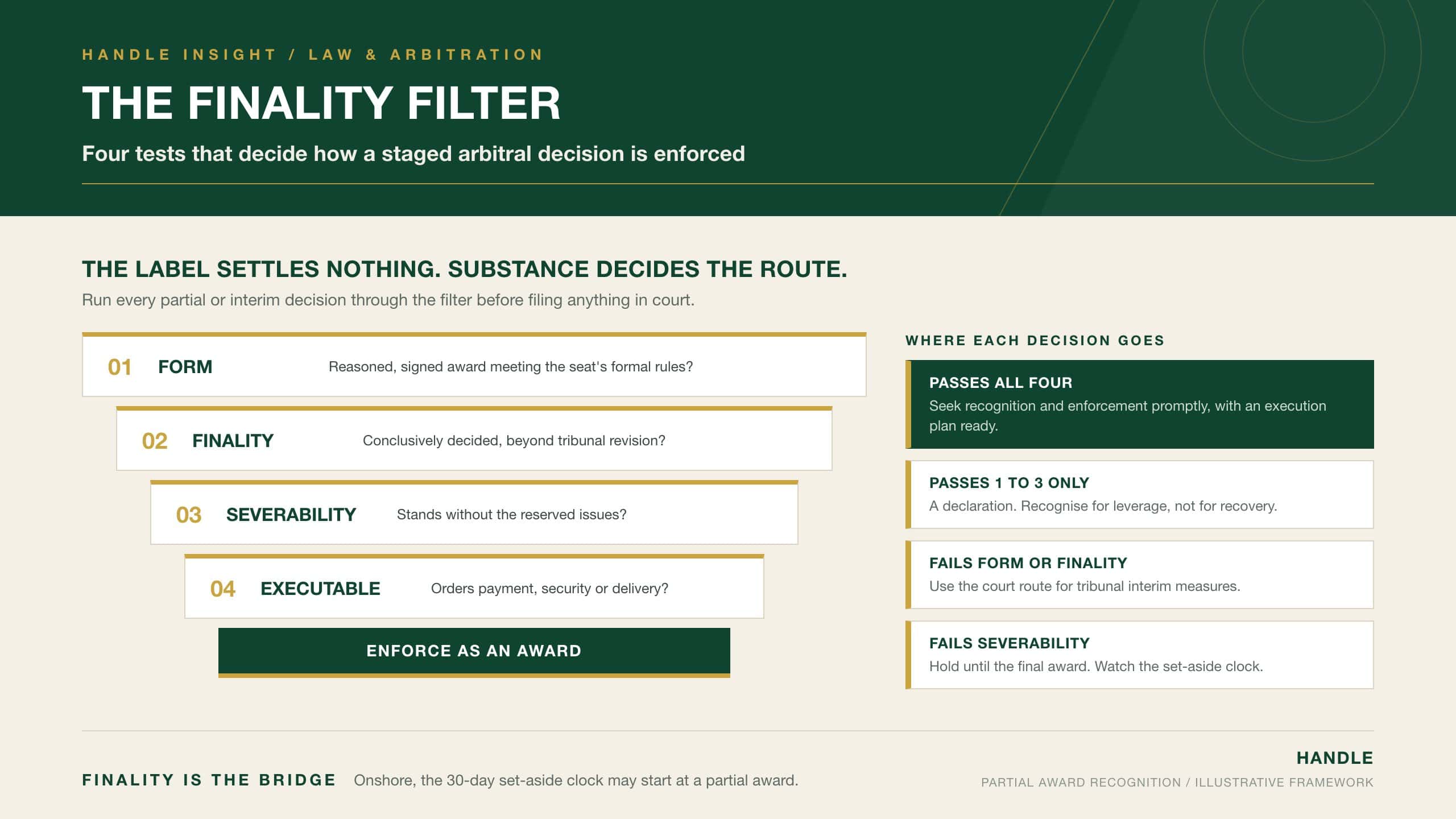
Every staged decision can be passed through four filters before an application is filed. Each filter removes decisions that are unlikely to succeed as awards, and what passes all four is the decision to lead with.
Filter 1: Form. Was the decision issued as a reasoned, signed award that meets the formal requirements of the seat? Decisions that fail here are presented, if at all, as interim measures.
Filter 2: Finality. Does the tribunal treat the issue as conclusively decided, with no power to revisit it? Provisional decisions move to the interim measures route.
Filter 3: Severability. Can the issue stand without the reserved matters? Findings that depend on later issues are held back until the final award.
Filter 4: Executable relief. Does the decision order payment, security or delivery that a court can execute? Declarations that pass the first three filters are still worth recognising for their effect on the dispute, but they do not generate recovery.
The filter separates two questions that are often merged: whether a decision can be recognised, and whether recognising it now is worthwhile. A decision that passes all four filters should usually be enforced promptly. A decision that passes three may be recognised for leverage. A decision that fails form or finality should be taken down the interim measures route, or left until the final award.
How Counterparties Resist, and How Resistance Is Contained
Resistance to early enforcement tends to follow predictable lines. The respondent argues that the decision is provisional, that it duplicates the eventual final award, that enforcement interferes with the continuing arbitration, or that the time for challenge has not yet run. Each argument is answered by the facts of the decision itself: its wording, its reasons, the tribunal’s treatment of the issue as closed and the precise relief sought in the application.
The respondent’s own options are time-limited. If it intends to challenge a partial award, it must act within the applicable set-aside period. A respondent that does nothing and later attacks the partial award when the final award is enforced may find its challenge out of time.
Common Failures in Recognising Partial and Interim Awards
- Relying on the label “interim award” without examining whether the decision is final or provisional in substance.
- Failing to ask the tribunal for a reasoned partial award, so that an important determination is issued only as a procedural order.
- Seeking enforcement of relief broader than the decision actually grants, which invites the court to question the entire instrument.
- Assuming that foreign interim measures will be enforced under the New York Convention in the same way as final awards.
- Overlooking that the 30-day set-aside period onshore may run from notification of a partial award, not from the final award.
- Recognising a declaration of liability and expecting it to produce recovery, when it orders nothing a court can execute.
- Filing without an execution plan, so that a successful recognition order sits unused while assets move.
Most of these failures are decided long before the application is filed. They are decided when the decision is requested, framed and issued.
Conclusion
Recognition of partial or interim awards turns staged arbitral decisions into enforceable rights before the final award is made. The decisive questions are substantive. Is the decision issued in award form, final on the issue it decides, severable from the reserved matters and framed as relief a court can execute? Onshore, the Federal Arbitration Law permits partial awards and provides a court route for tribunal interim measures, while the 30-day set-aside period under Article 54 may run from notification of a partial award. The DIFC and ADGM Courts recognise both awards and tribunal interim measures under their own regimes. Foreign interim measures remain less certain under the New York Convention. The Finality Filter separates what can be recognised from what is worth recognising now, and directs everything else to the right route. Decisions are won at the tribunal. They are enforced in court. Finality is the bridge.


