

A losing party has two very different ways to resist an arbitral award, and confusing them is one of the most expensive mistakes in enforcement. Setting aside asks the courts of the seat to annul the award. Refusal to enforce asks a court where assets are located to decline to give effect to it. Within Award Recognition and Enforcement, the question of set aside vs refusal to enforce is therefore a question of forum, standard and consequence: which court decides, on what grounds, and with what effect beyond its own borders. A set-aside judgment can travel; a refusal generally does not. For awards connected with the UAE, the answer also depends on whether the seat is onshore, in the DIFC or in ADGM. Validity is decided once, at the seat. Enforceability is decided wherever the assets are.
Two Different Questions, Two Different Courts
A set-aside application asks whether the award should continue to exist in the legal order of the seat. It can only be brought before the courts of the seat, under the arbitration law of the seat, within the time limit that law prescribes. If it succeeds, the award is annulled there.
Resistance to enforcement asks whether an award, assumed to exist, should be recognised and executed in a particular country. It is decided by the courts of that country, under their own procedural law and, for foreign awards, under the New York Convention where it applies. If it succeeds, the award simply cannot be executed in that country.
Neither process is an appeal. Courts in both settings examine structural defects, not whether the tribunal reached the right answer on the facts or the law.
| Feature | Set Aside at the Seat | Refusal to Enforce |
|---|---|---|
| Court | Courts of the seat of arbitration only | Courts of each country where enforcement is sought |
| Governing law | Arbitration law of the seat | Law of the enforcing state, including the New York Convention |
| Who starts it | The award debtor, as applicant | The award creditor applies; the debtor resists |
| Time limit | Strict, set by the law of the seat | Arises whenever and wherever enforcement is sought |
| Effect if successful | Award annulled at the seat; may affect enforcement elsewhere | Award cannot be executed in that country only |
| Review of merits | No | No |
What Are the Grounds in Each Case?
The grounds overlap substantially, because most modern arbitration laws, including the UNCITRAL Model Law, mirror Article V of the New York Convention. In both settings the core grounds are incapacity or an invalid arbitration agreement, lack of proper notice or inability to present one’s case, the tribunal exceeding the scope of the submission, an improperly constituted tribunal or irregular procedure, non-arbitrable subject matter and conflict with public policy.
There is one ground that exists only at the enforcement stage. Under Article V(1)(e) of the New York Convention, an enforcing court may refuse recognition where the award has been set aside or suspended by a competent authority of the country in which, or under the law of which, it was made. This is the point where the two processes connect. The Convention says the enforcing court “may” refuse, and courts in different countries have taken different views on how much discretion that wording gives.
What If the Debtor Never Challenges at the Seat?
A debtor is not obliged to apply to set aside an award. Under the New York Convention, the grounds for refusing enforcement remain available in each enforcing court even if no challenge was brought at the seat. Some courts, however, take into account that a party had the opportunity to raise an objection at the seat and chose not to, particularly where the objection concerns procedure the party could have contested at the time.
For an award seated onshore in the UAE, the practical position is sharper. Once the 30-day period for an action to set aside has passed, the debtor has lost the seat track altogether, and the question becomes whether the competent court will ratify the award and issue an enforcement order. A debtor that intends to resist should decide within that window. A creditor should diarise the date on which the window closes, because it marks the point at which the award’s validity at the seat is settled.
Set Aside vs Refusal to Enforce Under UAE Law
The UAE has three arbitral seats with separate supervisory courts, and each applies its own rules on annulment and recognition.
UAE onshore seat. Under the Federal Arbitration Law (Federal Law No. 6 of 2018, as amended by Federal Law No. 15 of 2023), an action to set aside must be brought before the competent Court of Appeal within 30 days of notification of the award. The grounds are exhaustively listed in the law, and the court may raise non-arbitrability and conflict with public order of its own motion. Bringing a set-aside action does not of itself stay enforcement; the court may order a stay on request where the grounds appear serious, and may require security. The award creditor seeks ratification and an enforcement order under Article 55.
DIFC seat. Under the DIFC Arbitration Law (DIFC Law No. 1 of 2008), a set-aside application is made to the DIFC Courts and must generally be filed within three months of receipt of the award. The DIFC Courts also hear applications for recognition and enforcement, on grounds modelled on the New York Convention.
ADGM seat. Under the ADGM Arbitration Regulations 2015, the ADGM Courts supervise ADGM-seated arbitrations and determine applications to set aside and to recognise and enforce awards, within the time limits set by the Regulations.
Foreign awards enforced in the UAE. The UAE acceded to the New York Convention in 2006. Foreign awards are recognised onshore under the Convention and the procedure in the federal civil procedure legislation, now Federal Decree-Law No. 42 of 2022 on Civil Procedure. A UAE court cannot set aside a foreign-seated award. It can only decide whether to recognise and enforce it in the UAE.
| Scenario | Where Set Aside Is Sought | Where Refusal Is Argued | Key UAE Point |
|---|---|---|---|
| Onshore-seated award, onshore assets | Competent Court of Appeal | Same court system, on ratification | 30-day challenge window; no automatic stay |
| DIFC-seated award | DIFC Courts | DIFC Courts, and onshore courts at execution stage | Challenge generally within three months |
| ADGM-seated award | ADGM Courts | ADGM Courts, and onshore courts at execution stage | Time limits under the ADGM Arbitration Regulations |
| Foreign-seated award, UAE assets | Courts of the foreign seat only | UAE onshore courts, DIFC Courts or ADGM Courts | New York Convention grounds; no set-aside jurisdiction in the UAE |
Parallel Proceedings: Do Enforcement Courts Wait for the Seat?
Set-aside and enforcement frequently run at the same time. A debtor files to annul the award at the seat, while the creditor applies for recognition where the assets are. The enforcing court then has a choice.
Article VI of the New York Convention allows the enforcing court, if an application to set aside or suspend the award has been made at the seat, to adjourn its decision on enforcement and, on the application of the creditor, to order the debtor to give suitable security. Adjournment is discretionary. It is not automatic, and courts weigh the apparent strength of the set-aside application, the risk that assets will be dissipated and the delay already caused.
Security is the balancing tool. A debtor that wants enforcement paused should expect to be asked to secure the award. A creditor that faces adjournment should ask for security as the price of it.
Different Consequences, Different Leverage
The two outcomes are not equivalent. A refusal to enforce affects only the country that refuses. The award remains valid and can be enforced elsewhere, subject to each court’s own assessment. A successful set-aside removes the award in the legal order of the seat and gives every other enforcing court a Convention ground to refuse. In many jurisdictions, an award annulled at the seat will in practice not be enforced, although some courts have treated the question as discretionary.
This asymmetry shapes strategy. For the debtor, a credible set-aside application is the most powerful single tool. For the creditor, the strength of the award at the seat is the foundation of global recovery. Choosing the seat at the drafting stage is therefore a decision about which court will hold that power.
A Worked Example: One Award, Three Courts
The figures are illustrative. A tribunal seated in London issues an award of USD 20 million against a group company with assets in Dubai and in Singapore. Twenty days later, the debtor applies to the English courts to set the award aside for serious irregularity. The creditor applies for recognition in the UAE onshore courts and in Singapore.
The UAE court cannot set aside the London award. It can only decide whether to recognise it under the New York Convention. Faced with the pending English challenge, it may proceed, or adjourn and order security. The creditor asks for security of, say, USD 6 million against the Dubai assets as the condition of any adjournment. In Singapore, the creditor pursues recognition in parallel.
If the English challenge fails, both enforcement tracks continue with the security already in place. If it succeeds, the debtor can rely on the annulment in each enforcing court. The creditor’s leverage depends on how quickly it moved on enforcement while the challenge was pending.
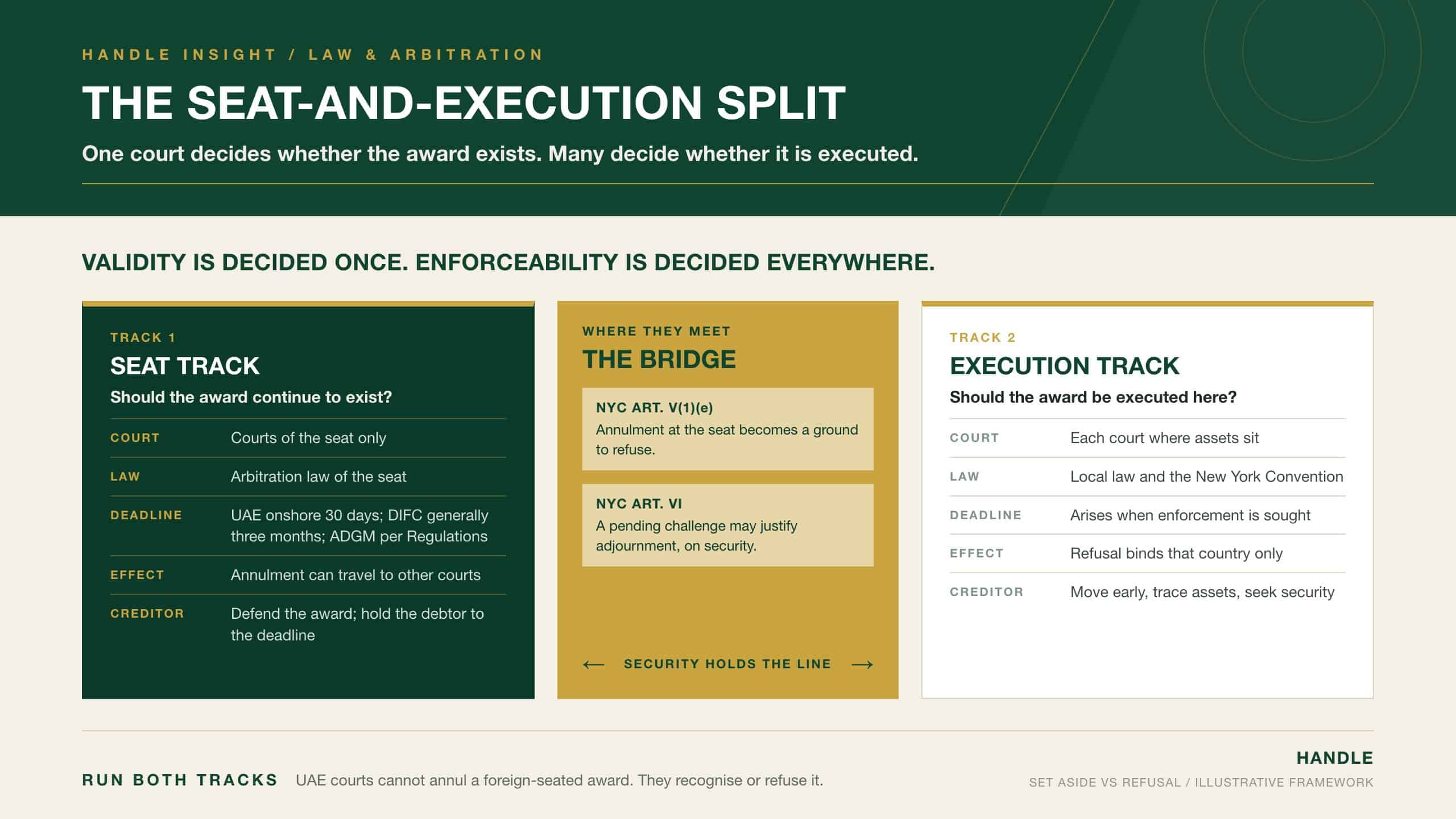
Original Analysis: The Seat-and-Execution Split
A practical way to manage award resistance is to treat every award as running on two separate tracks from the day it is issued.
- The Seat Track. One court, one law, one strict deadline. It decides whether the award exists. The creditor’s task is to defend the award there and to keep the debtor to the statutory time limit: 30 days for a UAE onshore award, generally three months for a DIFC award.
- The Execution Track. Many courts, each applying its own law and the New York Convention. They decide whether the award is executed in their territory. The creditor’s task is to move early, identify assets and seek security where a stay is requested.
- The Bridge. The two tracks meet at only two points: Article V(1)(e), where an annulment at the seat becomes a ground for refusal, and Article VI, where a pending challenge can justify adjournment on terms. Security sits at the bridge and is the creditor’s main protection.
The split forces each argument into the right forum. A debtor that raises seat issues before an enforcing court can be held to the narrower enforcement grounds. A creditor that waits for the seat track to finish before starting the execution track gives away time and leverage.
Common Mistakes in Set Aside and Enforcement Strategy
- Applying to a UAE court to set aside a foreign-seated award, when only the courts of the seat have that power.
- Missing the 30-day set-aside deadline for a UAE onshore award because the time was assumed to run from a later date.
- Assuming that a pending set-aside application automatically suspends enforcement, when in the UAE and under the New York Convention any stay is discretionary.
- Failing to request security when an enforcing court adjourns, leaving assets free to move while the challenge is decided.
- Arguing the merits of the dispute in either court, which neither has power to review.
- Choosing a seat at the drafting stage without considering how its courts approach annulment and how their judgments are treated where assets are located.
Each of these mistakes treats two separate controls as one. Keeping them apart is the basis of enforcement strategy.
Conclusion
Set aside and refusal to enforce are separate legal controls. Setting aside is decided once, by the courts of the seat, under the seat’s arbitration law and within a strict deadline, and it determines whether the award exists. Refusal to enforce is decided by each court where enforcement is sought, under its own law and the New York Convention, and it determines only whether the award is executed there. In the UAE, an onshore award must be challenged within 30 days of notification before the competent Court of Appeal, a DIFC award generally within three months before the DIFC Courts, and an ADGM award before the ADGM Courts under the ADGM Arbitration Regulations 2015. UAE courts cannot annul foreign awards, only recognise or refuse them. Parties that run the seat and execution tracks in parallel, and use security at the point where they meet, keep control of recovery. Validity is decided once. Enforceability is decided everywhere.


