

Banks hold more information about their customers than almost any other institution: balances, counterparties, borrowing, spending patterns and the identity documents behind every account. The law treats that information as confidential by default. A breach of banking confidentiality occurs when a bank, or someone acting within it, discloses or allows access to customer information without a lawful basis. Within Banking & Finance Disputes, these cases arise from misdirected emails, over-broad responses to authorities, staff browsing accounts, intra-group data sharing and cyber incidents, and they can lead to civil claims, regulatory sanctions and criminal exposure at the same time. The question in every case is the same: through which lawful gateway did the information leave the bank, and did the disclosure stay inside it? Confidentiality is the rule. Disclosure is the exception that must be proved.
Where Does the Duty of Banking Confidentiality Come From in the UAE?
The duty rests on several sources that operate together.
Central Bank legislation. The federal law governing the Central Bank of the UAE and the organisation of financial institutions requires licensed financial institutions to keep customer data and information confidential and prohibits its disclosure except where the law permits or the customer consents. Central Bank regulations and standards, including its consumer protection framework, add specific obligations on data protection, access control and the handling of customer information.
Criminal law. The UAE Crimes and Penalties Law, Federal Decree-Law No. 31 of 2021, penalises the disclosure of secrets learned by reason of a person’s profession or position without consent or legal authorisation. Bank employees can face personal criminal exposure for unauthorised disclosure.
Data protection law. The federal Personal Data Protection Law, Federal Decree-Law No. 45 of 2021, excludes from its scope banking and credit data that is regulated by its own legislation. Onshore banking confidentiality is therefore governed primarily by the Central Bank framework rather than by the general data protection law. In the financial free zones, the DIFC Data Protection Law No. 5 of 2020 and the ADGM Data Protection Regulations 2021 apply, alongside the conduct rules of the DFSA and the FSRA.
Contract. Account terms, facility agreements and non-disclosure undertakings usually contain express confidentiality provisions. In corporate banking, these clauses often define what may be shared with syndicate members, participants, rating agencies and professional advisers.
Civil liability. Under the UAE Civil Transactions Law, a customer can claim for breach of contract or for harm caused by a wrongful act. Compensation can extend to moral damage as well as financial loss, subject to proof of fault, harm and causation.
What Are the Lawful Gateways for Disclosure?
Confidentiality is not absolute. The law recognises a limited number of routes through which customer information may lawfully leave a bank. Each has conditions, and most breaches occur not because there was no gateway, but because the disclosure went beyond it.
| Gateway | Conditions | Typical Failure |
|---|---|---|
| Customer consent | Clear, informed and covering the specific purpose and recipient | Reliance on broad or outdated consent clauses |
| Court or competent authority order | A valid order from an authority with power to require disclosure | Disclosing more accounts, periods or parties than the order covers |
| Supervisory request | A request from the Central Bank, DFSA or FSRA within its powers | Responding to a foreign authority directly without a lawful channel |
| AML and CFT reporting | Suspicious transaction reports to the UAE Financial Intelligence Unit in good faith | Tipping off the customer or disclosing the report to third parties |
| Credit information reporting | Reporting to the licensed credit bureau as the law requires | Inaccurate data or sharing beyond the credit information framework |
Good-faith reporting of suspicious transactions under the UAE’s anti-money laundering legislation does not amount to a breach of confidentiality. The reverse also holds: disclosing that a report has been made is itself prohibited.
How Do Breaches Happen in Practice?
Disclosure to third parties without consent. Confirming a customer’s account status to an employer, family member, landlord or business partner is one of the most common sources of claims. The fact that the enquirer appears to have a legitimate interest does not create a gateway.
Over-broad responses to authorities. Banks receive frequent requests from courts, police, public prosecution and tax authorities. A valid request authorises disclosure of what it covers and no more. Sending additional accounts, longer periods or information on connected persons exceeds the gateway.
Internal misconduct. Employees who access accounts without a business need, or who pass information outside the bank, create liability for themselves and expose the institution if its access controls and monitoring were inadequate.
Group data sharing. Financial groups share information across subsidiaries for risk management, compliance and marketing. Sharing for compliance purposes may be permitted; sharing for cross-selling usually requires consent. Transfers to group entities outside the UAE raise additional questions about the lawful basis and the protection of the data abroad.
Cyber incidents and operational errors. Phishing, compromised credentials, misconfigured systems and misdirected emails expose data without any intention to disclose. Liability then turns on whether the bank maintained adequate security controls and responded properly once the incident was discovered.
Confidentiality in Corporate and Syndicated Banking
Corporate customers face a different kind of exposure. Information about a pending transaction, a covenant breach, a restructuring or a loan default can move markets, affect negotiations with other creditors and change the position of shareholders. Disputes in this area usually turn on the contract rather than on general principles.
Facility agreements typically permit disclosure to affiliates, professional advisers, potential assignees and participants, rating agencies and authorities, often subject to the recipient giving a confidentiality undertaking. Where a bank shares information outside those categories, or without obtaining the required undertaking, it may be in breach even if the recipient had a commercial interest in knowing. The analysis therefore starts with the exact wording of the confidentiality clause, its carve-outs and any market-standard confidentiality undertaking the parties adopted.
Is There a Public Interest Defence?
Common-law systems have historically recognised limited qualifications to banking confidentiality, including disclosure in the public interest. In the UAE, banks should not assume that a general public interest exception is available onshore. The safer position is that disclosure must fall within a gateway recognised by law, such as consent, a valid order, a supervisory request or statutory reporting. Concerns about wrongdoing are addressed through the reporting channels the law provides, principally suspicious transaction reporting and whistleblowing procedures within the regulatory framework, rather than through disclosure to private parties.
What Exposure Does a Breach Create?
A single incident can create three kinds of exposure that run in parallel and influence one another.
| Type of Breach | Civil Exposure | Regulatory Exposure | Criminal Exposure |
|---|---|---|---|
| Deliberate disclosure by an employee | Bank liable for employee conduct and control failures | Review of access controls and supervision | Employee prosecution for disclosure of secrets |
| Over-broad response to an authority | Claims by affected customers and connected parties | Review of request-handling procedures | Unlikely where the bank acted in good faith |
| Unconsented group or third-party sharing | Contract and tort claims | Findings on consent and data governance | Possible where disclosure was knowing and unauthorised |
| Cyber incident | Claims for financial loss and moral damage | Assessment of security and incident response | Against the attackers; rarely against the bank |
Regulatory findings are often used in subsequent civil proceedings as evidence of fault. Conversely, a bank that can show a robust control framework and a prompt, documented response is better placed in both forums.
A Worked Example: An Over-Broad Response to a Court Order
Consider an illustrative case. A UAE court orders a bank to produce statements for one named corporate account covering six months, in connection with a commercial dispute. The operations team, working from a search by customer group rather than by account, produces statements for four accounts covering thirty-six months, including two accounts belonging to a sister company that is not a party to the dispute.
The opposing party uses information from the sister company’s accounts in settlement negotiations. The sister company claims that the disclosure weakened its negotiating position on an unrelated transaction and seeks compensation of AED 5 million, illustratively, for financial loss and reputational harm.
The bank had a valid gateway, but only for one account and six months. Everything beyond that was disclosed without a lawful basis. The bank’s defence will focus on causation and quantum: whether the claimed loss actually flowed from the disclosure. Its regulatory position will depend on whether it identified the error, notified as required and corrected its procedures. The case is not about whether the bank was entitled to respond to the court. It is about whether it stayed within what the court required.
Original Analysis: The Disclosure Gateway Test
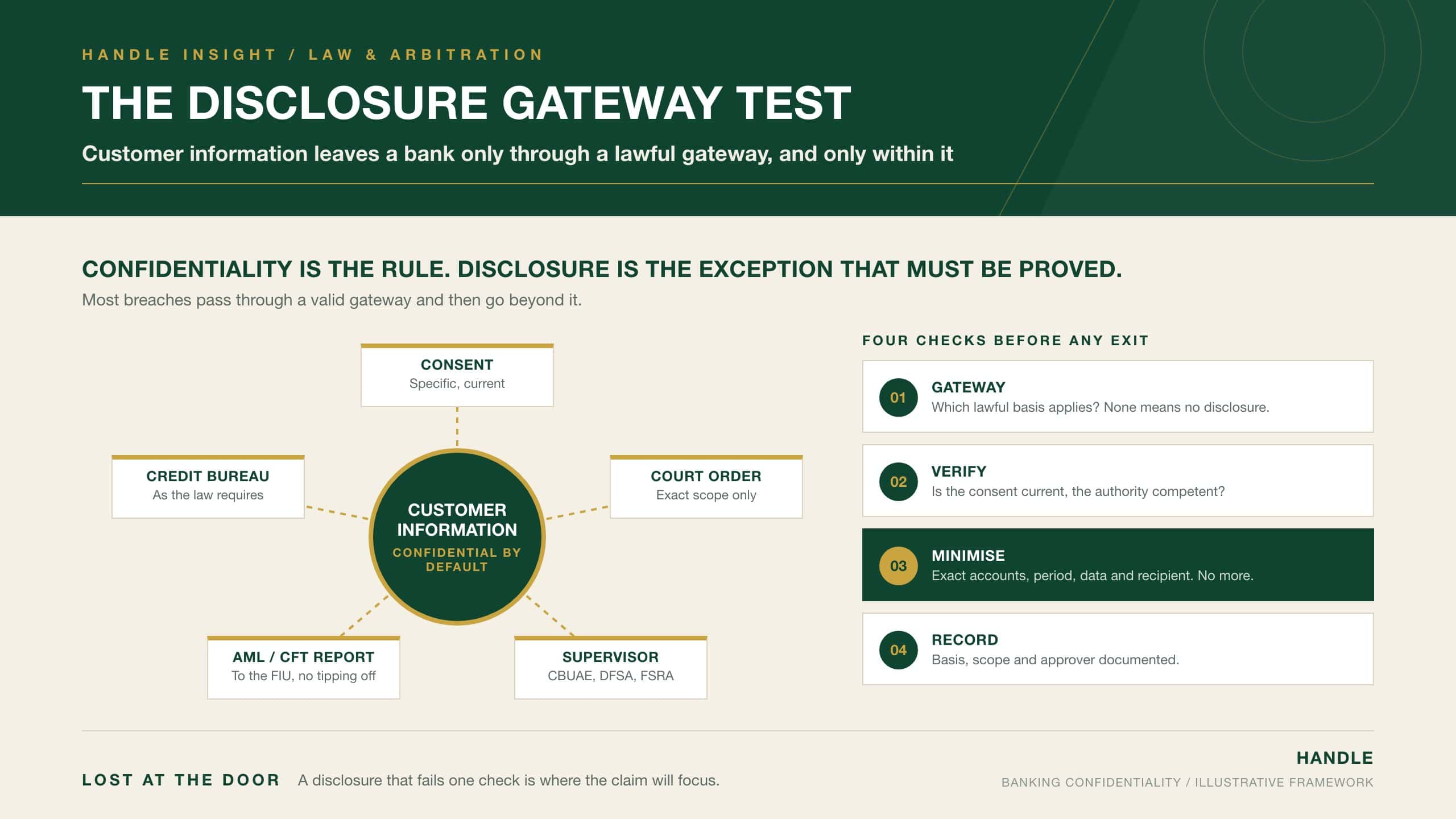
Most confidentiality disputes can be resolved, and most can be prevented, by asking four questions in sequence before any customer information leaves the bank.
1. Gateway. Which lawful basis applies: consent, a valid order, a supervisory request, statutory reporting or credit information reporting? If none applies, the information does not leave.
2. Verification. Is the gateway genuine? Consent must be specific and current. An order or request must come from an authority with power to make it, through a proper channel.
3. Minimisation. Does the disclosure match the gateway exactly, by customer, account, period, data type and recipient? Anything outside the scope is a separate disclosure without a basis.
4. Record. Is there a record of the gateway, the verification, the scope decision and the person who approved it? Without a record, the bank cannot prove it acted lawfully, even if it did.
The test treats confidentiality as a controlled exit rather than a vague duty. Each question corresponds to a control a bank can implement, audit and evidence. In a dispute, the same four questions structure the analysis of liability: a disclosure that passes all four is defensible, and a disclosure that fails any one of them is where the claim will focus.
Preventing Breaches and Containing Them When They Occur
Prevention depends on a small number of disciplines: role-based access with monitoring of unusual account access, a central function that handles every legal and regulatory request, consent mechanisms that are specific and refreshed, clear rules for group data sharing and regular training for staff in customer-facing and operations roles.
When a breach occurs, speed and documentation matter. The bank should contain the incident, establish what was disclosed and to whom, assess notification duties to the regulator and affected customers, preserve evidence and take legal advice early. Customers who suspect a breach should record what they know, request information from the bank in writing and seek advice before limitation periods or regulatory windows pass.
Common Failures in Managing Banking Confidentiality
- Treating any official-looking request as sufficient authority, without verifying the requesting body’s power to require disclosure.
- Responding to orders by customer group or relationship rather than by the exact accounts and periods specified.
- Relying on consent clauses drafted years earlier for purposes that no longer match how the data is used.
- Sharing customer information across a group for marketing on the basis of a compliance justification.
- Granting broad system access to staff without monitoring who views which accounts and why.
- Assuming a public interest justification exists onshore instead of using the statutory reporting channels.
- Failing to document the basis for each disclosure, which leaves the bank unable to prove compliance when challenged.
Each of these failures occurs at the point of exit. Confidentiality is lost at the door, not in the vault.
Conclusion
Breach of banking confidentiality claims turn on a simple principle: customer information leaves a bank only through a lawful gateway, and only within its limits. In the UAE, the duty rests on Central Bank legislation and regulation, the criminal prohibition on disclosing professional secrets, contract and civil liability, with the DIFC and ADGM data protection regimes and DFSA and FSRA rules applying in the financial free zones. The recognised gateways are narrow: consent, valid orders, supervisory requests, anti-money laundering reporting and credit information reporting. Banks should not assume a general public interest exception onshore. The Disclosure Gateway Test of gateway, verification, minimisation and record turns the duty into controls that can be audited and evidenced, and it structures the liability analysis when a dispute arises. Most breaches are not failures of intent. They are failures of scope. Confidentiality is kept at the point of exit.


