

Evidence rules and disclosure obligations decide most DIFC cases long before trial. The DIFC Courts operate a common law system in which the judge decides on the documents, the witness statements and the expert reports that each party has preserved, produced and deployed in time. Within DIFC Courts Litigation, the procedural framework is designed to put material facts on the table early, to keep disclosure proportionate and to penalise parties who conceal or lose what they should have kept. For a business facing a claim in the DIFC, the practical question is not what the law of evidence says in the abstract. It is whether the company’s records, people and advisers are ready to prove its case under the court’s timetable. Proof is built before the claim is filed. It is lost the same way.
How Do the DIFC Courts Approach Evidence?
The DIFC Courts apply their own procedural code, the Rules of the DIFC Courts, together with DIFC legislation and practice directions. The approach is recognisably common law: the parties gather and present evidence, the court actively manages the case, and the judge assesses relevance, reliability and weight.
Three principles shape everything that follows. First, evidence must relate to the issues defined in the pleadings. Material that does not help decide a pleaded issue adds cost without adding value, and the court will not admit or weigh it generously. Second, the court distinguishes between admissibility and weight. Relevant evidence is generally received, but its value depends on its source, its consistency with contemporaneous documents and whether better evidence was available. Third, procedure is proportionate. The court expects the scale of document production, witness evidence and expert work to match the value and complexity of the dispute.
The consequence is a forum that rewards organisation. Parties who know their documents, define the issues precisely and comply with directions control the evidential field. Parties who rely on volume or surprise lose credibility and often costs.
What Must Be Disclosed, and When?
Document production in the DIFC Courts is supervised by the court and structured around the issues in dispute. It is not the broad, unlimited discovery associated with some other common law systems. In general terms, each party produces the documents on which it relies, and the other side may then make specific, reasoned requests for further documents or narrow categories of documents that are relevant and material to the outcome. Objections, for example on grounds of privilege, confidentiality or disproportionate burden, are decided by the court if the parties cannot agree.
The process usually follows the close of pleadings and a case management conference, so that the dispute is defined before documents are exchanged. Directions fix the dates for production, for requests and for responses. Requests that are vague, duplicative or designed to increase the opponent’s cost are routinely refused or narrowed.
Two features are often misunderstood. First, a party cannot produce only the helpful parts of a document or a chain of correspondence and withhold the rest without justification. Second, the obligation does not end once the initial exchange is complete. Documents that come to light later and fall within what has been ordered or properly requested must be produced promptly. Late production without explanation damages credibility and may lead to costs or evidential consequences.
Privilege requires the same discipline. Communications with lawyers for the purpose of legal advice, and documents prepared for the dominant purpose of litigation, can generally be withheld, but the claim must be identified and justified rather than asserted in bulk. Internal reports that mix commercial and legal content, or advice shared widely with third parties, are where privilege claims are most often challenged. Deciding early who sees legal advice, and how it is labelled and stored, protects the claim later.
Disclosure Approaches Compared
| Feature | DIFC Courts | Broad Common Law Discovery | Onshore UAE Civil Procedure |
|---|---|---|---|
| Starting point | Documents relied on, plus targeted requests tied to the issues | Wide production of documents relevant to the claims | Parties submit the documents they rely on; no general disclosure obligation |
| Compelling the other side | Specific requests decided by the court | Extensive requests and depositions | Application to the court to order production of specific documents in limited circumstances |
| Court control | Active case management and proportionality | Varies by system; often party-driven | Judge-led; court-appointed experts are common |
| Witness evidence | Written statements, cross-examination at trial | Written or oral, often with depositions | Primarily documentary; witness hearings at the court’s discretion |
The comparison matters for groups that operate both onshore and in the DIFC. A business accustomed to onshore litigation, where documentary production is narrower and experts are frequently appointed by the court, can be unprepared for a DIFC process in which it must search, review and produce its own records and instruct its own expert.
Why Preservation Starts Before the Claim
Once litigation is reasonably in contemplation, a party should suspend routine deletion and preserve documents that may be relevant. In practice that means a written litigation hold sent to the people who hold relevant records, the suspension of automatic deletion settings on email and messaging systems, and the forensic collection of devices where the risk of loss is real.
Electronic evidence is the core of most modern commercial disputes. Metadata, version histories, messaging platforms and audit trails often reveal more about who knew what, and when, than formal correspondence. The court expects parties to search electronic records competently, to agree search methods where possible and to explain the approach taken.
The consequence of failure is not abstract. Where documents have been destroyed or lost after a dispute was foreseeable, the court may draw adverse inferences, reject evidence that cannot be tested against the original records, or make costs orders. A party that cannot produce its own records also struggles to prove its own case.
Witness Statements: Facts, Not Argument
Witnesses of fact give evidence through written statements exchanged before trial, which normally stand as their evidence in chief, and they may be cross-examined at the hearing. A statement should describe what the witness personally saw, heard or did, in the witness’s own words, and identify the documents to which it refers.
Statements that read as submissions damage the witness. Argument, commentary on the law and speculation about other people’s motives are routinely discounted. More importantly, credibility is tested against the documents. A witness whose recollection conflicts with contemporaneous emails, board minutes or transaction records will usually lose that contest. Preparation should therefore begin with the documents, not with the narrative.
Expert Evidence Under Court Control
Expert evidence is admitted only with the court’s permission and only where it will assist the court on matters outside its own expertise, such as valuation, accounting, engineering or industry practice. The court defines the field and the questions, and experts owe their primary duty to the court rather than to the party paying them.
Experts in the same discipline are commonly directed to meet and produce a joint statement identifying where they agree and disagree. This narrows the issues for trial. An expert who advocates for the instructing party, adopts an unexplained methodology or ignores contrary material will lose weight quickly, and that loss of weight often decides the quantum of the claim.
A Worked Example: The Cost of a Missing Chat Archive
The following example is illustrative. A distributor claims AED 12 million from a supplier for wrongful termination, alleging that the supplier’s regional manager orally approved a sales shortfall during a meeting and later confirmed it on a messaging app. The supplier denies any approval.
The distributor’s director gives a detailed witness statement but has replaced his phone and cannot produce the messages. The supplier produces its regional manager’s emails, CRM notes and a calendar entry for the meeting, none of which mention an approval. The supplier also requests the distributor’s own internal emails from the same week, which show the distributor’s finance team modelling termination risk after the meeting.
The court is left with an uncorroborated recollection set against consistent documents, and with evidence that the distributor itself expected termination. Even if the oral approval was in fact given, the claim is unlikely to succeed. A litigation hold and a forensic image of one phone, at a cost measured in thousands of dirhams, would have changed the evidential position of a claim worth twelve million.
Original Analysis: The Proof Readiness Timeline
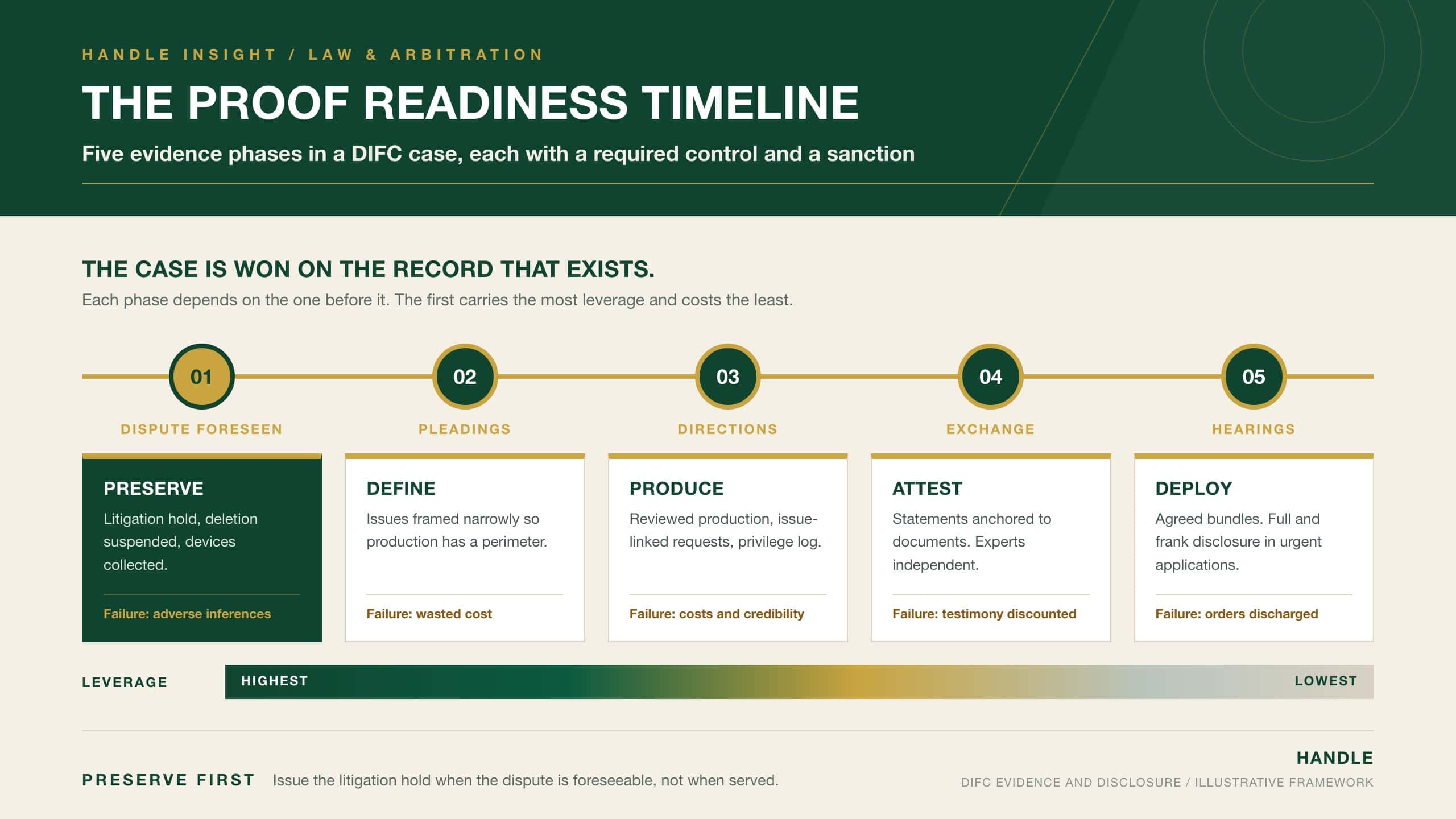
Evidence is not a single stage of a DIFC case. It is a sequence of obligations that run from the moment a dispute is foreseeable to the end of trial, and each stage depends on the one before it. We describe this as the Proof Readiness Timeline: five phases, each with a control the business must have in place and a sanction that follows if it does not.
| Phase | Trigger | Required Control | Consequence of Failure |
|---|---|---|---|
| 1. Preserve | Dispute reasonably anticipated | Litigation hold, suspension of deletion, device collection | Adverse inferences and an unprovable case |
| 2. Define | Pleadings filed | Issues framed narrowly and precisely | Unfocused production and wasted cost |
| 3. Produce | Case management directions | Reviewed production, reasoned requests, privilege log | Costs orders, credibility damage, unless orders |
| 4. Attest | Exchange of statements and reports | Statements anchored to documents; independent experts | Testimony discounted under cross-examination |
| 5. Deploy | Trial and interim hearings | Agreed bundles, candour in urgent applications | Discharge of interim orders; loss on weight |
The timeline makes one point clear. The first phase carries the most leverage and costs the least, yet it is the one most often neglected because it falls before lawyers are formally instructed. A party that controls preservation controls the evidential record for every phase that follows.
Admissibility, Weight and the Duty of Candour
Hearsay is not automatically excluded in the DIFC Courts, but it is treated with caution. The court asks why the original source is not being called, whether the statement is corroborated and whether it was made close to the events. Copies and secondary evidence are assessed against the explanation for the absence of originals.
Evidence obtained unlawfully or in breach of confidentiality obligations raises separate questions. The court may exclude it or reduce its weight, balancing its value against the fairness of the process, and the party using it may face separate liability.
Interim applications, such as freezing orders, impose a heightened standard. A party applying without notice must give full and frank disclosure of all material facts, including those that favour the absent respondent. Failure to do so can lead to the order being discharged and to adverse costs, regardless of the merits of the underlying claim.
Common Evidence and Disclosure Failures
- Businesses issue no litigation hold until proceedings are served, by which time routine deletion has already removed key messages.
- Parties assume that onshore practice applies and are unprepared to search, review and produce their own documents to a DIFC timetable.
- Requests to produce are drafted as wide categories rather than specific, issue-linked requests, and the court refuses them.
- Witness statements are drafted by lawyers as argument, then undermined in cross-examination by the witness’s own emails.
- Experts are instructed late, without the full document set, and produce reports that cannot survive a joint statement process.
- Applicants for urgent relief omit unhelpful facts and lose the order when the respondent returns to court.
Each of these failures is procedural in form and decisive in effect.
Conclusion
Evidence rules and disclosure obligations in the DIFC Courts are designed to resolve disputes on the documents, under active court control and in proportion to what is at stake. Production is targeted rather than unlimited, witness evidence is tested against contemporaneous records, and experts serve the court rather than the client. The parties who succeed are those who treat evidence as a continuous discipline: preserving records the moment a dispute is foreseeable, defining the issues precisely, producing and requesting documents on time, anchoring witness statements to the record and deploying evidence with candour at every hearing. The parties who fail usually do so early and quietly, through deleted messages, vague requests or statements that the documents contradict. In the DIFC, the case is won on the record that exists. Build it early. Keep it intact. Present it with discipline.


