

When an employee resigns and then claims to have been forced out, the employer’s position depends less on what happened than on what it can prove happened. Constructive dismissal allegations turn a resignation into a contested termination, and they are a recurring risk within Employment Litigation for Employers. UAE federal labour law does not use the phrase “constructive dismissal”. It does, however, allow an employee to leave without notice and keep end-of-service entitlements where the employer has failed to meet its obligations or has subjected the employee to assault or harassment, and employees frequently frame resignation claims as forced terminations. Employers who understand how these claims are built can dismantle them link by link. Those who do not often discover that the absence of a dismissal letter is not the absence of a dismissal. The record decides the case.
What Are Constructive Dismissal Allegations in Practice?
A constructive dismissal allegation arises when an employee resigns and asserts that the resignation was not voluntary but was caused by the employer’s conduct. The employee argues that the employer breached the contract or the law so seriously, or behaved so unreasonably, that continued employment became untenable.
The commercial consequence is that a resignation, which normally ends the relationship on the employee’s initiative with notice owed to the employer, is recharacterised as a departure caused by the employer. Depending on the facts and the forum, the employee may then claim unpaid wages and allowances, end-of-service gratuity, notice-related amounts and, where the court treats the termination as arbitrary, compensation.
How Does UAE Law Treat a Forced Resignation?
The federal Labour Law, Federal Decree-Law No. 33 of 2021 on the Regulation of Labour Relations, governs most private sector employment onshore and in the non-financial free zones. Three features are relevant.
First, Article 45 permits an employee to leave work without notice while retaining end-of-service entitlements in defined circumstances. These include the employer’s failure to fulfil its contractual or statutory obligations, provided the employee has notified the Ministry of Human Resources and Emiratisation (MOHRE) in advance as the law requires and the employer has not remedied the failure, and the employee being assaulted, subjected to violence or harassed by the employer or its representative. This is the closest statutory equivalent to constructive dismissal, and its procedural conditions matter.
Second, the law restricts unilateral changes. An employer may not, as a general rule, reduce an employee’s wage or assign work substantially different from the agreed work without the employee’s consent, save in the limited circumstances the law allows. The law also prohibits harassment, bullying and verbal, physical or psychological violence in the workplace, as well as discrimination on protected grounds.
Third, the law provides compensation for arbitrary dismissal, capped at three months’ wage. Whether a forced resignation is treated as an arbitrary termination depends on the facts and the court’s characterisation.
Disputes begin with a complaint to MOHRE, which attempts amicable settlement and may issue a binding decision on claims below a statutory value threshold. Other disputes are referred to the labour courts. There is no separate employment tribunal onshore. Employers in the Dubai International Financial Centre and Abu Dhabi Global Market operate under different regimes, the DIFC Employment Law No. 2 of 2019 and the ADGM Employment Regulations 2019, with claims heard in the DIFC Courts and ADGM Courts respectively. The analysis of a forced resignation should always begin by identifying which regime applies.
What Conduct Typically Triggers an Allegation?
Most allegations fall into a small number of patterns. Each has a recognisable evidential profile.
| Trigger | Typical Employee Narrative | Employer Risk Factor | Strongest Employer Evidence |
|---|---|---|---|
| Reduction in pay or benefits | “My salary was cut without my agreement.” | No signed consent or contract amendment | Signed amendment, MOHRE-registered contract, consultation record |
| Demotion or change of role | “I was stripped of my responsibilities.” | Undocumented restructuring, change targeted at one person | Restructuring rationale, organisation charts, consistent treatment of peers |
| Harassment or bullying | “Management ignored what was happening to me.” | Complaints not investigated | Investigation file, outcome letter, measures taken |
| Unpaid wages | “I was not paid for months.” | Payroll arrears visible in the Wage Protection System | Payment records, agreed deferral signed by the employee |
| Targeted performance pressure | “They set me up to fail.” | Sudden warnings after years of good reviews | Contemporaneous objective performance data, fair improvement plan |
Original Analysis: The Causation Break Test
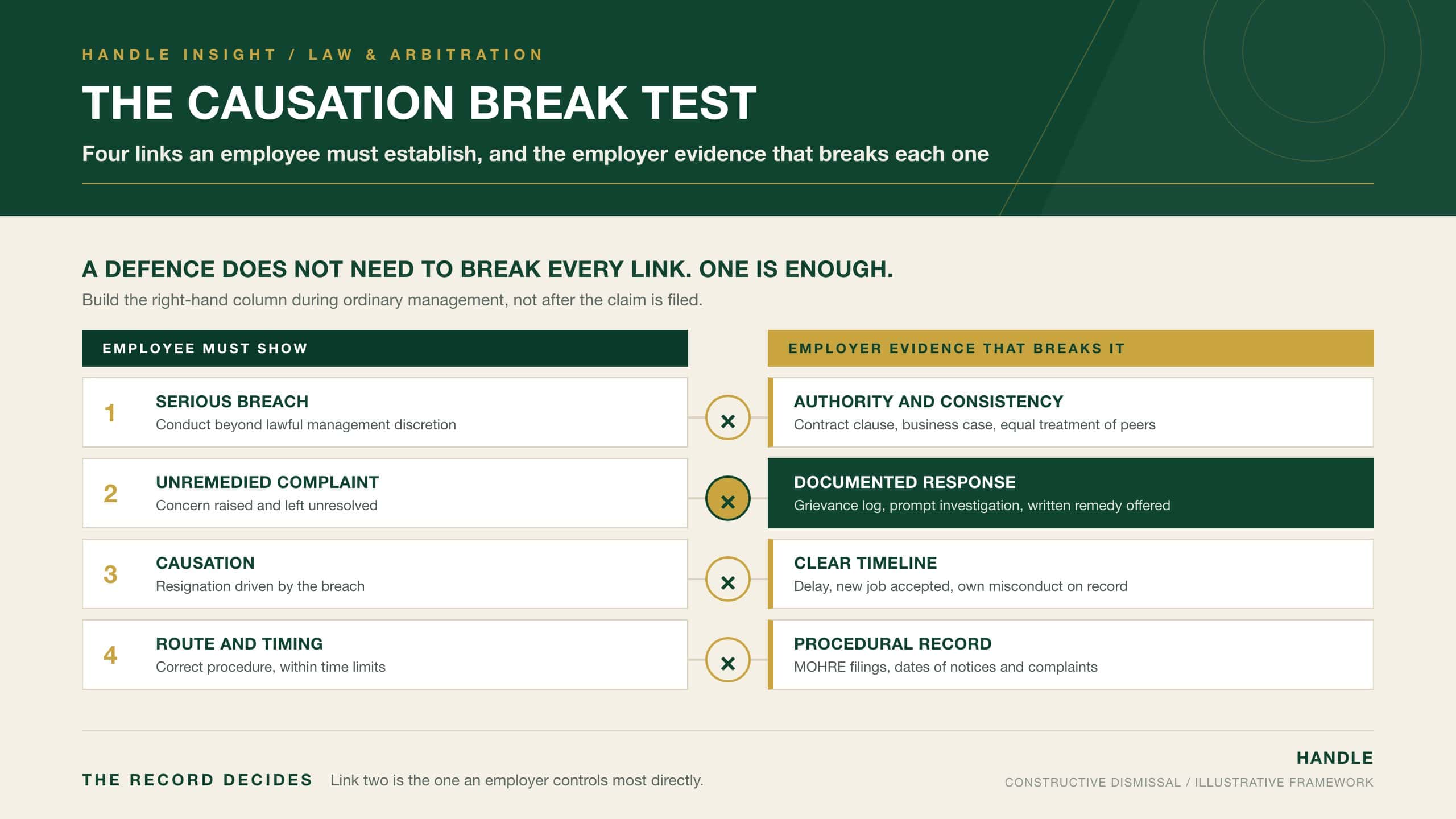
A constructive dismissal claim is a chain. To succeed, the employee must in substance establish four links. The Causation Break Test asks, for each link, what evidence the employer holds that would break it. A defence does not need to break every link. It needs to break one convincingly.
Link 1: Serious Breach
The employee must show conduct that amounts to a serious breach of the contract or the law, not merely a disagreement, a lawful management decision or an unwelcome but permitted change. The employer breaks this link by showing contractual authority, a legitimate business reason and consistent treatment of comparable employees.
Link 2: Unremedied After Complaint
The employee must generally show that the problem was raised and not fixed. This link is the one the employer controls most directly. A documented grievance process, a prompt investigation and a written outcome that addresses the complaint will often defeat the claim at this point. Where Article 45 is relied on for a failure to meet obligations, the statutory notification to MOHRE and the employer’s failure to remedy are themselves conditions.
Link 3: Resignation Caused by the Breach
The resignation must be a response to the breach. A resignation submitted many months after the alleged conduct, or immediately after accepting a job elsewhere, or following the employee’s own misconduct, weakens causation.
Link 4: Correct Route and Timing
The employee must use the correct procedure and bring the claim within the applicable time limits. Failure to follow the statutory route, or a significant delay, may limit the claim.
| Link | Employee Must Show | Evidence That Breaks the Link | Owner of the Evidence |
|---|---|---|---|
| 1. Serious breach | Conduct beyond lawful management discretion | Contract clause, business case, peer consistency | HR and line management |
| 2. Unremedied after complaint | Concern raised and ignored | Grievance log, investigation file, outcome letter | HR |
| 3. Causation | Resignation driven by the breach | Timeline, exit interview, evidence of new employment, misconduct record | HR and legal |
| 4. Route and timing | Correct procedure within time limits | MOHRE records, dates of notices and complaints | Legal |
A Worked Example: Breaking the Chain at Link Two
Consider an illustrative case. A sales manager on a basic salary of AED 25,000 a month and a commission plan has her territory reduced during a restructuring, which cuts her expected commission by about 30%. She raises a written grievance, saying the change was imposed on her alone. Six weeks later she resigns and files a MOHRE complaint claiming she was forced out.
The employer’s file shows the following. The restructuring was approved by the board two months before the territory change and affected five of the eight sales managers. The commission plan states that territories may be reallocated by management. Within five working days of the grievance, HR met the employee, investigated, and offered a transitional commission guarantee of AED 6,000 a month for six months, confirmed in writing. The employee did not respond before resigning.
Link 1 is weakened because the change was authorised, applied to most of the team and did not alter her basic salary. Link 2 is broken because the complaint was investigated promptly and a concrete remedy was offered. The employer still pays all accrued entitlements correctly, which removes any secondary claim. The allegation does not disappear, but its foundation does.
What Records Should Employers Maintain?
A defence is built before the dispute starts. Employers should hold signed employment contracts and every amendment, including evidence of consent to changes in pay or role; current job descriptions and organisation charts; a written grievance procedure and a log of grievances, investigations and outcomes; performance reviews, warnings and improvement plans with supporting data; restructuring decisions and their business rationale; Wage Protection System and payroll records; and records of exit interviews. Documents created at the time carry far more weight than statements prepared after a claim is filed.
How Can Employers Reduce the Risk?
Most constructive dismissal allegations follow a change that was poorly communicated or a complaint that was poorly handled. Before changing terms, employers should confirm contractual authority, consult the employee, explain the business reason and obtain written consent where the law requires it. Grievances should be acknowledged quickly, investigated by someone independent of the conduct complained of and closed with a written outcome. Managers should be trained on lawful performance management and on the workplace conduct standards the Labour Law imposes. Sensitive changes and disciplinary steps should be reviewed by HR or legal advisers before they are implemented.
Where a claim is threatened, early resolution is often the most efficient course. A negotiated settlement that pays undisputed entitlements, records the agreed terms clearly and complies with the Labour Law can close the matter at far lower cost than litigation. Settlement terms should be checked carefully, because entitlements guaranteed by law cannot simply be waived by agreement.
How Should an Employer Respond Once a Claim Is Filed?
The first days after a resignation letter alleging forced departure, or a MOHRE complaint, shape the outcome. The employer should take five steps in order.
First, preserve the record. Emails, messaging histories, HR files, payroll data and performance documents relating to the employee and the decision makers should be secured and protected from routine deletion. Second, identify the regime and the route: federal Labour Law with MOHRE and the labour courts, or the DIFC or ADGM framework with their own courts. Third, calculate and pay undisputed entitlements, such as accrued wages, accrued leave and end-of-service gratuity, so that the dispute is confined to the contested elements. Fourth, map the allegation against the four links of the Causation Break Test and identify which link the evidence breaks most clearly. Fifth, decide on strategy: defend in full, offer a targeted settlement or combine both through a without-prejudice proposal at the MOHRE settlement stage.
Throughout, communications with the departing employee should be measured and factual. Hostile or dismissive messages written after the resignation are frequently produced as evidence of the very conduct the employee alleges. The tone of the response is part of the defence.
Common Mistakes Employers Make
- Reducing pay or changing roles by internal memo, without the employee’s written consent or an amended contract where one is required.
- Treating a grievance as a sign of disloyalty rather than as an opportunity to fix a problem and create a defensible record.
- Starting performance management immediately after a complaint, which makes legitimate concerns look like retaliation.
- Delaying salary payments during cash pressure without documented agreement, which gives the employee a clear statutory breach to rely on.
- Applying the federal Labour Law analysis to an employee who is employed in the DIFC or ADGM, or the reverse.
- Withholding end-of-service entitlements after a disputed resignation, which adds a second, easily proven claim to the first.
Each mistake strengthens a link in the employee’s chain. Each corrective step weakens one.
Conclusion
Constructive dismissal allegations convert a resignation into a contested termination, and in the UAE they are usually framed around the employee’s statutory right to leave without notice where the employer fails to meet its obligations or permits harassment. The employee must in substance prove a chain: a serious breach, left unremedied after complaint, that caused the resignation, pursued through the correct route in time. The Causation Break Test shows employers where to concentrate. Contractual authority and consistent treatment answer the breach. A prompt, documented grievance process answers the complaint. A clear timeline answers causation. Accurate records answer the procedure. Employers who build these records as part of ordinary management rarely need to reconstruct them in litigation. Consent before change. Response before resignation. Evidence before argument.


