

A settlement agreement is only as valuable as the waiver it contains, and a waiver is only as durable as the process that produced it. Employers sign settlements to buy finality: a defined payment in exchange for the employee’s release of claims arising from the employment and its termination. That finality is tested when a former employee files a claim regardless, arguing that the waiver did not cover the dispute, that statutory entitlements were never paid, that consent was obtained under pressure or that the employer itself breached the settlement. Within Employment Litigation for Employers, settlement agreements and waiver enforcement are therefore treated as a discipline of drafting, process and performance rather than a single document. In the UAE, the analysis also depends on where the employment sits: onshore, in the Dubai International Financial Centre or in Abu Dhabi Global Market. A waiver survives challenge when every link in its chain holds.
What a Settlement Agreement Is For
A settlement agreement records the terms on which an employment dispute, or a potential dispute, is resolved. The employer typically pays sums beyond what is strictly due, and may provide other benefits such as an agreed reference or relaxation of restrictive covenants. In return, the employee releases claims against the employer and, where agreed, its group companies, directors and staff.
For the employer, the objectives are finality, certainty of cost and protection of confidential information and reputation. For the employee, the agreement offers prompt payment, clarity and the ability to move on without proceedings. A durable agreement reflects both sets of interests. One that serves only the employer’s drafting preferences invites challenge.
The Statutory Floor: What Cannot Be Waived
The most important principle in UAE onshore employment settlements is that statutory entitlements are a floor. Federal Decree-Law No. 33 of 2021 on the Regulation of Labour Relations treats any condition that diminishes a worker’s statutory rights as void unless it is more beneficial to the worker. A settlement that purports to waive end-of-service gratuity, accrued leave pay or unpaid wages, without paying them, is therefore vulnerable regardless of the employee’s signature.
The practical consequence is that a settlement should first pay, or expressly account for, every statutory entitlement, and then provide additional consideration for the release of disputed or contingent claims. The waiver is supported by the additional consideration, not by the payment of sums that were already owed. The Labour Law also requires the employer to pay the worker’s final dues within a short statutory period after the employment ends, so the settlement timetable should be built around that obligation rather than delaying it.
In the DIFC, Employment Law No. 2 of 2019 also sets minimum standards that cannot be contracted out of, but expressly recognises written agreements to terminate employment or resolve claims, subject to conditions that include the employee having had the opportunity to obtain independent legal advice. ADGM’s Employment Regulations 2019 contain comparable minimum-standard protections. In both centres, the current text of the relevant provisions should be checked when the agreement is drafted.
A Worked Example: Separating Entitlement From Consideration
Consider an illustrative onshore employee with six years of service, a basic monthly salary of AED 30,000 and a total monthly salary of AED 45,000, who is disputing the fairness of a termination and the amount of an unpaid bonus.
Under the Labour Law, end-of-service gratuity is calculated on basic wage at 21 days for each of the first five years of service and 30 days for each additional year, subject to an overall cap. On a daily basic wage of AED 1,000, that is 105 days plus 30 days, or AED 135,000.
| Settlement Component | Nature | Illustrative Amount (AED) |
|---|---|---|
| End-of-service gratuity (135 days of basic wage) | Statutory entitlement | 135,000 |
| Notice period of one month, paid in lieu | Contractual and statutory entitlement | 45,000 |
| Accrued but untaken leave (15 days) | Statutory entitlement | 15,000 |
| Ex gratia payment for release of disputed claims | Consideration for the waiver | 90,000 |
| Total | 285,000 |
Only the AED 90,000 ex gratia sum buys the waiver. If the agreement presented AED 285,000 as a single figure in exchange for a full release, and the gratuity or leave calculation later proved wrong, the employee could argue that statutory entitlements were waived without payment. Itemisation is not a formality. It is the evidence that the floor was respected. The figures are illustrative, and the calculation basis for leave and notice should follow the contract and the law in each case.
Drafting the Waiver Clause
The waiver clause is the core of enforcement. It should identify the claims released, the parties released and the parties giving the release. It should refer specifically to the dispute or proceedings being settled, including any reference number of a complaint already filed, as well as to claims arising from the employment and its termination generally.
Two drafting errors recur. Language that is too broad, purporting to release every conceivable claim including future and unknown rights, may be read down or challenged. Language that is too narrow, releasing only the specific complaint, leaves exposure to related claims about bonuses, incentive plans, discrimination or statutory payments. The clause should also carve out claims that cannot lawfully be waived and rights arising under the settlement itself, which makes the release more credible, not less.
Consent, Process and the Risk of Duress
A waiver signed under improper pressure is vulnerable. Employees who later challenge settlements commonly argue that they were given no time to consider the terms, were discouraged from taking advice, were threatened with consequences outside the employer’s legitimate options, or were misled about their entitlements.
Employers can protect the agreement through process. A reasonable period to review the terms, an express statement that the employee may take independent legal advice, a record that questions were invited and answered, and negotiation conducted in writing or with notes all create evidence of genuine consent. Pressure that links signature to unrelated matters, such as visa processing or the release of final dues, should be avoided entirely.
Common Challenges and the Safeguards That Answer Them
| Employee’s Challenge | Safeguard at Drafting or Signing |
|---|---|
| The waiver did not cover this claim | Specific reference to the dispute plus a defined general release; carve-outs stated expressly |
| Statutory entitlements were waived without payment | Itemised statutory payments shown separately from the ex gratia consideration |
| I signed under pressure | Review period, opportunity for independent advice, written negotiation record |
| I was misled about my rights or the facts | Accurate calculations, disclosure of relevant facts, no misleading statements |
| The employer breached the settlement | Payment on the agreed date, agreed reference issued, internal owner for each obligation |
Non-Financial Terms That Protect the Employer
Confidentiality clauses limit disclosure of the settlement terms and underlying allegations, with exceptions for legal advisers, family members, tax authorities and regulators. Non-disparagement clauses should be mutual where possible and realistic in scope. Return-of-property provisions should cover devices, documents and data, with confirmation that company information has been deleted from personal devices.
Restrictive covenants deserve particular attention. The settlement should confirm whether existing non-compete, non-solicitation and confidentiality obligations continue, and on what terms. Where the employer agrees to relax a covenant as part of the bargain, the variation should be recorded precisely. Under the onshore Labour Law, a non-compete must be limited in time, place and type of work, and the settlement should not attempt to extend a covenant beyond what the law permits.
Implementation: Where Good Agreements Fail
A well-drafted settlement can still be undone after signature. Payments must be made on the agreed dates and by the agreed method. Visa and work permit cancellations must be processed as agreed. References and internal announcements must follow the agreed wording. Each of these obligations usually sits with a different team, such as payroll, government relations and human resources, which is why they are missed.
The practical answer is a post-settlement checklist with a named owner for every obligation and a date by which it must be completed, reviewed by the person who negotiated the agreement. A failure to perform gives the employee an argument that the employer is in breach, and with it a route back into the dispute the settlement was meant to close.
When Should Employers Offer Settlement?
Settlement is most valuable early, before positions harden and before proceedings generate cost and management distraction. It is particularly appropriate where the facts are finely balanced, where senior or sensitive individuals are involved, or where the dispute could affect other employees. At the same time, employers should apply consistent internal criteria for when settlement is offered and at what level, so that one generous settlement does not set an expectation for every future dispute.
How the Position Differs Across UAE Jurisdictions
| Consideration | Onshore UAE | DIFC | ADGM |
|---|---|---|---|
| Governing law | Federal Decree-Law No. 33 of 2021 | DIFC Employment Law No. 2 of 2019 | ADGM Employment Regulations 2019 |
| Statutory minimums | Conditions less favourable than the law are void | Minimum standards apply; waivers permitted only as the law allows | Minimum standards apply |
| Dispute route | Ministry of Human Resources and Emiratisation, then the labour courts | DIFC Courts | ADGM Courts |
| Key settlement safeguard | Itemised payment of statutory dues before consideration for release | Written agreement and opportunity for independent advice | Written agreement aligned with the Regulations |
Original Analysis: The Waiver Durability Chain
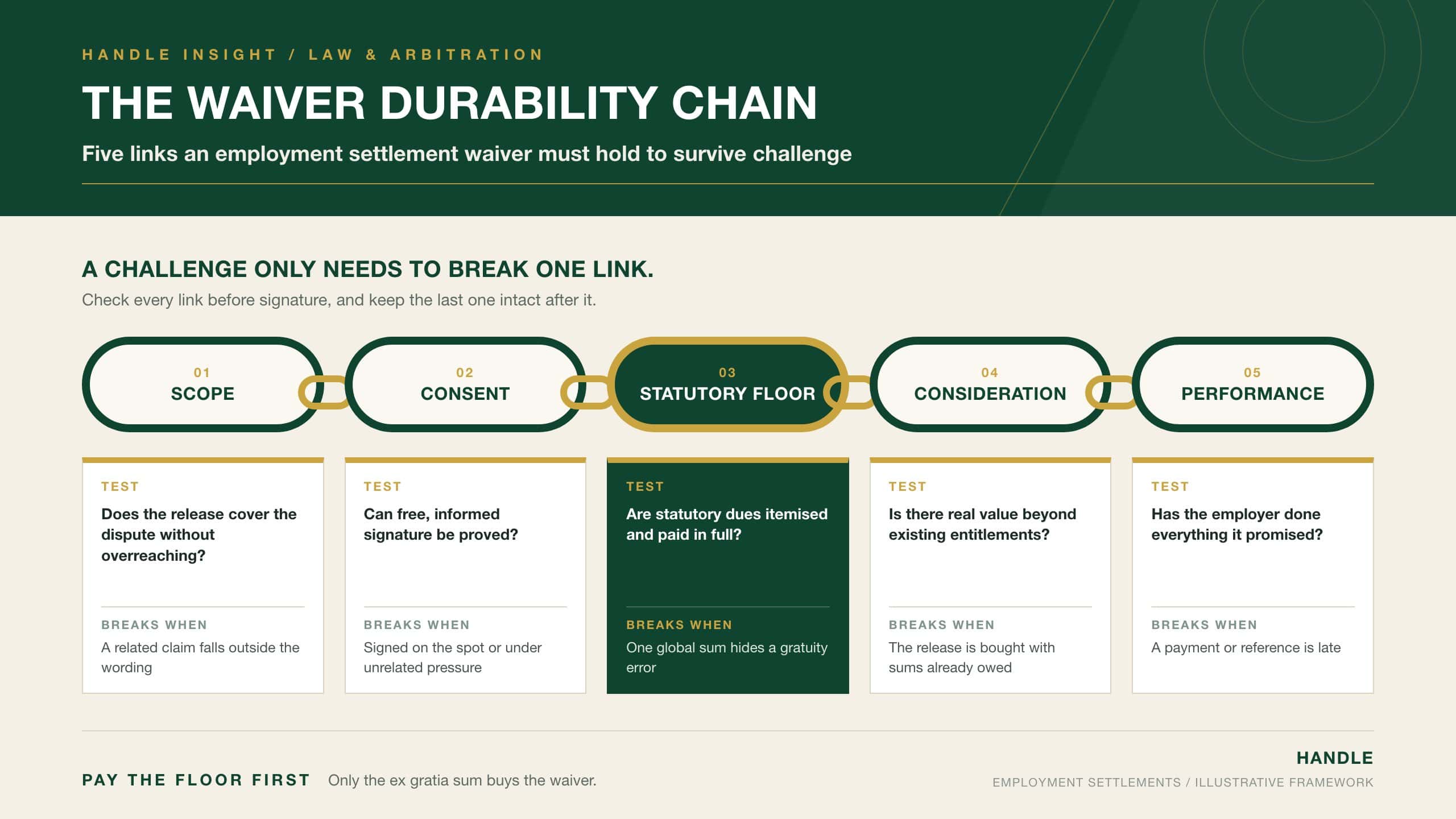
A settlement waiver can be tested as a chain of five links. A challenge succeeds when it breaks any one of them, so each must be checked before signature and maintained after it.
- Scope: does the release clearly cover the claims the employer needs to close, including the specific dispute, without overreaching into rights that cannot be waived?
- Consent: can the employer prove that the employee signed freely, with time to consider and the opportunity to take advice?
- Statutory floor: are all statutory entitlements calculated correctly and paid, or expressly accounted for, separately from the settlement consideration?
- Consideration: is there a real additional payment or benefit that the employee would not otherwise have received in exchange for the release?
- Performance: has the employer done everything the agreement promised, on time and in the agreed form?
The statutory floor is the link that fails most often in UAE onshore settlements, because it can be broken by an arithmetic error rather than a drafting choice. Performance is the link employers most often forget, because it fails after signature, when the matter is considered closed. A waiver that survives the first four links can still be undone by a late payment.
Common Failures in Settlement and Waiver Enforcement
- Presenting a single global sum without itemising statutory entitlements, which makes it impossible to show that the floor was respected.
- Using a generic template that is not aligned with the onshore Labour Law, the DIFC Employment Law or the ADGM Employment Regulations, as applicable.
- Requiring signature on the spot, which undermines any later argument that consent was informed and voluntary.
- Linking signature to unrelated matters such as visa cancellation or the release of final dues.
- Leaving restrictive covenants unaddressed, so that their status after settlement becomes a fresh dispute.
- Missing payment dates or failing to issue an agreed reference, which hands the employee a breach argument.
- Failing to retain the signed agreement, payment evidence and negotiation record in a place where they can be produced quickly.
Each failure weakens a link that the employer controlled. That is why settlement is a process to be managed, not a document to be signed.
Conclusion
Settlement agreements give employers finality only when the waiver they contain survives challenge. That depends on five things: a release that clearly covers the claims being closed, consent that can be proved, statutory entitlements calculated correctly and paid separately, genuine additional consideration for the release, and full performance by the employer after signature. In the UAE, the onshore Labour Law treats statutory rights as a floor that cannot be contracted below, while the DIFC and ADGM regimes set their own minimum standards and conditions for valid settlements. Employers that itemise payments, allow time and the opportunity for advice, address restrictive covenants expressly and assign an owner to every post-signature obligation convert settlement into durable protection. Those that treat it as a last-minute form invite the claim it was meant to prevent. Pay the floor. Prove the consent. Perform the promise.


