

Judgment debtors rarely hide assets in a vault. They hide them in paperwork: a sale to a related company at a fraction of value, a loan that will never be repaid, a management agreement that moves cash without any service in return, a new company that takes over the business of the old one. Sham transactions and piercing the corporate veil are the legal responses to that paperwork. Within Fraud and Asset Tracing, they allow a claimant to ask a court to look past the documents, identify the real transaction and the real controller, and make the assets reachable again. Courts do not do this lightly. Separate legal personality is a cornerstone of commercial law, and a claimant who alleges a sham must prove it. Substance defeats form only when substance is evidenced.
What Is a Sham Transaction?
A sham is a transaction whose documents do not reflect what the parties actually intended. The papers record one arrangement; the parties have agreed, expressly or tacitly, that something else will happen. A sale that is never paid for and after which the seller continues to use the asset, a loan with no expectation of repayment, or a backdated agreement prepared to explain a transfer after the event are classic examples.
The test focuses on common intention. It is not enough that a transaction is commercially unusual, tax-driven or unfavourable to creditors. A genuine transaction can be all of those things. A sham is one in which the parties never intended the documents to govern their real relationship. That is why sham claims are won on evidence of conduct after the transaction, not on criticism of the transaction’s design.
Sham Transactions and Piercing the Corporate Veil: Related but Different
The two doctrines are often argued together, but they answer different questions. A sham claim attacks a transaction and asks the court to disregard or recharacterise it. Veil piercing attacks the separation between a company and the person who controls it and asks the court to treat the company’s rights or liabilities as those of the controller, or the reverse.
Veil piercing is the narrower remedy. Under the English common law approach, which courts in the DIFC and ADGM draw upon, the leading UK Supreme Court decision in Prest v Petrodel Resources confines true piercing to cases where a person deliberately interposes a company to evade an existing legal obligation or to frustrate its enforcement. In most other cases, courts reach the same practical result through more conventional tools: finding that the company holds an asset on trust for its controller, treating the company as the controller’s agent or nominee, or holding the controller liable for his own wrongdoing.
| Remedy | What It Targets | What Must Be Shown | Typical Result |
|---|---|---|---|
| Sham declaration | A specific transaction | Common intention that the documents would not govern the real relationship | Transaction disregarded; asset treated as still belonging to the debtor |
| Veil piercing | The separation between a company and its controller | A company interposed to evade or frustrate an existing obligation | Controller and company treated as one for that obligation |
| Nominee, trust or agency finding | Assets held in another’s name | The holder has no real beneficial interest | Assets treated as the controller’s for enforcement |
| Avoidance of prejudicial transactions | Transfers that harm creditors | Statutory conditions, such as undervalue or a suspect period before insolvency | Transfer set aside or made unenforceable against creditors |
| Personal liability of managers | Directors and managers who misuse a company | Fraud, misuse of powers or breach of statutory duty | Manager personally liable to the company or creditors |
How UAE Law Approaches Sham and Veil Questions
Onshore UAE law approaches the same problems through codified rules rather than a general veil-piercing doctrine. The Civil Transactions Law (Federal Law No. 5 of 1985, as amended) contains provisions on simulated contracts: where the parties conceal their real agreement behind an apparent one, the real agreement governs between them, and creditors acting in good faith may rely on the reality. The same law allows a creditor to challenge a debtor’s dispositions that prejudice the creditor’s rights, such as gratuitous transfers that leave the debtor unable to pay.
The Commercial Companies Law, Federal Decree-Law No. 32 of 2021, preserves separate legal personality but imposes personal liability on directors and managers for fraud, misuse of authority and breaches of the law or the company’s constitution. The federal bankruptcy regime adds the possibility of avoiding certain transactions entered into during a period before insolvency, and of holding managers liable for company debts in defined circumstances. Beneficial ownership rules, which require companies to identify the individuals who ultimately own or control them, provide a further source of evidence.
In the DIFC and ADGM, the courts apply their own legislation and draw on English common law. Both can grant freezing and disclosure orders, including orders against third parties holding assets that are beneficially owned by the defendant. Onshore courts can grant precautionary attachment under the Civil Procedure Law, Federal Decree-Law No. 42 of 2022, where the claimant shows a serious claim and a risk to recovery.
What Evidence Collapses a Structure?
Courts look at what the structure does, not what it says. The most persuasive evidence comes from the parties’ own conduct and records.
| Indicator | What It Suggests | Where It Is Usually Found |
|---|---|---|
| Transfer at undervalue or without payment | No genuine sale was intended | Bank statements, valuation reports, land registry records |
| Continued use of the asset by the transferor | Economic reality unchanged after transfer | Utility bills, occupancy, insurance, vehicle records |
| Timing close to a claim, demand or judgment | Purpose of defeating enforcement | Correspondence, litigation chronology, corporate filings |
| Same individuals directing both sides | Absence of independent decision-making | Registers, board minutes, signatory mandates |
| Instructions given outside governance channels | The real controller sits behind nominal officers | Emails, messaging records, payment approvals |
| Circular or round-trip payments | Consideration is fictitious | Bank records traced across related entities |
No single indicator is decisive. A pattern is. Claimants who assemble a clear chronology linking timing, value, control and continued benefit present a far stronger case than those relying on suspicion about corporate complexity.
The Role of Asset Tracing
Tracing shows where value went. It follows funds through layered accounts and entities, identifies substitute assets bought with those funds and establishes that the same economic interest persists despite changes in legal title. Cash converted into property, shares or luxury goods remains traceable in principle, and the tracing exercise often produces the most compelling evidence of control, because the same person authorises each step.
Tracing and sham analysis reinforce each other. Tracing shows that value moved. Sham and veil analysis explain why the movement should be disregarded or why the recipient should answer for the debt.
Tracing is also where cross-border structures are most exposed. Value that leaves the UAE through a chain of offshore entities usually returns as property, investments or spending connected to the same individual. Following those steps in sequence, and recording who authorised each one, gives the court a factual narrative that does not depend on the defendant’s own account of the structure.
Interim Relief: Freezing What the Structure Was Built to Protect
Once there is credible evidence of a sham or of control through nominees, interim relief can be directed at the real controller and at the entities holding assets on his behalf. Freezing orders are drafted to capture assets the defendant owns directly or indirectly, or controls through others. Disclosure orders require the defendant to reveal assets, bank accounts and the identity of nominees, and each round of disclosure tends to expose the next layer of the structure.
Applications for interim relief demand candour. A claimant must present the evidence fairly, including points that favour the defendant. An order obtained on an overstated case is vulnerable to discharge, and that can damage the credibility of the wider claim.
Common Defences and How They Are Met
Formal compliance. The defendant points to signed agreements, board resolutions and registry filings. The response shows that the documents were not followed in practice: no payment, no change in use, no independent decision.
Commercial rationale. The defendant explains the transaction as tax planning, restructuring or a genuine sale. The response tests the explanation against market value, timing and the parties’ subsequent conduct. A genuine rationale explains the documents. It does not explain why the documents were ignored.
Independence. The defendant asserts that the recipient company is independently managed. The response produces evidence of instructions, shared accounts and benefit flowing back to the controller.
Worked Example: Reconstructing a Transfer
Consider an illustrative claimant holding a judgment for AED 30 million against a trading company. Two weeks after the claim was notified, the company transferred a warehouse valued at about AED 12 million and receivables of about AED 8 million to a newly formed affiliate for a stated price of AED 1 million, payable later. The same individual signs for both companies, and the affiliate operates from the same premises with the same staff.
The claimant’s evidence shows that the AED 1 million was never paid, that the debtor continued to collect and use rent from the warehouse, and that the affiliate’s bank account received the receivables and then paid the controlling individual’s personal expenses. On that evidence the claimant seeks a declaration that the transfer is a sham or, alternatively, unenforceable against creditors, together with freezing relief over the affiliate’s assets. If successful, around AED 20 million of value returns within reach of execution, against a stated consideration of AED 1 million that never moved.
The figures are illustrative. The pattern is common. Timing, undervalue, common control and continued benefit together tell a story that the documents cannot.
Original Analysis: The Substance Reconstruction Chain
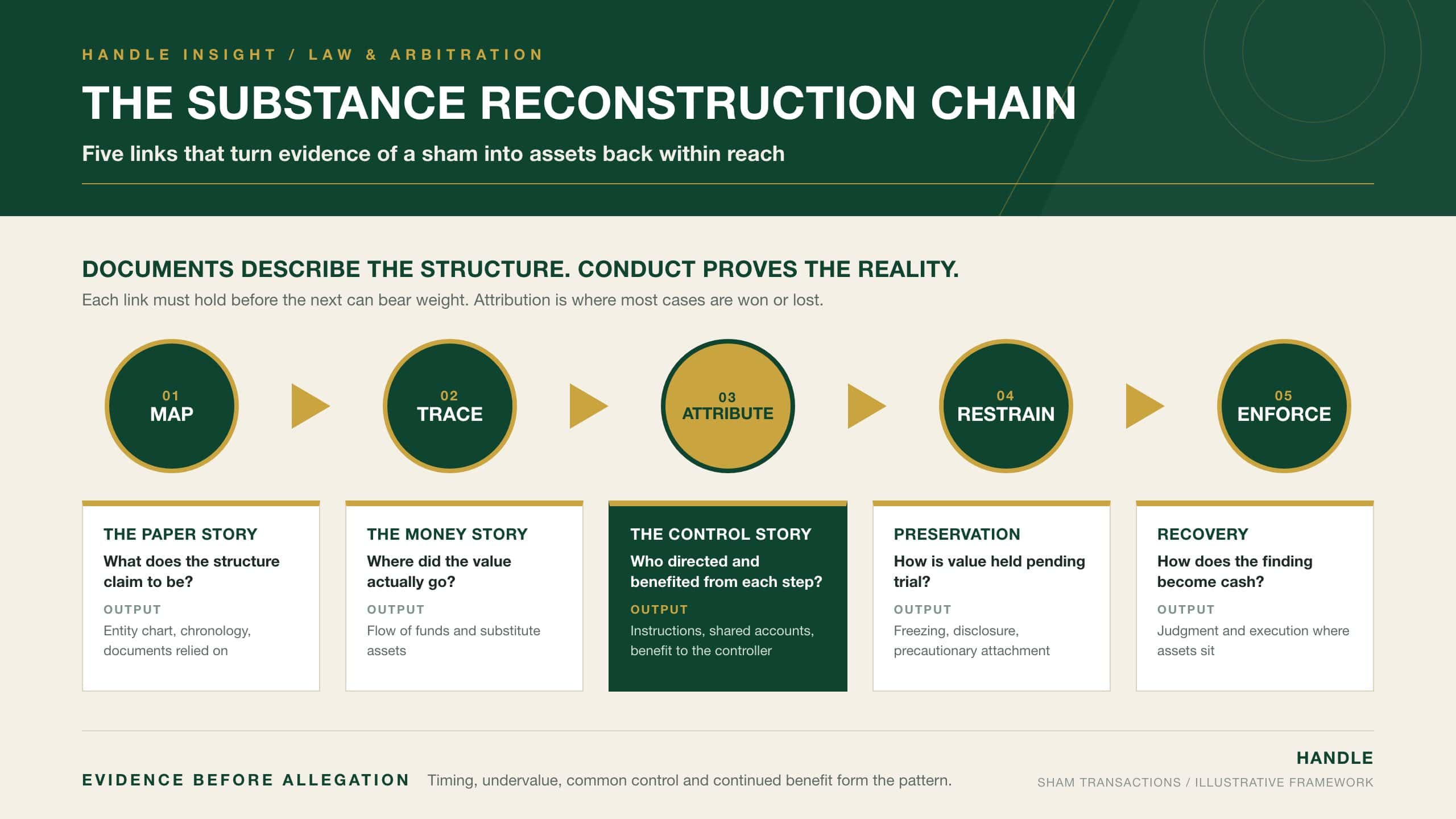
Successful sham and veil cases follow a five-link chain. Each link must hold before the next can bear weight.
| Link | Question | Output |
|---|---|---|
| 1. Map | What does the structure claim to be? | Entity chart, transaction chronology, documents relied on |
| 2. Trace | Where did the value actually go? | Flow of funds and substitute assets across entities |
| 3. Attribute | Who directed and benefited from each step? | Evidence of control, instruction and benefit |
| 4. Restrain | How is the value preserved pending trial? | Freezing, disclosure and precautionary attachment orders |
| 5. Enforce | How is the finding converted into recovery? | Judgment against the controller or entity, execution where assets sit |
The third link, attribution, is where most cases are won or lost. Mapping and tracing describe the structure. Attribution proves who stands behind it, and that proof is what justifies relief against someone other than the nominal owner.
Common Failures in Sham and Veil Claims
- Alleging a sham because a structure is complex, without evidence that the parties intended the documents to be disregarded.
- Seeking to pierce the veil when a nominee, trust or agency argument would achieve the same result on firmer ground.
- Moving for interim relief before attribution evidence is assembled, inviting discharge of the order.
- Failing to give full and frank disclosure in urgent applications, undermining credibility for the rest of the case.
- Tracing funds without connecting each step to a decision by the controller.
- Obtaining findings in one forum without planning recognition and execution where the assets are located.
Each failure gives the defendant’s paperwork a second life. Discipline in evidence is what ends it.
Conclusion
Sham transactions and abusive corporate structures are answered by evidence, not by suspicion. A sham claim must show that the parties never intended their documents to govern the real arrangement. Veil piercing, in its true sense, is reserved for companies interposed to evade an existing obligation, and most recoveries are achieved through related tools: nominee and trust findings, avoidance of prejudicial transfers and personal liability of those who misuse a company. In the UAE, onshore codified rules on simulated contracts and creditor protection sit alongside DIFC and ADGM courts that draw on English common law and offer strong freezing and disclosure relief. Across every forum the method is the same: map the structure, trace the value, attribute control, restrain the assets and enforce where they sit. Paper can disguise a transaction. It cannot change what happened.


