

A victim of fraud in the UAE rarely lacks a legal remedy. The more common problem is choosing between several, each run by a different authority, on a different timetable, with a different idea of what success means. A criminal complaint can lead to conviction without returning a dirham. A civil claim can win judgment after the assets have left the country. A regulatory report can freeze an account but leaves the claimant with no control over what follows. In Fraud and Asset Tracing, the framework matters as much as the facts. The legal frameworks for fraud in the UAE span criminal law, civil law, the procedural tools of three distinct court systems and a growing body of regulatory enforcement. Recovery depends on knowing which lever does what, which court can pull it and in what order to use them. The UAE provides multiple levers. Outcomes depend on sequence.
How Is Fraud Addressed Under UAE Law?
Fraud in the UAE is addressed on three tracks that intersect but do not merge. The criminal track punishes conduct: it is run by the police and the Public Prosecution and leads to conviction, fines, imprisonment and confiscation. The civil track compensates loss: it is run by the claimant before the courts and leads to judgment, damages and enforcement against assets. The regulatory track protects the financial system and regulated markets: it is run by supervisors, financial institutions and the Financial Intelligence Unit, and leads to account restrictions, sanctions and licensing consequences.
Each track has its own decision-maker. The claimant controls the civil case, including whether to settle. The claimant does not control the criminal case once it is filed, and has no control over regulatory action at all. Strategic control therefore depends on deciding which track leads, and how the others are used to support it.
| Feature | Criminal Track | Civil Track | Regulatory Track |
|---|---|---|---|
| Objective | Punishment and deterrence | Compensation and recovery | Integrity of regulated systems |
| Who decides | Police, Public Prosecution, criminal courts | Claimant and civil courts | Regulators, financial institutions, Financial Intelligence Unit |
| Claimant’s control | Low once filed | High | None |
| Asset outcomes | Confiscation; restitution not guaranteed | Attachment, judgment and execution | Account restrictions and freezes |
| Main strength | State investigative powers | Direct route to recovery | Speed of intervention |
The Criminal Framework
Fraud offences are defined principally in the Crimes and Penalties Law (Federal Decree-Law No. 31 of 2021), which replaced the former Penal Code of 1987. The law addresses fraud built on deception, the use of false names or capacities, fraudulent means that induce a victim to hand over money or property, breach of trust, and forgery. Fraud committed through electronic means is also addressed by the law on combating rumours and cybercrimes (Federal Decree-Law No. 34 of 2021), and money laundering of the proceeds is addressed by the federal anti-money laundering legislation.
A criminal complaint gives the claimant access to powers no private party has: arrest, search, seizure of documents and devices, travel bans and requests to banks. The Public Prosecution can also seek seizure of assets pending trial, and courts can order confiscation of the proceeds and instruments of crime on conviction. The victim may join a civil claim for compensation to the criminal proceedings.
The limits are equally important. The standard of proof is high. Investigative pace, charging decisions and any settlement with the accused are for the authorities, not the complainant. Confiscated assets do not automatically return to victims. And where a criminal case and a civil claim concern the same facts, the civil court may defer its decision until the criminal outcome is known, which can slow recovery considerably.
The Civil Framework
Onshore UAE courts apply a civil law system. Civil fraud claims are framed under the Civil Transactions Law, principally through liability for harmful acts, the rules on fraud and misrepresentation that vitiate a contract, and the principle that no one may be enriched without just cause at another’s expense. Claims against directors and managers may also rest on their statutory duties under the Commercial Companies Law (Federal Decree-Law No. 32 of 2021). Common law causes of action such as breach of fiduciary duty, deceit or conspiracy are not pleaded as such in the onshore courts, although the underlying conduct is usually actionable under the civil law categories.
The DIFC Courts and ADGM Courts operate differently. They apply common law based rules, conduct proceedings in English and recognise causes of action, remedies and standards of proof familiar from English practice, within the limits of their jurisdiction. A claimant with a dispute connected to those centres, or with a contract that confers jurisdiction on their courts, may therefore plead fraud in more familiar terms and access a wider range of interim relief.
Interim Relief: Controlling Assets Before Judgment
In fraud cases, delay is dissipation. Interim relief is therefore often more decisive than the eventual judgment.
Precautionary attachment. Under the Civil Procedure Law (Federal Decree-Law No. 42 of 2022), an onshore court may order precautionary attachment of the debtor’s assets, including bank accounts, real estate, shares and receivables held by third parties, where the claimant shows a debt or right that is sufficiently established and a risk that it will be lost. The application can be made without notice, and the claimant must then bring the substantive claim within a short statutory period or the attachment falls away.
Freezing and disclosure orders. The DIFC and ADGM Courts can grant freezing injunctions, including in appropriate cases worldwide freezing orders, together with ancillary disclosure orders requiring the respondent to identify its assets and orders against third parties holding information about the fraud. Their effectiveness against assets held onshore depends on the mechanisms for executing their orders through the onshore courts, which should be analysed before the application is made.
Travel bans. In appropriate civil and criminal cases, courts and prosecutors may restrict a debtor or suspect from leaving the UAE, which can be powerful leverage where the respondent’s personal presence matters to the outcome.
Which Forum Should Lead?
The UAE’s court systems offer different strengths, and the choice is constrained by jurisdiction. A claimant cannot simply choose the DIFC or ADGM Courts; there must be a jurisdictional basis, such as a connection with the centre or an agreement conferring jurisdiction.
| Consideration | Onshore Courts | DIFC Courts | ADGM Courts |
|---|---|---|---|
| Legal system | Civil law, UAE federal and emirate law | Common law based, DIFC laws | Common law, English law applied by statute |
| Language | Arabic | English | English |
| Key interim tool | Precautionary attachment | Freezing and disclosure orders | Freezing and disclosure orders |
| Reach over local assets | Direct, through local banks and registries | Through execution mechanisms with onshore courts | Through execution mechanisms with onshore courts |
| Jurisdiction | General | Requires a connection or agreement | Requires a connection or agreement |
Regulatory and Administrative Levers
Financial institutions in the UAE are subject to strict anti-money laundering obligations, including customer due diligence and the reporting of suspicious transactions to the Financial Intelligence Unit. A credible, well-evidenced report of fraud to a bank can lead to enhanced scrutiny and, in some cases, restrictions on an account, although the bank and the authorities act for their own reasons and on their own timetable.
Where the fraud involves a regulated entity, the relevant supervisor, such as the Central Bank, the Securities and Commodities Authority, the Dubai Financial Services Authority or the Financial Services Regulatory Authority, may take action including licence restrictions, fines and prohibitions on individuals. These consequences are not remedies for the victim. They are leverage, and they reinforce the incentive to cooperate in disclosure and settlement.
A Worked Example: Sequencing a Recovery
Consider an illustrative case. A trading company discovers that its former general manager diverted AED 25 million over two years to a company owned by a relative, through inflated supplier invoices. About AED 9 million appears to remain in two UAE bank accounts, and a villa in Dubai was purchased in the relative’s name.
Filing a criminal complaint first would bring investigative powers, but the company would lose control over pace, and any civil claim might later be suspended pending the criminal outcome. Instead, the company applies without notice for precautionary attachment over the two accounts and the villa, supported by the invoices and bank records it already holds. Having secured roughly AED 9 million in cash and the property, it files the substantive civil claim within the required period. It then files a criminal complaint for breach of trust and forgery, which supports a travel ban and allows the prosecution to obtain records the company cannot. Settlement discussions now take place with the assets secured and criminal exposure live. The sequence has converted three separate remedies into a single recovery strategy.
Cross-Border Evidence and Enforcement
Fraud proceeds rarely stay in one country. In criminal matters, evidence and assets abroad are pursued through mutual legal assistance and international judicial cooperation, which is powerful but slow and discretionary. In civil matters, UAE judgments and orders may be recognised abroad subject to the law of the place of enforcement, and foreign judgments and arbitral awards may be enforced in the UAE through the onshore courts under the Civil Procedure Law, or through the DIFC and ADGM Courts within their own regimes. The UAE’s accession to the New York Convention in 2006 means arbitral awards in fraud-related commercial disputes can be enforced in many jurisdictions.
Original Analysis: The Fraud Recovery Sequencing Map
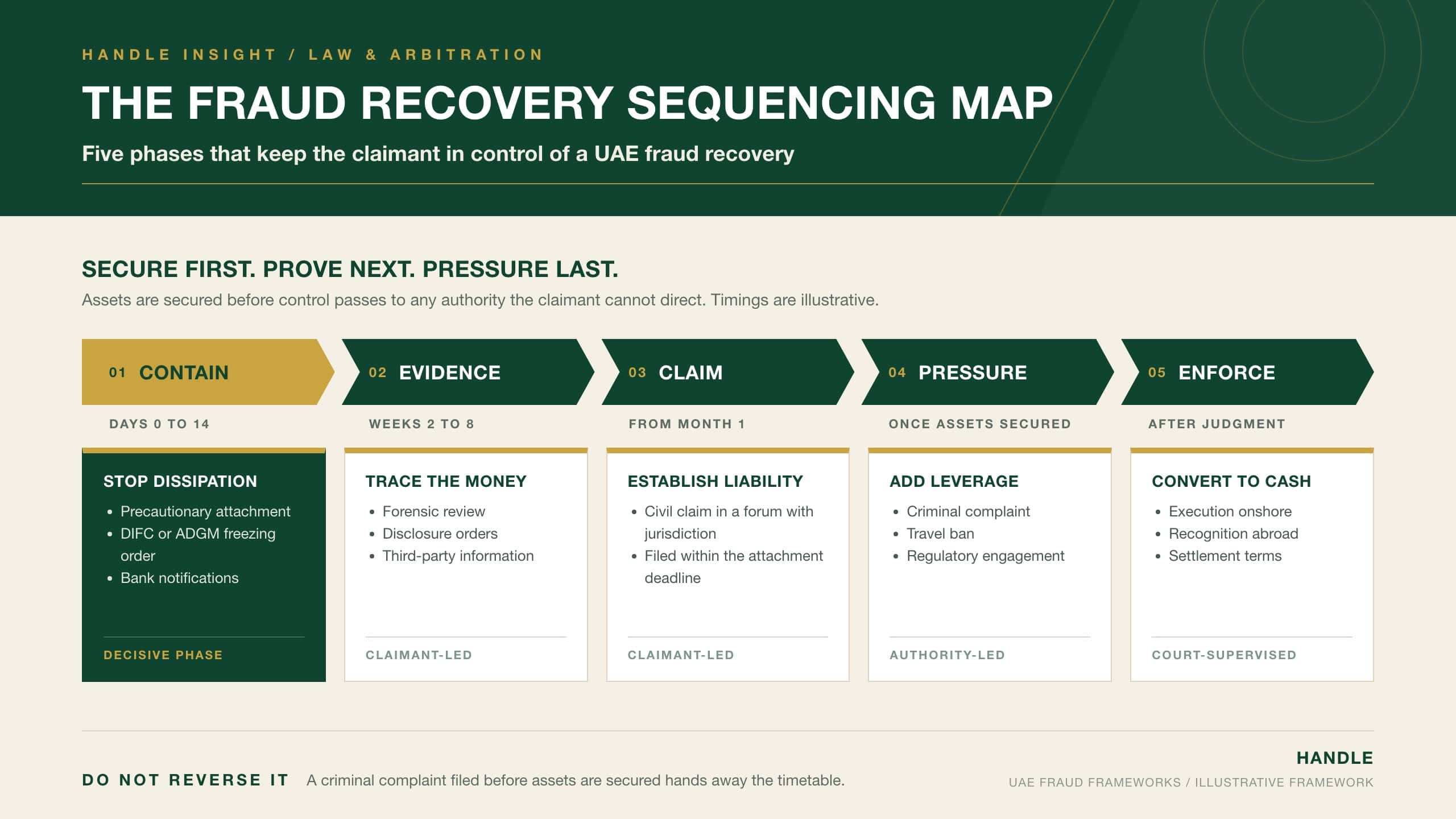
Most fraud recoveries in the UAE follow, or should follow, five phases. The map sets out the objective of each phase, the principal tools and the illustrative timing. Its core principle is that control is preserved by securing assets before the claimant surrenders the initiative to any authority it cannot direct.
| Phase | Objective | Principal Tools | Illustrative Timing |
|---|---|---|---|
| 1. Contain | Stop dissipation | Precautionary attachment, freezing orders, bank notifications | Days 0 to 14 |
| 2. Evidence | Prove the fraud and trace the money | Forensic review, disclosure orders, third-party information | Weeks 2 to 8 |
| 3. Claim | Establish liability in the chosen forum | Substantive civil proceedings | From month 1 |
| 4. Pressure | Add leverage without losing control | Criminal complaint, travel ban, regulatory engagement | Once assets are secured |
| 5. Enforce | Convert judgment or settlement into cash | Execution, recognition abroad, settlement terms | After judgment or agreement |
The first phase is decisive. A claimant that files a criminal complaint before securing assets alerts the respondent, hands the timetable to the authorities and may find that the money has moved before any court has acted. Reversing the sequence often surrenders control.
Common Failures in UAE Fraud Cases
- Filing a criminal complaint first, without any asset strategy, and losing control of timing and settlement.
- Pleading common law causes of action in the onshore courts instead of framing the claim under the Civil Transactions Law.
- Assuming that DIFC or ADGM jurisdiction is available without a proper connection or agreement.
- Obtaining a precautionary attachment and then missing the deadline for filing the substantive claim.
- Running civil, criminal and regulatory actions in parallel without coordination, so that one undermines another.
- Expecting confiscation in criminal proceedings to deliver restitution automatically.
- Leaving cross-border tracing until after judgment, when the assets have already left the UAE.
Each failure is a failure of sequence rather than of law. The remedies exist. Discipline decides whether they work.
Conclusion
The legal frameworks for fraud in the UAE offer a full set of tools: criminal offences under the Crimes and Penalties Law and the cybercrime legislation, civil liability under the Civil Transactions Law, precautionary attachment under the Civil Procedure Law, freezing and disclosure orders in the DIFC and ADGM Courts, and regulatory pressure through banks and supervisors. The tools are run by different authorities with different objectives, and only the civil track leaves the claimant in control. Effective recovery therefore begins by containing the assets, building the evidence and establishing the civil claim in a forum with proper jurisdiction, before criminal and regulatory levers are added as pressure. Cross-border tracing must start early, not after judgment. The framework does not reward the loudest complaint. It rewards the right sequence. Secure first. Prove next. Pressure last.


