Contracting with a state, a ministry or a state-owned enterprise brings a risk that private counterparties do not present: the counterparty may be able to argue that it cannot be sued, or that its assets cannot be touched, even after liability is established. Waiver of immunity clauses in contracts decide whether contractual rights against a state counterparty can be enforced or remain theoretical, which places them at the centre of Government & Sovereign Disputes, where jurisdiction, execution and access to assets must be secured when the contract is signed rather than when the dispute begins. Courts interpret these waivers narrowly. Immunity is rarely lost by implication, and a waiver that covers jurisdiction may say nothing about execution. A waiver clause is enforcement infrastructure. It is not boilerplate.
What Does a Waiver of Immunity Clause Do?
Sovereign immunity has two distinct dimensions. Immunity from jurisdiction protects a state from being sued in the courts of another state. Immunity from execution protects state property from attachment, arrest and sale to satisfy a judgment or award. Most legal systems now apply a restrictive approach, under which a state is not immune in respect of its commercial activities, but the details vary considerably between countries, and execution against state assets remains heavily protected almost everywhere.
A waiver clause is the state’s advance consent to set those protections aside, to the extent stated. It operates as a contractual and, in many systems, statutory mechanism: national immunity laws such as the United Kingdom’s State Immunity Act 1978 and the United States’ Foreign Sovereign Immunities Act 1976 recognise that a state can submit to jurisdiction and consent to execution in writing. The clause therefore does not create a right to enforce. It removes a defence that would otherwise defeat enforcement.
Jurisdiction and Execution: Two Waivers, Not One
The most common drafting error is to assume that a waiver of immunity from suit, or an agreement to arbitrate, also waives immunity from execution. In most systems it does not.
| Dimension | Immunity From Jurisdiction | Immunity From Execution |
|---|---|---|
| What it protects | The state from being made a defendant | State property from attachment and sale |
| Effect of an arbitration agreement | Generally treated as consent to the arbitration and to related supervisory court proceedings | Generally not treated as consent to execution |
| Effect of commercial activity | Usually removes immunity for disputes arising from that activity | May allow execution only against property used for commercial purposes, depending on the jurisdiction |
| Assets typically protected regardless | Not applicable | Diplomatic and consular property, military property and, in many systems, central bank assets unless specifically waived |
| What the clause must say | Express submission to the chosen courts or tribunal | Express consent to pre-judgment and post-judgment measures against defined assets |
An award without an execution waiver may be recognised by a court and still prove impossible to collect. The two waivers must be drafted together and tested together.
Who Has Authority to Waive?
A waiver binds the state only if it is given by a person or body with legal authority to give it under the state’s own law. Some states require ministerial approval, cabinet authorisation or legislative consent before an entity can submit to foreign jurisdiction, agree to arbitration or waive immunity. Others restrict which assets can be committed.
The position of state-owned enterprises needs particular care. A state-owned company with separate legal personality may be able to waive its own immunity, if it has any, but cannot waive the immunity of the state or of other state entities. If the commercial value of the contract depends on recourse to assets held by a ministry or another state body, that body must be a party or must give its own waiver, properly authorised.
Verification should be documented: a legal opinion from counsel in the state’s jurisdiction confirming capacity and authority, copies of the approvals relied on, and confirmation that the signatory was empowered. A defective authority is a defence that can be raised at the moment of enforcement, after years of proceedings.
Drafting Elements of an Enforceable Waiver
| Element | Purpose | Weak Formulation | Stronger Formulation |
|---|---|---|---|
| Express, irrevocable language | Overcome strict construction | “The parties agree to the jurisdiction of the tribunal” | The state “irrevocably and unconditionally waives” immunity, named expressly |
| Scope of proceedings | Cover every stage | Waiver limited to “any suit” | Arbitration, court proceedings, interim relief, recognition and enforcement |
| Execution consent | Open access to assets | Silent on execution | Express consent to attachment before and after judgment or award |
| Asset description | Reduce public-purpose arguments | “All assets” | Assets used or intended for commercial purposes, with carve-outs for protected categories |
| Forum coverage | Allow enforcement where assets sit | One named jurisdiction | Any jurisdiction in which enforcement is sought |
| Authority representation | Support capacity | None | Representation of authority, supported by approvals and a legal opinion |
A clause that claims to reach every asset of the state, including diplomatic and military property, is less credible than one that excludes those categories. Courts are more willing to give effect to a clause that respects the limits the law imposes anyway.
Interaction With Arbitration Agreements
Arbitration is the usual dispute mechanism in contracts with state counterparties, because it offers a neutral forum and awards that can be enforced in the many states party to the New York Convention, which the UAE joined in 2006. The New York Convention, however, governs recognition of the award. It does not override national rules on immunity from execution.
The arbitration clause and the waiver should be drafted as one system. The seat determines which courts supervise the arbitration and hear any challenge. The waiver should cover proceedings in those courts, and in any court where recognition and enforcement may be sought. Where the counterparty is in the UAE and the seat is onshore, the Federal Arbitration Law, Federal Law No. 6 of 2018 as amended by Federal Law No. 15 of 2023, governs: a set-aside application must be made to the competent Court of Appeal within 30 days of notification of the award, and recognition and enforcement follow the statutory procedure. In the DIFC, the DIFC Arbitration Law No. 1 of 2008 applies, with set-aside applications to the DIFC Courts within three months, and in ADGM the ADGM Arbitration Regulations 2015 apply before the ADGM Courts.
The UAE Dimension
Investors contracting with UAE government bodies or government-related entities should consider three points. First, capacity: certain government entities need prior approval from a designated authority before agreeing to arbitration or to provisions that affect state rights, and the approval should be obtained and recorded before signature. Second, asset protection: UAE civil procedure rules protect public property of the federal government and the emirates from attachment, which means that execution against a government body will depend on the nature and ownership of the assets targeted. Third, entity structure: many government-related entities are separate commercial companies, and recourse will usually be limited to their own assets unless another entity has given security or a guarantee.
These points do not make enforcement impossible. They make it a matter of structure. Contracts that secure a creditworthy counterparty, proper approvals and, where appropriate, guarantees or security are far more valuable than contracts that rely on a broadly worded waiver alone.
Judicial Interpretation: Strict Construction
Courts interpret waivers restrictively because immunity reflects the sovereign equality of states. Ambiguity is generally resolved in favour of immunity. A waiver of immunity “from suit” may not cover execution; a waiver given in one agreement may not extend to a related agreement; and a waiver that refers only to the courts of one country may not support enforcement in another.
States facing execution often argue that targeted assets serve public purposes, such as accounts used for embassy operations or funds held for public programmes. A clause that identifies the categories of commercial assets intended to be available, and that requires the state to maintain records distinguishing commercial from public property, narrows the space for that defence.
Using the Waiver Once a Dispute Arises
A waiver is most valuable when it is invoked early. At the jurisdictional stage, the creditor should rely on it expressly to answer any immunity objection before the proceedings lose momentum. Before the award, it supports applications for interim measures against identified commercial assets. After the award, it shortens the enforcement debate, because the court’s attention moves from whether the state consented to which assets fall within that consent. Creditors should also map the counterparty’s commercial assets while the contract is being performed, when information about receivables, accounts and shareholdings is easiest to obtain. A waiver opens the door. Asset intelligence decides what passes through it.
Worked Example: Two Contracts, One Award
Consider an illustrative contractor that obtains an arbitral award of AED 180 million against a state-owned infrastructure authority. Under Contract A, the authority agreed only to arbitration. The award is recognised in two jurisdictions, but the authority asserts immunity from execution over its bank accounts, arguing that they fund public services. Recovery stalls while the courts examine the use of each account.
Under Contract B, the same authority, with documented cabinet-level approval, irrevocably waived immunity from jurisdiction and from execution in respect of its commercial assets, excluding diplomatic, military and central bank property, and consented to pre-award attachment. The contractor attaches receivables owed to the authority by a foreign commercial counterparty worth about AED 95 million and a shareholding in a commercial joint venture valued at around AED 110 million. Faced with execution on assets it cannot credibly describe as public, the authority settles for AED 165 million.
The figures are illustrative. The difference between the outcomes lies entirely in the contract.
Original Analysis: The Sovereign Waiver Ladder
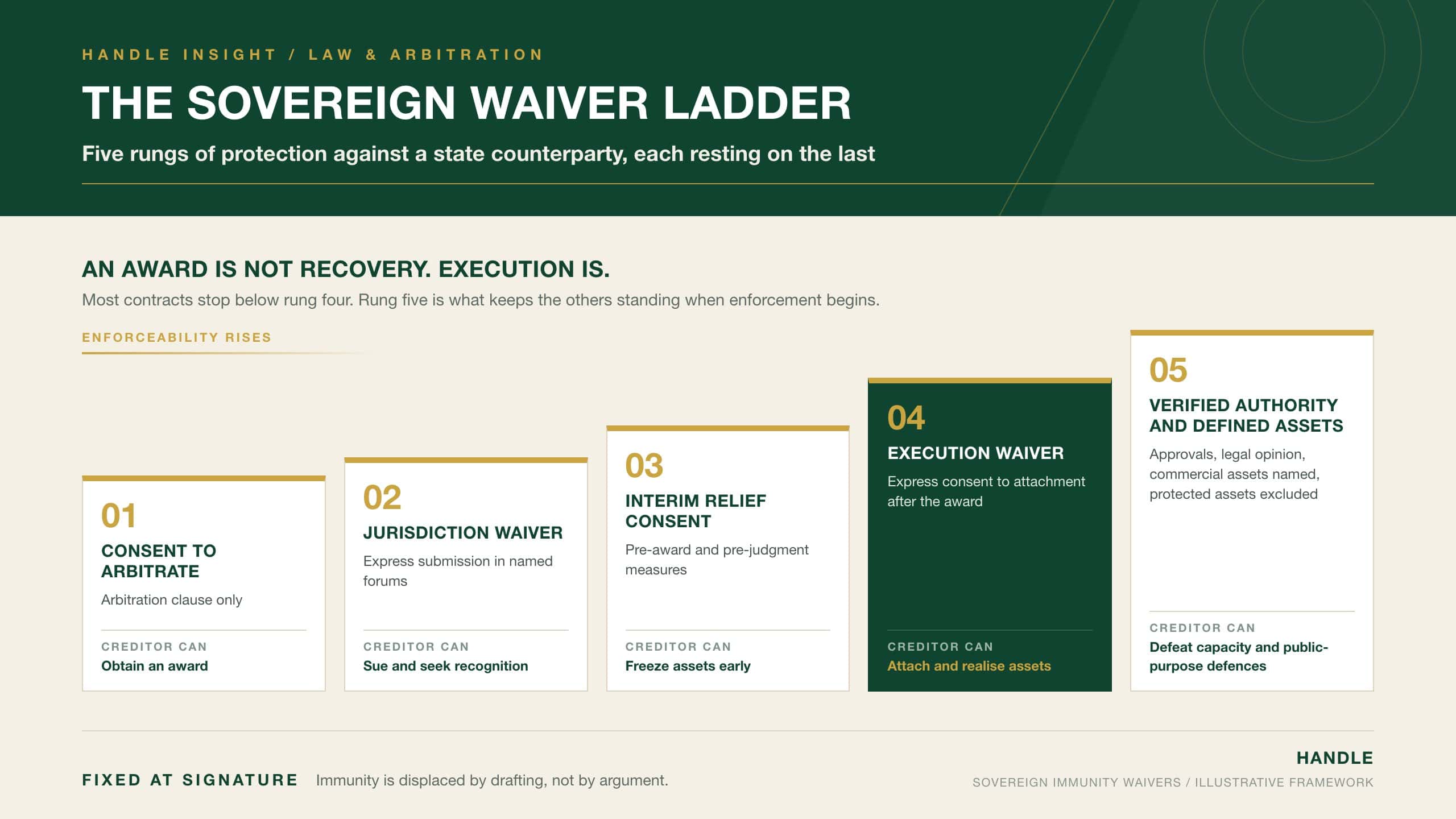
The Sovereign Waiver Ladder ranks the protection a creditor actually holds. Each rung adds a layer of enforceability, and each rung depends on those beneath it.
| Rung | What the Contract Contains | What the Creditor Can Do |
|---|---|---|
| 1. Consent to arbitrate | Arbitration agreement only | Obtain an award; enforcement against assets uncertain |
| 2. Jurisdiction waiver | Express waiver of immunity from suit in named forums | Bring court proceedings and recognition actions |
| 3. Interim relief consent | Consent to pre-judgment and pre-award measures | Freeze assets while the dispute is decided |
| 4. Execution waiver | Express waiver of immunity from execution | Attach and realise assets after the award |
| 5. Verified authority and asset definition | Documented approvals, legal opinion, defined commercial assets and carve-outs | Defeat capacity and public-purpose defences |
Rung four is where most contracts fall short. Rung five is what makes the others hold. A clause that reaches rung four without verified authority can still fail on the day it is needed.
Common Waiver Failures
- Treating an arbitration clause as a complete waiver, leaving execution immunity untouched.
- Obtaining a waiver from a state-owned company when the assets that matter belong to the state or another state entity.
- Failing to verify that the signatory and the approving body had authority to waive immunity under the state’s own law.
- Drafting waivers that claim to reach all assets, including categories that the law protects regardless, which undermines credibility.
- Limiting the waiver to one jurisdiction when assets may be located in several.
- Using different waiver language across related agreements, creating gaps that the counterparty can exploit.
Each failure is fixed at signature or not at all. Immunity is displaced by drafting, not by argument.
Conclusion
Waiver of immunity clauses decide whether a contract with a state counterparty produces recoverable value or only a recognised claim. Immunity from jurisdiction and immunity from execution are separate protections, and an agreement to arbitrate usually addresses only the first. An enforceable waiver is express and irrevocable, covers every stage from interim relief to execution, applies wherever assets may be found, describes the commercial assets intended to be available and excludes the categories the law protects regardless. It must also be given by a body with verified authority under the state’s own law. In the UAE, capacity approvals, the protection of public property and the separate personality of government-related entities make structure as important as wording. The work must be done at signature. Authority confirmed. Scope defined. Execution enabled.