An arbitral award decides who owes what. It does not move money. The period between the award and actual payment is where most of the commercial value of a dispute is either secured or eroded, and it is governed less by the tribunal than by the debtor’s choices, the challenge rules at the seat and the location of assets. Within Law & Arbitration, settlement after arbitration covers two distinct outcomes: a negotiated resolution reached before the final award, and payment or compromise after the award has been issued. The honest answer to how long it takes is that settlement can happen within days, within the payment period fixed by the award, or only after months of challenge and enforcement proceedings. What determines the answer can be mapped in advance. An award is a claim on value. Settlement is the moment that value is converted into cash.
What Does Settlement After Arbitration Actually Mean?
The phrase is used loosely, and the looseness causes poor planning. Three different events are often described as settlement after arbitration.
The first is a settlement reached during the proceedings, before the tribunal rules. The parties agree terms, and the arbitration is either withdrawn or the agreement is recorded by the tribunal as an award on agreed terms, commonly called a consent award.
The second is voluntary compliance with a final award. The losing party pays the sum awarded, with any interest and costs, within the period the award specifies or within a reasonable time after it is notified.
The third is a post-award compromise. The award creditor accepts a discount, an instalment schedule or a transfer of assets in exchange for prompt certainty, rather than pursuing full enforcement through the courts.
Each of these runs on a different clock and carries a different risk profile. A party that treats them as one event will misjudge both its leverage and its timetable.
Why Many Disputes Settle Before the Final Award
Arbitration is designed to produce a binding decision, but its procedural stages also reveal information that changes each party’s assessment of risk. Settlement pressure tends to peak at identifiable moments: after document production exposes the strength of the evidence, after expert reports quantify the exposure, shortly before the final hearing when costs are about to escalate, and after any preliminary ruling that signals the tribunal’s view on a key issue.
A settlement reached at these points can be documented in two ways. A private settlement agreement ends the dispute contractually but, if breached, may require fresh proceedings. A consent award converts the agreed terms into an arbitral award. Under the UAE Federal Arbitration Law (Federal Law No. 6 of 2018, as amended by Federal Law No. 15 of 2023), the DIFC Arbitration Law (DIFC Law No. 1 of 2008) and the ADGM Arbitration Regulations 2015, a tribunal may record a settlement in the form of an award, which then carries the same status as any other award for recognition and enforcement purposes. Where the counterparty’s willingness to pay is in doubt, a consent award is usually the stronger instrument.
How Long After a Final Award Is Settlement Paid?
Once the final award is issued, timing depends on four variables: what the award orders, whether the debtor can pay, whether the debtor challenges the award, and where its assets are located.
| Post-Award Scenario | Typical Indicative Timing | What Drives It |
|---|---|---|
| Voluntary compliance | Days to a few weeks | Debtor accepts the outcome and values reputation or ongoing relationships |
| Payment within a period set by the award | Commonly 30 to 90 days, as specified | Liquidity arrangements, internal approvals, financing |
| Negotiated post-award compromise | Weeks to several months | Discount, instalments or asset transfer agreed against certainty |
| Challenge at the seat followed by enforcement | Several months to more than a year | Set-aside proceedings, appeals, stay applications and court calendars |
| Multi-jurisdiction enforcement | Often a year or longer | Recognition in each jurisdiction, asset tracing, sovereign or regulatory constraints |
These ranges are indicative only. They describe patterns, not entitlements, and any individual case can move faster or slower depending on the conduct of the parties and the courts involved.
The UAE Post-Award Timetable: Onshore, DIFC and ADGM
For awards connected with the UAE, the seat of the arbitration determines which court supervises the award and how long the debtor has to challenge it. That challenge window is the single most important variable in the settlement timetable.
UAE onshore seat. Under the Federal Arbitration Law, an application to set aside an award must be filed with the competent Court of Appeal within 30 days of notification of the award. The grounds are limited and do not permit a review of the merits. An application to set aside does not of itself suspend enforcement, although the court may order a stay on request where it considers the grounds serious, and may require security. The award creditor applies for ratification and an enforcement order under Article 55 of the law, after which execution proceeds through the execution courts under the federal civil procedure framework.
DIFC seat. Under the DIFC Arbitration Law, a set-aside application must generally be made to the DIFC Courts within three months of receipt of the award. Recognition and enforcement are also sought from the DIFC Courts.
ADGM seat. Under the ADGM Arbitration Regulations 2015, challenges to the award and applications for recognition and enforcement are dealt with by the ADGM Courts, within the time limits set by the Regulations.
Foreign awards. The UAE acceded to the New York Convention in 2006. A foreign award is recognised and enforced onshore under the Convention and the procedure in the federal civil procedure legislation, now Federal Decree-Law No. 42 of 2022 on Civil Procedure, on the limited grounds the Convention allows.
| Seat | Supervising Court | Challenge Window | Effect on Settlement Timing |
|---|---|---|---|
| UAE onshore | Competent Court of Appeal | 30 days from notification of the award | Short window creates an early decision point for both parties |
| DIFC | DIFC Courts | Generally three months from receipt of the award | Longer window can delay voluntary payment while the debtor weighs a challenge |
| ADGM | ADGM Courts | As prescribed by the ADGM Arbitration Regulations | Common-law court practice; timing depends on the application made |
| Foreign seat, UAE assets | Seat courts for challenge; UAE courts for enforcement | Governed by the law of the seat | Two clocks run at once; recognition in the UAE may proceed while a challenge is pending abroad |
What Happens If the Losing Party Does Not Pay?
If the debtor does not comply, the award creditor must convert the award into an enforceable court order and then execute it against assets. Execution measures can include attachment of bank accounts, attachment of receivables owed by third parties, seizure and sale of movable and immovable property, and orders directed at shares in companies. Where assets are held outside the seat, recognition proceedings may be required in each jurisdiction where they are located.
Enforcement is rarely the end goal in itself. In practice, the credible threat of enforcement is what brings a reluctant debtor to the table. A creditor that has already obtained an enforcement order, identified assets and prepared attachment applications negotiates from a materially stronger position than one that has only an award.
Factors That Lengthen or Shorten the Timeline
The terms of the award. An award that specifies a clear sum, currency, payment date and rate of post-award interest leaves little room for argument. An award requiring performance, transfers or accounting is slower to implement and easier to dispute.
The debtor’s liquidity. A debtor that accepts liability but lacks cash may still settle quickly if offered instalments or a short discount for early payment.
The prospects of a challenge. A challenge with weak grounds still consumes time. The length of the challenge window at the seat, and whether a stay of enforcement is likely, shape the debtor’s incentive to delay.
Asset location and structure. Assets held through holding companies, in several jurisdictions or by state-linked entities lengthen enforcement and increase the value of a negotiated outcome.
Regulatory or sovereign constraints. Currency controls, sanctions and immunity arguments can delay payment even where the debtor is willing.
A Worked Example: Pricing a Post-Award Settlement
The following figures are illustrative only. A UAE-seated tribunal issues an award of AED 12 million against a contractor. The contractor signals that it may apply to set aside the award. The creditor estimates that, if it proceeds to full enforcement, it has an 85% probability of recovering the full amount within about 12 months, with legal and enforcement costs of around AED 600,000.
The expected gross recovery is AED 10.2 million (85% of AED 12 million). After costs, the expected net recovery is AED 9.6 million. Applying an illustrative 8% annual cost of capital to reflect the 12-month delay reduces its present value to roughly AED 8.9 million.
On these assumptions, an offer of AED 10 million paid within 30 days is worth more to the creditor than pursuing enforcement, even though it represents a discount of about 17% to the face value of the award. The contractor, for its part, avoids challenge costs, enforcement measures against its accounts and the reputational effect of attachment. The award fixes the ceiling. Time, cost and risk set the price.
Original Analysis: The Award-to-Cash Timeline
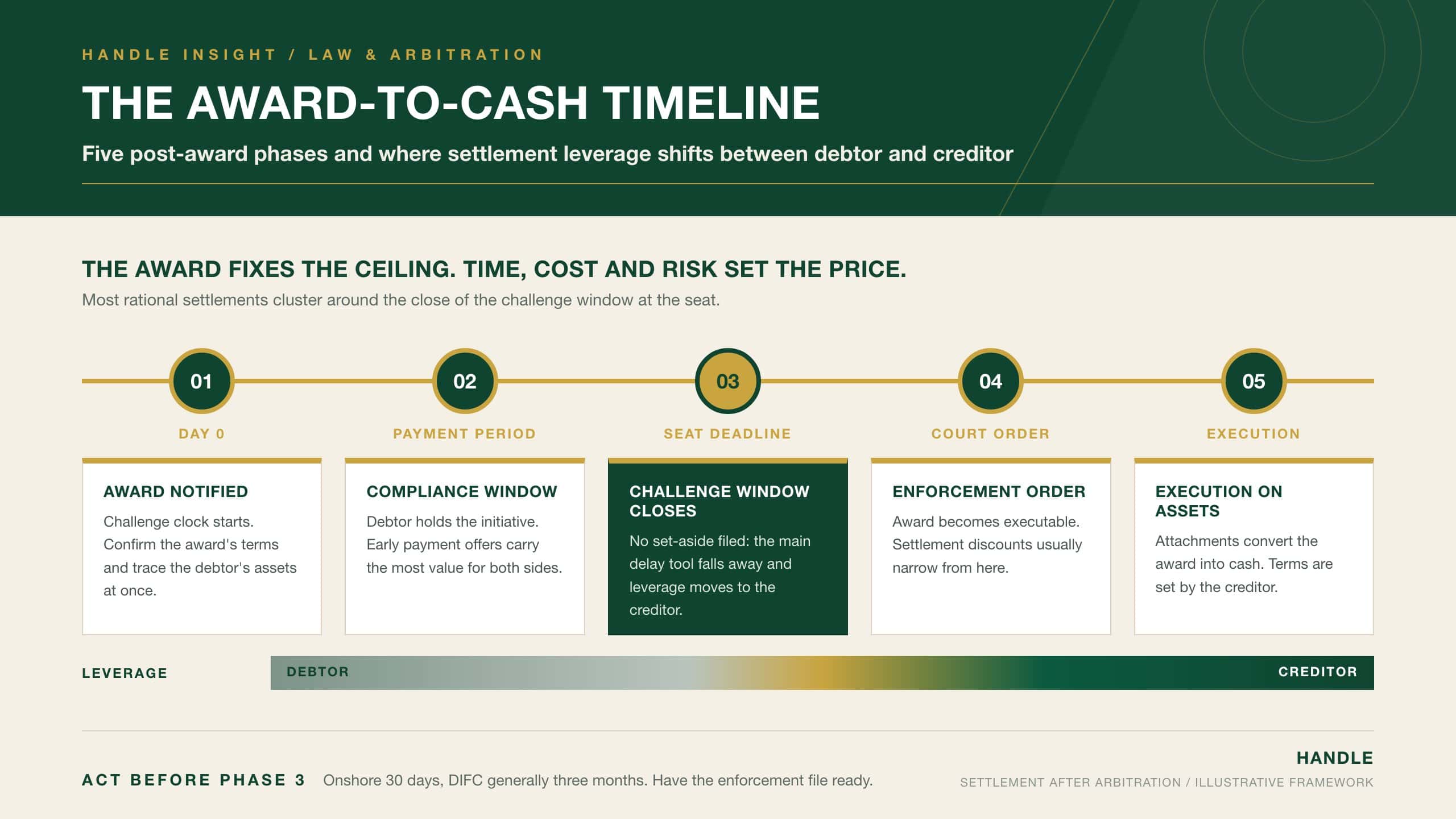
A practical way to manage settlement after arbitration is to treat the post-award period as five consecutive phases, each with its own decision point and its own balance of leverage. The model is illustrative, but it reflects how leverage shifts between debtor and creditor as each clock runs out.
- Phase 1: Award notified. The award is received and the challenge clock starts. Leverage is balanced, and the creditor should immediately confirm the debtor’s assets and the award’s precise terms.
- Phase 2: Voluntary compliance window. The payment period set by the award runs. The debtor holds the initiative, but early payment offers carry the highest value for both sides.
- Phase 3: Challenge window closes. On an onshore UAE seat, 30 days from notification; on a DIFC seat, generally three months. If no challenge is filed, the debtor’s main delay tool falls away and leverage moves decisively to the creditor.
- Phase 4: Recognition and enforcement order. The award becomes executable. Settlement offers made at this stage usually carry smaller discounts.
- Phase 5: Execution against assets. Attachments and sales convert the award into cash. Settlement remains possible, but on terms increasingly dictated by the creditor.
The critical point is Phase 3. Most rational post-award settlements cluster just before or just after the challenge window closes, because that is when both sides know whether the award will be tested. A creditor that has prepared its enforcement file before that date captures the leverage. A creditor that begins preparing only afterwards gives it back.
Common Failures in Managing Settlement After Arbitration
- Treating the award as the end of the matter, rather than as the start of a recovery process that needs its own plan and budget.
- Allowing the challenge window to pass without having identified assets or prepared enforcement applications, which wastes the moment of maximum leverage.
- Recording a mid-arbitration settlement only in a private agreement when a consent award would have provided a directly enforceable instrument.
- Agreeing instalment settlements without default clauses, security or an agreed consent to enforcement of the full award if payments stop.
- Assuming that a set-aside application automatically suspends enforcement, when in the UAE and many other jurisdictions it does not.
- Ignoring post-award interest when pricing a discount, so that a settlement which appears generous is in fact below the award’s current value.
Each of these failures stems from the same error. The parties plan for winning the arbitration and not for collecting on it.
Conclusion
Settlement after arbitration can take days, a few months or more than a year. The difference is rarely luck. It depends on what the award orders, whether the debtor can and will pay, how long the seat allows for a challenge and where the debtor’s assets are held. For UAE-related awards, the seat sets the first critical clock: 30 days to apply to set aside an onshore award, generally three months for a DIFC award, and the periods set by the ADGM Arbitration Regulations for an ADGM award. A set-aside application does not stop the creditor preparing enforcement. Parties that map the post-award phases, price settlement offers against the real cost and timing of enforcement and act before the challenge window closes convert awards into cash faster. Winning the award establishes the right. Managing the timeline realises it.