Interest is often treated as an arithmetical afterthought to an arbitration award. In practice it can be one of the largest components of recovery. Calculating interest on an arbitration award means determining the additional amount payable on top of the principal sum to compensate for the time during which the successful party was kept out of its money, both before the award is issued and after it until payment. Within Law & Arbitration, interest matters because it shapes settlement leverage, enforcement pressure and the true economic value of a claim. The amount depends on four variables: the rate, the start date, the end date and the method of calculation, together with the base on which interest runs. Each is decided by the contract, the governing law and the tribunal’s mandate, and each can be argued. Over a long dispute, the way interest is calculated can matter as much as the principal claim. Interest is not a footnote to the award. It is part of the claim.
Why Interest Is Awarded in Arbitration
Interest compensates for the time value of money. A party that should have been paid on a due date but was paid years later has lost the use of that money, either because it had to borrow to replace it or because it lost the return it could have earned. Without interest, a respondent would benefit from delay, and every month of procedural resistance would reduce the real value of the claim.
Interest therefore serves three functions. It restores the claimant to the economic position it would have occupied if payment had been made on time. It removes the incentive to withhold payment during the proceedings. And, after the award, it creates continuing pressure to pay rather than resist enforcement.
Pre-Award and Post-Award Interest Compared
Tribunals distinguish between interest for the period before the award and interest for the period after it. The two serve different purposes and are often calculated on different bases.
| Feature | Pre-Award Interest | Post-Award Interest |
|---|---|---|
| Period covered | From breach, due date or date of loss until the award | From the award, or a stated grace period, until payment |
| Primary purpose | Compensation for being kept out of money during the dispute | Pressure to comply and compensation for delay in payment |
| Usual source of rate | Contract rate, governing law or a commercial benchmark | Rate stated in the award, or a rate fixed by the governing law |
| Base | The principal sum or each instalment from its due date | Principal only, or principal plus pre-award interest and costs, as the award states |
| Main points of dispute | Start date, rate and whether compounding is permitted | Base, grace period and whether interest continues during challenges |
A well-drafted award states each element expressly. An award that grants interest at a stated rate without specifying the base or the end date invites further dispute at the enforcement stage.
How Is Interest on an Arbitration Award Calculated?
The basic formula for simple interest is principal multiplied by rate multiplied by time. If an award grants USD 5,000,000 with simple interest at 6 per cent a year for three years, the interest is USD 5,000,000 × 0.06 × 3, which equals USD 900,000, giving a total of USD 5,900,000 before costs.
Compound interest applies the rate to accumulated interest as well as the principal. The formula is principal multiplied by one plus the rate, raised to the power of the number of compounding periods. On USD 10,000,000 at 8 per cent compounded annually for five years, the total is USD 10,000,000 × 1.08 to the power of five, approximately USD 14,693,000. The equivalent simple interest figure would be USD 14,000,000. The difference grows with both the rate and the duration.
Where a claim consists of several unpaid invoices or instalments, interest is usually calculated separately on each amount from its own due date. Tribunals may also adopt a single mid-point date for convenience where the amounts are numerous and the effect is small. Both approaches should be explained in the award.
Where Does the Interest Rate Come From?
The rate is determined in a recognised order of priority.
The Contract
If the contract specifies a default or late payment rate, tribunals generally apply it unless it is unlawful under the governing law or contrary to public policy at the seat or place of enforcement. A clear contractual clause is the most reliable source of interest.
The Governing Law
Where the contract is silent, the substantive governing law may supply a rate or a method, and may restrict the availability of compound interest.
Commercial Benchmarks
Where neither the contract nor the law fixes a rate, tribunals often select a benchmark reflecting the cost of borrowing in the currency of the award, plus a margin. For US dollar awards, the Secured Overnight Financing Rate (SOFR) has replaced US dollar LIBOR, which ceased to be published. For dirham amounts, the Emirates Interbank Offered Rate (EIBOR) is a common reference. Contracts that still refer to LIBOR should be reviewed, because a reference to a discontinued benchmark creates an avoidable argument about the replacement rate.
Simple Versus Compound Interest
Many awards apply simple interest unless the contract or governing law provides otherwise. Compound interest is more common in financial disputes, investment treaty arbitration and claims where the claimant can show that it would itself have paid or earned compound interest during the period. Investment treaty tribunals have increasingly accepted compound interest as reflecting commercial reality.
Whether compound interest is available depends on three questions. Does the contract provide for it? Does the governing law permit it? And would an award of compound interest be enforceable where the respondent’s assets are located? A tribunal may have power to award compound interest under the governing law, yet the award could face resistance at enforcement if the law of the enforcing court treats such interest as contrary to public order.
Interest on Costs and When Tribunals Reduce Interest
Interest is not limited to the principal claim. Tribunals may also award interest on legal costs, arbitration fees and tribunal expenses, usually from the date of the award or from the date the costs were paid. Where costs are substantial, this adds a further layer of post-award exposure.
Tribunals may also refuse or reduce interest. Common reasons include delay caused by the claimant itself, a contractual exclusion of interest, restrictions in the governing law, or a damages methodology that already compensates for the cost of money, such as a discounted cash flow valuation brought forward to the award date. Interest must compensate. It must not duplicate.
Interest on Arbitration Awards in the UAE
The UAE Federal Arbitration Law, Federal Law No. 6 of 2018 as amended by Federal Law No. 15 of 2023, does not prescribe a rate of interest. The tribunal’s power to award interest derives from the parties’ agreement and the applicable substantive law. For contracts governed by onshore UAE law, the distinction between commercial and civil obligations matters: interest on commercial debts is recognised under the UAE’s commercial legislation, now Federal Decree-Law No. 50 of 2022 on Commercial Transactions, while civil law treats interest more restrictively. Onshore courts have generally awarded simple interest, and compound interest is viewed cautiously.
Enforcement shapes strategy. An onshore award is ratified and enforced by the competent court under the Arbitration Law and the Civil Procedure Law, Federal Decree-Law No. 42 of 2022, and a foreign award is enforced under the New York Convention, to which the UAE acceded in 2006. In either case, the enforcing court may examine whether the interest component is consistent with public order. Awards seated in the DIFC under the DIFC Arbitration Law No. 1 of 2008, or in ADGM under the ADGM Arbitration Regulations 2015, are governed by their own regimes, but where enforcement is sought against assets onshore, the onshore analysis remains relevant. Parties should therefore separate the interest component clearly in their claims, so that any challenge to it does not affect the principal sum.
A Worked Example: Pre-Award and Post-Award Together
Consider an illustrative commercial claim of AED 10 million that fell due on 1 January 2022. The contract provides for late payment interest at 8 per cent a year, simple. The award is issued on 1 January 2025 and grants post-award interest at 5 per cent a year, simple, until payment. The respondent pays eighteen months after the award.
| Component | Calculation | Amount (AED) |
|---|---|---|
| Principal | Amount due | 10,000,000 |
| Pre-award interest | 10,000,000 × 8% × 3 years | 2,400,000 |
| Post-award interest on principal only | 10,000,000 × 5% × 1.5 years | 750,000 |
| Post-award interest on principal plus pre-award interest | 12,400,000 × 5% × 1.5 years | 930,000 |
| Total recovery, narrow base | Principal + pre-award + post-award on principal | 13,150,000 |
| Total recovery, wide base | Principal + pre-award + post-award on combined sum | 13,330,000 |
Interest adds between 31.5 and 33.3 per cent to the principal in this example. The choice of base alone moves recovery by AED 180,000, and that choice must be made in the award, not argued about afterwards. The figures are illustrative. The sensitivity is real.
Original Analysis: The Interest Exposure Matrix
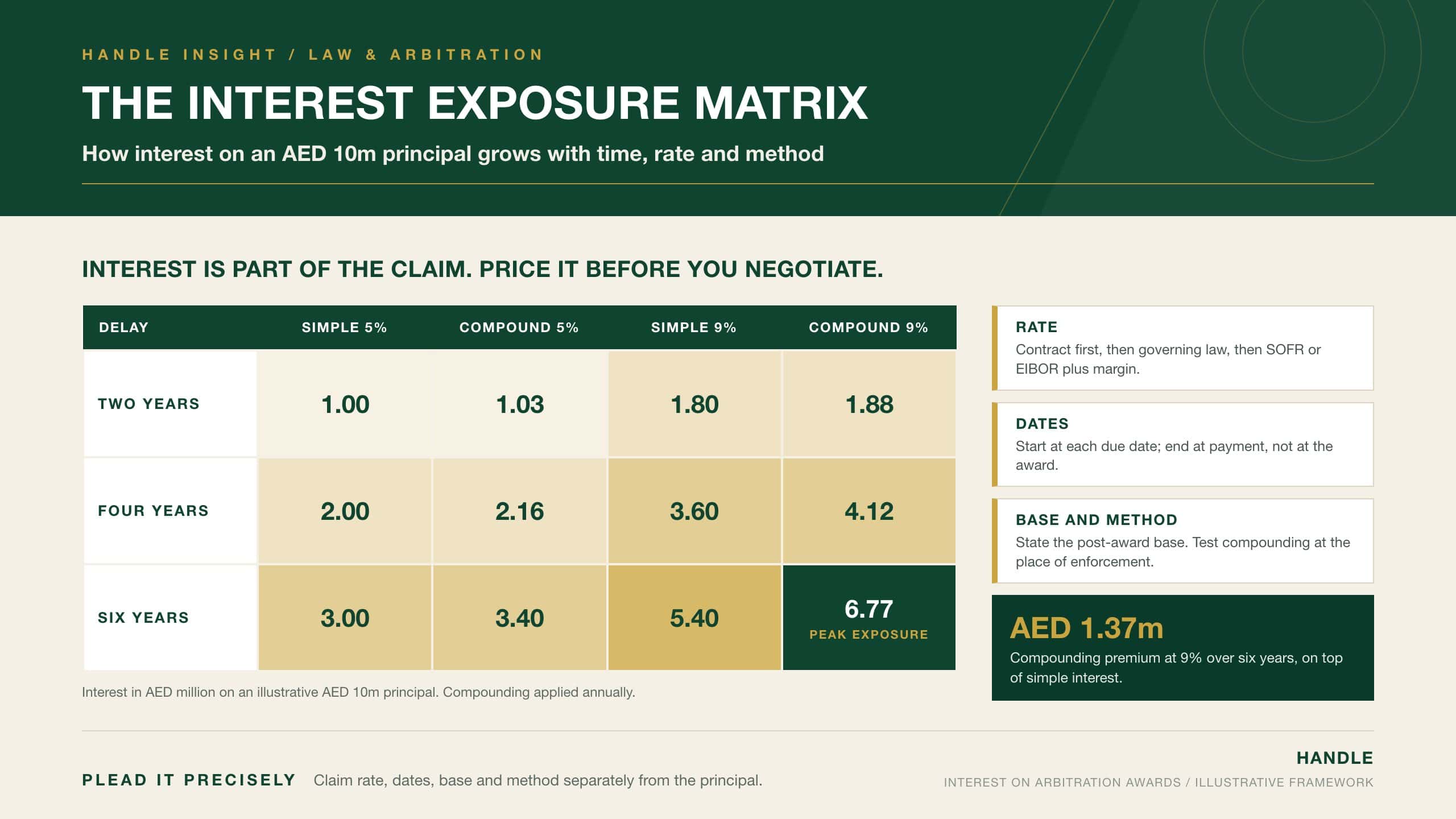
Parties often negotiate settlement on the principal claim and treat interest as a residual. The Interest Exposure Matrix reverses that habit. It shows how interest grows across two dimensions: the duration of the dispute and the method and rate applied. On an illustrative AED 10 million principal, simple interest at 5 per cent over two years adds AED 1.0 million, while compound interest at 9 per cent over six years adds approximately AED 6.77 million. At 9 per cent over six years, compounding alone adds approximately AED 1.37 million over simple interest.
| Duration of Delay | Simple at 5% | Compound at 5% | Simple at 9% | Compound at 9% |
|---|---|---|---|---|
| Two years | 1.00 | 1.03 | 1.80 | 1.88 |
| Four years | 2.00 | 2.16 | 3.60 | 4.12 |
| Six years | 3.00 | 3.40 | 5.40 | 6.77 |
All figures are illustrative interest amounts in AED million on a principal of AED 10 million, with compounding applied annually.
The matrix supports three decisions. In drafting, it shows the value of a clear contractual rate and an express position on compounding. In dispute strategy, it shows each side what a year of procedural delay is worth. In settlement, it converts the abstract question of interest into a specific number that can be traded. Interest exposure is a function of time. Time is a function of strategy.
Common Mistakes in Claiming and Calculating Interest
- Failing to plead interest expressly, including the rate, start date, end date, base and method, so that the tribunal has no basis to award it.
- Relying on a contract that refers to a discontinued benchmark such as LIBOR without addressing the replacement rate.
- Claiming compound interest without considering whether it will be enforceable where the respondent’s assets are located.
- Using a single start date for a claim made up of many instalments, which overstates or understates interest and invites challenge.
- Leaving the base for post-award interest unspecified, which creates a second dispute at enforcement.
- Ignoring the effect of the claimant’s own procedural delay, which a tribunal may take into account in reducing interest.
- Combining interest with a damages methodology that already includes financing costs, which risks double recovery.
Conclusion
Calculating interest on an arbitration award requires five decisions: the rate, the start date, the end date, the base and the method. The contract is the first source of the rate, followed by the governing law and commercial benchmarks such as SOFR or EIBOR. Simple interest is the common default, while compound interest depends on the contract, the governing law and the law of the place where the award will be enforced. In the UAE, the Arbitration Law leaves interest to the parties and the substantive law, and enforcing courts may review the interest component against public order, so claims should present interest separately and precisely. The Interest Exposure Matrix shows how quickly interest grows with time, rate and compounding, and turns it into a number that can be negotiated. Interest preserves the value of the award. Precision preserves the interest.