

Online infringement now moves faster than the remedies designed to stop it. A takedown notice removes one copy; within hours the same content reappears on a mirror domain, a new marketplace account or a different hosting provider. Chasing content in that environment is a contest the rights holder rarely wins. Blocking orders for online platforms change the target. Instead of pursuing each copy, they restrict the routes through which users reach it. Within Injunctions and Emergency Relief, blocking orders are the instruments through which a court or competent authority requires intermediaries such as internet service providers, platforms, hosts and registrars to disrupt access to infringing locations or services. They are not content moderation tools. They are enforcement measures that neutralise scale, stabilise the rights holder’s position while liability is determined and preserve the value of any final remedy. The decision is not whether to act, but at which access layer to act and how narrowly. Control the route, not the copy.
What Is a Blocking Order, and What Is It Not?
A blocking order is a direction addressed to an intermediary that controls a point through which users reach an infringing service. It requires that intermediary to prevent or restrict access, usually to specified domains, IP addresses, URLs, accounts or listings. The intermediary is generally not the wrongdoer. It is addressed because it controls a chokepoint the wrongdoer depends on.
That distinction shapes everything that follows. Because the order binds a party that has done nothing wrong, the threshold is disciplined, the scope must be precise and safeguards for lawful users are expected. A blocking order is also distinct from a platform’s own content policies. Moderation is voluntary and discretionary. A blocking order is compelled, defined and reviewable.
Why Do Takedowns Alone Fail at Scale?
Notice-and-takedown works when infringement is occasional and hosts are cooperative. It fails in three recurring situations. The first is rotation, where operators run networks of mirror domains and accounts so that removing one location simply shifts traffic to the next. The second is velocity, where the harm occurs within hours, as with live sports streams, product launches or coordinated leaks, and any remedy that arrives after the event is worthless. The third is opacity, where operators are offshore, anonymous or judgment-proof, so a direct action against them cannot be served or enforced.
Blocking orders respond to each. They contain scale by restricting the routes through which audiences arrive. They substitute intermediary compliance for direct enforcement against an unreachable defendant. And, where designed with update mechanisms, they keep pace with rotation without a fresh application for every new mirror.
Which Access Layer Should the Order Target?
Relief must match the layer being exploited. Each layer offers a different combination of speed, precision and resistance to evasion, and each carries a different risk of blocking lawful activity.
| Access Layer | Typical Measures | Strength | Principal Limitation |
|---|---|---|---|
| Internet service providers | DNS blocking, IP blocking, URL filtering | Territory-wide reach through a small number of licensed operators | Circumvented by VPNs and alternative DNS; IP blocks can catch shared hosting |
| Platforms and marketplaces | Account suspension, listing removal, re-registration prevention | Highly precise; targets the seller or channel directly | Operators open new accounts unless identity linkage is ordered |
| Hosting, CDN and cloud providers | Service suspension, instance isolation, routing disablement | Removes the service at source rather than restricting local access | Providers may sit outside the jurisdiction |
| Registrars and DNS operators | Domain suspension, prevention of resolution or transfer | Disrupts the rehosting cycle and brand-confusing domains | Effective mainly where the registrar or registry is reachable |
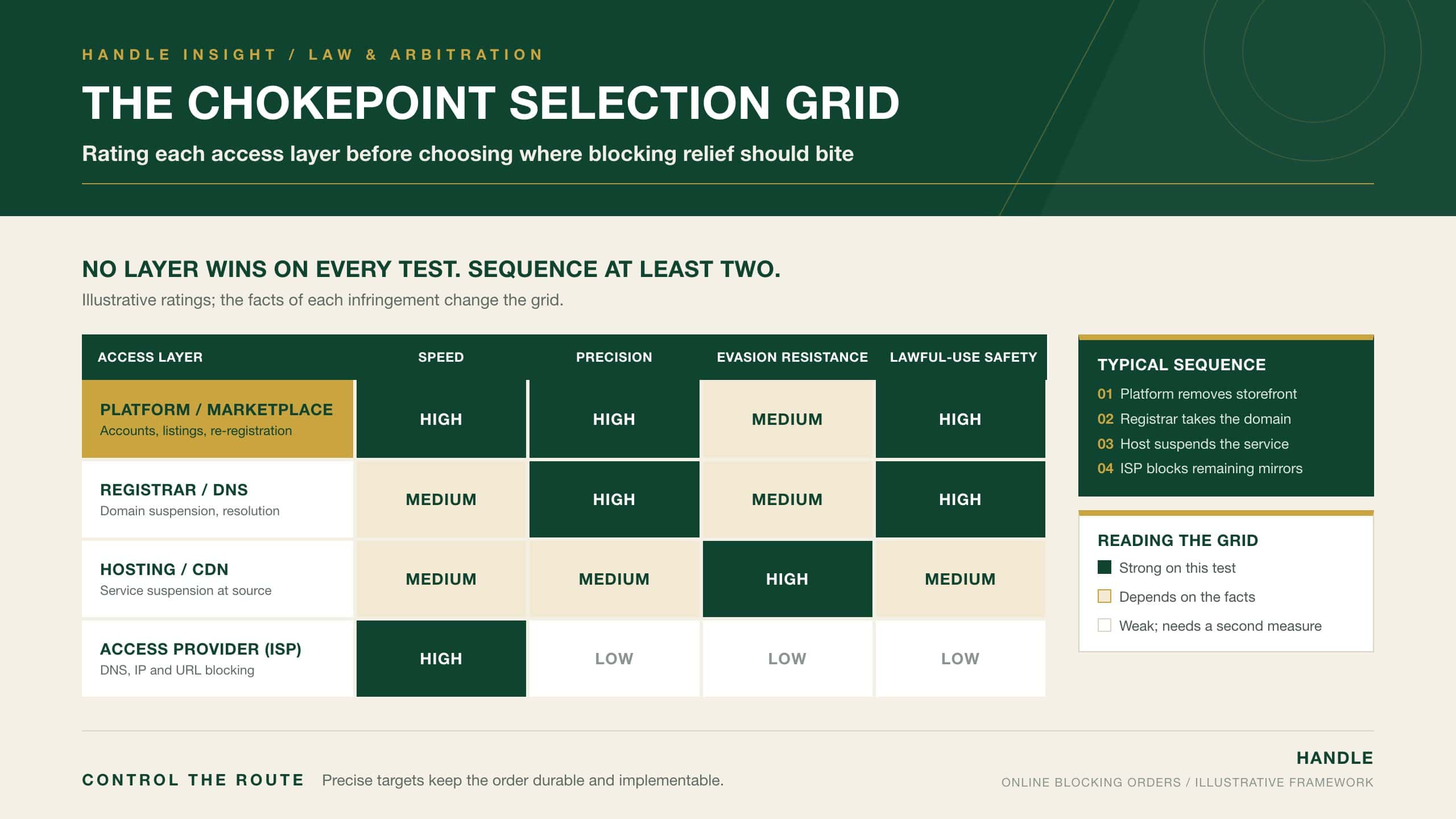
In practice the strongest strategies combine layers: a platform order to remove the storefront, a registrar order to take down the domain and an access-provider measure for the mirrors that remain.
What Must an Applicant Establish?
Because the order affects third parties, the threshold reflects their interests as well as the applicant’s. The precise test depends on the forum and the legal basis relied upon, but the same elements recur.
| Requirement | What the Decision-Maker Looks For | Evidence That Satisfies It |
|---|---|---|
| Clear rights | A protected right held or licensed by the applicant | Registrations, licence chain, ownership records |
| Ongoing infringement | Persistence, not an isolated incident | Dated captures, traffic data, repeat test purchases |
| Ineffective alternatives | Takedowns or direct action have failed or are futile | Notice log, response record, evidence of rehosting |
| Proportionality | Targets and methods limited to what is necessary | Defined target list, chosen technique, overblocking assessment |
| Safeguards | Protection for lawful users and the intermediary | Carve-outs, review pathway, landing page, cost arrangements |
Overbroad blocking invites challenge and resistance from intermediaries. Precision is not a concession. It is what makes the order durable.
Without-Notice Applications and the Duty of Candour
Where giving notice would itself trigger evasion, relief is often sought without notice to the operator. Live events, coordinated releases and automated distribution pipelines are the typical justifications: by the time a contested hearing could be held, the harm is complete.
Without-notice relief carries a heightened duty of disclosure. The applicant must place before the decision-maker the technical limitations of the proposed measure, the risk of blocking lawful content, the alternatives considered and any facts that weigh against the order. An application that conceals weakness may be set aside when the operator or an intermediary returns to court. Candour sustains the remedy.
Building the Technical Record
Blocking orders are technical as much as legal. The evidence must show not only that infringement is occurring, but that the targeted endpoints are connected. Traffic data, server logs, screenshots, file hashes, payment trails and shared infrastructure such as common analytics identifiers or hosting fingerprints can link mirrors to a single operation. That linkage is what justifies a dynamic order, under which new endpoints can be added on verified notice without a new application, subject to oversight and a right for affected parties to object.
The record should also anticipate implementation. Intermediaries need precise identifiers, a clear technique and a reporting obligation. An order that an ISP cannot implement without guesswork will be implemented slowly.
How Does Blocking Work in the UAE?
The UAE position differs in important respects from the common-law model on which much international commentary on blocking orders is based, and the original framing of this topic in terms of equitable jurisdiction and contempt does not translate directly to onshore UAE proceedings.
Internet access in the UAE is provided through a small number of licensed telecommunications operators, and access management is overseen by the Telecommunications and Digital Government Regulatory Authority under its internet access management framework. Blocking of online content is therefore frequently achieved through the regulator and the licensed operators, acting on reports, regulatory policy or directions from competent authorities, rather than solely through civil injunctions addressed to ISPs. Federal Decree-Law No. 34 of 2021 on Combatting Rumours and Cybercrimes provides a criminal framework under which unlawful online content and websites can be addressed, and rights holders can pursue infringement under Federal Decree-Law No. 38 of 2021 on Copyright and Neighbouring Rights and Federal Law No. 36 of 2021 on Trademarks.
On the civil side, the onshore courts can grant urgent and precautionary measures under the civil procedure framework (Federal Decree-Law No. 42 of 2022), which can support orders directed at identified defendants and, in appropriate cases, at intermediaries. Compliance by licensed operators is reinforced by their regulatory obligations rather than by a contempt jurisdiction. The DIFC Courts and ADGM Courts have broad injunctive powers within their jurisdictions, but whether an order binds a particular intermediary depends on that intermediary’s connection to the jurisdiction. Any UAE blocking strategy should therefore be designed around the route most likely to produce implementation, which may be regulatory, criminal, civil or a combination.
A Worked Example: Containing a Rotating Stream Network
Consider an illustrative case. A rights holder licensing a sports competition in the region identifies 40 domains streaming its matches without authority. Takedown notices to hosts produce removal of 12 streams, but within two weeks 25 new mirrors appear, most sharing the same analytics identifiers and payment processor as the originals.
The rights holder assembles a record linking all 65 endpoints to one operation, demonstrates that notices have failed and proposes a measure limited to domain and URL blocking during match windows, with a procedure for adding verified new mirrors within 24 hours of notice. Parallel requests target the registrar for the 8 domains registered with a reachable provider and the marketplace selling access subscriptions. The illustrative outcome is that audience reach on match days falls sharply, the operator’s subscription channel is closed and the remaining mirrors are added under the update mechanism rather than through new applications. No single measure would have achieved this alone.
Original Analysis: The Chokepoint Selection Grid
The Chokepoint Selection Grid is a method for choosing where to direct blocking relief. It rates each access layer against four criteria: speed of implementation, precision, resistance to evasion and collateral risk to lawful users. The grid is read row by row to find the layer that offers the best balance for the specific infringement, and column by column to identify the gaps a second measure must cover.
| Access Layer | Speed | Precision | Evasion Resistance | Collateral Risk |
|---|---|---|---|---|
| Platform and marketplace | High | High | Medium | Low |
| Registrar and DNS | Medium | High | Medium | Low |
| Hosting and CDN | Medium | Medium | High | Medium |
| Access provider (ISP) | High | Low to medium | Low | Medium to high |
The ratings are illustrative and vary with the facts. The grid’s lesson is consistent: no layer scores well on every criterion, so effective relief is sequenced across at least two. Platform measures usually come first because they are precise and fast. Access-provider measures cover what remains, scoped narrowly to limit overblocking.
Duration, Review and Cross-Border Reach
Blocking relief is dynamic. Interim orders preserve the position pending determination of liability, and periodic review allows targets to be refined as facts change. Online access ignores borders, but enforcement does not: local orders restrict access within the territory even where content is hosted abroad, and ancillary measures extend controls to further intermediaries where access persists. Blocking also complements other relief, including disclosure orders to identify operators, asset freezes over payment channels and final injunctions once liability is established. Data protection obligations, including those under Federal Decree-Law No. 45 of 2021 on the Protection of Personal Data where applicable, should shape any measure that requires intermediaries to process user information.
Common Failures in Blocking Order Strategy
- Applying too late, after the event or release window has passed and the harm the order was meant to prevent is complete.
- Targeting a single layer, so operators simply move traffic to the route the order did not cover.
- Drafting overbroad targets such as whole IP ranges on shared hosting, which disrupts lawful users and invites challenge.
- Omitting an update mechanism, so each new mirror requires a fresh application and the rights holder falls behind.
- Assuming that a common-law style injunction will operate in the same way before every UAE forum, instead of designing for the route that will actually be implemented.
- Failing to disclose technical limitations in a without-notice application, exposing the order to discharge.
Each failure turns a strong case into a weak remedy. Each is avoidable with a precise target list and a sequenced plan.
Conclusion
Blocking orders for online platforms impose control at the access layer when content-level enforcement fails. They contain scale, substitute intermediary compliance for action against unreachable operators and keep pace with rotation where an update mechanism is built in. Their legitimacy depends on discipline: clear rights, persistent infringement, evidence that alternatives have failed, narrow targets and safeguards for lawful users. In the UAE, the route to implementation runs through licensed operators, the telecommunications regulator, the criminal and intellectual property frameworks and the civil courts’ precautionary powers, and strategy must be designed around that reality rather than an imported model. The Chokepoint Selection Grid shows that no single layer is sufficient. Relief must be sequenced across platforms, registrars, hosts and access providers. Precision preserves the order. Speed preserves the remedy.


