

Paying a claim does not have to be the end of an insurer’s loss. Through subrogation, the insurer that has indemnified its insured acquires the right to pursue the party that caused the loss, and third party recovery turns that right into cash returned to the balance sheet. Within Insurance & Reinsurance Litigation, subrogation claims and third party recovery are where indemnity becomes accountability. The difficulty is that recovery value leaks long before any claim is filed: through releases the insured signed, waivers buried in commercial contracts, liability caps, evidence that was never preserved and limitation periods that started running on the day of the loss. The legal right is usually clear. The recoverable value is not. Subrogation is won or lost in the weeks after the loss, not in the courtroom.
What Is Subrogation and Why Does It Matter?
Subrogation allows an insurer, having paid its insured, to step into the insured’s position and exercise the insured’s rights against third parties responsible for the loss. It serves two purposes. It prevents the insured from recovering twice, once from the insurer and again from the wrongdoer. And it places the economic burden of the loss on the party at fault rather than on the insurance market as a whole.
For insurers and reinsurers, recoveries are not incidental. They reduce net incurred losses, improve loss ratios and support pricing discipline. A recovery programme that systematically captures value from responsible third parties is part of underwriting performance, not an afterthought to it.
Disputes arise in predictable places: when third parties deny liability, when insureds have compromised recovery rights, when contracts purport to waive subrogation and when several insurers disagree about who recovers what.
When Do Subrogation Rights Arise in the UAE?
The insurer’s right generally depends on payment. Until the insurer has indemnified its insured, the cause of action belongs to the insured. Where the insurer has paid only part of the loss, its subrogated interest is usually limited to the amount paid, and the insured retains its own claim for the uninsured balance, such as a deductible or losses above the policy limit. Excess insurers may recover in proportion to the layer they paid.
Onshore in the UAE, the insurer’s right of subrogation is established by statute in the Civil Transactions Law: an insurer that has paid compensation is subrogated to the insured’s claims against the person who caused the damage, up to the amount it paid. The right does not depend on the common law concept of equitable subrogation, and it is usually supplemented by express subrogation and cooperation clauses in the policy. Insurance business onshore is supervised by the Central Bank of the UAE.
In the DIFC and ADGM, whose courts apply common law based principles, subrogation operates in a way that will be familiar from English practice, including questions about the order in which recoveries are applied between insurer and insured. Insurers in those centres are regulated by the DFSA and the FSRA respectively.
In every forum, the policy wording matters. Contractual subrogation clauses commonly give the insurer control of proceedings, the right to sue in the insured’s name and a duty on the insured to cooperate and not to prejudice recovery.
How Are Recovery Rights Lost Before Recovery Begins?
The most common reason a subrogation claim fails is not legal weakness. It is erosion of rights before the insurer becomes involved. Insureds settle with or release third parties to preserve a commercial relationship, accept liability caps in contracts, discard damaged equipment or allow site evidence to be cleared.
Preservation is therefore the first operational task after a significant loss:
- Identify every potential recovery target as soon as the loss is notified, before the claim is adjusted.
- Remind the insured in writing of its obligation not to release, settle with or admit liability to any third party without the insurer’s consent.
- Secure physical evidence, data logs, maintenance records and witness details, with chain of custody documented.
- Obtain and review every contract between the insured and potential defendants, focusing on waivers, caps, indemnities and dispute resolution clauses.
- Diarise limitation dates for each target under each potentially applicable law.
Waivers of Subrogation and Liability Caps
Waivers of subrogation are common in construction, energy, logistics and facilities contracts, where parties agree that each will rely on its own insurance rather than claim against the other. Where a valid waiver applies, the insurer takes the insured’s rights subject to it and generally cannot recover.
Disputes therefore centre on scope. A waiver may apply only to losses covered by a specified project policy, only to named parties, only during a defined period or only to certain categories of property. Reading the waiver precisely, alongside the policy and the underlying contract, often reveals that a broadly asserted waiver does not reach the loss in question. Liability caps and exclusions of consequential loss operate in the same way: they do not remove the claim, but they define its ceiling.
Who Can the Insurer Pursue?
Subrogation succeeds only where liability is enforceable against a defendant capable of paying. Recovery targets fall into three broad groups, and the strongest pathway should be chosen rather than pursuing every theory at once.
| Recovery Target | Liability Basis | Key Evidence | Typical Obstacles |
|---|---|---|---|
| Contractual counterparty | Breach of contract or contractual indemnity | Contract terms, specifications, performance records | Waivers, liability caps, exclusion clauses |
| Third party in tort | Harmful act, fault and causation | Incident reports, expert analysis, witness evidence | Contributory fault, proof of causation |
| Manufacturer or supplier | Defective product or breach of warranty | Technical defect analysis, supply chain records | Foreign domicile, expert disagreement |
| Other insurers | Contribution where policies overlap | Policy wordings, allocation calculations | Rateable proportion and priority disputes |
Solvency and asset location should be assessed alongside liability. A strong claim against a defendant with no reachable assets recovers nothing.
Who Controls the Proceedings and the Settlement?
Once subrogation is engaged, control becomes the practical question. Who directs the litigation, who approves settlement, how costs are funded and how any recovery is shared between insurer and insured must be settled at the outset.
Where the policy gives the insurer control, it should be exercised clearly and early. Where the insured has an uninsured interest, such as a large deductible or business interruption losses above the limit, a written recovery agreement should allocate control, costs and proceeds. Without one, insured and insurer may pursue the same defendant on different strategies, and an insured settlement can compromise the insurer’s claim.
Multiple Insurers, Contribution and Reinsurance
Large losses often involve property, liability and specialty insurers, sometimes in layers. Subrogated recoveries may be pursued jointly or by one insurer on behalf of others. Contribution disputes arise where policies overlap, and allocation of recoveries must follow indemnity proportions and the terms of any recovery agreement.
Recoveries also flow upstream. Depending on treaty or facultative terms, a recovery may reduce the ceded loss and be shared with reinsurers. Reporting recoveries accurately and promptly to reinsurers avoids later disputes over credit and entitlement.
Cross-Border Recovery and Limitation
Defendants are frequently located outside the UAE, particularly manufacturers and international contractors. The choice of forum should be driven by where the defendant’s assets are and how readily a judgment or award can be enforced there. Arbitration clauses in the insured’s contracts bind the subrogated insurer, and an arbitral award may be easier to enforce abroad than a court judgment, given the reach of the New York Convention, to which the UAE acceded in 2006.
Limitation requires particular care. Under UAE law, limitation periods vary by type of claim, and claims in tort can run from the date the injured party knew of the damage and the person responsible, rather than from the date the insurer paid. Different periods may apply in the DIFC, ADGM and foreign jurisdictions. Protective proceedings or written standstill arrangements should be considered wherever a deadline approaches before the claim is ready.
A Worked Example: Where the Value Goes
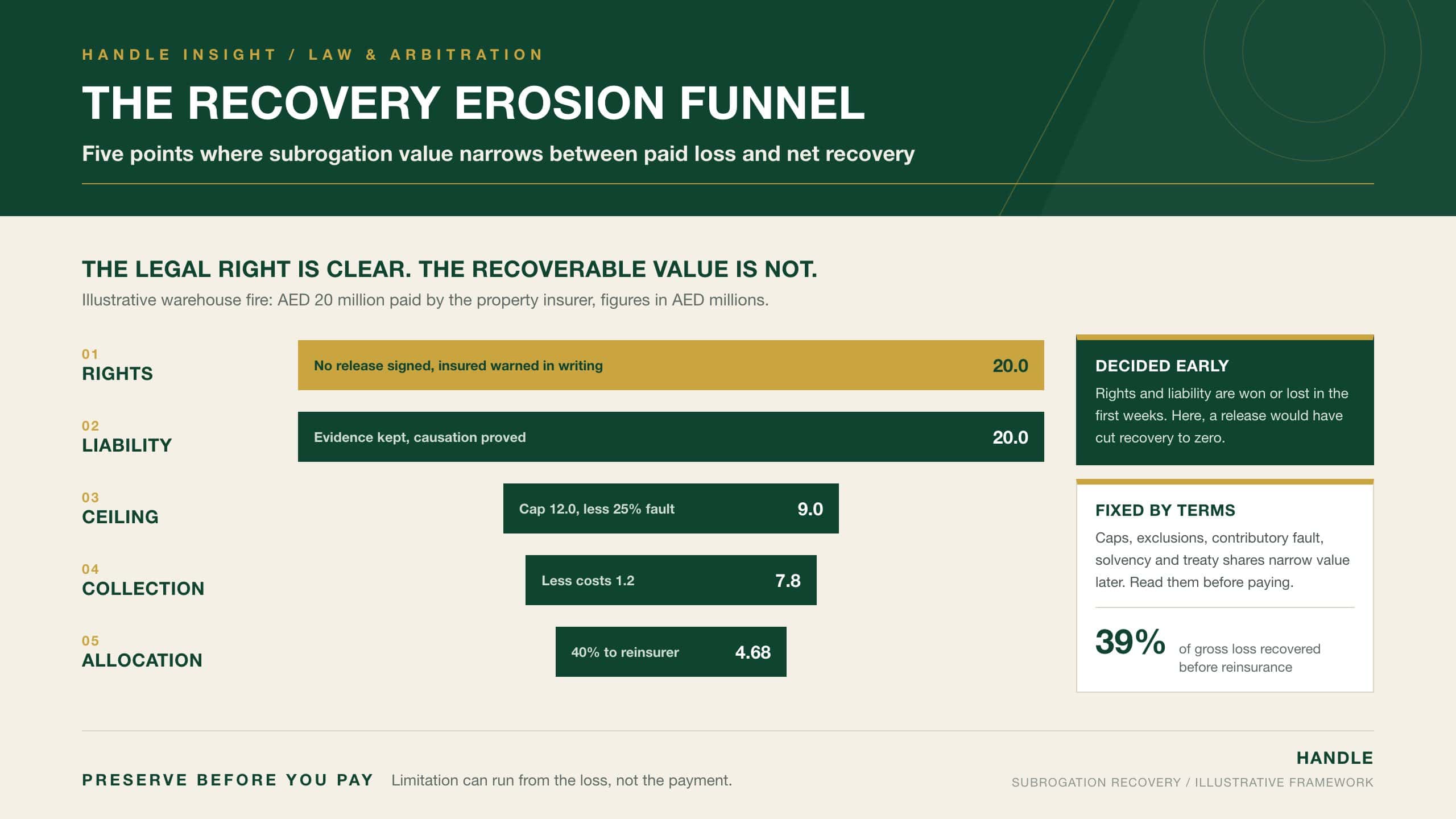
Consider an illustrative fire at a UAE warehouse caused by faulty electrical work. The property insurer pays its insured AED 20 million. The contractor’s agreement with the insured caps the contractor’s liability at AED 12 million, so that is the realistic ceiling of the contractual claim.
The contractor argues that the insured’s poor storage practices contributed to the spread of the fire, and the parties settle on the basis of a 25% reduction, bringing the recovery to AED 9 million. Legal and expert costs of AED 1.2 million reduce the net recovery to AED 7.8 million. Under a 40% quota share treaty, AED 3.12 million is credited to the reinsurer, leaving AED 4.68 million for the insurer’s own account.
A recovery of 39% of the gross loss before reinsurance is a respectable outcome. It would have been zero if the insured had signed a broad release with the contractor after the fire, or if the limitation period had been missed.
Original Analysis: The Recovery Erosion Funnel
A useful way to manage subrogation is to treat recoverable value as a funnel that narrows at five predictable points. Each point is a place where value can be lost and where early action can preserve it.
| Stage | Question | Value Lost Through | Control Action |
|---|---|---|---|
| 1. Rights | Has the insured preserved the claim? | Releases, waivers, admissions | Immediate non-prejudice notice and contract review |
| 2. Liability | Can fault and causation be proved? | Lost evidence, weak expert analysis | Evidence preservation and early expert engagement |
| 3. Ceiling | What do caps and contributory fault allow? | Liability caps, exclusions, apportionment | Precise reading of contract terms and quantum |
| 4. Collection | Can the defendant pay, and where? | Insolvency, assets abroad, limitation | Solvency checks, forum selection, protective filings |
| 5. Allocation | Who shares the net recovery? | Costs, insured’s uninsured interest, reinsurance | Written recovery agreement and timely reporting |
The first two stages are where the largest losses occur and where the insurer has the most influence, because they depend on actions taken in the first weeks. The later stages narrow value through terms that are fixed or facts that are external. Measuring each recovery file against the five stages shows where the portfolio is leaking value and which controls would recover the most.
Common Subrogation Failures
- Adjusting and paying the claim without reviewing the insured’s contracts, so waivers and caps are discovered only when recovery is attempted.
- Failing to warn the insured against releasing or settling with third parties, then facing a coverage dispute when it does.
- Allowing damaged equipment or site evidence to be disposed of before experts have examined it.
- Assuming limitation runs from the date of payment rather than from the date of loss or knowledge.
- Pursuing several weak liability theories in parallel instead of the strongest enforceable one.
- Litigating against a defendant without assessing its solvency or the enforceability of a judgment where its assets are.
- Recovering funds without a written agreement on allocation with the insured and other insurers.
Each failure is a decision made, or not made, early in the life of the claim.
Conclusion
Subrogation claims and third party recovery return capital to insurers after loss, but only where the right has been preserved and the value protected from the moment the loss occurs. Onshore in the UAE the right is statutory and limited to the amount paid; in the DIFC and ADGM it follows common law based principles; in every forum the policy wording and the insured’s contracts shape what can be recovered. Value narrows at five points: rights, liability, ceiling, collection and allocation. The first two are decided in the early weeks, through non-prejudice notices, contract review, evidence preservation and limitation control. The later stages call for a precise reading of caps, realistic solvency analysis, a forum where judgments can be enforced and a written recovery agreement. Insurers that manage these points deliberately recover more. Payment closes the claim. Recovery closes the loss.


