

Parties choose mediation, arbitration and expert determination for many reasons, but one of the strongest is that a dispute resolved privately does not become a public signal to lenders, investors, regulators, employees and competitors. Within Mediation & Alternative Dispute Resolution (ADR) Frameworks, confidentiality in ADR processes is the set of legal rules and contractual commitments that keeps that signal contained. It is often assumed rather than secured. A private hearing is not the same as a confidential process, a mediator’s duty of discretion does not bind the parties’ own experts, and an award that must be enforced through a court may leave the private forum altogether. Confidentiality protects leverage only when it is defined, binding and enforceable. Privacy is a setting. Confidentiality is an obligation.
Why Confidentiality Matters in ADR
Litigation produces public filings, open hearings and published judgments. Each of these can change the bargaining position of the parties and their relationships with third parties. A lender may reprice credit on learning of a large claim. A competitor may use allegations about product quality. A family dispute may unsettle employees, partners and counterparties of the family business.
Confidentiality allows the dispute to be resolved on its merits rather than distorted by external reaction. It also enables candour. Parties are more willing to acknowledge risk, test settlement ranges and share commercially sensitive information when they know that what they say will not be published or used against them elsewhere. For institutions, family enterprises and investment structures that rely on stable relationships with capital providers, that protection has a direct economic value.
Privacy and Confidentiality Are Not the Same
Privacy means that outsiders cannot attend. Arbitration hearings and mediation sessions are normally private in this sense. Confidentiality goes further: it imposes a duty on participants not to disclose information about the process, the material exchanged or the outcome. A process can be private without being confidential. Without a confidentiality obligation, a party could lawfully share documents, witness statements or the award with third parties after a private hearing.
The distinction matters because many parties discover the gap only after a leak. The remedy is to treat confidentiality as something to be drafted and verified, not inferred from the forum.
What Confidentiality Must Cover
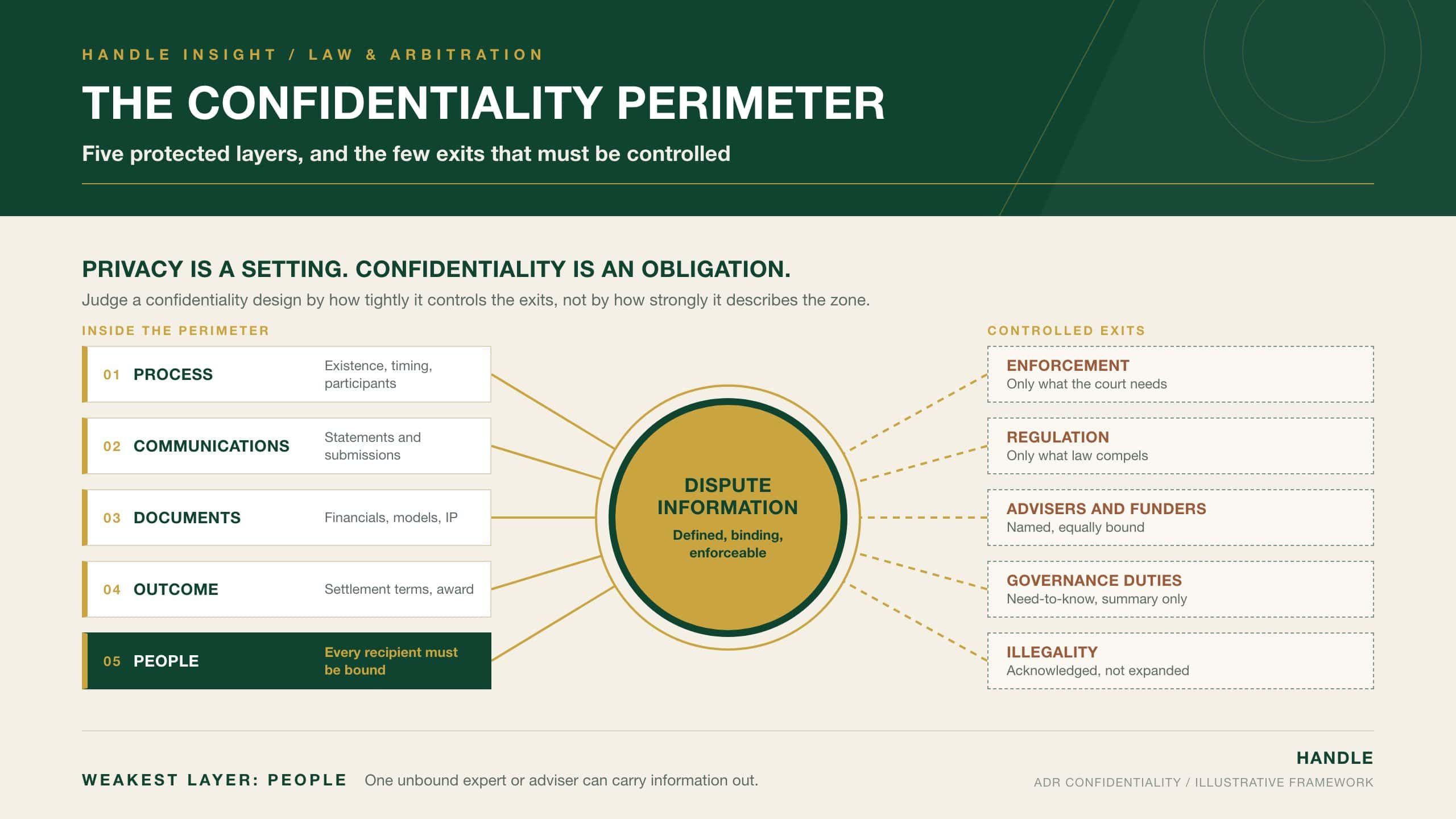
Effective protection operates across five layers, each of which can leak independently.
Process. The existence of the dispute, its timing, the identity of participants and the procedural steps. Even the fact that a dispute exists can be market-sensitive.
Communications. Statements made in mediation, submissions in arbitration, expert reports and evaluator feedback.
Documents. Financial records, valuation models, intellectual property and governance documents disclosed for the purpose of the process.
Outcome. Settlement terms, awards and expert determinations, which may set a reference point for future negotiations with other counterparties.
People. Every person who receives information: parties, counsel, experts, tribunal members, mediators, transcribers, funders and observers. Protection is only as strong as the least-bound participant.
How Confidentiality Differs Across ADR Mechanisms
| Mechanism | Default Position | Main Gap | What to Draft |
|---|---|---|---|
| Mediation | Private; mediators normally bound by confidentiality; statutory and rule-based protection for mediation communications in many systems | Parties’ advisers and experts may not be bound; settlement terms may not be covered | Mediation agreement binding all attendees and covering the settlement |
| Arbitration | Private hearings; confidentiality depends on the seat’s law and the institutional rules chosen | Court applications to set aside or enforce the award may expose it | Express clause covering pleadings, evidence, award and related court steps |
| Expert determination | Contractual; few statutory rules | Data supplied to the expert and the determination itself | Confidentiality and use restrictions in the expert’s appointment terms |
| Early neutral evaluation | Usually on a without prejudice basis | Evaluator’s view being used as leverage in later proceedings | Clear statement that the evaluation is inadmissible and non-binding |
The UAE Position
Confidentiality in the UAE depends on the forum and the seat. Under the federal Arbitration Law, Federal Law No. 6 of 2018 as amended by Federal Law No. 15 of 2023, hearings are held privately unless the parties agree otherwise, and the award may not be published without the parties’ consent. The law does not, however, prevent the award from entering the public court system when it is challenged or enforced. An application to set aside an award must be filed with the competent Court of Appeal within 30 days of notification of the award, and recognition and enforcement also proceed through the courts. Parties should assume that the existence of the award, and possibly its contents, may become visible at that stage.
The DIFC Arbitration Law No. 1 of 2008 and the ADGM Arbitration Regulations 2015 contain provisions protecting the confidentiality of arbitral proceedings, subject to defined exceptions, and the DIFC Courts and ADGM Courts can hear arbitration-related applications in private in appropriate cases. Institutional rules commonly used in the UAE, including the DIAC Arbitration Rules 2022, also contain confidentiality obligations. Federal legislation on mediation and conciliation in civil and commercial disputes protects the confidentiality of mediation and restricts the use of statements made in it in later proceedings.
One point is often missed. The common law “without prejudice” rule, which protects settlement communications from being used as evidence, is a feature of English-derived systems such as the DIFC and ADGM. Onshore UAE civil law does not apply that rule in the same form. Where a dispute may end up before onshore courts, the protection of settlement communications should be secured expressly by agreement and through the procedural framework of the chosen ADR process.
Carve-Outs That Must Be Controlled
Confidentiality is never absolute. A sound clause anticipates the necessary exceptions and limits each one to its purpose.
| Carve-Out | Why It Exists | Risk If Drafted Broadly | Control |
|---|---|---|---|
| Enforcement | An award or settlement may need to be filed in court | The entire record becomes public | Disclosure only to the extent required, with applications for private hearings where available |
| Regulatory and statutory duties | Regulated firms and listed companies may have to report | A general “required by law” phrase covers voluntary disclosure | Disclosure limited to what is legally compelled, with notice to the other party where lawful |
| Professional advisers and funders | Parties need advice, insurance and funding | Information spreads to unbound third parties | Named categories, each bound by equivalent obligations |
| Governance and fiduciary duties | Boards, trustees and fund managers may have to inform stakeholders | Wide internal circulation and onward leakage | Need-to-know distribution and summary-level disclosure |
| Illegality and public interest | Confidentiality cannot conceal crime or regulatory breach | Disputes over whether the exception is triggered | Acknowledged in the clause so that the remainder stays enforceable |
Drafting Confidentiality That Holds
An effective clause defines what is confidential, who is bound, for how long and with what consequences. It extends to every participant, including experts, transcribers and funders, either directly or by requiring each party to procure equivalent undertakings. It restricts use, not only disclosure, so that information obtained in the process cannot be used for other commercial purposes. It survives the end of the process. And it provides for injunctive relief, because damages are rarely an adequate remedy for disclosure that has already occurred.
Consistency matters as much as content. Where a group has a shareholders’ agreement, a financing agreement and a services agreement, each with a different confidentiality and dispute resolution clause, a single dispute can fall under conflicting obligations. Aligning those clauses is part of dispute readiness.
What Strategic Value Does Confidentiality Create?
The value of confidentiality extends beyond any single dispute. Three effects compound over time, particularly for repeat market participants.
Reputation containment. A dispute resolved privately does not become part of the public narrative about the enterprise. Allegations that are never tested in public do not attach to the brand, the founders or the management team.
Stability of capital relationships. Lenders, investors and insurers react to what they see. Confidential resolution allows a company to disclose what its contracts require, in the form it chooses, rather than having counterparties learn of the dispute from a court list or a news report and reprice risk before the facts are understood.
Protection of future negotiations. A confidential settlement or award does not become a reference point for other customers, suppliers or partners. A company that concedes a price adjustment to one distributor need not see the same concession demanded by every other distributor.
A party that insists on strict confidentiality also signals that it intends to resolve the dispute without public pressure tactics. That signal alone often moderates the other side’s behaviour.
Worked Example: A Shareholder Dispute Under Covenant Pressure
Consider an illustrative family holding company whose two branches dispute a AED 150 million buy-out price. The company has a AED 400 million bank facility that requires it to notify the lender of material litigation.
The parties agree to mediate and then, if needed, to arbitrate in the DIFC. Their mediation agreement binds both branches, their counsel and the valuation experts, and covers the settlement terms. The company’s notice to the lender states only that a shareholder matter is being resolved through confidential ADR, without figures or allegations, which satisfies the covenant without disclosing positions. The mediation fails on price, and the arbitration produces an award of AED 132 million. The paying branch complies voluntarily within the agreed period, so no court application is needed and the award never enters a court file. Had enforcement been required, the clause would have limited disclosure to what the court needed.
The figures are illustrative. The design is transferable. Every exit from the perimeter was anticipated before the dispute began.
Original Analysis: The Confidentiality Perimeter
The Confidentiality Perimeter treats information about a dispute as a protected zone with five layers inside it and a small number of controlled exits. The test of a confidentiality design is not how strongly it describes the zone but how tightly it controls the exits.
Inside the perimeter sit the five layers: process, communications, documents, outcome and people. The exits are enforcement, regulation, advisers and funders, governance duties and illegality. Each exit should have a gatekeeper, a defined scope and a notice requirement. The weakest point is almost always the people layer, because a single unbound expert or adviser can carry information out of the perimeter without breaching any obligation.
Applied before a dispute arises, the perimeter becomes a checklist for clause drafting. Applied once a dispute starts, it becomes a disclosure log that records who has received what, and under which obligation.
Common Confidentiality Failures
- Assuming that a private hearing creates a duty of confidentiality, when the governing rules or the contract do not impose one.
- Relying on “without prejudice” protection in a forum or legal system that does not recognise it in the same form.
- Binding the parties but not their experts, funders or other advisers, who then become uncontrolled channels.
- Drafting carve-outs so broadly that a party can justify almost any disclosure as legally required.
- Ignoring the court stage, so that a set-aside or enforcement application exposes the full award.
- Leaving inconsistent confidentiality and dispute resolution clauses across related agreements.
Each failure turns a private process into a public one. Confidentiality must be designed before it is needed.
Conclusion
Confidentiality in ADR processes is one of the main reasons parties choose mediation, arbitration and expert determination, yet it is frequently assumed rather than secured. Privacy keeps outsiders out of the room. Confidentiality binds everyone inside it. In the UAE, the protection available depends on the seat, the institutional rules and the court stage: federal arbitration law, the DIFC and ADGM regimes and mediation legislation all provide a foundation, but court applications to challenge or enforce an award can expose what the process was meant to protect, and onshore law does not treat settlement communications in the same way as common law systems. The answer is drafting. Define the protected information, bind every participant, restrict use as well as disclosure, and control each exit from the perimeter. Leverage is preserved by design. It is lost by assumption.


