

When an allegation of misconduct, a regulatory inquiry or a whistleblower report reaches the board, the first decision is not what happened. It is who will find out, under whose authority and with what protection for the material produced. Within Regulatory and Investigations mandates, structuring investigation committees is the step that settles those questions. A committee with a written mandate, independent members and direct control of counsel can direct scope, protect confidential advice, manage regulators and carry remediation through to closure. A committee that only receives updates from management cannot. Regulators, auditors and courts judge the investigation by its structure long before they judge its findings. An investigation is only as credible as the authority that commissioned it.
What Is an Investigation Committee For?
An investigation committee is a body of the board, or of an equivalent governing body, to which the board delegates authority to run a specific inquiry during a period of heightened legal or regulatory risk. Its purpose is to make decisions: approve scope, instruct advisers, control budget, receive findings, decide on disclosure and direct remediation.
The distinction between deciding and observing is fundamental. A committee that monitors an investigation run by management adds a reporting layer but does not change who controls the outcome. Where the matter touches senior executives, that arrangement leaves the people with the greatest interest in the result in charge of establishing the facts. Regulators recognise the pattern quickly, and it undermines both the findings and the institution’s credibility in any later enforcement discussion.
When Should a Committee Be Formed?
Committee formation should follow defined triggers rather than case-by-case discretion. Typical triggers include credible allegations against senior management or directors, formal inquiries or information requests from a regulator, whistleblower reports that pass an initial credibility screen, significant audit findings suggesting fraud or control override, material data breaches and potential sanctions, anti-money laundering or bribery exposure.
Thresholds are best agreed in advance, in a board-approved investigations policy, so that the decision to escalate is mechanical rather than political. Delay in forming a committee is rarely neutral. Evidence can be lost, witnesses can coordinate their accounts and regulators may later treat hesitation as tolerance.
| Trigger | Recommended Response | Why the Structure Changes |
|---|---|---|
| Operational complaint with no management involvement | Handled by compliance or internal audit | No conflict at senior level; standard reporting lines are adequate |
| Allegation involving a senior executive | Board-level committee of independent directors | Management cannot investigate itself |
| Regulatory inquiry or information request | Committee with external counsel instructed directly | Disclosure and engagement decisions carry enforcement consequences |
| Allegation involving a director or the chair | Committee excluding the conflicted director, with external counsel | Board collegiality cannot override independence |
| Multi-jurisdiction exposure | Committee coordinating counsel across jurisdictions | Different privilege, data and disclosure rules apply |
What Must the Mandate Contain?
The committee’s authority must be formally delegated by board resolution and recorded in written terms of reference. Anything that is not delegated remains contested, and contested authority is what stalls investigations at the moment speed matters most.
A complete mandate usually covers six powers:
- Authority to approve, expand and narrow the scope of the investigation, with documented reasons for each change.
- Authority to instruct external counsel, forensic accountants and other experts, and to receive their advice directly.
- Unrestricted access to documents, systems, data and personnel, with management obliged to cooperate.
- Control of the investigation budget, so that funding cannot be used as a lever to limit inquiry.
- Authority to decide, or to recommend to the board, whether and when to engage with or disclose to regulators.
- Authority to direct remediation, including disciplinary recommendations and control changes, and to verify completion.
The terms of reference should also state to whom the committee reports, how often and in what form, and the conditions on which the committee will be dissolved.
Who Should Sit on the Committee?
Composition determines credibility. Members should be independent of the matter under investigation, have no commercial interest in its outcome and be capable of making difficult decisions about colleagues. In practice this usually means independent non-executive directors, often drawn from the audit or risk committee, with at least one member who has legal, audit or regulatory experience.
Executives or directors who may be implicated must be excluded entirely, not merely asked to abstain on certain items. Partial participation creates a credibility defect that cannot be repaired after the event. The general counsel may also need to step back if the legal function’s own conduct or advice is in question.
The board retains ultimate accountability, but it delegates execution. That separation preserves independence while maintaining governance continuity. Reporting to the board should be structured around milestones and decisions required rather than narrative updates, and should be given in a way that protects confidential legal advice.
How Is Confidentiality and Privilege Protected?
Committee structure is one of the main ways an institution protects the confidentiality of an investigation. The rules, however, differ significantly by jurisdiction, and structures borrowed from English or US practice do not transfer automatically to the UAE.
In the DIFC and ADGM, whose courts apply common law based procedural rules, legal professional privilege is recognised, including for communications with lawyers for the purpose of legal advice and, in defined circumstances, for material prepared for litigation. Instructing external counsel directly from the committee, and having counsel retain forensic experts, strengthens the argument that investigation material falls within that protection.
Onshore UAE law does not have an equivalent, fully developed doctrine of legal professional privilege. Protection comes mainly from the professional confidentiality obligations of lawyers under the federal law regulating the legal profession and from general confidentiality rules, and its reach in onshore proceedings and regulatory inquiries is narrower and less predictable. Committees with onshore exposure should therefore assume that internal documents may ultimately be seen by a court or regulator, and write accordingly.
Whatever the jurisdiction, three disciplines apply:
- Investigation material is circulated strictly on a need-to-know basis, to committee members and authorised advisers only.
- Findings are reported orally or in counsel-prepared documents rather than in widely distributed internal memoranda.
- Personal data is handled in line with the applicable regime, whether the federal Personal Data Protection Law, the DIFC Data Protection Law or the ADGM Data Protection Regulations.
How Should the Committee Work With Management and Regulators?
Management supports the investigation operationally but does not control it. Requests for information are made formally, in writing and through the committee or its counsel. Informal briefings by management to investigators, or by investigators to management, should be avoided because they blur the line between the investigated and the investigators.
Decisions on regulatory engagement are among the most consequential the committee will make. Whether the matter involves the DFSA, the FSRA, the Central Bank of the UAE or another authority, the committee should control the timing and content of any voluntary disclosure and every response to an information request. Communications and commercial teams should not make statements about the matter without committee approval. Disclosure should generally follow, rather than precede, a sufficient understanding of the facts, a legal assessment of obligations and a credible remediation plan, unless a rule or regulator requires earlier notification. Where a mandatory notification duty applies, it overrides any preference for timing.
A Worked Example: Structuring the First Two Weeks
Consider an illustrative DIFC-regulated asset manager whose compliance officer receives a whistleblower report alleging that a senior portfolio manager has been allocating trades to favour a related account.
On day one, the chair of the audit committee is notified under the investigations policy. By day three, the board passes a resolution forming a three-member committee of independent directors, excluding the chief executive, who supervises the portfolio manager. The resolution delegates the six mandate powers and sets an initial budget of AED 750,000, reviewable by the committee itself.
By day five, the committee instructs external counsel, who in turn engages forensic data specialists. A document preservation notice is issued to relevant staff and IT is directed to suspend routine deletion. By day ten, counsel briefs the committee orally on the initial data review. The committee then considers, with counsel, whether the facts trigger a notification obligation to the DFSA and records its reasoning. By day fourteen, the committee approves a defined scope covering eighteen months of trading, with a documented basis for any later expansion.
Every step in this sequence is visible in the record. That record is what the regulator will examine first.
When Does the Committee’s Work End?
A committee’s work does not end with fact-finding. Findings must be converted into remediation: disciplinary decisions, recovery of losses where appropriate, changes to controls and policies, and in some cases changes to governance or senior personnel. Each remediation action should have an owner, a deadline and a method of verification, and the committee should track them until they are complete.
The committee should remain in place until the risk is contained, remediation has been implemented and tested, and any regulatory process has reached a stable position. Premature dissolution signals unresolved exposure. Closure should be recorded in a final board resolution confirming that the committee’s delegated authority has returned to the board and its standing committees, and stating where the investigation record will be held and who may access it.
Original Analysis: The Investigation Mandate Hub
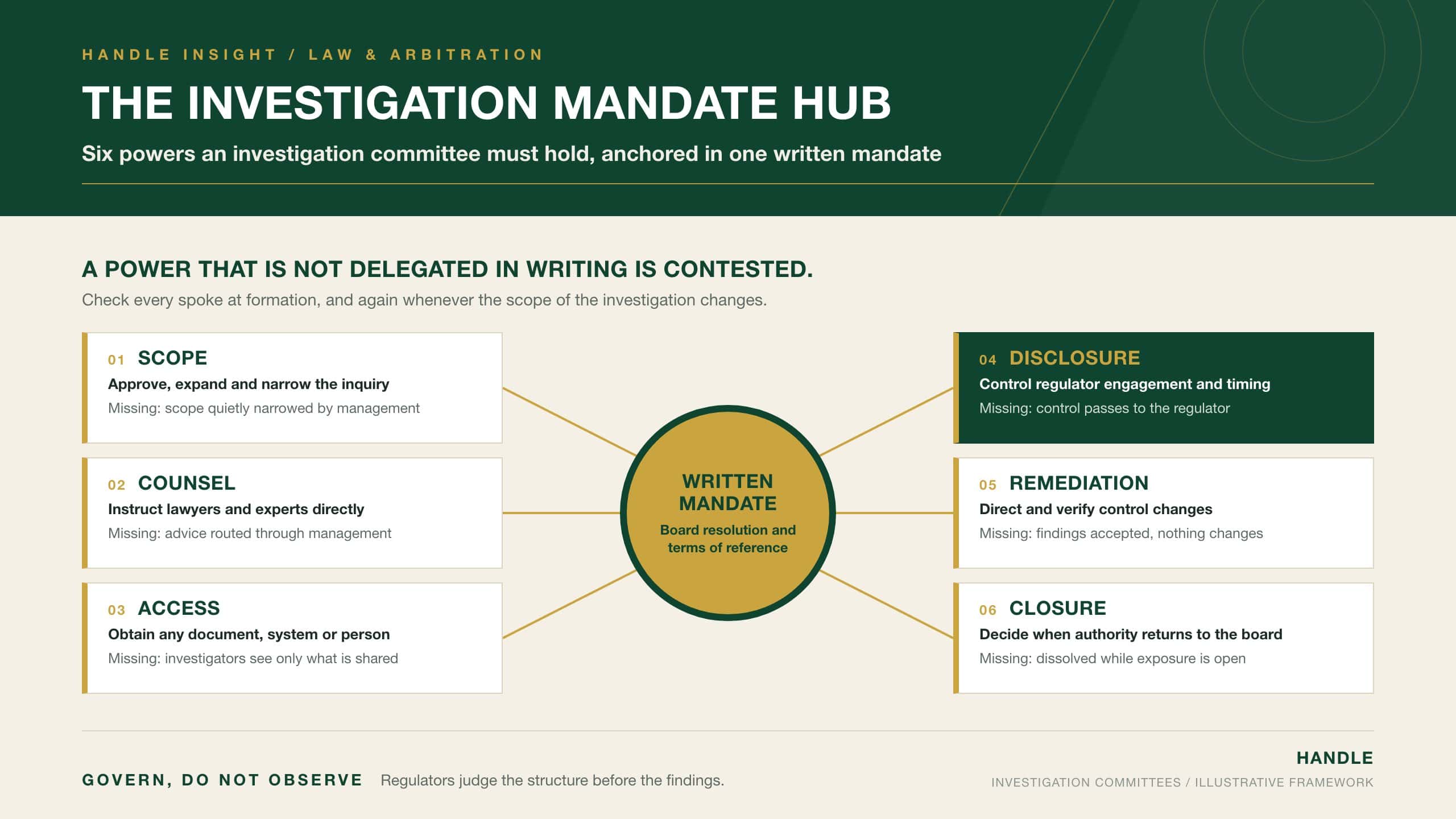
A practical way to test whether a committee is structured to govern rather than observe is to picture its authority as a hub with six spokes. The hub is the written mandate: the board resolution and terms of reference. The spokes are the six powers the committee must hold for the investigation to be credible.
| Spoke | Power Held by the Committee | Failure if Missing |
|---|---|---|
| Scope | Approve, expand and narrow the inquiry with recorded reasons | Scope drifts or is quietly narrowed by management |
| Counsel | Instruct lawyers and experts directly | Advice flows through management and protection weakens |
| Access | Obtain any document, system or person | Investigators see only what management chooses to share |
| Disclosure | Control regulatory engagement and its timing | Premature or inconsistent statements transfer control to the regulator |
| Remediation | Direct and verify disciplinary and control changes | Findings are accepted but nothing changes |
| Closure | Decide when risk is contained and authority returns to the board | The committee dissolves while exposure remains open |
The spokes depend on the hub. A power that is exercised in practice but not written into the mandate can be challenged by management, questioned by auditors and discounted by regulators. Disclosure is the spoke with the highest consequence, because a single premature or inconsistent statement can shift control of the matter from the institution to the authority. Reviewing the mandate against all six spokes at formation, and again whenever scope changes, keeps the structure intact while the facts develop.
Common Structural Failures
- Appointing an advisory-only committee that receives reports but has no authority to direct scope, advisers or remediation.
- Allowing a potentially implicated executive to attend meetings or receive papers, which taints every subsequent finding.
- Letting management instruct counsel and forward advice to the committee, weakening both independence and any claim to privilege.
- Assuming that common law privilege applies to onshore UAE proceedings, and producing internal documents on that assumption.
- Circulating draft findings widely by email, creating records that may later be disclosable.
- Engaging the regulator before the facts are understood, or delaying a notification that a rule clearly requires.
- Dissolving the committee once fact-finding ends, before remediation has been implemented and verified.
These defects are far easier to prevent than to repair. Design at formation is decisive.
Conclusion
Structuring investigation committees is an exercise in institutional authority. The committee must be formed on defined triggers, staffed by members independent of the matter and given a written mandate that delegates control of scope, counsel, access, disclosure, remediation and closure. Confidentiality must be protected with an accurate understanding of the forum: privilege is recognised in the DIFC and ADGM, while onshore protection rests largely on professional confidentiality and is narrower. Management supports the investigation but does not direct it. Regulators are engaged on the committee’s timetable unless a rule requires otherwise, and always on the basis of understood facts. The committee remains in place until remediation is verified and authority is formally returned to the board. Committees built this way govern scrutiny. Committees that only observe surrender it. Structure decides the outcome before the facts do.


