

A joint venture between equal or near-equal partners is built on the assumption that they will agree. Deadlock mechanisms in JV agreements exist for the day they do not. When the board or the shareholders cannot pass a resolution on a matter the venture needs decided, such as a budget, a capital call, a key appointment or a change of strategy, the business does not stand still for long. It drifts, loses staff and customers, and eventually becomes the subject of litigation that neither partner wanted. Within Shareholder & Joint Venture Control Disputes, a well-designed deadlock clause is the difference between a disagreement that is resolved on a timetable and one that destroys the asset it concerns. The best clauses are not a single remedy but a sequence: narrow the scope of possible deadlock, give the parties time and structure to agree, provide a binding decision on the specific issue where one is possible, and only then allow an exit. A deadlock clause should resolve the question before it ends the partnership.
What Is a Deadlock in a Joint Venture?
A deadlock arises when the persons entitled to make a decision for the venture cannot reach the majority or unanimity the constitutional documents require, and the matter cannot be left undecided without harm to the business. It is most common in 50:50 ventures, but it also arises where a minority partner holds veto rights over reserved matters.
The usual triggers are predictable. Partners diverge on strategy, one wishing to expand and the other to harvest cash. A capital call is resisted by the partner with less appetite or less liquidity. Management appointments become proxies for control. A breakdown of trust turns routine decisions into contests. Because these triggers are predictable, the clause can and should be designed around them.
Defining deadlock precisely is the first drafting task. A good definition specifies the matters that can give rise to deadlock, the number of failed meetings or the period without resolution required, and a formal notice that starts the resolution process. Without that precision, the parties argue first about whether a deadlock exists at all.
Preventing Deadlock Before It Arises
The most effective deadlock mechanism is the one that is never triggered. Several design choices reduce the number of matters on which deadlock is possible.
Reserved matters requiring unanimity should be limited to decisions that genuinely affect each partner’s investment, such as changes to the constitution, new share issues, related-party transactions and the sale of the business. Operational matters should be delegated to management under an approved business plan. Where a partner contributes particular expertise, it may be given a casting vote over a defined category of decisions, such as technical standards. And where an annual budget cannot be agreed, a fallback rule, such as continuing on the previous year’s budget adjusted for inflation, allows the venture to keep operating while the disagreement is resolved.
Internal and Assisted Resolution Mechanisms
When a deadlock arises, the first stages of a well-drafted clause aim to resolve it without changing ownership.
Escalation to senior management. The matter is referred to the chief executives or chairs of the parent companies, who are often less invested in the board-level dispute and better placed to trade one issue against another.
Cooling-off period. A defined period, often 30 to 60 days, during which no exit mechanism can be triggered and the parties are expected to negotiate. It reduces the risk of decisions taken in anger.
Mediation. A neutral mediator assists the parties to reach their own agreement. Mediation is non-binding, but it is inexpensive relative to the alternatives and often succeeds where the dispute is about relationships as much as substance.
Binding Decision Mechanisms
Where negotiation fails, some deadlocks can be resolved by a binding decision on the specific issue rather than by dissolving the venture.
Expert determination suits technical or valuation questions: the appropriate depreciation policy, whether a plant meets specification, the fair value of a contribution. An independent expert decides within a short timetable, and the decision is binding if the agreement says so.
Arbitration provides a binding, confidential and internationally enforceable decision. Its limitation in deadlock situations is conceptual. Tribunals decide disputes about rights and obligations: whether a party breached the agreement, whether a capital call was validly made. They do not ordinarily substitute their own business judgement for the partners’ on whether to approve a budget or enter a market, unless the agreement expressly empowers them to do so and the applicable law permits it. A deadlock about commercial direction is therefore rarely solved by arbitration alone.
Exit-Based Deadlock Mechanisms
If a deadlock cannot be resolved, exit mechanisms end it by changing ownership. They are powerful precisely because they are drastic, and their presence often encourages agreement at earlier stages.
| Mechanism | How It Works | Best Suited To | Main Risk |
|---|---|---|---|
| Russian roulette | One party names a price; the other must either sell at that price or buy at it | Partners of similar financial strength | The richer party can name a low price the other cannot fund |
| Texas shoot-out | Both submit sealed bids; the higher bidder buys the other’s shares | Partners who both want to continue the business | Same funding asymmetry; outcome turns on one bid |
| Dutch auction | Bids are adjusted over several rounds until one party accepts | Partners seeking a more negotiated price discovery | Longer timetable and more room for tactical bidding |
| Put and call options | A party may require the other to buy, or may require it to sell, at a formula or expert price | Ventures with a natural long-term owner | Disputes over the valuation formula or trigger |
| Sale or winding up | The venture is sold to a third party or liquidated | Situations where neither party can or will buy | Value destruction; often the outcome both sides least want |
Which Mechanism Fits Which Deadlock?
Deadlocks differ in kind, and the right mechanism depends on what the parties are actually disagreeing about. Matching the mechanism to the type of deadlock is the central design judgement.
| Type of Deadlock | Example | Most Suitable Mechanism | Least Suitable Mechanism |
|---|---|---|---|
| Technical or valuation | Disagreement on an engineering standard or the value of a contribution | Expert determination | Shoot-out |
| Dispute of right | Whether a capital call was validly made or a partner is in breach | Arbitration or court proceedings | Mediation alone |
| Operational | Approval of the annual budget or a senior hire | Budget fallback, escalation, casting vote on defined matters | Winding up |
| Strategic direction | Expansion versus sale; entry into a new market | Escalation, mediation, then exit mechanisms | Arbitration on the merits of the strategy |
A single clause can route different deadlocks to different mechanisms, provided the categories are defined clearly enough that the parties cannot dispute which route applies.
A Worked Example: The Funding Asymmetry Problem
Consider an illustrative 50:50 venture valued at AED 80 million, so that each partner’s stake is worth around AED 40 million. Partner A is a large group with ready access to funding. Partner B is a family business whose wealth is largely invested in the venture.
Under a Russian roulette clause, A serves a notice offering to buy B’s stake for AED 30 million. B must either sell at AED 30 million or buy A’s stake at AED 30 million. If B cannot raise AED 30 million within the notice period, it is forced to sell at a price AED 10 million below its own view of value. The mechanism designed to ensure a fair price instead rewards the party with the deeper balance sheet.
The figures are illustrative. The protections are well established: longer funding periods, a floor price set by an independent valuer, a requirement that the offering party demonstrate committed funding, or the replacement of the roulette with an expert-priced put and call structure where the partners’ resources are unequal.
The UAE Dimension
Where the venture is an onshore limited liability company under the Commercial Companies Law (Federal Decree-Law No. 32 of 2021), share transfers are effected through the competent licensing authority and normally require notarised documents and an amendment to the memorandum of association. Partners in an onshore LLC also have statutory pre-emption rights on transfers. A shoot-out or option that depends on the losing party signing transfer documents should therefore be supported by completion mechanics, such as pre-agreed powers of attorney, and the constitutional documents should be aligned with the shareholders’ agreement so that the two do not conflict.
Ventures structured through a Dubai International Financial Centre or Abu Dhabi Global Market holding company, under DIFC Companies Law No. 5 of 2018 or the ADGM Companies Regulations 2020, can embed deadlock and transfer provisions in the articles and rely on the DIFC Courts or ADGM Courts, which are familiar with these mechanisms. Where a buy-out would move the venture from joint to sole control, the parties should also consider whether the transaction requires merger clearance under the UAE Competition Law (Federal Decree-Law No. 36 of 2023), since a change of control may constitute an economic concentration if the relevant thresholds are met.
Original Analysis: The Deadlock Resolution Staircase
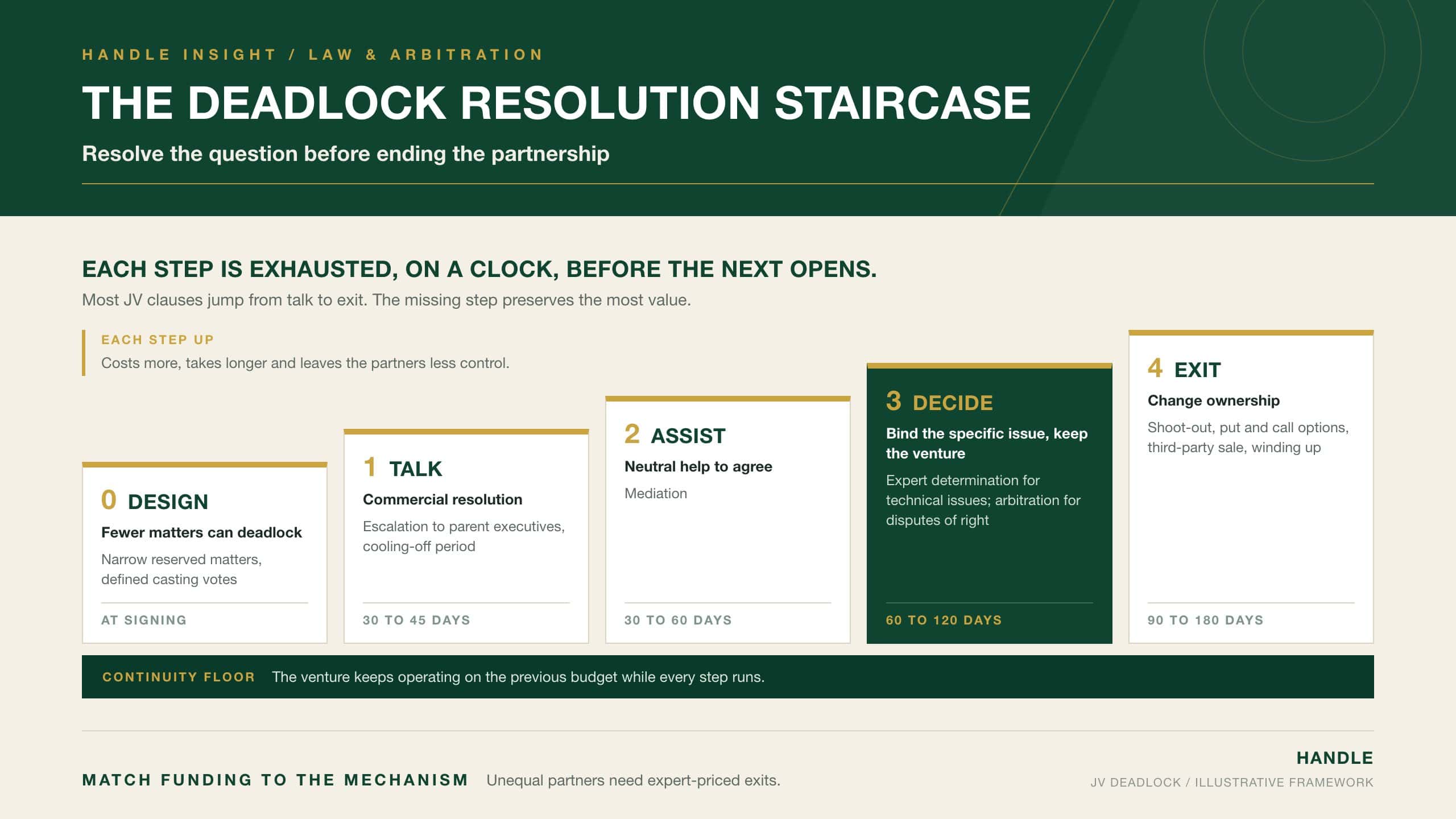
Many JV agreements move directly from negotiation to exit, with nothing in between. That leaves the parties with a binary choice between continuing to disagree and ending the venture. The Deadlock Resolution Staircase adds the missing steps. Each step must be exhausted, within a fixed time, before the next is available, and the business continues operating throughout on a defined fallback basis.
| Step | Purpose | Mechanisms | Illustrative Time Limit |
|---|---|---|---|
| 0. Design | Reduce the matters that can deadlock | Narrow reserved matters, casting votes on defined issues, budget fallback | At signing |
| 1. Talk | Allow commercial resolution | Escalation to parent executives, cooling-off period | 30 to 45 days |
| 2. Assist | Restore negotiation with neutral help | Mediation | 30 to 60 days |
| 3. Decide | Resolve the specific issue without ending the venture | Expert determination for technical issues; arbitration for disputes of right | 60 to 120 days |
| 4. Exit | End the deadlock by changing ownership | Shoot-out, put and call options, third-party sale, winding up | 90 to 180 days |
The Decide step is the one most often missing and the one that preserves the most value. Many deadlocks are not about the future of the partnership at all, but about a single technical question or a single disputed right. Resolving that question binds the parties and leaves the venture intact. Exit should be reserved for deadlocks about direction, where no third party can or should decide for the partners.
Common Failures in Deadlock Clauses
- Defining deadlock loosely, so that the first dispute is about whether the clause has been triggered at all.
- Making every operational decision a reserved matter, which multiplies the occasions on which deadlock can occur.
- Omitting a budget fallback, so that the business has no authority to operate while the deadlock is being resolved.
- Moving straight from negotiation to a shoot-out, which turns narrow disagreements into contests over ownership.
- Using a Russian roulette between partners of unequal financial strength, which allows the stronger party to dictate the price.
- Relying on arbitration to decide commercial questions that a tribunal is not empowered to answer.
- Failing to align the shareholders’ agreement with the constitutional documents and onshore transfer formalities, so that the agreed exit cannot be completed.
Each failure is a drafting decision made, or avoided, at signing. That is when the deadlock clause must be built.
Conclusion
Deadlock mechanisms in JV agreements protect a venture from the disagreement its structure makes possible. The strongest clauses work as a sequence rather than a single remedy: they narrow the matters that can deadlock, keep the business operating on a fallback basis, give the partners time and assisted negotiation, provide a binding decision on technical issues or disputed rights, and only then permit an exit through a shoot-out, options or a sale. Exit mechanisms must reflect the partners’ relative financial strength, or they reward the deeper balance sheet rather than the fairer price. In the UAE, onshore transfer formalities and pre-emption rights, the choice of a DIFC or ADGM holding structure and possible merger control review all affect whether the chosen route can actually be completed. Build the staircase at signing. Keep the business running. End the partnership only when the question cannot be resolved.


