The appeals process in UAE courts gives a losing party two further chances to change the outcome, but each chance is narrower than the one before. The Court of Appeal can look again at the facts and the law. The Court of Cassation looks only at the law. Each stage has its own deadline, its own rules on new evidence and its own effect on whether the judgment can be enforced in the meantime. Within the UAE Onshore Courts Litigation framework, appeals are therefore best understood as a funnel rather than a ladder: the case does not climb to a higher re-hearing, it passes through progressively tighter filters towards finality. Parties who understand that shape can use each stage to correct real errors and to manage enforcement risk. Parties who treat appeals as a second trial waste time and often strengthen the judgment against them. Appeals reward precision, not persistence.
How Is the UAE Appellate System Structured?
Onshore litigation in the UAE runs through three tiers: the Court of First Instance, the Court of Appeal and a court of cassation. The cassation tier is the Federal Supreme Court for cases heard in the federal courts, and the Court of Cassation of the local judicial authority in Dubai, Abu Dhabi and Ras Al Khaimah, each of which operates its own court system. The procedural framework is set by the federal Civil Procedure Law, Federal Decree-Law No. 42 of 2022, and its implementing regulations, together with local practice directions.
Not every judgment can travel through all three tiers. The law sets monetary thresholds and subject-matter limits that determine whether a first instance judgment is appealable and whether an appellate judgment can be taken to cassation. These thresholds are revised from time to time and differ between categories of case, so they should be checked for each matter at the outset rather than assumed.
| Tier | What It Reviews | New Evidence | General Time Limit | Effect on Enforcement |
|---|---|---|---|---|
| Court of First Instance | The full dispute, facts and law | Yes, as the trial court | Not applicable | Judgment generally enforceable once final, unless provisional enforcement applies |
| Court of Appeal | Facts and law, within the grounds raised | Yes, new evidence and defences; no new claims | Generally 30 days; shorter in urgent matters | Appeal generally suspends enforcement of the first instance judgment |
| Court of Cassation | Errors of law, jurisdiction and serious procedural defects | No; facts are treated as settled | Generally 60 days | Does not by itself suspend enforcement; a stay may be requested |
The time limits shown are general rules. The applicable period, and the date from which it runs, depend on the nature of the case and of the judgment and on how and when the judgment was issued or notified. They must be confirmed for each case, because late filings are rejected regardless of merit.
What Can the Court of Appeal Change?
The appeal to the Court of Appeal is the most consequential stage in most onshore commercial disputes. The appeal transfers the case to the appellate court within the limits of what was appealed. The court can review the facts, the evidence, the expert report and the legal reasoning, and it issues its own judgment.
Parties may present new evidence and new defences and arguments at this stage. What they generally cannot do is introduce new claims that were not part of the case at first instance. The Court of Appeal is also not bound by the first instance expert report. Where objections to that report are substantiated, it may refer the matter back to the same expert, appoint a new expert or a committee of experts, or form its own view on the evidence. In technical, accounting and construction disputes, the appellate expert stage frequently changes the outcome.
The appeal is made by a statement of appeal setting out the judgment challenged, the grounds and the relief sought. The respondent may file its own cross-appeal. Grounds should identify specific errors and explain how each affected the result. General dissatisfaction with the outcome is not a ground.
Possible Outcomes
The Court of Appeal may uphold the first instance judgment, amend it, for example by adjusting the amount awarded, or overturn it and give a different judgment. Because the appellate court decides the case itself rather than sending it back, its judgment replaces the first instance judgment on the points appealed.
What Does the Court of Cassation Review?
Cassation is not a third trial. The Court of Cassation reviews whether the law was correctly applied and interpreted, whether the court had jurisdiction, whether the judgment is adequately reasoned and whether a procedural defect affected the result. It does not re-weigh evidence or substitute its own assessment of the facts, which are treated as established by the lower courts unless the reasoning on them is legally defective.
A cassation appeal must be filed by an advocate admitted to plead before the Court of Cassation, and the grounds must be framed as errors of law. A cassation statement that simply repeats factual arguments made below is likely to be rejected.
If the court finds no error, it rejects the appeal and the appellate judgment stands. If it finds an error, it may quash the judgment and remit the case to the Court of Appeal for reconsideration, or, in circumstances permitted by the procedural law, decide the matter itself. A judgment of the Court of Cassation is final within the onshore system.
How Appeals Interact With Enforcement
For a party that has won at first instance, the question is often not whether the judgment will survive appeal but when it can be enforced. As a general rule, a first instance judgment is not enforceable while an appeal against it is pending, unless the law or the court has made it subject to provisional enforcement. Certain categories of judgment, including some in urgent and commercial matters, may carry provisional enforcement, often against security.
The position changes at the appellate stage. A judgment of the Court of Appeal is generally enforceable even if a cassation appeal is filed. The party appealing to cassation may ask the court to stay enforcement, and the court may grant a stay where enforcement would cause serious harm that would be difficult to reverse, and may require security. A stay is not automatic. Many judgment debtors file in cassation on the assumption that enforcement will pause, and discover that it does not.
A Worked Example: Two Appeals and One Enforcement Window
Consider an illustrative construction dispute in the Dubai Courts. The Court of First Instance awards the contractor AED 6.4 million against the developer, based on a court-appointed expert’s valuation of variations.
The developer appeals within the 30-day period, attacking the expert’s methodology. The judgment is not yet enforceable. The Court of Appeal appoints a committee of three experts, which values the variations at AED 4.1 million, and gives judgment for that amount. The contractor files in cassation, arguing that the appellate court misapplied a contractual time-bar clause. The developer considers a cassation appeal of its own, but its objections are essentially factual and would not succeed at that tier.
Meanwhile, the appellate judgment for AED 4.1 million is enforceable. The contractor opens an execution file and seeks attachment of the developer’s bank accounts. The developer applies to the Court of Cassation for a stay, but the court declines because the developer is solvent and the payment could be reversed if the cassation appeal succeeded. The contractor recovers AED 4.1 million while its own cassation appeal for the balance proceeds. The case shows the funnel in operation: facts were reopened once, the law was reviewed once, and enforcement followed the stage at which the facts became settled.
Should You Appeal? Weighing Merit, Cost and Leverage
The decision to appeal should be taken on a short written assessment rather than on instinct. Three questions matter. First, is there an identifiable error, of fact at the appellate stage or of law at cassation, that changed the result? Second, what will the appeal cost in fees, court charges, expert costs and management time, compared with the amount realistically at stake? Third, how does the appeal affect enforcement and settlement? A well-founded appeal against a first instance judgment can preserve the status quo and create room to negotiate. A weak appeal delays the inevitable, adds cost and may produce an appellate judgment that is harder to challenge. Respondents should make the same assessment in reverse, including whether to cross-appeal points they lost. In many cases, the period between judgments is the moment of greatest settlement leverage for both sides.
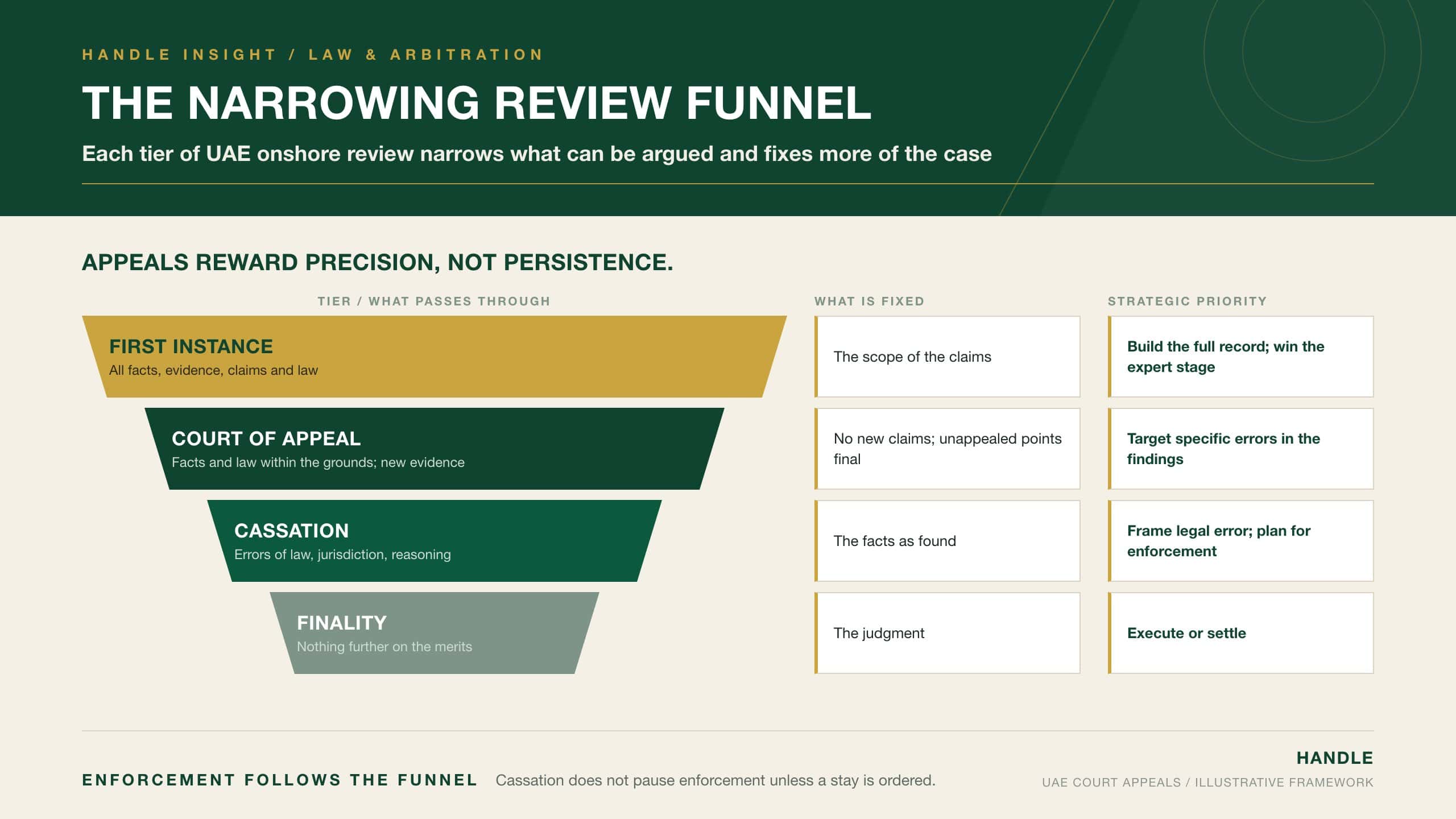
Original Analysis: The Narrowing Review Funnel
The UAE appellate process can be modelled as a funnel with three filters. Each filter reduces what can be argued and increases what is fixed. A party’s strategy at each stage should match the width of the filter.
| Filter | What Passes Through | What Is Fixed | Strategic Priority |
|---|---|---|---|
| First Instance | All facts, evidence, claims and law | The scope of the claims | Build the complete record and secure the expert stage |
| Appeal | Facts and law within the grounds; new evidence and defences | No new claims; unappealed points become final | Target specific errors, especially in the expert findings |
| Cassation | Errors of law, jurisdiction and reasoning | The facts as found | Frame genuine legal errors; manage enforcement and any stay |
| Finality | Nothing further on the merits | The judgment | Execute or settle |
The funnel produces two practical rules. First, the widest filter is the most valuable, so the case should be built at first instance as though there will be no second chance on the facts. Second, enforcement follows the narrowing: the further the case travels, the less protection an appeal offers against payment. A party that understands where it sits in the funnel can decide when to appeal, when to settle and when to pay.
Arabic, the Record and Consistency
Proceedings in the onshore courts are conducted in Arabic, and documents in other languages must be translated by a certified legal translator. Terminology should be fixed early and used consistently at every tier. A contractual term translated one way at first instance and another way on appeal invites arguments that the courts misunderstood the contract, and makes legal error harder to demonstrate in cassation.
Common Failures in UAE Appeals
- Missing the appeal or cassation deadline because the starting date was miscalculated or a new power of attorney was not ready.
- Re-arguing the facts in cassation instead of identifying a specific error of law, which leads to rejection.
- Introducing new claims on appeal, which the Court of Appeal will not entertain, instead of preserving them at first instance.
- Assuming that a cassation appeal suspends enforcement, and failing to prepare for execution or to apply properly for a stay.
- Neglecting the expert stage at first instance on the expectation that the Court of Appeal will correct it.
- Using inconsistent translations of key contractual terms across tiers, weakening the client’s position at each stage.
Each failure reflects a misunderstanding of the funnel. Each is avoided by treating the first instance as the decisive stage and the later tiers as precise tools.
Conclusion
The appeals process in UAE courts moves a dispute through three tiers, each narrower than the last. The Court of Appeal can review facts and law, admit new evidence and defences, appoint new experts and substitute its own judgment, but it will not hear new claims. The Court of Cassation reviews only errors of law, jurisdiction and reasoning, and treats the facts as settled. Deadlines are strict and must be confirmed for each case. Enforcement follows the narrowing: an appeal generally suspends a first instance judgment, but a cassation appeal does not suspend an appellate judgment unless a stay is ordered. For businesses, investors and family offices litigating onshore, the lesson is to build the record at first instance, appeal only on identifiable errors and plan for enforcement at every stage. The funnel narrows. Finality arrives.