The first strategic decision in any onshore dispute in the UAE is not the argument. It is the court. The architecture of UAE Onshore Courts Litigation is defined by a deliberate division between the federal judiciary and the independent local judiciaries that certain emirates have retained. The two systems apply largely the same federal legislation, yet they are administered separately, they culminate in different apex courts and they execute judgments through different execution departments. Federal vs local court jurisdiction therefore determines which judges hear the case, which court has the final word on the law, how long the route to finality is and how efficiently a judgment can be turned into recovered assets. Parties do not simply choose between the systems. Jurisdiction follows the connections of the dispute to a particular emirate. A claim filed in the wrong system loses time it cannot recover. Jurisdiction is the first decision. Enforcement is its consequence.
Why the UAE Has Two Onshore Court Systems
The UAE Constitution establishes a federal judiciary while allowing individual emirates to retain their own local judicial bodies. Abu Dhabi, Dubai and Ras Al Khaimah maintain independent local court systems, administered respectively by the Abu Dhabi Judicial Department, the Dubai Courts and the Ras Al Khaimah Courts. Sharjah, Ajman, Umm Al Quwain and Fujairah fall within the federal judicial system administered by the federal Ministry of Justice.
Neither system is subordinate to the other in ordinary civil and commercial matters. Each has its own first instance, appeal and apex courts, and each issues judgments that are final within its own hierarchy. The difference lies in administration, appellate routing and which court gives the final interpretation of the law in a particular case.
Both systems sit alongside the courts of the two financial free zones, the DIFC Courts and the ADGM Courts, which operate under separate common law based frameworks. Those courts are outside the scope of this article, which concerns the onshore systems only.
What Distinguishes Federal and Local Court Jurisdictions?
| Feature | Federal Courts | Local Courts |
|---|---|---|
| Emirates covered | Sharjah, Ajman, Umm Al Quwain and Fujairah | Abu Dhabi, Dubai and Ras Al Khaimah, each with its own system |
| Administration | Federal Ministry of Justice | Emirate-level judicial departments |
| Court hierarchy | Federal Court of First Instance, Federal Court of Appeal, Federal Supreme Court | Court of First Instance, Court of Appeal, Court of Cassation of the emirate |
| Apex court for the case | Federal Supreme Court | The emirate’s Court of Cassation |
| Procedural law | Federal Civil Procedure Law | Federal Civil Procedure Law, with local administrative practice |
| Execution of judgments | Federal execution courts | The emirate’s own execution courts |
Procedurally, the systems are closer than their separate structures suggest. Civil and commercial cases in both are governed by the federal Civil Procedure Law, Federal Decree-Law No. 42 of 2022, and by the same federal substantive legislation. The practical differences arise in case management, scheduling, the appointment and use of court experts, electronic filing platforms, fees and the responsiveness of execution departments.
How Is Jurisdiction Determined at Filing?
Jurisdiction attaches to an emirate, and therefore to a court system, through the connections of the dispute. Under the Civil Procedure Law, the general rule is that a claim is brought in the court of the place where the defendant is domiciled. Additional connecting factors may give jurisdiction elsewhere, including the place where the contract was concluded or performed, the location of property in dispute and, for certain claims, the place where the harm occurred.
The choice of system follows from the choice of emirate. A claim against a defendant domiciled in Dubai belongs, in principle, before the Dubai Courts. A claim against a defendant domiciled in Sharjah belongs before the federal courts sitting in Sharjah. Where several emirates are connected to the dispute, the claimant may have more than one available forum, and the choice between them becomes a strategic decision.
Filing in the wrong court rarely ends the claim, but it is costly. The court will decline jurisdiction and may refer the case to the competent court, which consumes time, may require further fees and can affect interim measures that depend on the original filing.
Appellate Pathways and Final Authority
The appellate structure is where the systems diverge most clearly. A federal case moves from the Federal Court of First Instance to the Federal Court of Appeal and, where the conditions for cassation review are met, to the Federal Supreme Court. A local case moves from the emirate’s Court of First Instance to its Court of Appeal and then to its Court of Cassation.
The Federal Supreme Court also has a constitutional role that sits above both systems. Among its functions, it decides conflicts of jurisdiction between federal and local judicial authorities, and between the judicial authorities of different emirates. Where a federal court and a local court both claim, or both decline, jurisdiction over the same dispute, the Federal Supreme Court resolves the conflict.
Precedent and Interpretive Consistency
The UAE does not apply a formal doctrine of binding precedent. Even so, the principles stated by apex courts carry significant persuasive authority, and lower courts tend to align with them. The Federal Supreme Court shapes interpretation within the federal system. Each local Court of Cassation shapes interpretation within its emirate.
Because the apex courts are separate, interpretations of the same federal provision can differ between systems. A well-prepared litigation strategy therefore examines how the relevant apex court has approached the issue, rather than assuming a single national position.
Enforcement and the Location of Assets
A judgment has value only when it can be executed. Each system has its own execution courts, which handle attachments, account freezes, sales of assets and other compulsory measures. Judgments of federal and local courts are UAE judgments and can be executed across emirates, but execution against assets located in another emirate proceeds through the execution court of that emirate. That adds procedural steps and time.
For this reason, asset location should influence the choice of forum from the outset. Where the defendant’s principal assets are concentrated in the same emirate as the court, execution is usually more direct. Where assets are spread across several emirates, the claimant should plan for parallel execution steps and consider precautionary attachments early.
Interim Measures and the Cost of Delay
The forum decision is often made under time pressure. Where there is a risk that a debtor will move or dissipate assets, the claimant may need a precautionary attachment or other urgent order before the main claim is decided. Applications of this kind are made to the competent court in the relevant system, and the order must usually be followed by a substantive claim within the time the rules allow. A forum error at this stage is particularly damaging, because an urgent order obtained from a court without jurisdiction may be lifted, and the opportunity to secure assets may not return. The urgent application and the main claim should therefore be planned together, in the same system, from the outset.
When Does Each System Offer an Advantage?
Where a claimant has more than one available forum, the choice should be made on practical grounds rather than habit. The federal system offers a single hierarchy and execution structure across four emirates, which can simplify disputes in which the defendant and its assets are spread across Sharjah, Ajman, Umm Al Quwain and Fujairah. A local system offers concentration: where the defendant, the performance of the contract and the assets all sit within Abu Dhabi, Dubai or Ras Al Khaimah, a single local system can take the case from filing to execution without crossing into another administration. Familiarity with the court’s procedures, its expert practice and its execution department is also a legitimate factor. The better forum is the one that shortens the path to recovery.
A Worked Example: Routing a Multi-Emirate Claim
Consider an illustrative supplier based in Sharjah with an unpaid claim of AED 8 million against a buyer. The contract was signed in Sharjah and performed by delivery to the buyer’s warehouses in Dubai. The table shows how the routing changes depending on where the buyer is domiciled and holds its assets.
| Scenario | Buyer Domicile | Main Assets | Available Forums | Strategic Preference |
|---|---|---|---|---|
| A | Dubai | Dubai | Dubai Courts; possibly federal courts in Sharjah as place of contracting | Dubai Courts: forum and assets in the same emirate |
| B | Dubai | Abu Dhabi | Dubai Courts; possibly federal courts in Sharjah | Dubai Courts, with execution planned through Abu Dhabi execution courts |
| C | Sharjah | Sharjah and Ajman | Federal courts; possibly Dubai Courts as place of performance | Federal courts: single system for judgment and execution |
The availability of each forum must be confirmed against the facts and the procedural rules, and the preference may change if speed, interim relief or the court’s approach to a particular legal issue is decisive. The scenarios are illustrative. The method is constant: identify every connected emirate, map the assets, then choose the forum that shortens the route from filing to recovery.
Original Analysis: The Two-Ladder Court Map
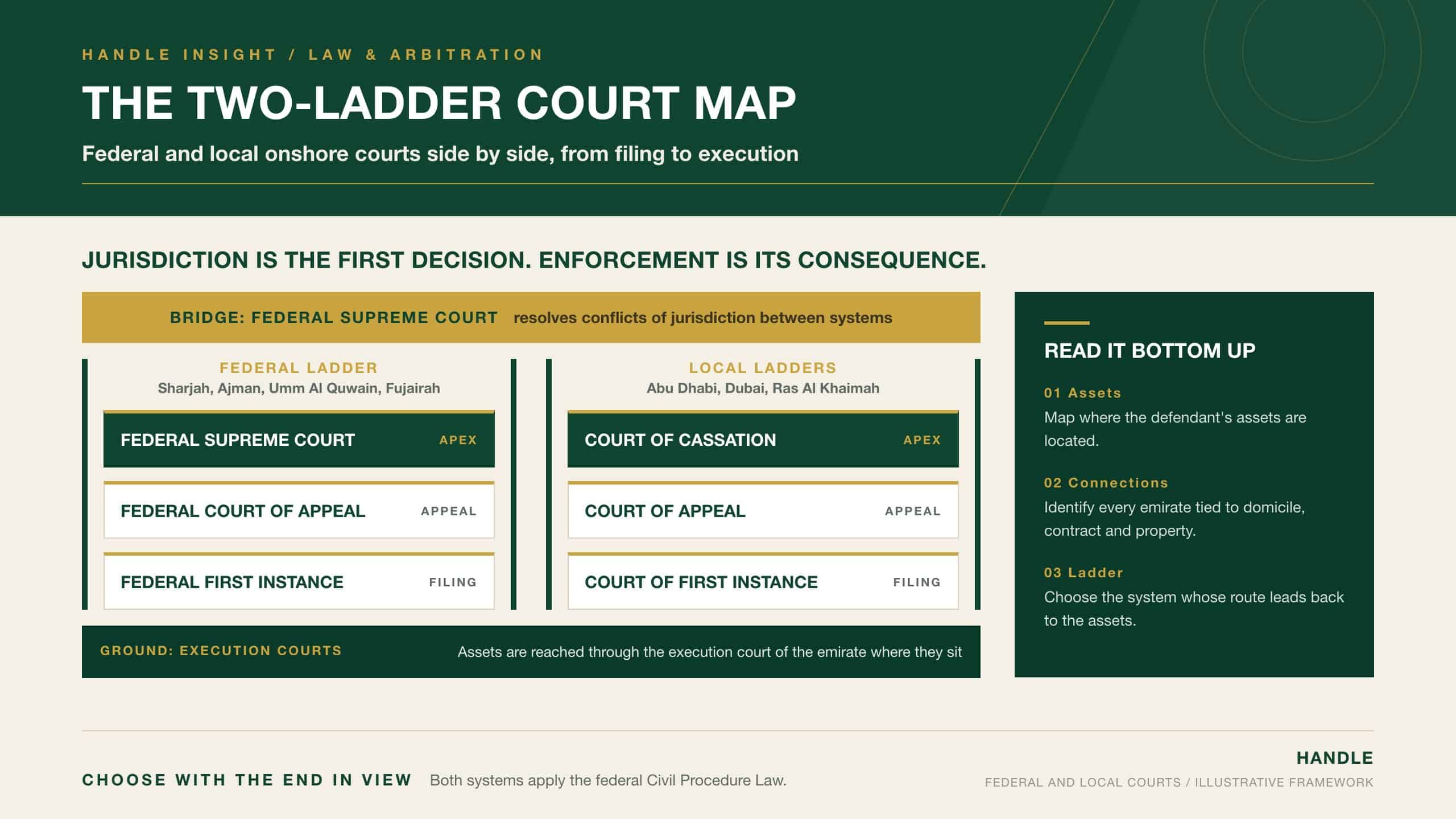
Onshore litigation in the UAE can be pictured as two parallel ladders. Each ladder has three rungs: first instance, appeal and apex court. The federal ladder ends at the Federal Supreme Court. Each local ladder ends at the emirate’s Court of Cassation. A bridge sits above both ladders: the Federal Supreme Court’s power to resolve conflicts of jurisdiction between them. Beneath the ladders lies the ground on which every case ultimately lands: the execution court in the emirate where the assets are.
| Level | Federal Ladder | Local Ladder | Question for the Litigant |
|---|---|---|---|
| Bridge | Federal Supreme Court resolves conflicts of jurisdiction | Is there any risk that two systems claim or decline the case? | |
| Apex | Federal Supreme Court | Court of Cassation of the emirate | Which apex court’s view of the law will decide the case? |
| Appeal | Federal Court of Appeal | Court of Appeal of the emirate | How long is the route to a final judgment? |
| First instance | Federal Court of First Instance | Court of First Instance of the emirate | Which emirate does the dispute connect to? |
| Ground | Federal execution courts | Local execution courts | Where are the assets, and which execution court controls them? |
The map is read from the bottom up. Start with the assets, then confirm the connected emirates, then choose the ladder whose rungs lead most directly back to those assets. A judgment from the top of the wrong ladder still has to come down to the right ground.
Common Mistakes in Choosing Between Federal and Local Courts
- Filing where the claimant is based rather than where the defendant is domiciled or the dispute is connected.
- Choosing a forum without mapping where the defendant’s assets are located and which execution court controls them.
- Assuming that a principle established by one apex court will be applied in the same way by another.
- Overlooking the risk of a conflict of jurisdiction where several emirates are connected to the dispute.
- Delaying precautionary attachments while the forum question is debated, allowing assets to move.
- Confusing the onshore courts with the DIFC Courts or ADGM Courts, which operate under separate jurisdictional rules.
Conclusion
The distinction between federal and local court jurisdictions defines how onshore litigation in the UAE is filed, escalated and enforced. Abu Dhabi, Dubai and Ras Al Khaimah operate independent local court systems ending in their own Courts of Cassation, while Sharjah, Ajman, Umm Al Quwain and Fujairah fall within the federal system ending in the Federal Supreme Court, which also resolves conflicts of jurisdiction between the two. Both systems apply the federal Civil Procedure Law, but they differ in administration, apex authority and execution practice. Jurisdiction follows the dispute’s connections to an emirate, and recovery follows the location of assets. The Two-Ladder Court Map brings those elements together so that the forum is chosen with the end in view. Structure determines the route. The route determines recovery.