A judgment records who is right. It does not, by itself, move money. Execution proceedings in the UAE are the stage at which a court’s decision is converted into payment, delivery or compliance, and they operate under their own judge, their own procedure and their own logic. Within UAE Onshore Courts Litigation, execution is where many creditors lose the value they spent years winning, not because the law is weak but because the file was opened without an enforceable title, without asset intelligence or without a plan for escalation. The execution judge does not revisit the merits. The judge applies pressure in proportion to what the creditor can identify and prove. Recovery is decided by preparation, not by the size of the judgment.
What Are Execution Proceedings in the UAE?
Execution proceedings are the compulsory enforcement of an executory instrument through the execution judge of the competent onshore court. The governing framework is the federal Civil Procedure Law, Federal Decree-Law No. 42 of 2022, which replaced the earlier Civil Procedure Law and its implementing regulation and contains a full set of rules on executory instruments, attachment, judicial sale and coercive measures. In Dubai, Abu Dhabi and Ras Al Khaimah the local judicial authorities administer these rules; in the other emirates the federal courts do.
Execution is a separate judicial phase. The trial and appellate judges have finished their work. The execution judge controls the file, decides which measures to order, rules on objections and supervises sales and settlements. Arguments about whether the debt was owed are closed. The only questions that remain are whether the title is enforceable, what the debtor owns and how quickly it can be reached.
Which Titles Can Be Executed?
Execution starts from an executory instrument, not from a claim. The main categories are court judgments and orders that have become enforceable, arbitral awards that have been recognised and ratified by the competent court, settlements approved by a court, notarised documents, and other documents to which the law gives executory force.
Two practical points deserve attention. First, since the reform of the UAE commercial transactions regime, a cheque returned unpaid for insufficient funds can be presented directly to the execution judge as an executory instrument for the unpaid amount, without first obtaining a judgment on the debt. Second, an arbitral award must pass through recognition before it can be executed: the UAE Arbitration Law, Federal Law No. 6 of 2018 as amended by Federal Law No. 15 of 2023, provides for ratification and enforcement of awards, and a set-aside application must be made within 30 days of notification of the award. Foreign judgments and awards follow their own recognition route, with the UAE a party to the New York Convention since 2006.
When Does a Judgment Become Enforceable?
Timing determines leverage. A first-instance judgment is generally not enforceable while the time for appeal is running or while an appeal is pending, unless provisional execution applies. Provisional execution is available by force of law in certain categories, including urgent and summary matters, and the court can order it in other cases, frequently on condition that the creditor provides security.
A judgment of the Court of Appeal is enforceable even if the debtor files an appeal in cassation. Filing for cassation does not automatically suspend execution; the debtor must apply for a stay, and the Court of Cassation may grant one, often against security. For a creditor, this means the window between the appeal judgment and the cassation hearing is not a waiting period. It is the moment to open the execution file.
The judgment must also carry the execution formula and be served in the prescribed form. Administrative gaps at this stage, such as a missing certified copy or incorrect party details, are the most avoidable cause of delay.
How an Execution File Moves
The creditor files an execution application identifying the instrument, the parties, the amount and the measures requested. The debtor is notified and given a short statutory period to comply voluntarily. If payment is made, the file closes. If not, the execution judge moves to compulsory measures.
From that point the file advances through attachment, realisation and, where needed, coercion. The execution judge can request information from banks, land departments, vehicle registries and other authorities, and can order the debtor to disclose assets. Each step depends on the creditor feeding the file with specific targets and pressing for the next measure when one is exhausted.
The Execution Toolkit
The measures available are broad. Their value depends on matching the right tool to the asset and to the debtor’s behaviour.
| Measure | Target | Speed | Main Limitation |
|---|---|---|---|
| Bank attachment | Balances held with UAE banks | Fast once accounts are identified | Accounts may hold little at the moment of attachment |
| Garnishment (attachment in the hands of a third party) | Receivables, rent and amounts owed to the debtor | Moderate; depends on the third party’s response | The third party may dispute the debt it owes |
| Movable seizure and auction | Vehicles, equipment, inventory, valuables | Moderate | Auction values are often below market value |
| Real estate attachment and judicial sale | Land and units registered in the debtor’s name | Slower; valuation and auction required | Prior mortgages rank ahead of the execution creditor |
| Share attachment | Shares and equity interests in companies | Variable | Valuation and transfer restrictions in the constitution |
| Travel ban | The debtor personally | Fast | Pressure only; it does not recover value directly |
| Civil detention | A debtor able to pay who refuses | Conditional | Strict statutory conditions and exemptions apply |
Certain assets cannot be attached at all, including public property of the state and specified categories of personal necessities and a portion of salaries. A creditor that targets exempt assets spends time without gaining ground.
Execution Against Corporate Debtors
Corporate debtors present different pressure points. Bank accounts, receivables from customers, inventory, vehicles registered to the company and shares in subsidiaries are the obvious targets. Licence-related pressure can also apply in practice, because a company whose accounts are frozen and whose receivables are garnished struggles to renew licences, pay staff or keep trading.
Personal measures against managers or shareholders are not automatic. Separate legal personality means the company’s debt is not the manager’s debt. Personal liability or personal coercive measures require a specific legal basis, such as a statutory liability provision, a personal guarantee or proven misconduct. Creditors who expect a travel ban on a director merely because the company has not paid are usually disappointed. Planning for this at the contract stage, through guarantees and security, is more effective than seeking it at execution.
Objections and Execution Disputes
Debtors can raise objections, but the grounds are narrow. They typically concern payment or settlement already made, defects in the executory instrument or its service, the exempt status of a particular asset, or third-party ownership of an attached asset. Objections that reopen the merits are rejected.
The burden lies on the party raising the objection. A debtor that claims to have paid must prove it. A third party that claims an attached asset belongs to it must produce title. The creditor’s task is to answer quickly and to keep other measures moving while the objection is heard, so that a single dispute does not stall the whole file.
Instalments, Security and Settlement
The execution judge may approve payment by instalments where circumstances justify it. Default on an instalment typically restores full enforcement of the outstanding balance. A debtor may also offer substitute security to lift a particular measure, such as releasing an account in exchange for a bank guarantee, and the judge assesses whether the security is adequate.
Settlements reached during execution can be recorded in the file. Their main value is enforceability: a recorded settlement can be enforced without fresh litigation if the debtor defaults. Creditors should ensure that any settlement preserves existing attachments until payment is complete.
Worked Example: Sequencing a Recovery
Consider an illustrative creditor holding a final appellate judgment for AED 4.2 million against a trading company. Pre-filing research identifies three bank relationships, a major customer that owes the debtor about AED 1.1 million, four company vehicles and a warehouse unit valued at roughly AED 3.5 million and mortgaged for AED 2.0 million.
The creditor files on the day the appeal judgment is issued, without waiting for the cassation period. Bank attachment captures AED 0.6 million within the first weeks. Garnishment against the customer secures AED 1.1 million as invoices fall due. The vehicles are seized and sold for AED 0.2 million. The warehouse is attached and, assuming a sale at its valuation, after the mortgagee’s AED 2.0 million is paid from the auction proceeds, about AED 1.3 million in equity remains available to the execution creditor, leaving a shortfall of roughly AED 1.0 million before costs and interest. Faced with an attached warehouse and a garnished customer, the debtor proposes a recorded settlement for the balance in three instalments, secured by a bank guarantee.
The figures are illustrative. The sequence is not. Liquid targets first, receivables second, hard assets third, and settlement on the creditor’s terms when pressure is at its highest.
Original Analysis: The Execution Pressure Timeline
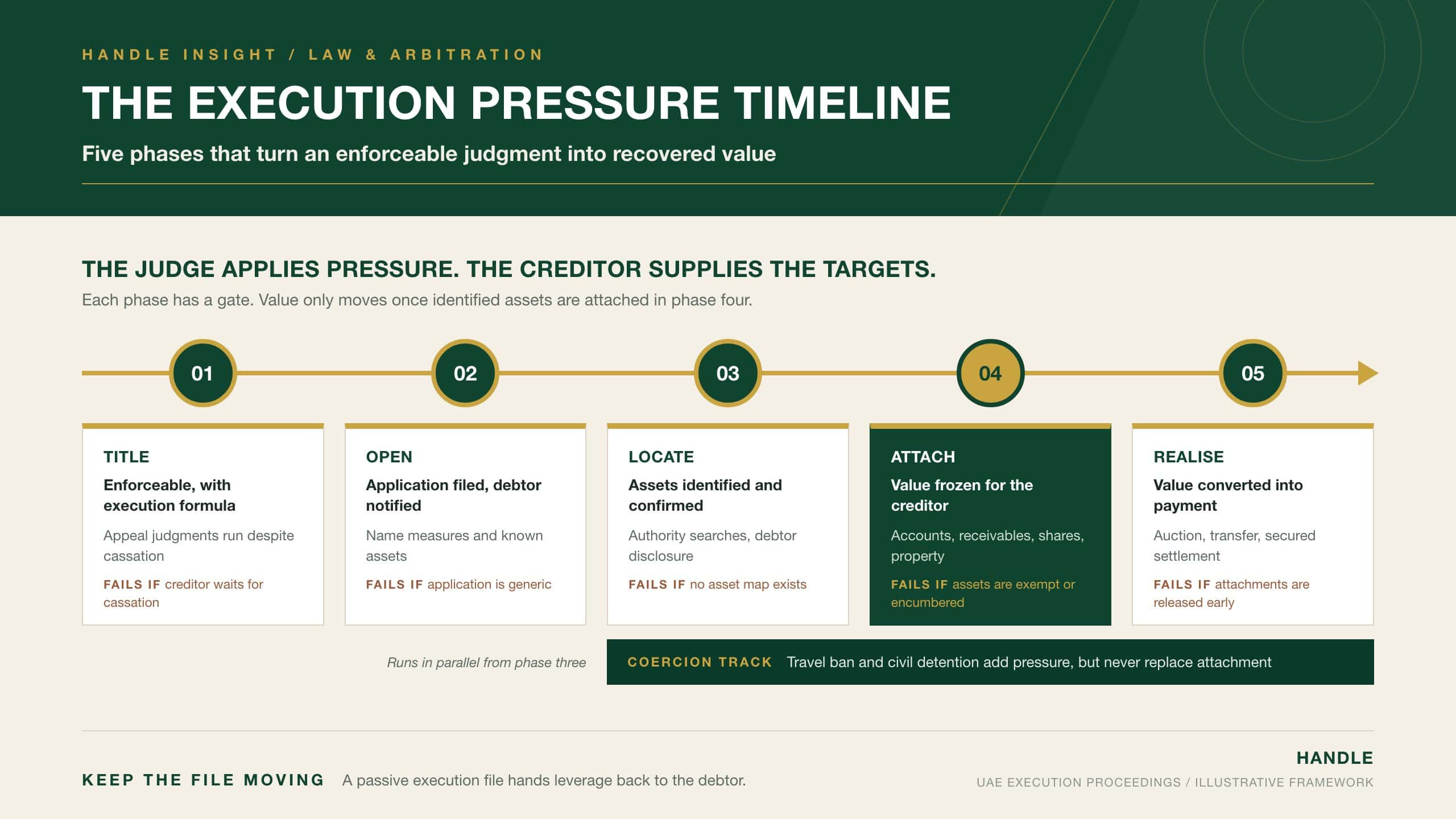
Successful execution follows five phases. Each phase has a gate that must be passed before the next one produces value, and each has a typical point of failure.
| Phase | Gate to Pass | Creditor Action | Typical Failure |
|---|---|---|---|
| 1. Title | Instrument is enforceable and carries the execution formula | Confirm finality or provisional execution; obtain certified copies | Waiting for cassation that does not suspend execution |
| 2. Open | Application filed and debtor notified | Specify measures and known assets in the application | Generic applications that give the judge nothing to act on |
| 3. Locate | Assets identified and confirmed | Request authority searches and debtor disclosure | No asset map before filing |
| 4. Attach | Value frozen in the creditor’s favour | Attach accounts, garnish receivables, attach shares and property | Targeting exempt or encumbered assets |
| 5. Realise | Value converted into payment | Press for auction, transfer or secured settlement | Releasing attachments before payment is complete |
Coercive measures such as travel bans and detention run alongside phases three to five, not after them. They add pressure but do not replace attachment. Phase four is where most recoveries are won or lost, because it is the point at which identified value becomes legally unavailable to the debtor.
Common Execution Failures
- Delaying the execution file until cassation is decided, even though the appellate judgment is already enforceable.
- Opening the file without an asset map, leaving the execution judge with no specific measure to order.
- Relying on travel bans for pressure while the debtor’s accounts and receivables remain untouched.
- Attaching assets that are exempt by law or already fully mortgaged, which consumes time without producing recovery.
- Assuming that directors or shareholders are personally exposed to the company’s judgment debt without a legal basis.
- Agreeing to instalments or substitute security that release existing attachments before payment is secured.
- Leaving the file passive between hearings, so that measures lapse and the debtor reorganises its assets.
Each failure shifts leverage back to the debtor. Execution rewards the creditor that keeps the file moving.
Conclusion
Execution proceedings in the UAE give a creditor a strong set of tools: a dedicated execution judge, access to information held by banks and registries, attachment of accounts, receivables, shares and property, judicial sale, and coercive measures for debtors who can pay but will not. Those tools do not operate on their own. They respond to an enforceable title, a precise application and an asset map that tells the judge where value sits. Appellate judgments can be executed while cassation is pending. Liquid assets should be attached before hard assets. Settlements should keep attachments in place until payment is made. A creditor that prepares the file before judgment, opens it as soon as the title is enforceable and presses each phase in turn converts the judgment into recovery. The judgment establishes the right. Execution delivers it.