Legal representation in UAE courts is often treated as a matter of choosing a law firm. In practice it is a matter of authority: who is permitted to appear, what they are permitted to do, and whether the documents conferring that authority will be accepted at each stage of the case. Within the UAE Onshore Courts Litigation framework, representation rules decide whether a claim can be filed on time, whether a defence can be heard, whether a settlement binds the client and whether a judgment can be enforced. Rights of audience before the onshore courts are restricted to advocates enrolled for that purpose. Their power to act comes from a power of attorney whose wording and formalities are scrutinised. Arabic is the language of the proceedings. Each of these rules is simple to state and costly to overlook. In UAE litigation, authority is established before argument begins.
Who Can Represent a Party Before the UAE Onshore Courts?
The UAE has three distinct court systems. The onshore courts comprise the federal courts and the local judicial authorities in Dubai, Abu Dhabi and Ras Al Khaimah, which operate their own courts of first instance, appeal and cassation. The DIFC Courts and the ADGM Courts are separate common law courts with their own procedural rules and registers of practitioners. This article concerns the onshore courts, where the rules are the most restrictive.
Before the onshore courts, the right to appear and plead on behalf of another person is reserved by the federal legislation regulating the advocacy profession, together with the rules of the local judicial authorities, to advocates enrolled on the relevant roll. Those advocates are, as a general rule, UAE nationals. Foreign-qualified lawyers practising in the UAE are typically licensed as legal consultants: they may advise, draft, coordinate strategy and prepare materials, but they do not appear before the onshore courts on behalf of clients.
Many international law firms in the UAE therefore work alongside local advocates’ offices, or have an affiliated advocacy practice, so that pleadings and hearings are handled by an enrolled advocate while strategy is shared with the wider team. The advocate of record carries personal professional responsibility for what is filed.
Can a Party Represent Itself?
Individuals may, in principle, appear in person, and the courts may permit certain close relatives to appear for them in limited cases. A company acts through its legal representative. In practice, however, commercial litigation of any size is conducted through advocates, and the higher the court the stronger the requirement becomes: a cassation appeal must be signed by an advocate admitted to plead before the Court of Cassation. A director who attempts to run a significant commercial case without an advocate faces procedural risk, language constraints and limited credibility before the court.
| Representative | Rights of Audience Onshore | Typical Role |
|---|---|---|
| Advocate enrolled before the relevant court | Yes, within the levels of court for which admitted | Files pleadings, attends hearings, pursues appeals and execution |
| Foreign-qualified legal consultant | No | Strategy, drafting, evidence preparation, coordination with advocates |
| In-house counsel | No, save in specific roles permitted by law | Instructions, document collection, settlement authority within the company |
| Individual litigant | Limited, subject to the court’s procedures | Appearing in person in smaller matters |
| Company director or manager | Acts as legal representative, not as advocate | Grants the power of attorney and gives instructions |
Why the Power of Attorney Is the Real Control Instrument
An advocate’s authority to act derives from a power of attorney granted by the client. The court checks it at filing and may check it again whenever the advocate takes a step that requires specific authority. If the power is missing, expired, defective in form or too narrow, the step can be rejected.
Form and Authentication
A power of attorney executed in the UAE is normally notarised before a UAE notary public, many of which now operate electronically. A power executed abroad must be notarised in the country of signature and then legalised through the applicable chain, typically including the UAE embassy or consulate and the UAE Ministry of Foreign Affairs, before being translated into Arabic by a certified legal translator. For a foreign parent company, this chain often takes longer than the time available to file a defence, which is why powers of attorney should be prepared before a dispute arises rather than after.
General Authority and Specific Authority
A general litigation power of attorney permits the advocate to file claims, submit defences, attend hearings and take the ordinary procedural steps necessary to pursue the case. Certain acts, however, dispose of the client’s rights and require express authority. These generally include settlement, admission of a claim, waiver of a right or of a judgment, acceptance or refusal of a decisive oath, agreeing to arbitration and similar steps. If the power of attorney does not expressly confer them, the advocate cannot validly take them, and a settlement agreed in court can be challenged.
Continuity Across Stages
A power of attorney should expressly cover appeal, cassation, execution and related urgent and summary proceedings. Execution proceedings, including attachments, travel bans where available and the sale of attached assets, require authority as clearly as the claim itself. Gaps between stages create delays at exactly the moments when time limits are short.
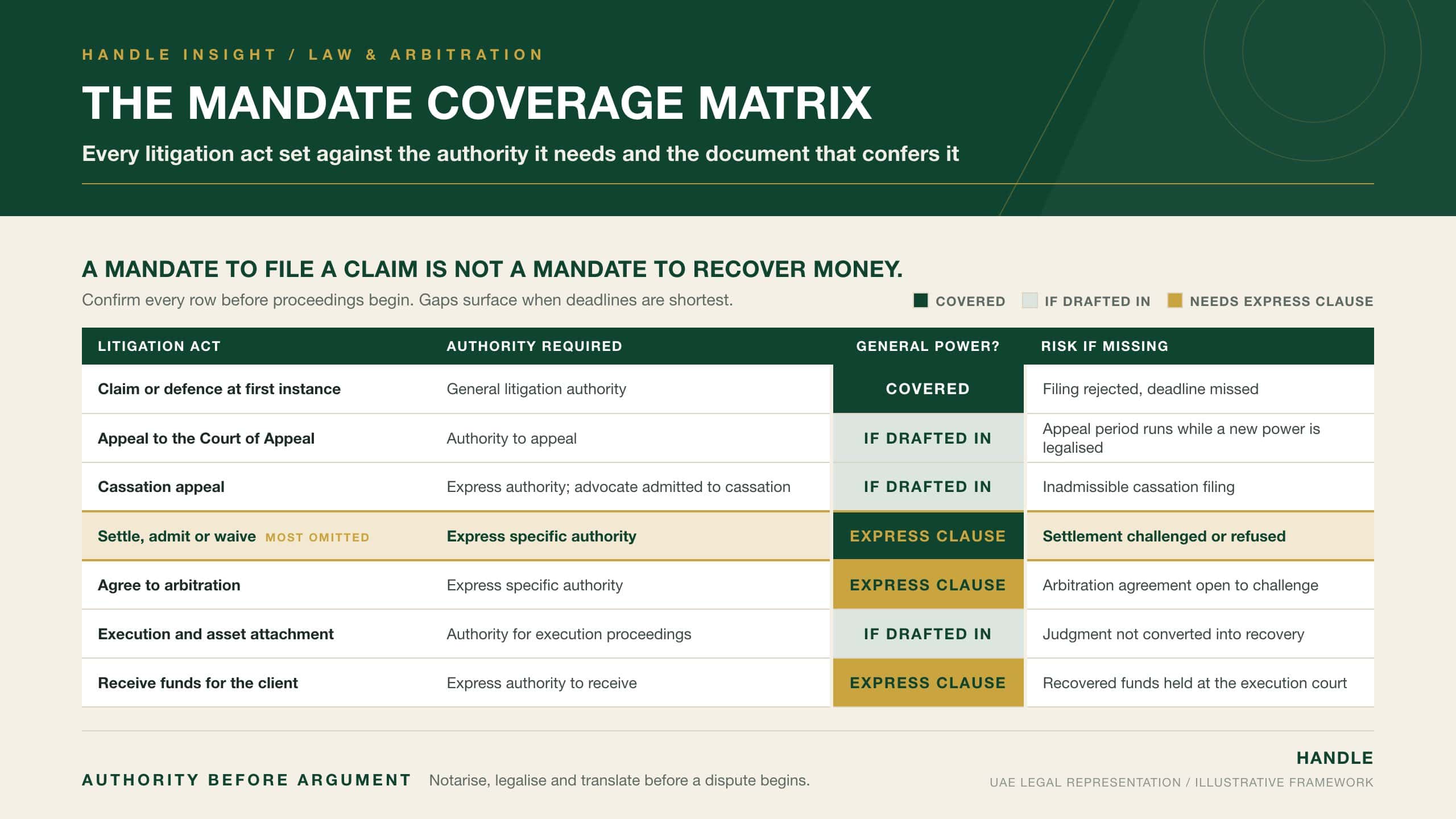
Original Analysis: The Mandate Coverage Matrix
The most useful way to audit representation is to set each litigation act against the authority it requires and the document that confers it. The Mandate Coverage Matrix does this in one view. Every row should be confirmed before proceedings begin.
| Litigation Act | Authority Required | Usually Covered by a General Litigation Power? | Risk if Missing |
|---|---|---|---|
| File a claim or defence at first instance | General litigation authority | Yes | Filing rejected or deadline missed |
| Appeal to the Court of Appeal | Authority to appeal | Usually, if drafted to include appeals | Appeal period lapses while a new power is legalised |
| Cassation appeal | Authority to appeal in cassation and an advocate admitted before that court | Only if expressly included | Inadmissible cassation filing |
| Settle, admit or waive | Express specific authority | No | Settlement challenged or refused by the court |
| Agree to arbitration | Express specific authority | No | Arbitration agreement open to challenge |
| Commence execution and attach assets | Authority for execution proceedings | Only if expressly included | Judgment cannot be converted into recovery |
| Receive funds on the client’s behalf | Express authority to receive | Not always | Recovered funds held up at the execution court |
The matrix reveals a pattern. The acts that create the greatest value for the client, namely settlement, execution and receipt of funds, are the acts most often omitted from a standard power of attorney. A mandate drafted for filing a claim is not a mandate drafted for recovering money.
A Worked Example: The Foreign Parent and the Short Deadline
Consider an illustrative case. A Singapore-incorporated group is sued in the Dubai Court of First Instance through its onshore subsidiary, a limited liability company, for AED 8 million. The subsidiary’s manager can sign a power of attorney before a Dubai notary within a day, so the defence is filed in time.
The Singapore parent, joined as a second defendant on the basis of a guarantee, has no power of attorney in place. Its documents must be signed by an authorised director, notarised in Singapore, legalised through the applicable chain, attested by the UAE Ministry of Foreign Affairs and translated into Arabic. In this illustration the process takes 18 calendar days. The parent’s defence is therefore prepared by the advocate but cannot be formally submitted for its client at the first hearing, and the advocate must ask the court for time.
The judgment at first instance goes against both defendants. The subsidiary’s power of attorney covered only first instance proceedings, so a new power is required to appeal within the 30-day appeal period. The group then decides to settle at AED 5.5 million, and discovers that neither power confers settlement authority. Three separate authority gaps, none of them about the merits, consumed time and negotiating leverage that a single properly drafted mandate would have preserved.
Language, Procedure and the Advocate’s Role
Arabic is the language of the onshore courts. Pleadings are drafted in Arabic, and documents in other languages must be accompanied by certified Arabic translations. Translation is not a clerical step. Contractual terms, technical expressions and financial definitions must be rendered consistently across the claim, the expert stage, the appeal and execution, because the court will read the case through those words.
Onshore procedure is predominantly written. Many courts conduct case preparation through a case management office or electronic filing system before the matter reaches a judge. The advocate controls the sequence of submissions, the timing of document production, the response to expert reports and the observance of every time limit. Most onshore commercial disputes involving accounts, construction or valuation are referred to a court-appointed expert, and the advocate’s handling of the expert stage frequently decides the case.
Representation in the DIFC and ADGM Courts
The DIFC Courts and ADGM Courts operate in English under common law procedure. Each court maintains its own rules on who may conduct litigation and appear before it, including registration of practitioners. Foreign-qualified lawyers can be admitted under those rules, and the courts have their own provisions on litigants in person and on representation of companies. Parties choosing these courts, whether by contract or because the dispute has a qualifying connection, should confirm the requirements of the specific court rather than assume that the onshore position applies, or the reverse.
Costs of Representation
Advocates’ fees are agreed contractually with the client. Onshore courts may award a contribution towards legal fees to the successful party, but such awards are typically modest compared with the actual cost of representation. Litigation budgets should therefore assume that most fees will not be recovered from the losing side. Court fees, expert fees and translation costs should be planned separately, because they arise at different stages and some must be paid in advance for the case to proceed.
Common Failures in Legal Representation
- Relying on a foreign-qualified lawyer to file or appear before the onshore courts, which results in rejected submissions and lost time.
- Waiting until a claim is served to prepare a power of attorney for a foreign entity, when legalisation alone can exceed the time available.
- Granting a power of attorney that covers first instance only, so that appeals, cassation and execution each require new documents under pressure.
- Omitting express authority to settle, admit, waive or receive funds, which leaves a negotiated settlement or a recovery exposed to challenge.
- Allowing powers of attorney to expire or remain in force for advocates no longer instructed, which creates confusion over who speaks for the client.
- Using inconsistent translations of key terms across stages, which undermines the clarity and credibility of the client’s case.
- Splitting instructions between several advisers without a single advocate of record responsible for deadlines and filings.
Each failure is administrative in origin and substantive in effect. Most are prevented by a single review of the mandate before proceedings begin.
Conclusion
Legal representation in UAE courts rests on three controls: an advocate entitled to appear before the relevant court, a power of attorney whose scope and formalities match every act the case will require, and disciplined handling of Arabic pleadings, expert evidence and time limits. The onshore courts apply these rules strictly, and the DIFC and ADGM Courts apply their own. Most representation failures are not failures of advocacy. They are gaps in authority that surface at the worst possible moment: when an appeal period is running, when a settlement is within reach or when a judgment must be executed. Companies, investors and family offices active in the UAE should put powers of attorney in place before disputes arise, cover appeal, cassation, settlement and execution expressly, and appoint a single advocate of record. Authority comes first. Argument follows.