Arbitration is chosen for its advantages: confidentiality, specialist decision-makers, procedural flexibility and an award that can be enforced across borders. Its disadvantages receive less attention at the drafting stage, and they usually surface only when a dispute has already begun and the forum can no longer be changed. Within Law & Arbitration, the question is not whether arbitration is better or worse than litigation in the abstract. The question is which specific features of arbitration will work against a party in the disputes its contracts are likely to produce, and whether those weaknesses can be designed out in advance. The disadvantages of arbitration are real: limited review of errors, high direct costs, narrower disclosure, weak powers over third parties, slower urgent relief and the absence of precedent. Most are manageable. Some are not. A dispute clause is a risk allocation. It should be priced like one.
What Are the Disadvantages of Arbitration?
The disadvantages of arbitration fall into three groups. The first concerns finality: an award is binding and can be challenged only on narrow grounds, so a wrong decision usually stands. The second concerns cost and procedure: the parties pay for the tribunal and the institution, and the process can become as long and expensive as court litigation. The third concerns power: a tribunal derives its authority from the parties’ agreement, so it has limited reach over non-parties, limited coercive power and, in some situations, limited ability to act quickly.
Each disadvantage is the reverse side of an advantage. Finality provides certainty. Party funding buys specialist arbitrators and procedural control. Consensual jurisdiction is what makes awards enforceable internationally. A party that wants the benefits must accept the trade-offs, or deliberately mitigate them.
Why Limited Review Is the Most Serious Disadvantage
In most systems, there is no appeal on the merits of an arbitral award. Courts will not revisit the tribunal’s findings of fact, its interpretation of the contract or its assessment of damages. Review is confined to procedural and jurisdictional defects and to public policy.
In the UAE, the Federal Arbitration Law, Federal Law No. 6 of 2018 as amended by Federal Law No. 15 of 2023, permits an application to set aside an award only on the limited grounds the law sets out, such as the absence of a valid arbitration agreement, a party’s inability to present its case, the tribunal exceeding its mandate or a conflict with public order. The application must be filed with the competent Court of Appeal within 30 days of notification of the award. In the DIFC, the DIFC Arbitration Law No. 1 of 2008 allows a set-aside application to the DIFC Courts within three months, and the ADGM Arbitration Regulations 2015 provide a comparable framework before the ADGM Courts. None of these regimes permits a court to substitute its view of the merits for the tribunal’s.
For a party facing a single, high-value dispute, this means the quality of the tribunal is the quality of the outcome. There is no second chance to correct an error of law or a misreading of the evidence. Finality cuts both ways.
When Does Arbitration Become More Expensive Than Litigation?
Arbitration requires the parties to fund the forum directly. Tribunal fees, institutional administration charges, hearing venues, transcription and document platforms are paid by the parties, in addition to legal and expert fees that would arise in litigation anyway. Three-member tribunals multiply the arbitrator cost and often lengthen the timetable because diaries must be aligned.
Cost becomes a disadvantage when the claim value is modest relative to the fixed costs of the process, when a party is resource-constrained and faces a well-funded opponent, or when the dispute is document-heavy and the tribunal allows extensive procedural rounds. Cost allocation rules can shift the burden to the losing party, but recovery is never complete and depends on the respondent’s ability to pay.
A Worked Example: Budgeting the Forum
Consider an illustrative construction claim of AED 20 million seated in Dubai under institutional rules. The figures below are illustrative assumptions, not institutional scales.
| Cost Element | Sole Arbitrator (AED) | Three-Member Tribunal (AED) |
|---|---|---|
| Tribunal fees | 450,000 | 1,200,000 |
| Institutional and hearing costs | 200,000 | 300,000 |
| Legal fees per party | 2,500,000 | 3,200,000 |
| Expert fees per party | 600,000 | 700,000 |
| Total cost for one party | 3,750,000 | 5,400,000 |
| Cost as share of claim | 18.8% | 27.0% |
On these assumptions, the choice of tribunal size alone changes one party’s cost by AED 1.65 million, and the total cost of a three-member process exceeds a quarter of the amount in dispute. Even if the claimant wins and recovers most of its costs, it carries the funding burden for the life of the case. A clause that defaults to three arbitrators for every dispute, regardless of value, builds that cost into contracts that will never justify it.
Narrow Disclosure and Weak Powers Over Third Parties
Arbitral disclosure is narrower than court discovery in common law systems. Tribunals typically order production of specific documents or narrow categories that are relevant and material. This is efficient when both parties hold their own records. It is a disadvantage when the critical evidence sits with the opponent, when fraud or concealment is alleged, or when documents are held by a third party.
A tribunal has no inherent power over persons who are not parties to the arbitration agreement. It cannot compel a non-party bank, auditor or former employee to produce evidence without court assistance. Joinder and consolidation are similarly constrained. Where a transaction involves several contracts with inconsistent dispute clauses, or where the real counterparty is a group company that did not sign, claims can fragment across parallel proceedings with inconsistent outcomes. The UAE Arbitration Law permits joinder of a third party only in limited circumstances, and institutional rules such as those of the Dubai International Arbitration Centre provide additional mechanisms, but none of them can create consent where none exists.
Urgent Relief and Enforcement Gaps
Many institutional rules now provide for emergency arbitrators, and the UAE Arbitration Law allows the tribunal to order interim measures. However, a tribunal cannot itself freeze a bank account, and an emergency arbitrator’s order binds only the parties. Where assets may be dissipated within days, a court application for a precautionary attachment is often faster and more effective. The UAE Arbitration Law preserves the right of parties to seek interim measures from the competent court before or during the arbitration.
Enforcement is also not automatic. An award must still be recognised and enforced by a court. Onshore UAE awards are ratified and enforced under the Arbitration Law and the Civil Procedure Law, Federal Decree-Law No. 42 of 2022. Foreign awards benefit from the New York Convention, to which the UAE acceded in 2006, but the award debtor can still raise the Convention’s defences, and enforcement against hidden assets or state entities can take years. Winning the award is one milestone. Collecting the money is another.
Confidentiality, Precedent and Consistency
Confidentiality protects commercial information, but it also means awards are rarely published and do not create binding precedent. Parties cannot easily predict how a tribunal will approach a novel issue, and different tribunals may decide similar questions differently. In emerging sectors, this lack of published guidance can increase legal uncertainty.
Confidentiality is also less absolute than parties assume. Once a party applies to a court to set aside or enforce an award, the award and parts of the record may enter court files. Parties who value privacy should consider this before relying on arbitration to keep a dispute out of view.
Procedural Variability, Delay and Perceived Bias
Arbitral procedure is shaped by the tribunal and the parties rather than by a fixed code. Two tribunals applying the same rules may take very different approaches to document production, witness evidence, expert conferencing and the length of hearings. That flexibility is useful when it is managed. Without firm case management, it allows procedural rounds to multiply, and complex arbitrations involving several parties, technical evidence and large damages claims can run for years.
Concerns about impartiality also arise. Arbitrators must be independent and must disclose circumstances that could give rise to justified doubts, and the 2023 amendments to the UAE Arbitration Law strengthened the rules on conflicts. Even so, in specialised sectors where the same practitioners appear repeatedly as counsel, experts and arbitrators, perceived proximity can affect confidence in the process. Careful appointment, full disclosure and early challenges where warranted are the only practical safeguards. Procedure is an asset only when someone controls it.
Commercial Versus Consumer and Employment Criticism
Much of the public criticism of arbitration concerns mandatory clauses in consumer and employment contracts, where bargaining power is unequal and arbitration may restrict access to courts or collective claims. Those concerns are less relevant to negotiated commercial contracts between sophisticated parties, such as M&A agreements, joint ventures, financing documents and infrastructure contracts, where arbitration is chosen deliberately and its trade-offs can be priced. The analysis in this article is directed at the commercial context.
Original Analysis: The Forum Fit Quadrant
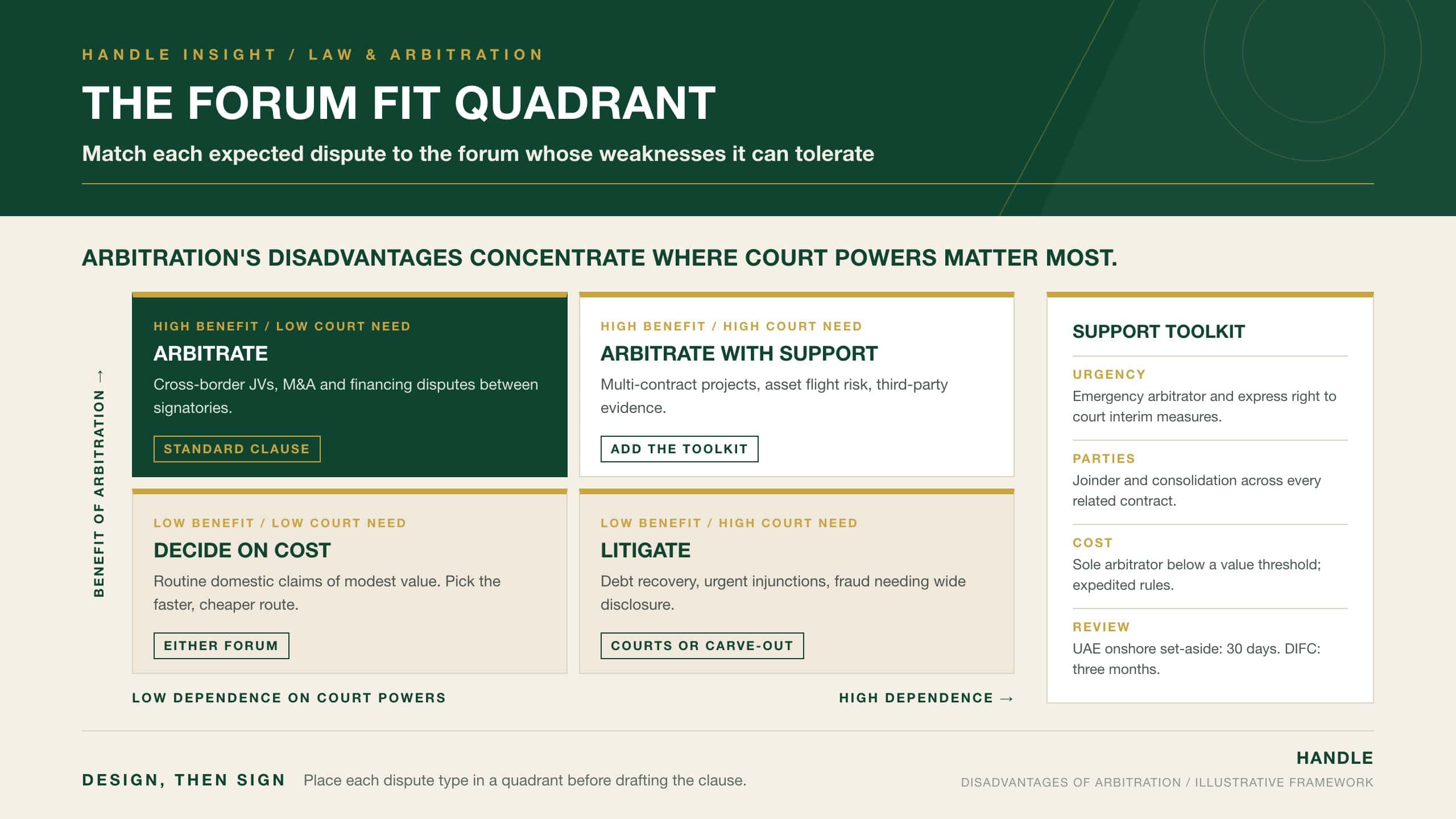
The disadvantages of arbitration matter most when two conditions combine: the dispute needs powers that only courts hold, and the party gains little from arbitration’s distinctive benefits. The Forum Fit Quadrant maps each expected dispute type on two axes. The first is the value of arbitration’s benefits for that dispute: finality, confidentiality, specialist decision-makers and cross-border enforceability. The second is dependence on court powers: urgent asset relief, compulsion of third parties, broad disclosure and multi-party coordination.
| Quadrant | Benefit of Arbitration | Dependence on Court Powers | Recommended Approach |
|---|---|---|---|
| Arbitrate | High | Low | Standard arbitration clause; sole arbitrator below a value threshold |
| Arbitrate with support | High | High | Arbitration plus emergency arbitrator, joinder and consolidation provisions, and express preservation of court interim relief |
| Decide on cost | Low | Low | Either forum; choose the faster and cheaper route for the expected claim size |
| Litigate | Low | High | Court jurisdiction, or carve out specific claims such as debt recovery and injunctions |
The quadrant shifts the decision from a general preference to a clause-by-clause design choice. A shareholder agreement for a cross-border joint venture usually sits in the first or second quadrant. A domestic supply contract with small, frequent payment claims may sit in the third or fourth. The disadvantages of arbitration are concentrated in the fourth quadrant. That is where clauses most often go wrong.
Common Mistakes When Choosing Arbitration
- Copying a three-member tribunal clause into every contract, regardless of the likely value of disputes.
- Using different dispute clauses across related contracts, so that one transaction produces several disconnected proceedings.
- Failing to preserve access to court interim measures, leaving a party without fast asset protection.
- Assuming confidentiality will survive set-aside or enforcement proceedings in court.
- Choosing a seat without checking the set-aside regime and the timetable for challenging awards there.
- Ignoring where the counterparty’s assets are located and whether an award can be enforced there efficiently.
- Treating arbitration as automatically faster, without providing for expedited procedures or tribunal case management.
Each mistake turns a manageable disadvantage into a structural one that cannot be corrected once the dispute arises.
Conclusion
The disadvantages of arbitration are limited review of errors, direct and sometimes substantial costs, narrow disclosure, weak powers over third parties, slower urgent relief, enforcement that still depends on courts, and the absence of published precedent. In the UAE, awards can be set aside only on narrow grounds and within short time limits, whether onshore, in the DIFC or in ADGM, so the tribunal’s decision is usually the final word. None of this makes arbitration the wrong choice. It makes the choice a design decision. The Forum Fit Quadrant helps parties match each expected dispute to the forum that suits it, and to add support mechanisms where arbitration is chosen despite a need for court powers. Arbitration rewards preparation. It punishes assumption. The clause decides the dispute before the dispute begins.