Silence is not a defence in arbitration. A party that ignores a notice of arbitration does not stop the proceedings, does not deprive the tribunal of jurisdiction and does not prevent an award being issued and enforced against its assets. Within Law & Arbitration, ignoring arbitration is best understood as a sequence of forfeited rights: the right to choose an arbitrator, to object to jurisdiction in time, to test the evidence, to reduce the damages and to negotiate from strength. Modern arbitration laws, including the UAE Federal Arbitration Law and the DIFC and ADGM regimes, are built to keep proceedings moving when one party disengages, while protecting that party’s right to be properly notified. The protection is procedural, not substantive. Absence does not freeze the dispute. It hands control of it to the other side.
Does Arbitration Stop If One Party Ignores It?
It does not. Arbitration laws and institutional rules anticipate non-participation and provide for the process to continue. If a respondent fails to submit a defence without sufficient cause, the tribunal may continue the proceedings. Under the UNCITRAL Model Law approach followed in the DIFC and ADGM, and under the UAE Federal Arbitration Law (Federal Law No. 6 of 2018, as amended by Federal Law No. 15 of 2023), that failure is not in itself treated as an admission of the claim. The tribunal still has to be satisfied that the claim is established.
That safeguard is narrower than it sounds. The tribunal decides on the record in front of it. If only one party has filed evidence, expert reports and legal submissions, the record is one-sided, and the tribunal has no obligation to construct the absent party’s case for it.
What the law does insist on is proper notice. Tribunals and supervising courts examine carefully whether the absent party was notified at the address agreed in the contract, or otherwise in accordance with the rules and the law of the seat. A claimant that cannot prove proper service exposes its award to challenge. A respondent that was properly served gains nothing by staying silent.
What Happens at Each Stage If You Do Not Respond?
Notice of arbitration. The claimant serves a notice or request for arbitration in accordance with the arbitration agreement, the applicable rules and the law of the seat. The arbitration usually starts on receipt of that notice. Ignoring it does not invalidate it.
Constitution of the tribunal. If the respondent does not nominate an arbitrator within the time allowed, the institution, or in an ad hoc arbitration the competent court at the seat, makes the appointment instead. For an onshore UAE seat, that court is the court specified in the Federal Arbitration Law; for the DIFC and ADGM, it is the DIFC Courts or ADGM Courts. Institutions such as DIAC, ICC, LCIA and SIAC all have default appointment mechanisms.
Jurisdictional objections. A plea that the tribunal lacks jurisdiction must generally be raised no later than the statement of defence. A party that never files a defence risks losing the ability to raise that objection effectively, and arbitration laws, including the UAE law, provide that a party who knows of a procedural irregularity and proceeds without objecting in time may be treated as having waived it.
Evidence and hearing. The tribunal may hold the hearing and decide on the evidence before it if a party fails to appear or produce documents without sufficient cause.
The award. The tribunal issues a final award, often including the claimant’s legal costs, the arbitration costs and interest. It binds the absent party in exactly the same way as an award made after a fully contested hearing.
| Stage | What the Tribunal or Institution Does | What the Silent Party Loses |
|---|---|---|
| Notice of arbitration | Treats the arbitration as commenced on receipt | Early opportunity to settle or narrow the claim |
| Tribunal formation | Appoints an arbitrator by default | Any say in who decides the dispute |
| Jurisdiction | Rules on its own jurisdiction, often unopposed | A timely objection, which may later be treated as waived |
| Evidence and hearing | Proceeds on the claimant’s record | Cross-examination, expert challenge and counterclaims |
| Award | Issues a binding award, including costs and interest | Any influence over quantum or form of relief |
| Post-award | Award becomes enforceable after recognition | Most arguments that could have been made earlier |
Is a Default Award Enforceable?
Yes. An award made in a party’s absence is enforceable on the same basis as any other award, provided that party was properly notified and given an opportunity to present its case. The UAE acceded to the New York Convention in 2006, and the Convention covers more than 170 contracting states. A creditor holding an award against a silent respondent can therefore seek recognition wherever that respondent holds assets.
In the UAE, an onshore-seated award is made executable through ratification and an enforcement order under Article 55 of the Federal Arbitration Law. A foreign award is recognised under the New York Convention and the procedure in the federal civil procedure legislation, now Federal Decree-Law No. 42 of 2022 on Civil Procedure. DIFC and ADGM awards are recognised by the DIFC Courts and ADGM Courts respectively. Once recognised, execution can extend to bank accounts, receivables, real estate and shareholdings.
Can You Challenge the Award Later?
Only on narrow grounds, and choosing not to participate is not one of them. The grounds for setting aside an award, under the UAE Federal Arbitration Law and under the Model Law-based DIFC and ADGM regimes, focus on structural defects: an invalid arbitration agreement or lack of capacity, a party not being given proper notice of the appointment of an arbitrator or of the proceedings or otherwise being unable to present its case, the tribunal exceeding its mandate, an improperly constituted tribunal, non-arbitrable subject matter and conflict with public order or public policy.
The notice ground is the one most relevant to a non-participating party. It succeeds where notice was genuinely defective. It does not succeed where the party received proper notice and chose to ignore it. Time limits are strict. For an onshore UAE award, an application to set aside must be filed with the competent Court of Appeal within 30 days of notification of the award. For a DIFC award, the application must generally be made within three months of receipt. For an ADGM award, the ADGM Arbitration Regulations 2015 set the period.
| Response Option | Cost and Effort | Rights Preserved | Typical Risk |
|---|---|---|---|
| Full participation | Highest | All defences, counterclaims and influence over quantum | Adverse award on a contested record |
| Participation limited to jurisdiction | Moderate | Jurisdictional objection, with the option to defend on the merits if it fails | Objection rejected and merits left late |
| Acknowledge and negotiate | Low to moderate | Settlement leverage, provided procedural deadlines are protected | Deadlines missed while talks continue |
| Complete silence | Lowest in the short term | Only challenges based on defective notice or fundamental defects | Uncontested award for the full claim plus costs and interest |
A Worked Example: The Price of Silence
The figures are illustrative. A supplier commences an arbitration seated onshore in the UAE, claiming AED 8 million for unpaid invoices and lost profits. The respondent has documents showing defective deliveries and has its own counterclaim for about AED 1.5 million.
If the respondent participates, it estimates that its evidence could reduce the claim to around AED 3.5 million, and that its counterclaim could reduce net exposure further to about AED 2 million. It would spend roughly AED 700,000 on its own legal costs. Its realistic exposure is therefore about AED 2.7 million.
If it ignores the arbitration, the tribunal decides on the claimant’s evidence alone. An award of the full AED 8 million, plus an illustrative AED 900,000 in costs and interest running from the award, produces exposure of roughly AED 8.9 million. The counterclaim is not decided at all and may need separate proceedings.
The difference is more than AED 6 million. Silence did not save AED 700,000 in fees. It cost several times that amount.
Consequences Beyond the Award Itself
The legal exposure is only part of the cost. An unchallenged award and the enforcement that follows are visible to banks, auditors, investors and counterparties. Attachment of accounts can trigger cross-default clauses in financing documents. Auditors may require the award to be provided for in the financial statements. In shareholder and joint venture disputes, an uncontested award can shift control of a company or an asset before the absent party has engaged at all. Silence can therefore convert a contained commercial dispute into a governance, financing and reputational problem.
How to Respond Without Conceding Liability
Engaging with an arbitration is not an admission. A respondent that doubts the claim or the tribunal’s authority has several measured options. It can acknowledge receipt and reserve all rights, including its jurisdictional objections. It can nominate an arbitrator while stating that it does so without prejudice to those objections. It can file a jurisdictional challenge and ask for it to be decided as a preliminary issue. It can open settlement discussions on a without prejudice basis while keeping every procedural deadline in its diary. Each of these steps preserves options that complete silence gives up. The first task on receiving a notice is therefore not to decide whether to fight, but to secure the calendar.
Original Analysis: The Default Escalation Ladder
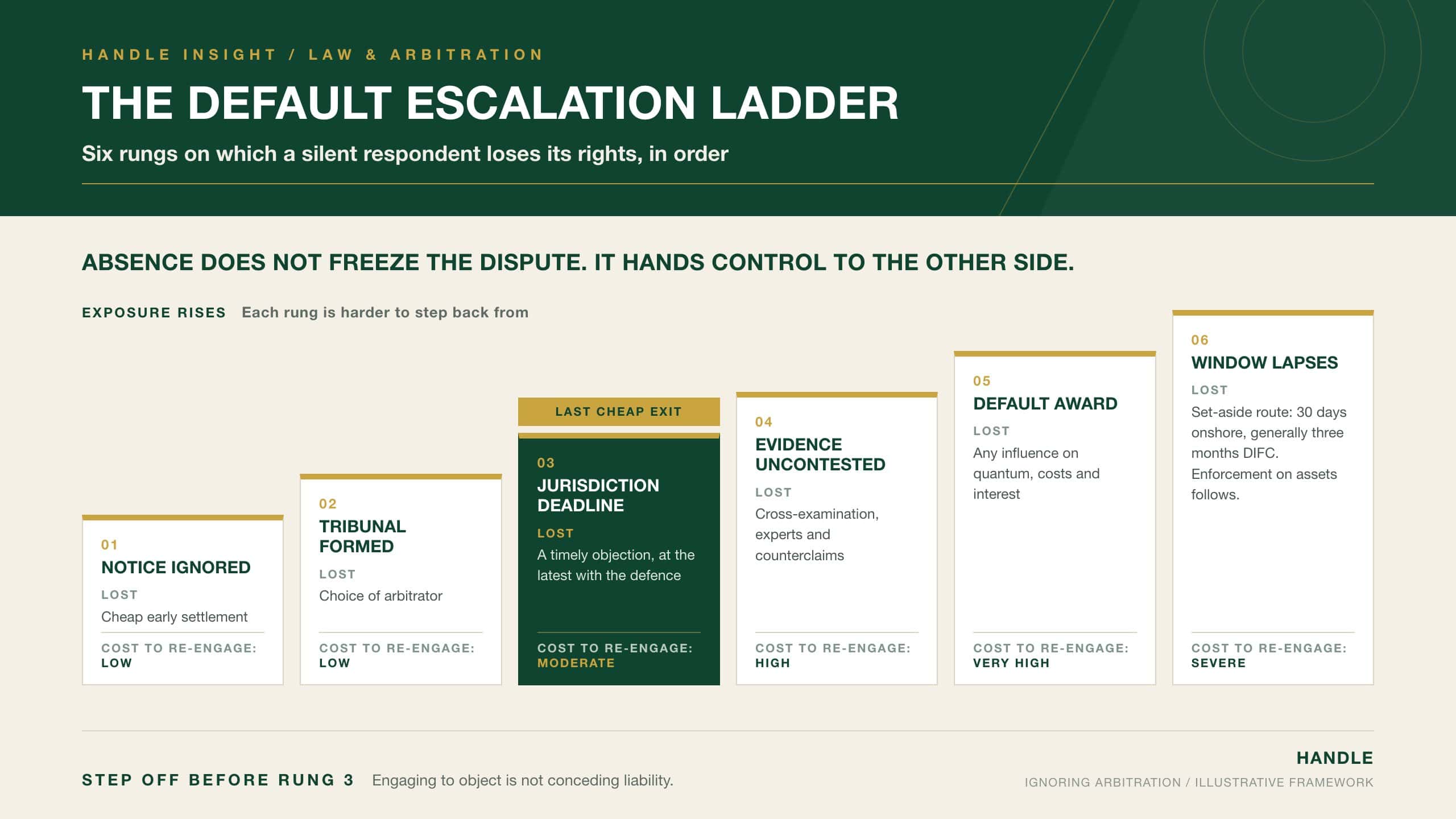
A non-participating party does not lose everything at once. It loses options in a predictable order, and each rung of the ladder is harder to come back down from. The Default Escalation Ladder sets out six rungs.
- Rung 1: Notice ignored. The arbitration is commenced. Settlement is still cheap and fully negotiable.
- Rung 2: Tribunal formed without you. The right to nominate an arbitrator is gone.
- Rung 3: Jurisdiction deadline passes. The statement of defence date is the last moment to raise a jurisdictional objection safely. This is the critical rung, and the last inexpensive point to re-engage.
- Rung 4: Evidence goes uncontested. The record is built entirely by the claimant.
- Rung 5: Default award issued. Liability, quantum, costs and interest are fixed.
- Rung 6: Challenge window lapses and enforcement begins. After 30 days for an onshore UAE award, or generally three months for a DIFC award, the main remaining question is which assets are attached first.
The ladder is a decision tool. A party that receives a notice of arbitration should know which rung it is on and what it costs to step off. Most of the value is preserved by acting before Rung 3.
Common Failures When Ignoring Arbitration
- Believing that a dispute about whether the arbitration clause is valid justifies silence, when the safer course is to appear and object to jurisdiction in time.
- Assuming that a tribunal will not proceed without the respondent, when arbitration laws and institutional rules expressly allow it to.
- Relying on later set-aside proceedings to cure non-participation, when the grounds are narrow and proper notice defeats the most relevant one.
- Letting settlement talks run without acknowledging the arbitration or protecting deadlines, so that procedural rights lapse during negotiations.
- Failing to update the notice address in the contract, so that properly served notices go unread.
- Overlooking the cost of an uncontested award on group companies, lenders and counterparties once enforcement measures reach bank accounts.
Every one of these failures turns a manageable dispute into an enforcement problem. None of them is solved by waiting.
Conclusion
If you do not respond to arbitration, the arbitration continues without you. An arbitrator can be appointed on your behalf, the tribunal can rule on its own jurisdiction, the hearing can proceed on the claimant’s evidence and a binding award can be issued with costs and interest. Under the UAE Federal Arbitration Law and the DIFC and ADGM regimes, a failure to defend is not an admission, but the absent party gives up the means to contest the case. A later challenge succeeds only on narrow grounds, within strict time limits, and proper notice defeats the ground most relevant to a silent party. Once recognised, the award can be enforced against assets in the UAE and across the New York Convention states. Engaging early, even only to object to jurisdiction, preserves options that silence destroys. Absence does not limit exposure. It fixes it.