Missing arbitration does not pause the case. It hands the case to the other side. Once a tribunal is satisfied that the arbitration agreement is valid, that it has jurisdiction and that the absent party was properly notified, it can proceed, weigh the claimant’s evidence and issue a binding award that is enforceable in the courts of the seat and, through the New York Convention, in most commercial jurisdictions. What happens if you miss arbitration therefore depends less on the absence itself than on when it occurs and what it forfeits: the right to shape the tribunal, the right to object to jurisdiction, the right to test evidence and, eventually, most of the grounds on which an award could be resisted. Within Handle’s Law & Arbitration practice, non-participation is treated as a risk event that requires an immediate procedural assessment rather than a wait-and-see posture. Silence is not a defence. It is a decision with consequences.
What Does It Mean to Miss Arbitration?
Missing arbitration covers a range of conduct, from a deliberate refusal to engage to an inadvertent failure caused by a notice sent to an outdated address. It includes failing to respond to a notice or request for arbitration, failing to nominate an arbitrator, missing deadlines for written submissions, failing to produce documents, being absent from a hearing and ignoring the award once it is issued.
The legal effect differs at each point. Ignoring the request for arbitration surrenders influence over the tribunal. Missing the written phase leaves the claimant’s case unanswered. Missing the hearing removes the opportunity to cross-examine witnesses and experts. Ignoring the award moves the dispute from the tribunal to the courts, where the scope for argument is narrow and the creditor holds the initiative.
Four variables decide the outcome in any given case: the arbitration agreement, the institutional rules it adopts, the law of the seat and the reason for the absence. A party that was never properly notified is in a fundamentally different position from a party that received notice and chose not to engage.
Can Arbitration Continue Without You?
Yes. Modern arbitration laws and every major set of institutional rules are designed so that one party cannot defeat the process by refusing to take part. Where a respondent fails to nominate an arbitrator, the institution or the competent court appoints one. Where a respondent fails to file a defence, the tribunal continues. Where a party fails to attend a hearing without sufficient cause, the tribunal may proceed and decide on the evidence before it.
In the UAE, Federal Arbitration Law No. 6 of 2018 (as amended by Federal Law No. 15 of 2023) follows this approach. A respondent’s failure to submit a statement of defence does not, of itself, amount to an admission of the claim, but the tribunal is entitled to continue the proceedings and render an award. The same logic applies under the DIFC Arbitration Law No. 1 of 2008 and the ADGM Arbitration Regulations 2015, both of which are based on the UNCITRAL Model Law, and under the rules of the main institutions used in the region.
The important qualification is that a default is not a judgment by default in the litigation sense. The claimant must still prove its case. In practice, however, an unopposed case is far easier to prove, and tribunals are entitled to draw reasonable inferences from a party’s failure to produce evidence it controls.
What You Lose at Each Stage of Absence
The cost of non-participation accumulates. Each stage closes options that cannot easily be reopened, which is why the timing of re-entry matters as much as the decision to re-enter.
| Stage Missed | What the Absent Party Loses | What May Still Be Available |
|---|---|---|
| Request for arbitration | Influence over the tribunal, the procedural timetable and the language and venue arrangements | Late appearance, jurisdictional objection if raised in time |
| Tribunal constitution | The right to nominate a co-arbitrator; challenges based on facts already known | Challenges based on later disclosures, participation in the written phase |
| Statement of defence | Jurisdictional objections, counterclaims and set-off arguments not raised in time | Leave to file late, at the tribunal’s discretion and usually with a costs consequence |
| Document production and hearing | Cross-examination, expert challenge and the chance to correct the claimant’s damages model | Post-hearing submissions if the tribunal permits them |
| Award | Voluntary settlement leverage and most merits arguments | Set-aside at the seat on limited grounds; resistance to enforcement on treaty grounds |
The most consequential loss is often the earliest. Most arbitration laws, including the UAE Arbitration Law, require a plea that the tribunal lacks jurisdiction to be raised no later than the statement of defence. A party that stays silent past that point may find that its strongest objection is treated as waived.
What Happens If You Miss an Arbitration Hearing?
A missed hearing does not end the arbitration. If the tribunal is satisfied that notice of the hearing was properly given and that no sufficient cause for the absence has been shown, it will normally proceed. The attending party presents its witnesses and experts without cross-examination, and the tribunal may make procedural rulings and close the evidentiary record.
A careful tribunal will document the notice it gave and may invite the absent party to explain itself. That caution protects the award. It does not protect the absent party, whose version of the facts never reaches the record.
Absence by Choice Versus Absence by Defect
Courts treat two kinds of absence very differently. A party that knew of the arbitration and chose not to participate is generally bound by the result. A party that was not given proper notice of the appointment of an arbitrator or of the proceedings, or was otherwise unable to present its case, may have a legitimate ground to challenge the award.
| Factor | Absence by Choice | Absence by Defect |
|---|---|---|
| Notice | Received at the contractual or registered address | Not received, or sent in a way the agreement and rules did not permit |
| Opportunity to present a case | Available but declined | Denied by the way the proceedings were conducted |
| Set-aside prospects at the seat | Weak; non-participation is not itself a ground | Recognised ground under the UAE, DIFC and ADGM regimes |
| Resistance to enforcement abroad | Rarely succeeds | Available under Article V(1)(b) of the New York Convention |
| Practical posture | Negotiate from weakness or pay | Act quickly and preserve evidence of the defect |
The distinction is evidential. Assertions of defective notice made late and without proof are rarely persuasive.
Can You Challenge an Award If You Missed the Proceedings?
Possibly, but the window is narrow and the grounds are limited. Under the UAE Arbitration Law, an application to set aside an award must be filed with the competent Court of Appeal within 30 days of notification of the award (Article 54). The grounds are exhaustive and procedural in nature: an invalid arbitration agreement, incapacity, a failure of proper notice or an inability to present one’s case, an award outside the scope of the submission, irregular composition of the tribunal and conflict with public policy, among others. The court does not re-hear the merits.
In the DIFC, the set-aside period under the DIFC Arbitration Law is three months and applications go to the DIFC Courts. In ADGM, challenges are brought before the ADGM Courts under the ADGM Arbitration Regulations 2015. In all three regimes, a party that simply ignored a properly notified arbitration will struggle to identify a ground that survives scrutiny.
Missing the set-aside deadline compounds the problem. Once it passes, the award becomes much harder to attack at the seat, and the creditor can proceed to recognition and enforcement. Onshore, that process runs under Article 55 of the Arbitration Law and the civil procedure rules now contained in Federal Decree-Law No. 42 of 2022 on Civil Procedure.
Enforcement Exposure After a Default Award
A default award is as enforceable as any other award. The UAE acceded to the New York Convention in 2006, and an award made in the UAE can be presented for recognition in more than 170 Contracting States. Enforcement can reach bank accounts, receivables, real estate, shares in subsidiaries and other assets wherever they are located.
The creditor chooses the forums. The debtor, having been absent from the arbitration, enters each enforcement proceeding with no record of its own case and only the limited treaty grounds to rely on.
Enforcement also ends confidentiality. Arbitration is private. Recognition and attachment proceedings usually are not, which brings banks, investors and counterparties into the picture at the worst possible moment.
A Worked Example: The Price of Silence
Consider an illustrative dispute. A supplier claims AED 12 million for unpaid invoices and lost profits under a distribution agreement. The respondent believes, with good evidence, that AED 4 million of the invoices relate to defective goods and that the lost-profit claim of AED 3 million is speculative.
If the respondent participates, a realistic outcome might be an award of around AED 5 million plus a share of costs, with a reasonable prospect of settling earlier for less. If the respondent ignores the arbitration, the tribunal hears only the supplier’s evidence. The defects are never proved. The damages model is never tested. An award of the full AED 12 million plus interest and the claimant’s costs, which in a contested institutional arbitration of this size can be substantial, becomes a plausible result.
On these illustrative figures, silence could cost several times the amount the respondent actually disputed. The figures are hypothetical. The pattern is not.
What If There Is a Valid Reason for the Absence?
Tribunals have discretion to accommodate genuine difficulty. Serious illness, force majeure events, a change of counsel at short notice or a credible dispute about notice can justify an adjournment, an extension or permission to file late. The test is whether the party acted promptly and in good faith once it was able to.
The weakness of most such applications is delay. The request should be made immediately, in writing, with supporting evidence and a proposed revised timetable.
Original Analysis: The Re-Entry Window Timeline
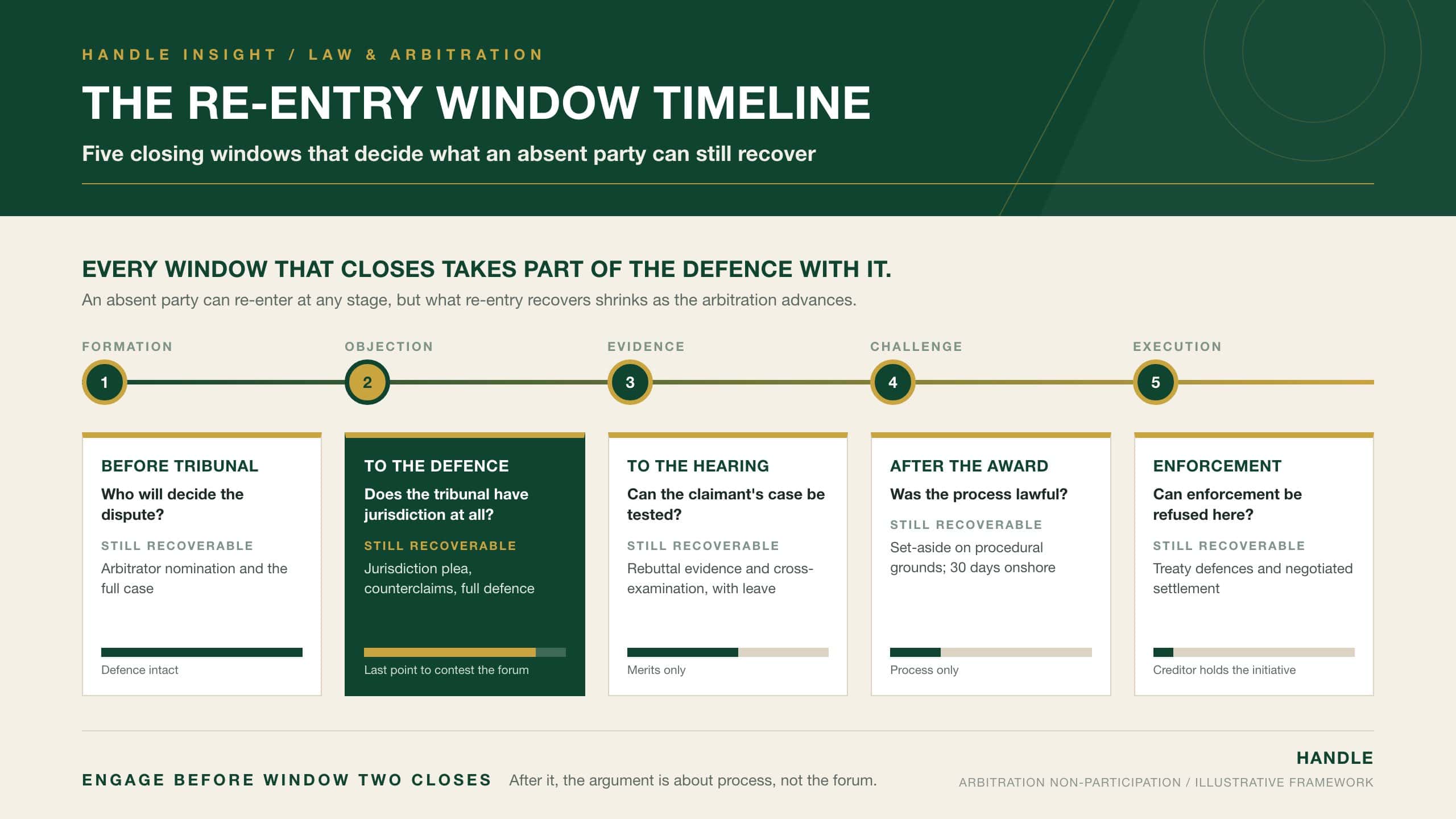
A practical way to think about non-participation is as a series of closing windows. At each stage of an arbitration, a party that has been absent can still re-enter, but what re-entry can recover shrinks as the proceedings advance. The Re-Entry Window Timeline sets out five windows and the question each one poses.
| Window | Point in the Proceedings | Question to Answer | What Re-Entry Can Still Recover |
|---|---|---|---|
| 1. Formation | Request received, tribunal not yet constituted | Who will decide the dispute? | Almost everything, including arbitrator nomination |
| 2. Objection | Up to the statement of defence | Does the tribunal have jurisdiction at all? | Jurisdictional challenge, counterclaims, the full defence |
| 3. Evidence | Document production to the close of the hearing | Can the claimant’s case be tested? | Rebuttal evidence and cross-examination, subject to leave |
| 4. Challenge | From notification of the award to the set-aside deadline | Was the process lawful? | Set-aside on procedural grounds only |
| 5. Execution | Recognition and enforcement proceedings | Can enforcement be refused here? | Treaty defences and negotiated settlement |
The objection window is the pivot. Before it closes, a party can still contest whether the arbitration should exist at all. After it closes, the argument shifts from whether the tribunal can decide to what it should decide, and then to whether the result can be resisted. A respondent that re-enters during the first two windows recovers its full case. A respondent that waits until the fourth or fifth is arguing about process while the creditor is pursuing assets.
Common Failures When a Party Misses Arbitration
- Treating a notice of arbitration as a negotiating letter, which allows the tribunal to be constituted without the respondent’s nominee.
- Assuming that a jurisdictional objection can be raised at any time, when most laws require it no later than the statement of defence.
- Relying on informal settlement discussions without asking the tribunal to suspend the timetable, so deadlines expire while the parties talk.
- Failing to update notice addresses in contracts and corporate records, which turns a valid notice into an unseen one.
- Missing the 30-day set-aside period onshore, or the three-month period in the DIFC, while internal approvals are sought.
- Moving assets after an award in the belief that this prevents enforcement, which invites freezing orders and can create separate liability.
- Asserting defective notice without evidence, which damages credibility in every subsequent court.
Each of these failures arises from treating arbitration as optional. It is not optional once a valid agreement exists and notice has been given.
Conclusion
Missing arbitration rarely stops the proceedings. Once a valid agreement exists and proper notice has been given, the tribunal can be constituted without the absent party, the claimant’s evidence can go unanswered and a binding award can be issued and enforced across borders. What the absent party loses depends on when it stops participating: first influence over the tribunal, then the right to object to jurisdiction, then the chance to test evidence, and finally most grounds for resisting the award. Under the UAE Arbitration Law, the window to seek annulment is 30 days from notification of the award, and the grounds are procedural, not a second hearing on the merits. A genuine notice defect remains a real defence, but only if it is proved and raised promptly. The lesson is consistent. Engage early. Object in time. Preserve the record. Participation protects options that absence surrenders.