
A motion to compel arbitration is a request asking a court to enforce an arbitration agreement by stopping the litigation in front of it and sending the dispute to the forum the parties chose. It arises when one party sues in court despite having signed an arbitration clause, and the other party insists on the bargain. Within Law & Arbitration, the motion is better understood as the first contest of the dispute rather than a procedural preliminary. It decides whether the claim will be heard in public or in private, by judges or by arbitrators, under court procedure or under institutional rules, and with which route to enforcement at the end. The label varies between legal systems. In the United States it is a motion to compel; in England it is an application for a stay; in the UAE it is a plea that the court lacks the power to hear a dispute covered by an arbitration agreement. The function is the same everywhere. An arbitration clause is only as strong as the first objection made to protect it.
What Is a Motion to Compel Arbitration Actually Asking the Court to Do?
The moving party asks the court for three things: to recognise that a binding arbitration agreement exists, to decline to decide the merits of the dispute itself, and to leave the parties to arbitrate. Depending on the jurisdiction, the court will stay its proceedings, dismiss the claim, or declare it inadmissible.
The court is not asked to decide who is right about the underlying contract. It is asked to decide who should decide. That distinction shapes the entire hearing. Evidence about breach, loss or performance is largely irrelevant. Evidence about consent, authority, scope and the conduct of the parties since the dispute began is decisive.
Most modern legal systems approach these applications with a strong presumption in favour of arbitration. The New York Convention, to which the UAE acceded in 2006, obliges the courts of contracting states to refer parties to arbitration when seized of a matter covered by a valid written arbitration agreement, unless the agreement is null and void, inoperative or incapable of being performed. National arbitration laws repeat that obligation in their own terms.
Why Parties Litigate Despite an Arbitration Clause
A party that signed an arbitration clause and then sues in court usually does so for a reason. Sometimes it genuinely believes the clause does not apply: the dispute arises under a different contract, the counterparty is not a signatory, or the clause is defective. Sometimes the choice is tactical. Court proceedings may offer interim measures quickly, a public forum that increases pressure on a reputation-sensitive defendant, a lower upfront cost than institutional fees, or a home-court advantage.
The defendant’s preference for arbitration is equally strategic. Arbitration offers confidentiality, a tribunal chosen for commercial expertise, a neutral venue, procedural flexibility and, through the New York Convention, an award that can be enforced in a large number of countries. The motion to compel is therefore a contest over leverage as much as a contest over law.
| Factor | Court Litigation | Arbitration |
|---|---|---|
| Visibility | Generally public hearings and judgments | Private, with confidentiality depending on the rules and agreement |
| Decision-maker | Assigned judge or panel | Tribunal selected by or for the parties |
| Language and procedure | Set by the court; Arabic in UAE onshore courts | Agreed by the parties or set by the tribunal |
| Review of the outcome | Appeal and further review on the merits or on law | No appeal on the merits; limited annulment grounds at the seat |
| Cross-border enforcement | Depends on treaties and reciprocity for judgments | New York Convention recognition in contracting states |
What Courts Examine When Deciding the Motion
Although the procedure differs between jurisdictions, courts tend to ask the same questions in broadly the same order.
Does a Valid Arbitration Agreement Exist?
The court asks whether the parties actually agreed to arbitrate. That involves formation, form and authority. Most arbitration laws, including the UAE Federal Arbitration Law No. 6 of 2018, require the agreement to be in writing, although writing is interpreted broadly to include exchanges of correspondence, electronic communications and incorporation by reference. Authority is a distinct question. Under the UAE law, an arbitration agreement on behalf of a legal person must be concluded by a representative authorised to agree to arbitration. A manager or employee who signs a contract containing an arbitration clause without that authority can expose the clause to challenge, which is why authority should be checked when the contract is signed rather than when it is disputed.
Does the Dispute Fall Within the Clause?
A clause covering “all disputes arising out of or in connection with this agreement” reaches further than one covering only “disputes regarding the interpretation of this agreement”. Courts read broad clauses broadly, but they will not extend a clause to a separate contract with its own dispute resolution provisions, or to parties who never accepted it, without a recognised legal basis. Multi-contract transactions with inconsistent clauses are a frequent source of motions that fail.
Is the Agreement Enforceable and the Dispute Arbitrable?
The opposing party may argue that the agreement is void, inoperative or incapable of performance, for example because of fraud directed at the clause itself, an unworkable designation of an institution that does not exist, or a subject matter that the law reserves to the courts. Under UAE law, matters in which conciliation is not permitted cannot be referred to arbitration, and certain categories of dispute are reserved to the courts or to specialised bodies.
Has the Right to Arbitrate Been Waived?
A party that participates in litigation on the merits before invoking the clause may be found to have given up its right to arbitrate. This is the question most often lost through inattention rather than through weak law.
How the UAE Treats Arbitration Objections
The UAE has three court systems relevant to this question, and each applies a recognisable version of the same principle.
In the onshore courts, the Federal Arbitration Law requires a court before which a dispute covered by an arbitration agreement is brought to dismiss the claim if the defendant raises the arbitration agreement before submitting any request or defence on the merits, unless the court finds the agreement void or incapable of being performed. Two consequences follow. First, the objection is not raised by the court of its own motion; the defendant must raise it. Second, timing is strict. A defendant who files a substantive defence first and only later mentions the arbitration clause risks being treated as having accepted the court’s jurisdiction. The commencement of court proceedings does not prevent arbitration from being started or continued while the objection is pending.
In the DIFC Courts, applying DIFC Arbitration Law No. 1 of 2008, and in the ADGM Courts, applying the ADGM Arbitration Regulations 2015, the regime follows the UNCITRAL Model Law approach: a court seized of a matter covered by an arbitration agreement refers the parties to arbitration if a party requests it no later than its first statement on the substance, unless the agreement is null and void, inoperative or incapable of being performed. Both courts operate in English, apply common law procedure and have a strong record of supporting arbitration agreements.
| Question | UAE Onshore Courts | DIFC and ADGM Courts |
|---|---|---|
| Governing framework | Federal Arbitration Law No. 6 of 2018, as amended by Federal Law No. 15 of 2023 | DIFC Arbitration Law No. 1 of 2008; ADGM Arbitration Regulations 2015 |
| How the objection is made | Plea raised by the defendant in its first submission | Application to refer the parties to arbitration |
| Latest safe moment | Before any request or defence on the merits | No later than the first statement on the substance |
| Result if successful | Claim dismissed; parties proceed to arbitration | Parties referred to arbitration; court proceedings do not continue on the merits |
| Main ground for refusal | Agreement void or impossible to perform | Agreement null and void, inoperative or incapable of being performed |
What Happens When the Motion Succeeds or Fails
If the motion succeeds, the court proceedings end or pause and the claimant must commence or continue the arbitration. Limitation periods, interim relief already granted and costs incurred in court then become practical questions. A claimant that sued in court to obtain urgent protection may still be able to keep or seek interim measures from the court in support of arbitration, which the UAE, DIFC and ADGM regimes all recognise in appropriate cases.
If the motion fails, the dispute proceeds in court. Whether the refusal can be challenged immediately or only on appeal against the final judgment depends on the jurisdiction and on the form of the decision. A party that intends to rely on the clause should record its objection clearly, maintain it through each stage, and avoid conduct that could be construed as abandoning it.
A Worked Example: The Defence Filed One Week Too Early
Consider an illustrative case. A Dubai distributor sues its supplier in the onshore Court of First Instance for AED 12 million under a distribution agreement that contains an ICC arbitration clause seated in the DIFC. The case is scheduled before the case management office and the supplier’s advocate receives the claim on day zero.
On day 14 the supplier’s team, under pressure to respond, files a memorandum disputing the quantum of the claim and attaching evidence of the distributor’s own breaches. On day 21 its external counsel reviews the file and adds a plea that the dispute is subject to arbitration. The distributor responds that the supplier has already defended on the merits.
The supplier now faces a real risk that the plea will be treated as late, and that a twelve-million-dirham dispute it intended to resolve privately before an international tribunal will be decided in Arabic, in public, with two further levels of review available to the losing side. Had the first filing raised the arbitration agreement before any word on the merits, the claim would have faced dismissal at the threshold. The difference was not the strength of the clause. It was seven days and the order of two paragraphs.
Original Analysis: The Forum Gatekeeper Sequence
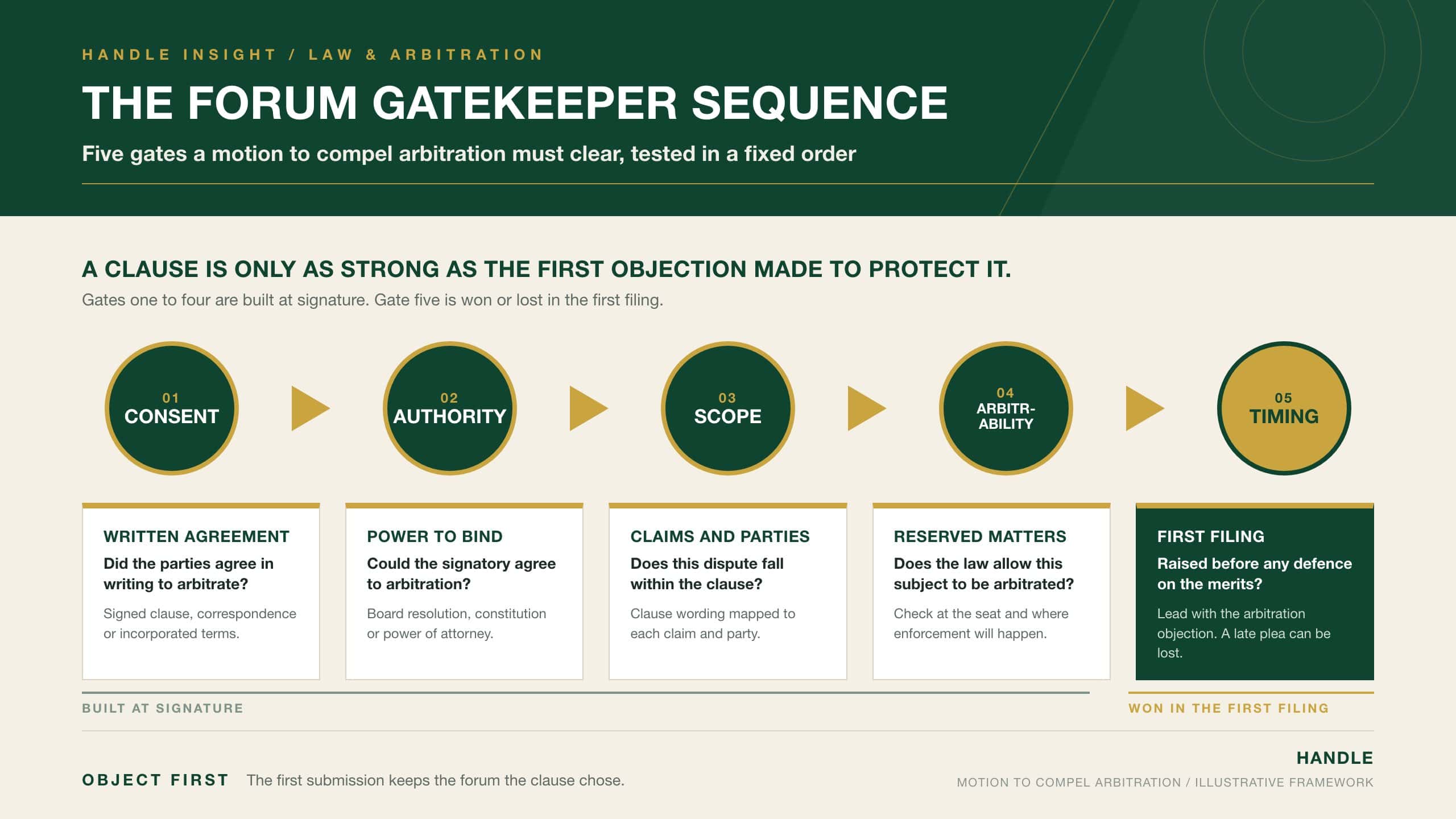
A motion to compel arbitration is won or lost at five gates, and they should be tested in a fixed order before any filing is made. Each gate answers a question that the court will ask, and each has a specific piece of evidence that closes it.
| Gate | Question | Evidence That Closes It |
|---|---|---|
| 1. Consent | Did the parties agree in writing to arbitrate? | Signed clause, correspondence or incorporated terms |
| 2. Authority | Was the signatory empowered to agree to arbitration? | Board resolution, constitutional powers or power of attorney |
| 3. Scope | Does this dispute, between these parties, fall within the clause? | Clause wording mapped against each claim and each party |
| 4. Arbitrability | May the law allow this subject matter to be arbitrated? | Analysis of reserved matters at the seat and place of enforcement |
| 5. Timing | Was the objection raised before any defence on the merits? | First filing that leads with the arbitration objection |
The sequence is cumulative. A clause that clears consent, authority, scope and arbitrability can still be lost at the fifth gate by a single premature filing. Conversely, perfect timing cannot save a clause signed by an unauthorised manager. The first four gates are built when the contract is drafted and signed. The fifth is controlled entirely by the defendant in the first days of a dispute, which is why it is the gate where disciplined procedure produces the greatest return.
Common Failures in Enforcing Arbitration Clauses
- Filing a defence on the merits, even a partial one, before raising the arbitration agreement, which can be treated as acceptance of the court’s jurisdiction.
- Allowing contracts containing arbitration clauses to be signed by officers without authority to agree to arbitration, leaving the clause open to challenge years later.
- Using inconsistent dispute resolution clauses across related contracts, so that claims under one document fall outside the clause in another.
- Naming an institution or set of rules that no longer exists or is described inaccurately, inviting an argument that the clause cannot be performed.
- Assuming that non-signatory group companies, guarantors or successors are bound without checking whether the law of the seat recognises that extension.
- Ignoring arbitrability until the motion is argued, when part of the dispute concerns a subject matter reserved to the courts.
- Commencing arbitration late, so that the defendant has persuaded the court but has no proceeding in place to protect its position.
Each of these failures is preventable. Most are prevented at signature, and the remainder in the first response to a claim.
Conclusion
A motion to compel arbitration asks a court to honour the parties’ choice of forum by declining to hear a dispute they agreed to arbitrate. Courts in most commercial jurisdictions, including the UAE onshore courts and the DIFC and ADGM Courts, support that choice when a valid written agreement exists, the dispute falls within it, the subject matter is arbitrable and the objection is raised in time. The legal standard is favourable. The practical risk lies in execution: clauses signed without authority, related contracts with inconsistent clauses, and objections raised after a defence on the merits. For UAE businesses, investors and family offices, the motion is the moment at which a contractual promise becomes a procedural reality. It should be prepared before any dispute arises and executed in the first filing. The clause sets the forum. The first submission keeps it.