Arbitration in banking is a private, binding method of resolving financial disputes outside the national courts, chosen in advance by the parties to a loan, guarantee, trade finance instrument, investment mandate or other banking contract. Within Law & Arbitration, it is best understood not as an alternative to litigation in general but as a tool suited to particular banking disputes: those that cross borders, involve sophisticated parties, need confidentiality or must be enforced against assets in several countries. For a simple debt owed by a local borrower, a court may still be the faster route. For a syndicated facility with collateral in three jurisdictions, an arbitral award enforceable under the New York Convention may be the only practical route. The real question for a bank, borrower or family office is not whether arbitration is better than court. It is which forum fits the dispute the contract is most likely to produce. Forum choice is credit risk management.
What Is Arbitration in Banking?
In banking arbitration, the parties agree in their contract that disputes will be decided by one or more arbitrators rather than by a national court. The agreement may refer to an arbitral institution and its rules, fix the seat of the arbitration, the number of arbitrators and the language, and set out how the tribunal is appointed. When a dispute arises, a party commences the arbitration, the tribunal is constituted, the parties exchange written submissions and evidence, a hearing is held if needed, and the tribunal issues a final and binding award.
The arbitration agreement commonly appears in facility agreements, guarantees and security documents, trade finance contracts, derivatives and treasury documentation, private banking and portfolio management mandates, and agreements between shareholders and lenders in private capital structures.
The award is not self-executing. If the losing party does not pay, the winner must have the award recognised and enforced by the courts where the debtor’s assets are located. That is where arbitration’s main advantage for banking lies: the New York Convention gives arbitral awards a recognition framework across a very large number of countries, which many court judgments do not enjoy.
Which Banking Disputes Suit Arbitration?
Arbitration is used across most areas of commercial banking. Loan and facility disputes concern repayment, interest, covenant breaches, events of default, acceleration and the enforcement of security. Trade finance disputes involve letters of credit, documentary collections, guarantees and commodity financing. Investment banking and capital markets disputes arise from advisory mandates, structured products and syndicated lending. Private banking disputes concern portfolio management, suitability, mandate breaches and losses in wealth structures.
The common thread is not the product but the profile of the dispute. Arbitration suits disputes where the parties are commercially sophisticated, where the facts or the products are technical, where confidentiality matters, and where enforcement may be needed outside the country of the governing law. It suits less well a high volume of small, straightforward debt claims against domestic borrowers, where a court with summary procedures may deliver a judgment faster and at lower cost.
Arbitration Versus Litigation for Banking Disputes
| Factor | National Courts | Arbitration |
|---|---|---|
| Confidentiality | Hearings and judgments are generally public | Private, with confidentiality often provided by institutional rules or agreement |
| Decision-maker | Assigned judge | Arbitrators chosen for banking and finance expertise |
| Speed on simple debt | Often fast where summary or fast-track procedures exist | Can be slower, as the tribunal must first be constituted |
| Cross-border enforcement | Depends on treaties and reciprocity for each country | New York Convention recognition in its contracting states |
| Multi-party disputes | Joinder of parties usually available | Joinder and consolidation depend on consent and rules |
| Interim relief against assets | Directly enforceable court orders | Tribunal and emergency orders, often supported by courts |
| Appeal | Appeal available | Final, subject to limited set-aside grounds |
The comparison shows why banks often draft carefully rather than choose arbitration by default. Arbitration’s strengths are enforcement, expertise and confidentiality. Its weaknesses are the time needed to constitute a tribunal, limited power over third parties and the absence of an appeal on the merits.
How Does Banking Arbitration Work in the UAE?
The UAE offers three distinct legal frameworks for arbitration. Onshore, arbitration is governed by the Federal Arbitration Law No. 6 of 2018, as amended by Federal Law No. 15 of 2023, which is based on the UNCITRAL Model Law. In the Dubai International Financial Centre, the DIFC Arbitration Law No. 1 of 2008 applies, with the DIFC Courts as the supervisory court. In the Abu Dhabi Global Market, the ADGM Arbitration Regulations 2015 apply, with the ADGM Courts as the supervisory court. The parties’ choice of seat determines which framework governs the arbitration and which court hears any challenge to the award.
The timetable for challenge differs. Onshore, an application to set aside an award must be made to the competent Court of Appeal within 30 days of notification of the award. In the DIFC, the period for an application to set aside is three months. Onshore recognition and enforcement are governed by the Arbitration Law together with the federal civil procedure rules, now contained in Federal Decree-Law No. 42 of 2022 on Civil Procedure. The UAE acceded to the New York Convention in 2006, so foreign awards can be recognised in the UAE and UAE-seated awards can be enforced abroad in other contracting states.
Arbitral institutions are also part of the landscape. Dubai’s arbitration centres were consolidated into the Dubai International Arbitration Centre in 2021, and Abu Dhabi and the ADGM have their own institutional offerings. International institutions are also widely used for UAE banking contracts.
Two practical points deserve particular attention in banking documents. First, authority to agree to arbitration. Onshore, the signatory of an arbitration agreement on behalf of a company must have authority to agree to arbitrate, and lack of authority has historically been raised to resist enforcement. Banks should verify that board resolutions or powers of attorney expressly cover arbitration. Second, retail and consumer disputes. Complaints by individual retail customers are generally handled through the Central Bank’s consumer protection framework, including its independent ombudsman mechanism for banking and insurance complaints, rather than through arbitration clauses in standard terms.
A Worked Example: Choosing the Forum for a Cross-Border Facility
The following example is illustrative. A UAE bank lends AED 80 million to a group holding company incorporated in the ADGM. The facility is guaranteed by an operating subsidiary in another Gulf state and secured over shares in a European subsidiary. The borrower defaults.
If the facility agreement gave exclusive jurisdiction to a single national court, the bank would obtain a judgment in that court and then need to enforce it separately in the Gulf state and in Europe, relying on whatever treaty or reciprocity arrangements exist between those countries. Each enforcement could become a new proceeding.
If the facility agreement instead provided for arbitration seated in the ADGM, the bank would obtain a single award against the borrower and the guarantor, assuming both signed the arbitration agreement. That award could then be presented for recognition in each country where assets are held, under the New York Convention. The award is not guaranteed to be paid, but the route to each asset pool is defined in advance. For this dispute profile, the forum decision made at signing is worth more than any single clause in the security package.
Where Arbitration Meets Banking Regulation
An arbitration clause binds the parties. It does not bind the regulator. Supervisory action, licensing decisions, sanctions and regulatory penalties remain matters for the competent authorities and courts, and a tribunal cannot decide them. What a tribunal can decide is the private consequence: who owes what under the contract, and whether a breach of a regulatory rule also caused loss to the counterparty.
Confidentiality has similar limits. A bank in an arbitration may still be obliged to report matters to its regulator, to auditors or under anti-money laundering rules, and awards may become public when enforcement is sought in court. Parties should treat confidentiality as strong but not absolute.
For family offices and private credit providers, the same logic applies in reverse. Lending outside the regulated banking perimeter often relies entirely on contract, which makes the dispute resolution clause and its enforceability the main protection the lender has.
Original Analysis: The Banking Forum Fit Matrix
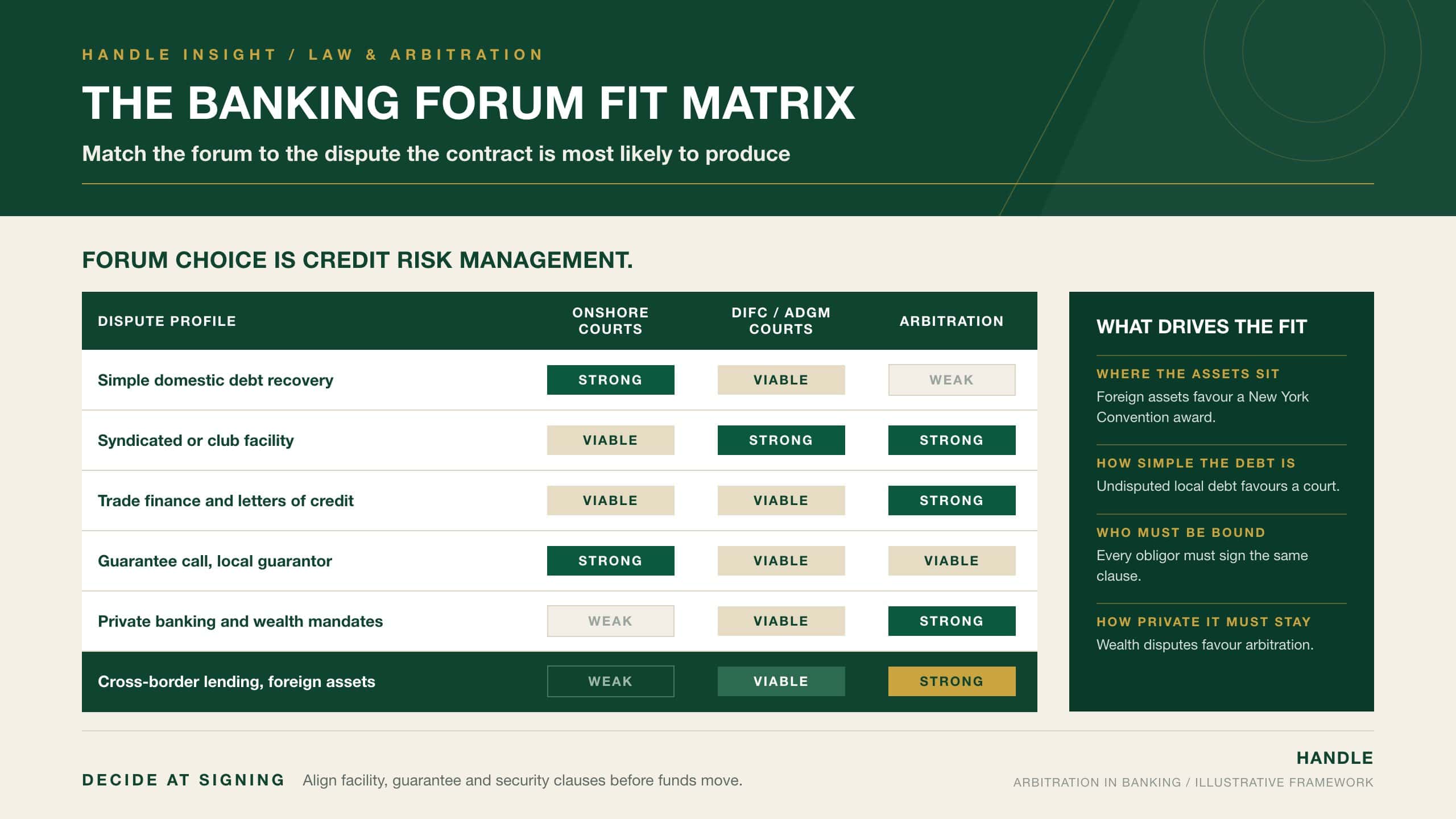
Banks and borrowers often choose a forum by habit or template. A more useful approach is to match the forum to the dispute profile the contract is most likely to generate. We describe this as the Banking Forum Fit Matrix, which rates three forums against six common dispute profiles. The ratings are illustrative and should be tested against the specific parties, assets and governing law.
| Dispute Profile | Onshore Courts | DIFC or ADGM Courts | Arbitration |
|---|---|---|---|
| Simple domestic debt recovery | Strong | Viable | Weak |
| Syndicated or club facility | Viable | Strong | Strong |
| Trade finance and letters of credit | Viable | Viable | Strong |
| Guarantee calls against a local guarantor | Strong | Viable | Viable |
| Private banking and wealth mandates | Weak | Viable | Strong |
| Cross-border lending with foreign assets | Weak | Viable | Strong |
The matrix makes the logic visible. Arbitration is strongest where enforcement abroad, confidentiality or specialist expertise dominate. Courts are strongest where the debtor and its assets are local and speed on undisputed debt matters most. The DIFC and ADGM Courts, with English-language common law procedure, occupy a middle position and are often a strong choice for complex financing within the UAE.
Drafting the Arbitration Clause for Banking Contracts
A banking arbitration clause should specify the seat, the institution and rules, the number of arbitrators and the method of appointment, the language, and the governing law of the contract. Multi-contract financings need consistent clauses across the facility agreement, guarantees and security documents so that related disputes can be heard together, with express consent to joinder and consolidation where the rules permit it.
Some lenders use asymmetric clauses that allow the bank, but not the borrower, to choose between courts and arbitration. These can preserve flexibility, but their treatment varies between legal systems and should be confirmed under the governing law and the law of the seat before reliance. Clauses should also address interim relief, preserving the right to seek urgent orders from a competent court in support of the arbitration.
Common Failures in Banking Arbitration Strategy
- Arbitration is chosen for every contract by default, including simple domestic debts that a court could resolve faster.
- Facility, guarantee and security documents contain inconsistent dispute resolution clauses, so one default produces several proceedings in different forums.
- Signatory authority to agree to arbitration is not documented, giving the debtor an argument against enforcement onshore.
- Asset location is not considered at signing, so the award is obtained in a form that is difficult to enforce where the assets actually sit.
- Interim relief is overlooked, and assets move while the tribunal is being constituted.
- The set-aside window at the seat is missed or misunderstood, by either party, with irreversible consequences.
Each failure is fixed at the drafting stage or not at all.
Conclusion
Arbitration in banking is a private and binding way of resolving financial disputes, agreed in advance in the contracts that create the financial relationship. Its value lies in confidentiality, specialist decision-makers and, above all, an award that can be recognised in the many countries that are party to the New York Convention. It is not the right forum for every banking dispute. Simple domestic debt recovery may be faster in court, while cross-border lending, trade finance and private wealth disputes often fit arbitration far better. In the UAE, the parties can choose between onshore arbitration under the Federal Arbitration Law, the DIFC and ADGM frameworks, and the national and financial free zone courts, each with different procedures and challenge periods. The Banking Forum Fit Matrix offers a disciplined way to make that choice at signing. Match the forum to the dispute. Align the clauses across the documents. Plan enforcement before lending.