Many disputes do not persist because the parties lack legal arguments. They persist because the negotiating structure rewards exaggeration. When each side expects the decision-maker to settle somewhere in the middle, each has an incentive to open high, concede slowly and wait. Final offer arbitration removes that incentive. Each party submits a single final proposal, and the arbitrator must choose one of them in full. There is no compromise award and no splitting of the difference. Within Law & Arbitration, final offer arbitration is best understood as a tool for disputes about numbers and terms rather than about liability: valuations, prices, compensation, buy-out terms and similar questions where both parties broadly accept that something is owed but disagree on how much. Its power lies in what it does to behaviour before the decision is made. An extreme offer is not a strong position. It is a losing one.
What Is Final Offer Arbitration?
Final offer arbitration is a form of arbitration in which each party submits its final proposal for resolving the dispute, and the arbitrator must select one of those proposals in its entirety. The arbitrator cannot modify either proposal, combine elements of both or substitute an independent figure. The selected proposal becomes the binding award.
The mechanism is also known as baseball arbitration, because it is associated with salary disputes in professional baseball in the United States, where player and club each submit a salary figure and the arbitrator chooses one. It is sometimes called pendulum or either-or arbitration. The labels describe the same core rule: the decision-maker chooses, but does not design.
Why Final Offer Arbitration Changes Negotiating Behaviour
In conventional arbitration and litigation, parties often assume the outcome will fall between their positions. That assumption encourages inflated claims and minimal offers, because an extreme position appears to pull the eventual compromise in one’s favour.
Final offer arbitration reverses the logic. Because the arbitrator will choose the proposal that appears more reasonable, an extreme offer increases the risk of losing entirely. Each party is pushed to estimate realistically how the arbitrator is likely to view the dispute and to place its offer close to that view. As both offers move towards the same range, the gap between them narrows, and settlement often becomes possible before any decision is required. Much of the value of the mechanism is realised before the award is issued.
Final Offer Arbitration Versus Conventional Arbitration
| Feature | Conventional Arbitration | Final Offer Arbitration |
|---|---|---|
| Tribunal’s role | Determines liability and quantum independently | Selects one party’s complete proposal |
| Range of possible outcomes | Any figure the evidence and law support | Only the two submitted proposals |
| Incentive on positions | Rewards high opening claims and low offers | Rewards realistic, defensible proposals |
| Suitability | Liability disputes, complex multi-issue claims | Disputes about value, price, compensation or terms |
| Typical duration and cost | Longer, with full pleadings and evidence | Often shorter, with focused submissions on value |
| Principal risk | Unpredictable compromise outcome | Binary outcome; one party loses entirely |
How Does Final Offer Arbitration Work?
The process follows a defined sequence, usually set out in the arbitration agreement or agreed once the dispute has arisen.
1. Agreement and Scope
The parties agree to use final offer arbitration, either in the original contract or after a dispute arises. The agreement defines the questions to be decided, the form the offers must take, the method of appointing the arbitrator and the timetable.
2. Exchange of Information and Submissions
Each party presents its evidence and arguments on the issues in dispute, including valuation analysis, expert reports and the relevant contractual provisions.
3. Submission of Final Offers
Each party submits its final offer, usually simultaneously and under seal so that neither can adjust its proposal in response to the other. Offers may consist of a single figure or a complete set of terms, such as a price, payment schedule and related obligations.
4. Hearing and Selection
The arbitrator reviews the evidence and selects the offer that is more consistent with the evidence and the agreed criteria. The arbitrator may not adjust either offer.
5. Award
The selected offer is recorded in a binding award that can be enforced in the same way as any other arbitral award.
Whole-Package or Issue-by-Issue?
Final offer arbitration can be structured in two ways, and the choice affects both the pressure on the parties and the flexibility of the outcome.
| Structure | How It Works | Advantage | Risk |
|---|---|---|---|
| Whole-package | The arbitrator chooses one party’s complete set of proposals | Maximum pressure to submit a balanced, credible package | One unreasonable term can sink an otherwise sound package |
| Issue-by-issue | The arbitrator chooses between the parties’ offers separately on each disputed issue | More nuanced outcome across several issues | Less pressure on each offer; combined outcome may be internally inconsistent |
Whole-package arbitration suits disputes in which the terms are interdependent, such as a buy-out price and its payment schedule. Issue-by-issue arbitration suits disputes involving several independent questions, such as separate pricing disputes on different products.
Where Final Offer Arbitration Is Used
The mechanism is most effective where the dispute centres on value and the parties need a fast, private resolution that preserves their relationship. Typical applications include price review clauses in long-term supply contracts, compensation disputes, shareholder buy-outs, partnership separations and valuation disagreements in M&A transactions, including earn-out and completion account disputes.
It is particularly relevant to family enterprises and closely held businesses. Disputes over share valuation, exit terms or dividend entitlements can destabilise operations, banking relationships and succession planning if they are litigated publicly over several years. Final offer arbitration converts the dispute into a focused valuation exercise conducted in private, and it pushes family members towards realistic positions before relationships are damaged further.
It is less suitable for disputes involving complex liability questions, allegations of fraud, several interconnected legal issues or significant technical evidence. In those cases, the arbitrator’s inability to craft a reasoned middle outcome is a disadvantage rather than a discipline.
Final Offer Arbitration Under UAE Law
The UAE Federal Arbitration Law, Federal Law No. 6 of 2018 as amended by Federal Law No. 15 of 2023, gives parties wide freedom to agree the procedure the tribunal will follow, and nothing in it prevents parties from agreeing that the tribunal must choose between final offers. The DIFC Arbitration Law No. 1 of 2008 and the ADGM Arbitration Regulations 2015 similarly respect party autonomy over procedure.
Three points deserve attention when final offer arbitration is used in a UAE-seated arbitration. First, the agreement must be clear. If the tribunal departs from the agreed mechanism, for example by awarding a figure between the two offers, the award may be open to challenge on the ground that the tribunal exceeded its mandate. Second, the award must satisfy the formal requirements of the applicable law. Under the UAE Arbitration Law, the award must be in writing and signed and, unless the parties agree otherwise, must state reasons, so the tribunal should explain why it preferred the selected offer. Third, the award is subject to the ordinary regime for challenge and enforcement: an onshore award may be challenged before the competent Court of Appeal within 30 days of notification, a DIFC-seated award within three months before the DIFC Courts, and foreign awards are enforceable in the UAE under the New York Convention, to which the UAE acceded in 2006.
A Worked Example: Where to Place the Offer
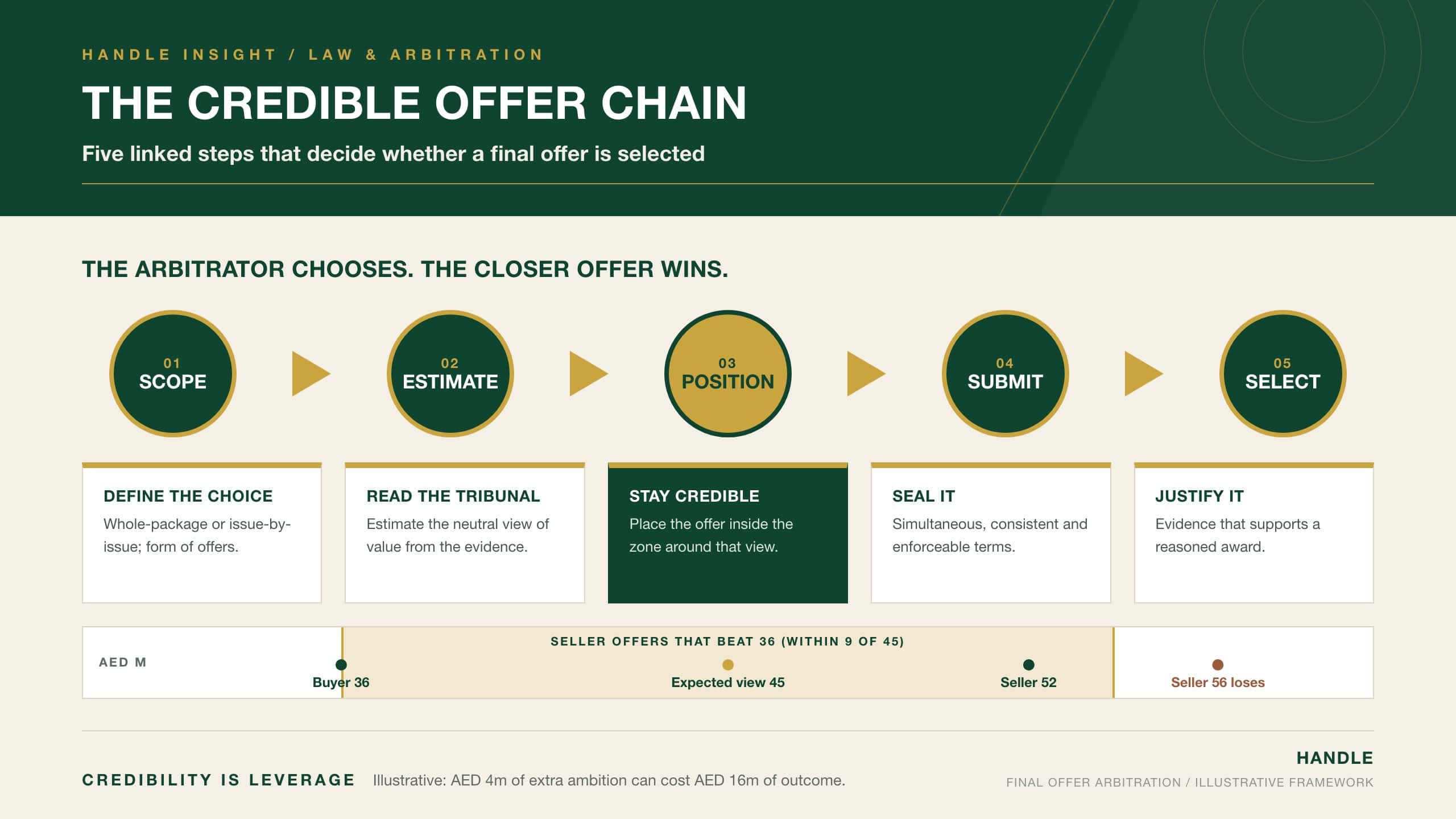
Consider an illustrative shareholder buy-out dispute. Expert evidence suggests the shares are worth between AED 40 million and AED 50 million, and both parties privately expect the arbitrator to view fair value at around AED 45 million. The arbitrator will choose the offer closer to that view.
| Scenario | Seller’s Offer (AED m) | Buyer’s Offer (AED m) | Distance from 45 | Likely Selection |
|---|---|---|---|---|
| A | 52 | 36 | Seller 7, buyer 9 | Seller’s offer: AED 52m |
| B | 56 | 36 | Seller 11, buyer 9 | Buyer’s offer: AED 36m |
| C | 48 | 42 | Seller 3, buyer 3 | Uncertain; strong case for settlement near 45 |
In scenario B, the seller’s extra AED 4 million of ambition costs it AED 16 million of outcome, because the arbitrator switches to the buyer’s offer. In scenario C, both parties have placed their offers close to the expected view, the gap has narrowed to AED 6 million and a negotiated settlement becomes the rational choice. The numbers are illustrative. The incentive is the point.
Drafting a Final Offer Arbitration Clause
The mechanism is only as reliable as the clause that creates it. A well-drafted clause defines the scope of disputes that will be decided by final offer, so that liability questions can be routed to conventional arbitration if needed. It states whether the arbitrator chooses on a whole-package or issue-by-issue basis, the form each offer must take and the deadline for submission. It provides for simultaneous sealed exchange and states whether, and until when, offers may be revised. It sets out the criteria the arbitrator must apply in choosing, such as fair market value under a specified valuation standard. And it addresses the usual elements of any arbitration agreement: the seat, the governing law, the rules, the number of arbitrators, the language and confidentiality.
Where final offer arbitration is added to a shareholder or joint venture agreement, it should also be aligned with the valuation, deadlock and exit provisions of that agreement, so that the same question is not answered by two different mechanisms. Ambiguity in the clause invites a dispute about the dispute.
Original Analysis: The Credible Offer Chain
A final offer is won or lost in its preparation. The Credible Offer Chain sets out five linked steps, each of which must be completed before the next.
- Scope. Define precisely what the offers must cover and whether the arbitrator chooses on a whole-package or issue-by-issue basis.
- Estimate. Build an independent estimate of how a neutral arbitrator is likely to view value, using the evidence the arbitrator will actually see.
- Position. Place the offer inside the credibility zone, close enough to the expected view to be selected, while capturing as much value as that constraint allows.
- Submit. Lodge the offer simultaneously and under seal, with every term internally consistent and enforceable.
- Select. Support the offer with evidence and reasoning that make the arbitrator’s choice easy to justify in a reasoned award.
The weakest step determines the result. A well-evidenced offer placed outside the credibility zone will lose, and a well-placed offer with an unenforceable term may be rejected.
Common Mistakes in Final Offer Arbitration
- Submitting an aggressive offer on the assumption that the arbitrator will be persuaded by advocacy rather than by distance from a realistic valuation.
- Using whole-package arbitration where one weak term can cause an otherwise reasonable package to be rejected.
- Drafting a clause that does not specify the form of offers, the timetable or whether offers are exchanged simultaneously.
- Choosing the mechanism for disputes that turn on liability or fraud, where a binary outcome is poorly suited to the issues.
- Overlooking the formal requirements for a valid, reasoned award at the seat.
- Failing to use the narrowing of positions to reach a negotiated settlement before the award.
Conclusion
Final offer arbitration is a structured form of arbitration in which the arbitrator must choose one party’s final proposal in full, without modifying it or splitting the difference. Its value lies in changing behaviour: extreme positions become risky, realistic offers become rational, and the narrowing gap often produces settlement before any award is made. It suits disputes about value, price, compensation and exit terms, including shareholder and family enterprise disputes, and is less suited to complex liability or fraud claims. UAE law, including the DIFC and ADGM regimes, allows parties to agree the mechanism, but the clause must be precise and the award must meet the formal requirements of the seat. The Credible Offer Chain shows how an offer should be prepared, from scope to selection. In final offer arbitration, credibility is leverage. Ambition without credibility loses.